
Franklin Electric's Mixed 2025 Financials and Strategic Expansion in Water and Energy Systems
Franklin Electric combined solid operating income growth with net income headwinds in 2025, fueled by acquisitions and innovation amid market uncertainties.
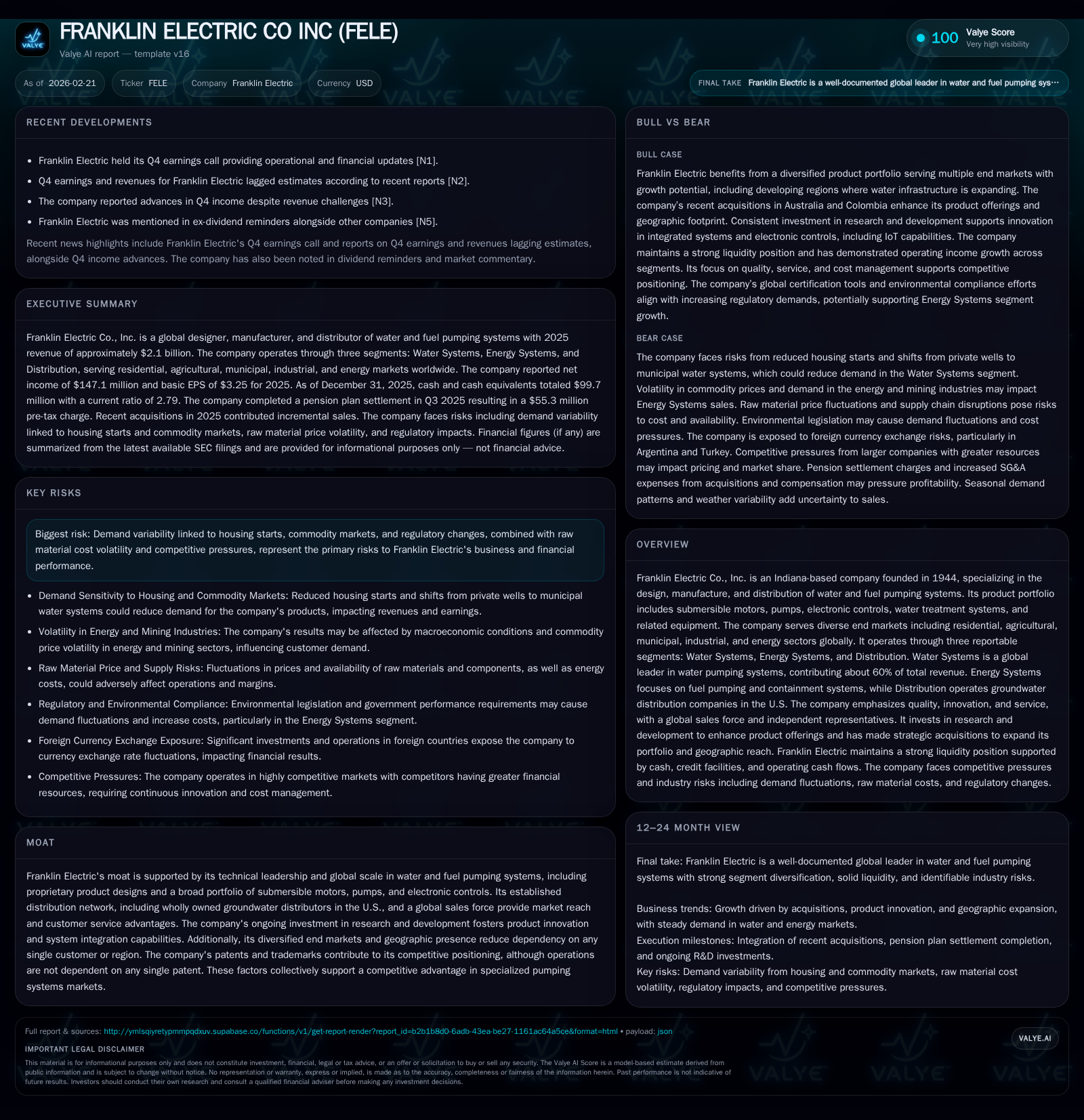
In fiscal 2025, Franklin Electric posted 10.4% growth in operating income yet faced an 18.4% decline in net income largely owing to a pension settlement charge. The company’s core Water Systems segment, representing around 60% of sales, saw steady revenue expansion supported by acquisitions like Barnes and PumpEng, while Energy Systems rebranding aligns with broader energy infrastructure ambitions. Capital deployment favored enhanced buybacks and dividends, backed by robust free cash flow generation. Despite navigating raw material inflation, housing cycle variability, and trade policy headwinds, Franklin maintains a technical moat through R&D and global distribution scale. Key metrics to watch include margin trends and acquisition integration progress.
Financial Performance Overview: Growth and Profitability Trends Through 2025
Franklin Electric navigated a nuanced financial landscape in fiscal year 2025 marked by diverging operational and bottom-line results. Operating income climbed a respectable 10.4% year-over-year to approximately $269 million, signaling effective management of volumes, pricing strategies, and cost controls amid ongoing external pressures [F1]. However, net income experienced an 18.4% contraction to roughly $147 million primarily driven by a significant one-time pre-tax pension settlement charge totaling $55.3 million related to actuarial losses recognized in accumulated other comprehensive loss during Q3 2025 [S2]. This non-recurring item materially compressed earnings per share despite sound underlying operating progress.
Operating cash flow declined modestly by 8.6% in the same period to about $239 million as working capital fluctuations offset core cash generation improvements [F1]. Capital expenditures grew moderately by nearly 9% to $45 million reflecting sustained investments in manufacturing capacity enhancements and technology upgrades supporting the company’s submersible motor and pump lines integral to their Water Systems leadership position [F1][S11]. The company’s balance sheet remained robust with current assets comfortably exceeding current liabilities, yielding a current ratio around 2.79 indicative of strong liquidity management as of year-end 2025 [F1]. Return on equity based on latest net income over equity approximates an acceptable 11.1%, underscoring moderate profitability despite earnings volatility.
Historical performance (annual)
| FY | Net ($mm) | CFO ($mm) | OpInc ($mm) | Capex ($mm) | Net YoY |
|---|---|---|---|---|---|
| 2025 | 147 | 239 | 269 | 45 | -18.4% |
| 2024 | 180 | 261 | 244 | 42 | -6.7% |
| 2023 | 193 | 316 | 262 | 41 | +3.2% |
| 2022 | 187 | 102 | 257 | 42 |
Note: Omitted columns lack sufficient annual XBRL coverage in the provided tags (need ≥2 annual points): Rev. Source: SEC companyfacts cache [F1].
Capital returns and efficiency (annual)
| FY | Div ($mm) | Buybacks ($mm) | FCF ($mm) |
|---|---|---|---|
| 2025 | 50 | 166 | 194 |
| 2024 | 47 | 61 | 220 |
| 2023 | 42 | 43 | 274 |
| 2022 | 37 | 40 | 60 |
Source: SEC companyfacts cache [F1].
Segment-Level Analysis: The Water Systems, Energy Systems, and Distribution Dynamics
Franklin Electric's business is organized into three primary segments that each carry distinct drivers impacting consolidated performance.
Water Systems Segment
Representing roughly six-tenths of total revenue, Water Systems is the cornerstone of Franklin’s global footprint in water pumping solutions, specializing in residential, agricultural, municipal, and industrial markets [S6][S15]. The segment's diverse offering includes technically advanced submersible motors with innovative water-lubrication designs that reduce wear and extend equipment life—important competitive differentiators rooted in Franklin's historic engineering leadership dating back decades [S15].
In Q3 and nine months ending September '25, Water Systems reported notable growth in sales volumes alongside price realization gains which contributed to better operating income (+$7.4 million Q3 YOY) despite pressure from product mix shifts and costs related to incremental acquisitions such as Barnes de Colombia S.A., a Colombian pump maker acquired early in the year [S2][S11]. These acquisitions provided approximately $37 million incremental revenue during the first nine months of ’25 lasting into full-year consolidation effects [N1][S2]. Stable backlog figures just shy of $100 million at beginning of February suggest consistent demand stability within this segment heading into '26 [S5].
Energy Systems Segment
The renaming of the former Fueling Systems business to Energy Systems reflects strategic intent beyond traditional fuel pumps towards integrated fuel containment technologies including electronic monitoring devices addressing evolving environmental regulations across its served geographies [S6][N1]. This repositioning opens avenues for growth tied not only to petroleum but broader fueling infrastructure sectors.
Energy Systems recorded modest but tangible operating income advancements (+$7.5 million YTD Sept ‘25) attributed primarily to volume upticks alongside favorable price structures but offset partially by product mix factors that compressed unit margins temporarily during seasonal or regulatory-driven spikes in demand cycles [S11]. The backlog remains stable slightly above $21 million reflective of steady orders for compliance-oriented products necessary within short timelines due to mandated environmental legislation enforcement phases [S5][S9].
Distribution Segment
Under the banner of Headwater Companies owned outright by Franklin, this U.S.-focused segment specializes in groundwater equipment distribution serving well-drilling contractors directly—a channel critical for downstream sales conversion of manufactured pumping components [S4][S15]. Despite a smaller revenue base compared with Water Systems, Distribution achieved significant improvements in profitability marked by leaner selling general & administrative expense control combined with higher sales volume realization (+$10.8 million YTD operating income increase) suggesting successful operational realignment effects implemented since prior years’ restructuring moves [S11][S19]. Backlog stays steady near $19 million supporting near-term visibility on distribution order flows [S5].
Recent Strategic Moves: Acquisitions and R&D Investment Impacts
Franklin Electric pursued acquisitive growth aggressively during early-mid-2025 with key transactions including Colombian-based Barnes and Australia’s PumpEng Pty Ltd targeting mining sector submersible pumps expansion—projects aimed at strengthening both geographic reach and specialized end-market depth consistent with the firm's long-term competitive thesis centered on proprietary motor/pump technologies with embedded electronic controls integration capabilities [N1][S2][S11].
Incremental sales contribution from these deals amounted to approximately $37.2 million through the first nine months confirming initial smooth integration without dilutive EBITDA impacts beyond reasonable ramp-up expenses or amortization burdens disclosed separately but modest relative scale [N1][S11]. Acquisition-related SG&A expenses rose concurrently but managed under overall margin improvements led mainly by organic volume increases.
Research & Development expenditure hovered near a stable band at ~$20 million annually—a deliberate spend level enabling continuous engineering refinement especially around submersible motor efficiency gains coupled with durability enhancements (e.g., advanced carbon bearing assemblies reducing mechanical failure risk), next-gen electronic drive packages offering real-time pump diagnostics & dry-run protection functionalities critical for system uptime assurance widely demanded across water systems verticals internationally [S16][S29]. Consistent R&D investment sustains technological moat preventing encroachment from commoditized pump vendors lacking integrated control systems competencies.
Navigating Market Risks: Raw Material Costs, Housing Cycles, and Regulatory Influences
Franklin Electric’s performance intricately ties to several exogenous factors presenting both cyclicality challenges and cost operations exposures.
Raw materials such as coil steel, stainless steel bar stock, copper wire bundles, aluminum ingot constitute significant input costs given electric motor winding needs—prices for which rose amid tariff spells targeting imports from Canada, China among others—impacts somewhat buffered via multi-sourcing strategies but unhedged exposure lingered throughout ’25 pushing gross margin pressures especially where price pass-through lagged end-customer acceptance levels forcing temporary EBIT compression episodes [S9][S23][S25].
Housing starts variability directly influences residential water system demand fluxes reflecting project deferrals or accelerations impacting seasonal revenue cadence—strong correlation remains between new home construction activity trends & submersible motor-pump purchase cycles—areas recently sluggish amidst macroeconomic tightening prompting vigilant outlook management internally regarding inventory levels & production pacing adjustments around weather seasonality downshifts particularly during Northern Hemisphere winter months when drilling activity falls markedly [S14][S21].
Regulatory arena imposes additional complexities via increasing municipal water systems replacing private wells reducing some groundwater pumping needs domestically while simultaneously triggering compliance-driven surge demand for Energy Systems fuel containment upgrades linked to air quality/environmental statutes forcing accelerated procurement mandates followed eventually by troughs once compliance thresholds met—a double-edged sword potentially amplifying revenue volatility quarter-to-quarter within that segment requiring flexible manufacturing capabilities & forward-looking workforce planning to optimize operational leverage sans costly underutilization risks [S9][S12].
Capital Allocation Review: Returns, Dividends, Repurchases, and Cash Generation
Amid evolving growth investments Franklin Electric emphasized shareholder returns through aggressive capital deployment initiatives bolstered by strong free cash flow generation dynamics.
FY25 free cash flow approximated $194 million after deducting capex from operating cash flows signaling solid liquidity foundations capable of underpinning sizable buybacks and dividend distributions without jeopardizing reinvestment commitments or balance sheet healthiness benchmarks established previously such as maintaining covenant headroom on revolving credit facilities maturing mid-decade horizon windows [F1][S7].
Dividends paid rose steadily reaching approximately $50 million highlighting disciplined payout expansion aligned roughly proportionally with adjusted earnings while stock buybacks soared dramatically reaching close to $166 million compared with prior year levels indicating board-level conviction prioritizing share base reduction as an efficient use of FCF surplus enhancing per-unit earnings potential going forward under existing capital structure parameters constrained modestly by debt maturities extending thru late decade milestones ensuring adequate refinancing optionality remains intact should market conditions prove favorable for opportunistic enhancements beyond organic options [F1][S8].
Cash & equivalents totaled nearly $100 million at year-end providing additional buffer against short-term working capital fluxes or unforeseen contingencies maintaining corporate flexibility even as FX exposure management becomes more complex due to significant foreign subsidiaries presence spanning Europe Latin America Asia South Africa regions accounting cumulatively for material portions of revenues though currency hedging remains selectively employed focused mainly on invoices matching local currency production sites mitigating cross-border translation impacts prudently without incurring excess hedging costs or basis risks per disclosures [F1][S12].
Outlook Factors: Market Backlogs, Innovation Pipelines, and Emerging Pressures
At early February ’26 reporting juncture Franklin Electric disclosed a stable consolidated backlog figure hovering near $139 million split mainly among Water ($99M), Energy ($21M), Distribution ($19M) segments evidencing healthy inbound order momentum despite uncertain macro factors including persistent raw material price pressure stemming from tariffs/retaliation uncertainties spanning North America-Chinese trade tensions still unresolved fully plus spot supply chain disruptions considerable amidst ongoing geopolitical frictions globally complicating vendor lead time planning assumptions crucial for just-in-time lean manufacturing execution frameworks employed extensively across plants worldwide [N1][S3][S25].
Innovation efforts remain focused on next-generation submersible motor designs incorporating enhanced thermal management permitting higher power densities while improving lifespan enabling reduced total cost ownership for customers requiring dependable continuous duty operation particularly relevant within industrial/agricultural applications embracing digital monitoring technology integration facilitating predictive maintenance workflows lowering unplanned downtime expenses further reinforcing competitive advantage vs commoditized alternatives broadly penetrating markets increasingly competing on value-add differentiation rather than price alone [S29].
Remaining future uncertainties include potential impact from evolving trade policies influencing material costs unpredictably; shifts within municipal water infrastructure investments altering groundwater pump replacement cycles; rapid regulation changes possibly triggering episodic demand surges/dips within Energy System offerings necessitating agile capacity adjustments; foreign currency volatility posing translation risk emphasizing need for calibrated hedging tactics maintaining profit stability attempting minimized quarter-to-quarter shock absorption requirement.
What Investors Should Watch Next: Key Metrics and Upcoming Catalysts
Investors focusing on Franklin Electric's trajectory should closely track sequential quarterly operating margin developments particularly within the Water Systems segment where volume leverage gains might offset persistent input cost inflation if pass-through pricing improves timely. Monitoring continued commercial execution effectiveness integrating Barnes/PumpEng acquisitions for synergy realization is critical since these bolt-on expansions underpin medium-term growth aspirations. Raw material inflation pass-through progress especially metals pricing recovery or softness influences gross margin resiliency compelling attention. Regulatory environment updates affecting private well demand versus municipal water systems could materially shift segment revenue dynamics requiring watchful interpretation of commentary points during earnings calls. Lastly quarterly headlines providing clarity on tariff evolution or supplier disruptions will remain pivotal as prolonged uncertainty here continues affecting procurement costs unpredictably impacting profitability outlooks beyond base forecasts.
This analysis is based solely on publicly available information including SEC filings ([F1],[S#]) and recent news transcripts ([N#]) as cited throughout text up to February 21, 2026. It does not constitute investment advice or recommendations.
Disclaimer: This is research-only, informational analysis and not investment advice. It may include AI-generated interpretation and general industry context. Always verify important details using primary sources.

Comments