
Moderna’s Shift from Pandemic Profits to Pipeline Promise
Moderna faces the challenge of transitioning from COVID-19 vaccine revenues to a diversified mRNA-driven pipeline amid regulatory and market headwinds.
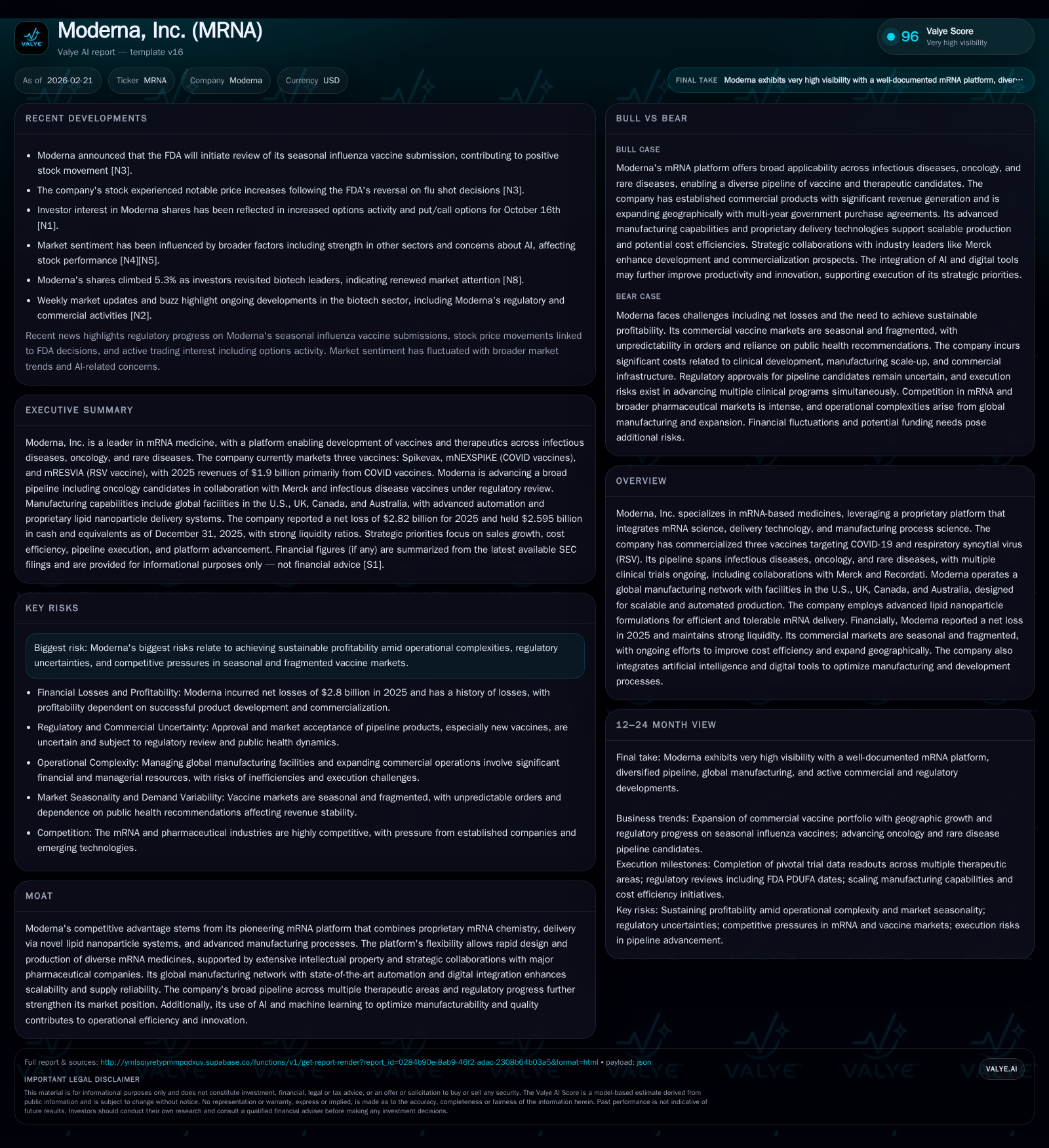
Moderna’s financial trajectory has dramatically shifted from record pandemic-era profits to sustained operating losses beginning in 2023 as COVID-19 vaccine demand waned. The company leverages its pioneering mRNA platform, including state-of-the-art lipid nanoparticle delivery and manufacturing automation, to advance a broad pipeline across infectious diseases, oncology, and rare diseases. Regulatory interactions, such as recent FDA acceptance of seasonal flu vaccine filings with an August 2026 PDUFA date, highlight evolving market dynamics. Moderna’s path forward hinges on successful commercialization beyond COVID vaccines, navigating competitive pressures, regulatory complexities, and capital allocation challenges while monitoring key clinical milestones. Investors should watch upcoming efficacy readouts and regulatory decisions shaping Moderna’s prospects.
From Pandemic Peak to Present: Dissecting Revenue and Profit Swings
Moderna experienced meteoric revenue growth during the peak COVID-19 pandemic years, highlighted by revenues climbing from approximately $14 million in FY2019 to $18.47 billion in FY2021 [F1]. This surge was driven predominantly by its COVID-19 vaccines Spikevax and mNEXSPIKE. Revenues further increased to $19.26 billion in FY2022 but declined sharply thereafter due to reduced global demand for pandemic vaccines amid easing public health emergencies.
Despite strong top-line results in early pandemic years, Moderna’s profitability reversed dramatically starting fiscal year 2023. Operating income plummeted from an operating profit of $9.42 billion in 2022 to consecutive multi-billion-dollar losses of -$4.24 billion (FY2023), -$3.94 billion (FY2024), and -$3.07 billion (FY2025). Net income mirrored this trend sharply: from a $8.36 billion profit in 2022 to losses of $4.71 billion (FY2023), $3.56 billion (FY2024), then narrowing slightly to $2.82 billion loss in FY2025 [F1]. This shift was compounded by steep declines in operating cash flow which turned negative after the pandemic peak: CFO dropped from nearly positive $4.98 billion in 2022 to -$3.12 billion (FY2023), -$3.00 billion (FY2024), and -$1.87 billion (FY2025), resulting in negative free cash flow despite capex reductions [F1].
Historical performance (annual)
| FY | Net ($bn) | CFO ($bn) | OpInc ($bn) | Capex ($mm) | Net YoY |
|---|---|---|---|---|---|
| 2025 | -2.8 | -1.9 | -3.1 | 192 | +20.8% |
| 2024 | -3.6 | -3.0 | -3.9 | 1051 | +24.5% |
| 2023 | -4.7 | -3.1 | -4.2 | 707 | -156.4% |
| 2022 | 8.4 | 5.0 | 9.4 | 400 |
Note: Omitted columns lack sufficient annual XBRL coverage in the provided tags (need ≥2 annual points): Rev, Div. Source: SEC companyfacts cache [F1].
Capital returns and efficiency (annual)
| FY | Buybacks ($bn) | FCF ($bn) | ROE% |
|---|---|---|---|
| 2025 | 0.0 | -2.1 | -32.6 |
| 2024 | 0.0 | -4.1 | -32.7 |
| 2023 | 1.2 | -3.8 | -34.0 |
| 2022 | 3.3 | 4.6 | 43.7 |
Source: SEC companyfacts cache [F1].
*Latest revenue point Q2/23 [F1]
Reflecting the move from finite pandemic sales toward pipeline investment stages, capex peaked at $1.05 billion in FY2024 but was sharply dialed back to $192 million by FY2025 as Moderna pursues efficiency [F1]. Importantly, Moderna's transition entails managing seasonal demand fluctuations characteristic of respiratory vaccines markets impacting stable revenue generation.
Platform Advantage: The Core of Moderna’s Competitive Moat
Moderna’s core competitive edge lies in its integrated mRNA platform combining proprietary mRNA chemistry innovations with advanced lipid nanoparticle (LNP) formulations facilitating efficient intracellular delivery exhibiting favorable tolerability profiles [S7]. This platform enables rapid design and modular adaptability essential for responding swiftly to viral variants or emerging health threats.
Significant investment in manufacturing process science has yielded automated global production facilities located strategically across the United States, United Kingdom, Canada, and Australia supporting scalability and quality control [S1]. Furthermore, Moderna uses AI and machine learning tools extensively for optimizing manufacturability parameters, enhancing yield predictability across batches [S1]. This digital infusion into biologics operations is a relatively novel frontier that positions Moderna ahead in operational efficiency within biopharma manufacturing.
Strategic collaborations with major pharma players such as Merck support advancing complex therapeutic candidates like intismeran autogene—an individualized neoantigen therapy progressing through registrational Phase 3 trials illustrating the platform's versatility beyond vaccines [S1]. Given the technical complexity of mRNA medicines and biologics license applications (BLAs), Moderna's ability to harmonize formulation science with scalable flexible platforms remains vital for competitive differentiation.
Emerging Regulatory Milestones and Market Acceptance Challenges
The regulatory landscape presents both milestones and uncertainties for Moderna's evolving product portfolio:
The FDA accepted Moderna's amended biologics license application for the seasonal influenza vaccine candidate (mRNA-1010) following a Type A meeting addressing prior Refusal-to-File issues [S1]. This filing seeks full approval for adults aged 50–64 years along with accelerated approval for those aged ≥65 under new evidentiary standards involving post-marketing commitments.
The assigned Prescription Drug User Fee Act (PDUFA) goal date is August 5, 2026—a key timeline that investors should watch for potential approval catalysis [N8][S1].
The broader vaccination landscape faces headwinds including fluctuating CDC/ACIP guidance impacting target populations eligible for vaccination leading to variable uptake rates [S1][N4]. Post-pandemic demand normalization introduces unpredictability on volume forecasts contributing to planning complexity.
Additionally, differences among global regulators about virus variant targeting strategies complicate development pathways potentially affecting launch timing or market share capture if competitors adapt faster or more effectively.
Clinical Pipeline Traction: Infectious Disease, Oncology, and Rare Diseases
Moderna advances an expansive pipeline alongside commercial vaccines:
In infectious diseases beyond COVID-19, the company launched mRESVIA targeting respiratory syncytial virus (RSV) yet sales have remained minimal so far amid competitive incumbents like Pfizer and GSK entering markets earlier than Moderna leading to challenging market penetration dynamics [S7].
Clinical trials continue robustly for candidate norovirus vaccine mRNA-1403; recent completion of enrollment for a second Northern Hemisphere cohort indicates progress toward potential registrational study conclusions [N3][S1].
Oncology programs are growing notably through collaboration with Merck on intismeran autogene (mRNA-4157), showing encouraging five-year Phase IIb recurrence-free survival data in high-risk melanoma patients on pembrolizumab combination therapy [S1]. Eight ongoing Phase II/III studies cross multiple tumor types underscore the platform’s flexibility.
Rare disease efforts include advancing propionic acidemia treatment candidate mRNA-3927 through registrational trials partnered with Recordati aimed at global commercialization [S1]. Methylmalonic acidemia therapeutic mRNA-3705 registrational study expected commencement adds pipeline depth.
This multi-indication approach reflects strategic prioritization targeting differentiated areas poised for higher commercial potential beyond seasonal vaccines.
Financial Dynamics: Cash Flow, Capital Allocation, and Shareholder Returns
Moderna’s financial stewardship reflects adaptation post-pandemic:
Operating cash flow turned sharply negative beginning FY2023 (-$3.12B) after strong positive generation previously ($4.98B+ in FY22). Despite cutbacks in capital expenditure spending from a peak exceeding $1B in FY24 to under $200M in FY25 reflecting capex discipline, free cash flow remained negative at approximately -$2B last fiscal year highlighting ongoing substantial investment needs [F1].
Equity base shrank alongside accumulated losses from nearly $19B at end FY22 to about $8.65B at end FY25 evidencing balance sheet contraction through net loss absorptions during transition periods [F1]. Approximate return on equity declined into deeply negative territory (-32.6%) reflecting sustained unprofitability amid scaling efforts.
Notably share repurchases collapsed—from over $3.33B repurchased in FY22 down to just $2M spent on buybacks FY25 indicating a strategic pivot away from shareholder return via buybacks toward liquidity preservation amid pipeline buildout [F1]. No dividends have been declared historically or recently reported consistent with biotech sector norms focusing capital inward on R&D rather than returns.
This financial profile underscores considerable near-term execution risk alongside necessity for continued capital infusion while seeking sustainable profitability pathways as product mix diversifies.
Risks and Opportunities in a Fragmented Vaccine Ecosystem
Moderna operates within highly competitive vaccine segments featuring seasonality and market fragmentation:
Primary competition derives largely from Pfizer/BioNTech’s mRNA-based COVID vaccines along with established players such as Sanofi and Novavax deploying alternative platforms impacting pricing power amid shrinking demand post-pandemic emergency de-escalations [S7][S4].
Patent litigations are active battlegrounds; lawsuits around intellectual property involving Pfizer/BioNTech regarding foundational mRNA technology persist with outcomes unresolved including appeals following USPTO patent board invalidations demonstrating ongoing uncertainty impacting operating risks [S12][S18][S26][S27].
Product liability protections afforded by U.S government indemnity under PREP Act during pandemic period are eroding post-emergency phase increasing potential exposure should adverse safety events arise placing reputational risk at stake despite insurance coverage frameworks [S5][S22].
Pricing pressures emerge from healthcare reforms notably Medicare drug price negotiation portending downward pricing trends affecting net realized prices particularly relevant for specialty therapeutics requiring premium pricing [S15][S24].
Fragmentation combined with regulatory shifts including recent Supreme Court rulings limiting agency deference heighten operational complexities moderating go-to-market strategies.
What Investors Should Monitor Next: Regulatory Reviews and Pipeline Readouts
Looking ahead there are several key upcoming events likely to materially influence Moderna’s trajectory:
FDA decision on seasonal influenza vaccine BLA anticipated by August 5, 2026 represents a pivotal catalyst defining near-term commercial outlook beyond COVID indications [N8][S1].
Clinical readouts from oncology programs like intismeran autogene across various tumor types will provide crucial efficacy signals given intensive competition within immuno-oncology space; trial progression milestones will indicate throughput capacity of their platform approach [S1].
Enrollment updates or pivotal data releases related to rare disease therapeutics including propionic acidemia candidate under Recordati partnership warrant close observation given these represent potential first-in-class assets targeting unmet needs [N3][S1].
Monitoring evolving regulatory guidance especially CDC/ACIP recommendations shaping vaccination rates will be essential given their direct impact on market demand projections amidst lingering public hesitancy nuances documented post-pandemic period.
While forecasts remain inherently uncertain given dynamic external factors — these milestones form important reading points anchoring Moderna’s transition from pandemic-reliant revenues toward diversified sustainable growth driven by scientifically advanced mRNA medicines portfolio.
This analysis is based solely on reported financials, SEC filings, company disclosures at the time of writing without any investment recommendation intended.
Disclaimer: This is research-only, informational analysis and not investment advice. It may include AI-generated interpretation and general industry context. Always verify important details using primary sources.

Comments