
American Homes 4 Rent’s Scale and Development Model Drive Steady Growth Despite Regulatory and Cost Pressures
AMH leverages its extensive built-for-rental development program and integrated property management platform to expand a geographically concentrated portfolio of single-family rental homes across the U.S.
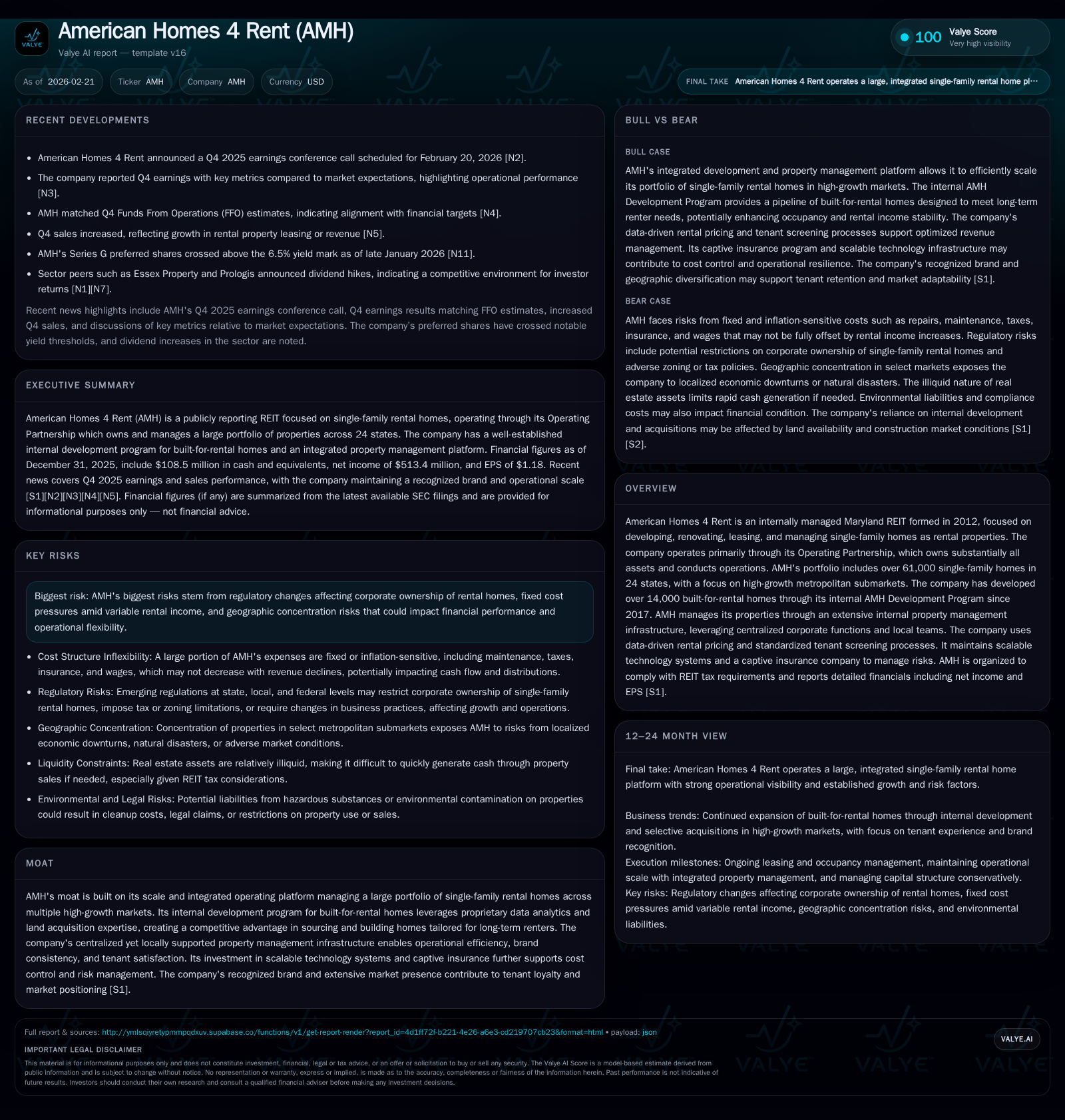
American Homes 4 Rent (AMH) operates a sizable portfolio of over 61,000 single-family homes across 24 states, growing steadily through its internal built-for-rental development program launched in 2017. The company combines centralized technology-enabled property management with local operations to optimize tenant experience and efficiency. While AMH's revenue and net income have exhibited moderate growth over recent years, it faces margin pressure from fixed operating costs and inflation, alongside regulatory risks limiting corporate ownership of rental homes. Its capital allocation prioritizes dividends, with no recent share repurchases. Monitoring acquisition cadence, leasing absorption rates, and cost inflation will be critical for future performance.
Company Overview and Strategic Positioning
American Homes 4 Rent (AMH) is a Maryland real estate investment trust specializing in single-family home rentals. Since its inception in late 2012, AMH has evolved into one of the largest owners and operators of single-family rental homes in the U.S., balancing scale with localized operational execution. The company’s Operating Partnership owns substantially all assets and conducts operations, managed coherently with AMH’s executive leadership.
Key to AMH's competitive edge is its integrated operating platform combining centralized functions—leasing analytics, marketing, accounting—with local leasing agents and onsite property managers. This hybrid model enhances operational efficiency while maintaining customer service quality at scale [S1][S5].
Historical Performance & Portfolio Growth
AMH’s portfolio reached approximately 61,479 owned properties by December 31, 2025; an additional ~3,785 homes are held through unconsolidated joint ventures [S9]. These properties concentrate predominantly within about ten metropolitan statistical areas (MSAs) known for population growth and strong rental demand—including Atlanta, Dallas-Fort Worth, Phoenix, and Las Vegas—which together represent nearly 58% of the operating portfolio [S10][S29].
Since launching its internal “built-for-rental” AMH Development Program in 2017, the company has delivered over 14,000 newly developed rental homes tailored specifically for long-term tenancy [S13]. This program mitigates acquisition scarcity by controlling land sourcing and home construction timelines (typically four to seven months vertical construction after land development) while integrating maintenance-resilient features favorable to renters [S13].
Financially, AMH demonstrated consistent revenue growth with reported revenues rising approximately from $1.14 billion in FY2019 to $1.18 billion by FY2020 [F1]. Although later annual revenue figures were not fully disclosed herein beyond FY2020 due to data limits, net income showed robust progression: from $310 million in FY2022 climbing steadily to $513 million in FY2025 [F1]. This reflects scaling benefits alongside effective rent pricing supported by proprietary data analytics [S13].
Operating cash flows have similarly increased from $665 million in FY2022 to $864 million by FY2025 [F1], signaling solid core cash generation capability despite elevated capital expenditure requirements related primarily to ongoing home development and renovations. The latter keep free cash flow negative when subtracting capex—reflecting growth investment intensity rather than underlying operational weakness.
Historical performance (annual)
| FY | Net ($mm) | CFO ($mm) | Net YoY |
|---|---|---|---|
| 2025 | 513 | 864 | +9.7% |
| 2024 | 468 | 812 | +8.3% |
| 2023 | 432 | 739 | +39.4% |
| 2022 | 310 | 666 |
Note: Omitted columns lack sufficient annual XBRL coverage in the provided tags (need ≥2 annual points): Rev, OpInc, Capex, Buybacks, FCF. Source: SEC companyfacts cache [F1].
Capital returns and efficiency (annual)
| FY | Div ($mm) | ROE% |
|---|---|---|
| 2025 | 446 | 7.3 |
| 2024 | 384 | 6.5 |
| 2023 | 319 | 6.2 |
| 2022 | 253 | 4.8 |
Source: SEC companyfacts cache [F1].
Note: Revenue post-2020 unavailable; net income & cash flow series start from FY2022.
Growth Drivers & Future Outlook
AMH’s advanced development program remains the cornerstone of its growth strategy. By building homes designed expressly for long-term renters with maintenance-efficient features such as durable finishes and optimized floor plans (typically three-plus bedrooms with two or more baths), AMH aims to sustain above-market occupancy levels and healthier tenant retention [S13]. The time-to-lease post-construction averages between roughly ten days up to fifty days depending on market conditions [S20].
Expansion will also depend on identifying new land parcels through their experienced acquisitions team utilizing proprietary analytics that target high-growth MSAs aligning with AMH’s credit-worthy tenant profile [S13]. Bulk acquisitions from third-party builders under the National Builder Program are evaluated regularly but have seen limited activity recently.
However, AMH faces several headwinds that could cap growth or compress margins:
- Inflationary Pressures: Rising labor costs across corporate personnel, property management staff, contractors; material price increases; higher property taxes; insurance premiums—all inflate fixed operating expenses faster than rental rates can adjust given competitive pressures [S1][S6].
- Regulatory Risks: Increasing governmental scrutiny on institutional ownership of single-family homes manifests via state/local laws restricting acquisitions or imposing financial disincentives; federal-level proposals may amplify these constraints potentially requiring divestitures or operational adjustments [S1][S22].
- Geographic Concentration: Heavy exposure (~58%) concentrated within fewer than a dozen metro areas heightens vulnerability to localized economic downturns or disasters impacting housing demand or property values [S22][S29].
Market competition intensifies not only from other institutional single-family operators but also traditional landlords of apartments/condos plus subsidized housing programs affecting tenant affordability choices.
Capital Allocation & Returns Profile
AMH emphasizes returning capital via steadily increasing dividends aligned with REIT distribution requirements. Dividend payouts rose from approximately $252 million in FY2022 to $446 million by end-FY2025 evidencing payout discipline amid expansion financing needs [F1][S11]. No significant share repurchases have occurred since small buybacks in the late-2010s [F1], indicating preference for reinvestment into portfolio buildout or dividend support.
The approximate return on equity stands near an estimated ~7.3% based on latest annual net income relative to equity base [$513M net income / $7B equity]—modest but typical for asset-heavy REIT models balancing steady cash yield and incremental NAV appreciation potential [F1]. Free cash flow remains negative due primarily to aggressive capex linked to ongoing development activity rather than operational deficiency.
Capital structure remains conservative with diversified funding via unsecured senior notes, revolving credit facilities containing covenants meant to preserve flexibility without excess leverage risk [S4][S7]. The captive insurance subsidiary reduces volatility from claims exposure enabling cost stabilization better fitting a large-scale residential landlord model [S12][S25].
Operational Execution & Technology Investments
AMH invests heavily in scalable operating infrastructure integrating data-driven rent pricing models with tenant screening incorporating credit scores and income ratios—helping maximize occupancy while reducing defaults [S25]. Leasing predominantly uses technology-enabled "self-showings" increasing efficiency.
The firm’s call center system supports centralized tenant communications via toll-free access automate routine requests efficiently while local teams maintain direct tenant relations including compliance monitoring with HOA rules—critical given complexity owning many suburban homes across jurisdictions [S5][S25]. In-house property management complements outsourced vendors providing economies of scale plus quality control consistency across markets.
Recent AI adoption initiatives include governance frameworks ensuring risk mitigation while enhancing analytics power further optimizing leasing and maintenance workflows—a forward-looking step given technology’s growing role in residential real estate management [S26].
Risks Overview
Aside from inflation and regulatory risks described earlier:
- Tenant-related risks include recession-driven defaults as rent affordability erodes rising cost-of-living pressures induced by inflation stretching household budgets; eviction processes remain costly and sensitive reputationally under growing tenant advocacy climate [S18][S19].
- Environmental risks such as contaminations or extreme weather events can impose unplanned capital needs adversely impacting results [S18][S24].
- Legal challenges arising from landlord-tenant disputes or government investigations could entail substantial costs diminishing profitability though AMH carries tailored insurance coverage mitigating most exposures barring deductibles/carve-outs [S16][S18].
- Loss or turnover among key management or skilled staff could slow execution effectiveness especially given sector competition for talent affecting development pace or property management quality [S1][S6].
What To Watch Next (Analysis)
In absence of explicit near-term guidance disclosures for financial metrics beyond Q4 '25 earnings (available but not detailed here), key indicators include:
- Development pacing: Number of new built-for-rental deliveries quarterly versus leasing absorption rates signaling portfolio expansion efficiency.
- Rental rate trends: Ability to push rents up amidst inflation without significant occupancy drops reflecting demand elasticity in targeted markets.
- Regulatory developments: New laws aimed at limiting corporate-sized residential landlord operations especially at state/local level that may impact pipeline feasibility.
- Expense trajectory: Monitoring if fixed operating costs rise disproportionately relative to revenues signaling margin compression risk.
- Capital deployment shifts: Changes toward acquisitions versus internal development possibly driven by rising land cost or construction delays.
- Tenant credit metrics: Levels of defaults/delinquencies amid macroeconomic shifts impacting cash flows reliability.
These factors combined will shape AMH's capacity to sustain attractive risk-adjusted returns for shareholders through dividends plus NAV growth over medium term.
Conclusion
American Homes 4 Rent offers a compelling example of scaling a dedicated built-for-rent single-family home REIT leveraging an integrated platform that marries centralized technology-enabled services with local operational coverage. Its sizeable footprint across multiple high-growth U.S. metros fuels steady revenue/net income gains driven principally by an internally operated home development program now approaching critical mass after delivering over fourteen thousand units since inception.
Nevertheless, the business faces meaningful headwinds including persistent inflation driving fixed cost escalation beyond what rental pricing can fully offset, evolving legislative/regulatory constraints targeting institutional single-family landlords, geographic concentration risk amid natural disasters or economic cycles impacting key MSAs, plus ongoing challenges posed by rising tenant cost burdens increasing default probability.
Capital allocation strategies reflect emphasis on dividend continuity while reinvesting heavily into new home inventory additions keeping free cash flow negative yet supporting future earnings growth prospects. Maintaining disciplined lease-up timelines post-construction together with vigilant monitoring of regulatory changes will be pivotal for forward performance stability.
This balance between aggressive expansion through wholly owned development projects paired with robust operational controls positions AMH uniquely within the fragmented U.S. single-family rental landscape —though investors must weigh macroeconomic sensitivities inherent within real estate cycles as well as the politically charged environment regarding corporate housing ownership policies.
This analysis is based solely on publicly available filings including American Homes 4 Rent’s latest SEC reports as of February 2026 along with supplemental news sources. It does not constitute investment advice nor an endorsement of any securities.
Disclaimer: This is research-only, informational analysis and not investment advice. It may include AI-generated interpretation and general industry context. Always verify important details using primary sources.

Comments