
Coursera’s Growth Steady Amid Costs and Pending Udemy Merger Integration
Coursera leverages a vast global learner base and AI-driven platform innovation while navigating profitability pressures and regulatory challenges.
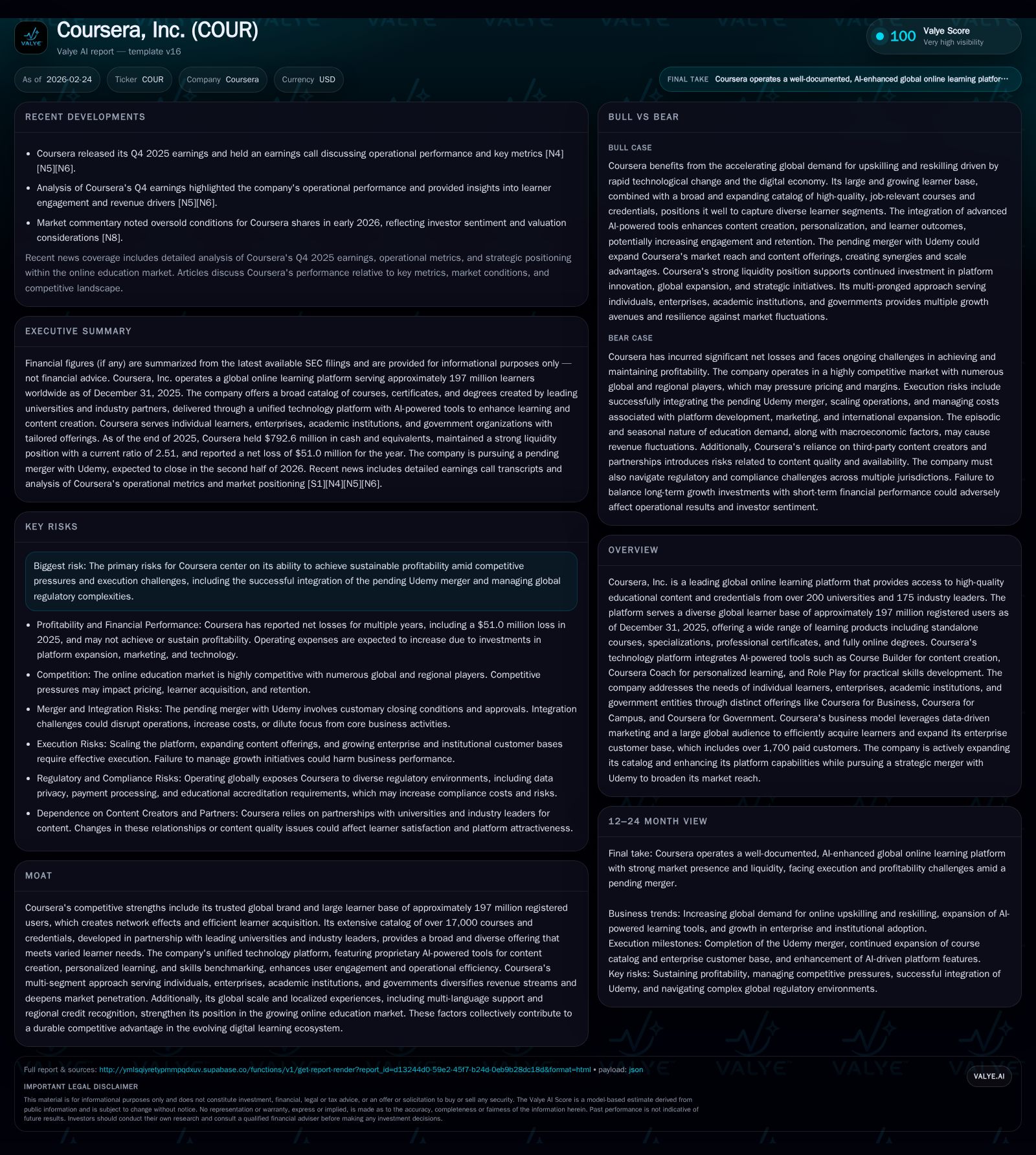
Coursera, Inc. remains a dominant player in global online learning with 197 million registered users and a rich catalog exceeding 17,000 courses tied to top universities and industry leaders. Over the past four years, the company has steadily narrowed operating losses driven by growth initiatives focused on blended education delivery, AI-powered course development tools, and expansion into enterprise and government skilling segments. While organic growth benefits from network effects and multi-channel revenue streams, significant costs related to platform scaling, content expansion, and the pending Udemy merger temper near-term profitability. Regulatory complexity in higher education accreditation and international compliance add additional execution risks. Looking ahead, success hinges on executing the merger integration effectively, monetizing new AI-enabled offerings, and expanding enterprise penetration globally.
Historical Performance and Growth Drivers
Coursera has demonstrated consistent progress since 2022 in managing its growth trajectory while addressing operating inefficiencies inherent in scaling a massive global online education platform. The company’s registered learners have surged to approximately 197 million as of December 31, 2025 [S4], establishing one of the largest adult learner communities worldwide. This expansive learner base forms the foundation of Coursera's competitive moat through network effects that increase organic reach via unpaid channels such as SEO-driven discovery and word-of-mouth referrals.
Financial data reveals significant improvements in operating income loss: from -$177 million in fiscal year (FY) 2022 to -$113 million in FY 2024, down further to -$77 million by FY 2025 [F1]. Similarly, net losses declined from -$175 million in FY 2022 to -$51 million in FY 2025, reflecting successful revenue scaling offsetting increased operating expenses primarily linked to product innovation and market expansion.
Operating cash flows turned positive starting in FY 2023 at roughly $30 million and increased notably to $109 million by FY 2025 [F1]. This suggests enhanced cash conversion during tightening loss trends. Capital expenditures remain minimal (~$1.5 million annually), indicating a low fixed asset intensity typical of software-as-a-service (SaaS) platforms built on scalable cloud infrastructure.
The following table summarizes financial performance across key metrics:
Historical performance (annual)
| FY | Net ($mm) | CFO ($mm) | OpInc ($mm) | Capex ($) | Net YoY |
|---|---|---|---|---|---|
| 2025 | -51 | 109 | -77 | 1500000 | +35.9% |
| 2024 | -80 | 95 | -113 | 1585000 | +31.8% |
| 2023 | -117 | 30 | -146 | 1147000 | +33.5% |
| 2022 | -175 | -38 | -177 | 1578000 |
Note: Omitted columns lack sufficient annual XBRL coverage in the provided tags (need ≥2 annual points): Rev, Div. Source: SEC companyfacts cache [F1].
Capital returns and efficiency (annual)
| FY | Buybacks ($mm) | FCF ($mm) | ROE% |
|---|---|---|---|
| 2025 | 0 | 107 | -8.0 |
| 2024 | 37 | 94 | -13.3 |
| 2023 | 58 | 28 | -18.9 |
| 2022 | -40 | -25.2 |
Source: SEC companyfacts cache [F1].
Note: Revenue figures are not available from the provided XBRL tags; dividends paid are not disclosed.
Business Model Nuances
Coursera’s multi-sided platform offers courses ranging from free microlearning modules to fully accredited online degrees through partnerships with over 200 universities and more than 175 industry leaders [S4]. This spectrum enables engagement across diverse learner needs—from beginners seeking entry-level professional certificates to advanced professionals pursuing career advancement.
Distinct verticals—Coursera for Business, Campus, Government—serve enterprise clients needing workforce upskilling/reskilling, academic institutions integrating online curricula, and public sector agencies developing talent pipelines respectively [S14][S15]. As of late-2025, more than 1,700 paid Enterprise customers leverage Coursera for Business solutions globally [S14].
A unique aspect lies in Coursera's proprietary generative AI tools integrated into its platform: Course Builder assists educators with custom course design; Coursera Coach personalizes learning journeys; Role Play simulates real-world skill application with AI feedback [S16]. These innovations not only improve content quality but also drive operational efficiencies—a critical edge given high competitive intensity in digital education.
Future Growth Outlook
Key growth levers include:
- Scaling adoption across enterprises seeking comprehensive internal training capabilities;
- International expansion benefiting from localized offerings e.g., translations into up to 26 languages and regionally recognized credits [S14];
- Educator network expansion enabling broader content variety aligned with emergent domains including generative AI skills;
- Monetization pathways through expanding entry-level certificates that funnel learners towards premium degree programs;
- Successful integration of Udemy post-merger will create synergies via combined catalog breadth and cross-selling opportunities [S15][S16].
However, these prospects face constraints:
- Execution risk around merging two large platforms with distinct cultures;
- Macroeconomic sensitivities impacting corporate budgets for skilling;
- Regulatory hurdles related to university partner accreditations especially amid evolving US Department of Education guidance ("Dear Colleague" Letter ambiguities) and state legislation [S20];
- Intensifying competition from both established players with greater resources (e.g., LinkedIn Learning) and new entrants leveraging cutting-edge AI-first education models [S13][S24].
Guidance & Milestones
Explicit forward-looking guidance remains undisclosed; key metrics to monitor include:
- Revenue growth rates post-Udemy merger completion,
- Operating margin trends signaling path to profitability,
- Expansion velocity of enterprise customer base,
- Retention/conversion rates within consumer freemium segments,
- Progress on regulatory approvals impacting degree offerings.
Industry observers will weigh Udemy merger regulatory approvals —contingent on antitrust clearances—and subsequent integration milestones announced via quarterly updates [N1][S3].
Capital Allocation & Financial Returns
Coursera's capital deployment prioritizes investment in technology innovation (R&D expenses predominantly concentrated in US, Canada, India), content development partnerships, and global sales expansion rather than shareholder returns through dividends or stock repurchases—the latter paused after $36.7 million spent in FY24 [F1][S11].
The company's modest capex reflects its cloud-based SaaS model requiring little physical infrastructure [F1]. Improving operating cash flow despite ongoing GAAP losses highlights improving operational leverage though returns measured by ROE are still negative (~-8%) given cumulative net losses relative to equity base approximately $636 million at FY25 end [F1].
Free cash flow for FY25 approximates $107 million (operating cash flow minus capex), underscoring healthy cash generation despite reported losses [F1]. Dividends paid are not available from provided tags.
Competitive Positioning & Risks
Coursera boasts competitive moats stemming from brand trust combined with an expansive learner ecosystem that generates valuable data insights fueling personalized marketing efficiencies [S6][S7]. Furthermore, its mix of academic credentials with industry-endorsed professional certificates is a distinctive advantage accelerating skills-to-jobs outcomes.
Yet the company navigates multiple risks including:
- The impact from complex global regulatory landscapes governing online education offerings particularly accreditation compliance;
- Cybersecurity threats potentially compromising sensitive learner data;
- Intensifying competition leading to pricing pressure or content creator attrition;
- The nascent generative AI wave that could disrupt current educational delivery methods forcing rapid adaptation or risking obsolescence;
- Execution risks tied to managing organizational complexity accelerated by ongoing globalization efforts;
- Potential litigation exposures relating to intellectual property or privacy matters as outlined in recent legal disclosures [S9][S10][S18].
Mission Profile & Corporate Governance
As a Public Benefit Corporation since February 2021, Coursera underscores its mission "to provide global access to flexible and affordable high-quality education supporting personal development" alongside fiduciary duties balancing commercial returns with social impact objectives comprised within its certificate of incorporation [S27]. This dual mandate potentially attracts mission-aligned talent and partners though may introduce tradeoffs between short-term financial metrics versus broader stakeholder considerations.
Conclusion & Monitoring Points
Coursera stands poised at a crossroads where solid organic growth fundamentals buttress an ambitious scale-up phase coinciding with transformative M&A activity through the Udemy merger. Success will require deft integration execution supported by continued innovation leveraging AI capabilities while navigating regulatory evolution.
Investors should track quarterly results emphasizing margin improvement trajectories, enterprise client expansions outside North America, updates on merger integration progress including cost synergies realized, potential shifts in customer acquisition economics amid rising competition, regulatory developments impacting credential offerings especially degree accreditations under DOE scrutiny, plus any material legal developments related to privacy or intellectual property.[N1][N2][N3]
Disclaimer: This report is for informational purposes only based on publicly available information as of February 24, 2026. It does not constitute investment advice or a recommendation to buy or sell any securities.
Disclaimer: This is research-only, informational analysis and not investment advice. It may include AI-generated interpretation and general industry context. Always verify important details using primary sources.

Comments