
Calix, Inc. Achieves Operating Turnaround with AI-Driven Broadband Platform
Calix reversed substantial losses in 2024 to deliver profitability in 2025, driven by AI-enabled managed services amid ongoing supply chain and competitive challenges.
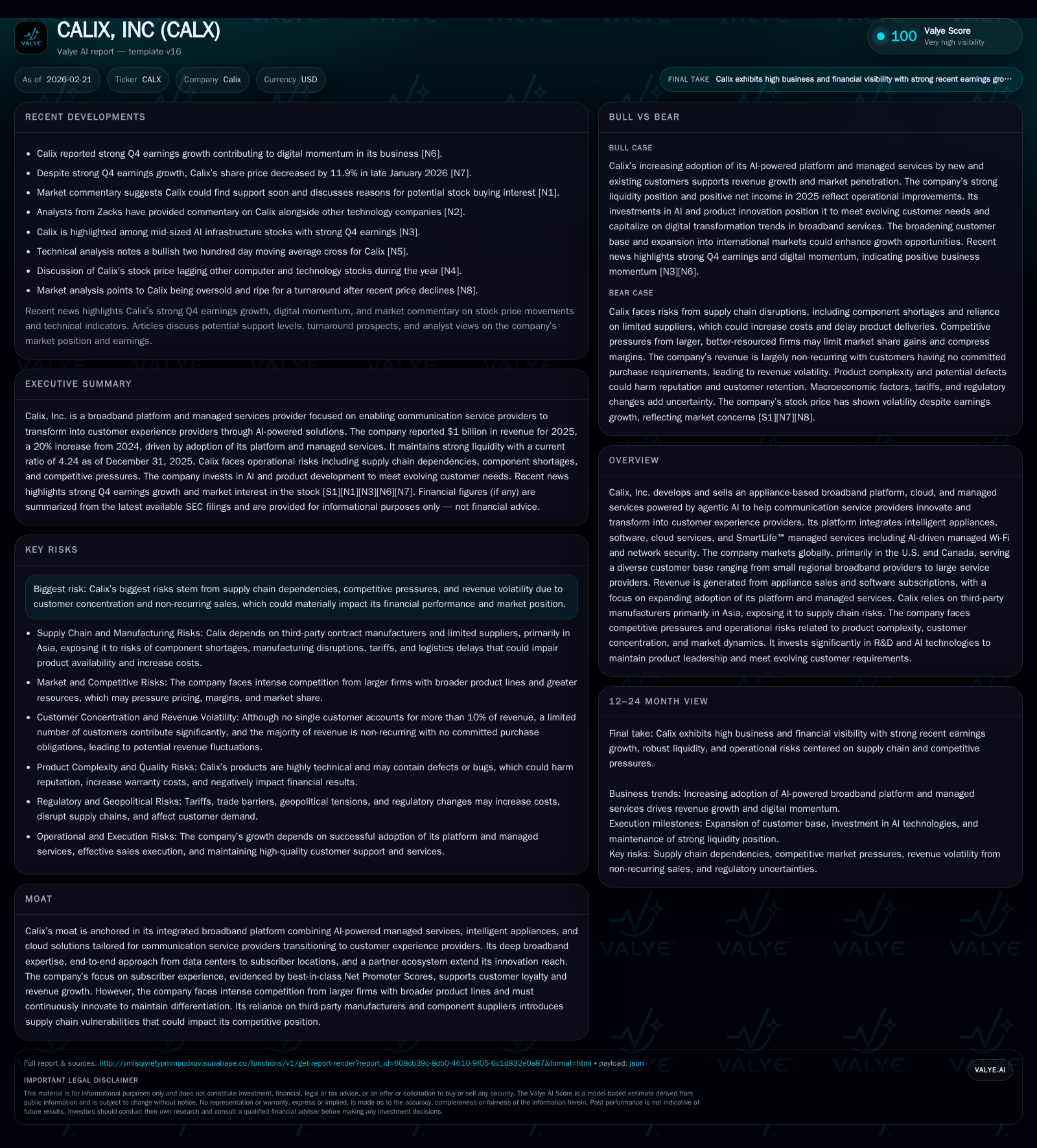
Calix, Inc. demonstrated a notable financial rebound in 2025, transitioning from a $43 million operating loss in 2024 to $21 million in operating income. This turnaround was propelled by accelerating adoption of its integrated broadband platform featuring AI-driven managed Wi-Fi and cloud services. Despite persistent supply chain vulnerabilities tied to Asian third-party manufacturers and heightened IP litigation risks, Calix expanded revenue 4.6% year-over-year while improving gross margins by focusing on higher-margin software subscriptions and SmartLife™ services. The company’s robust cash flow generation underpinned an increased stock repurchase authorization, signaling disciplined capital management. Future growth hinges on scaling platform adoption among diverse communication service providers amid geopolitical and operational headwinds.
From Volatility to Recovery: Calix’s Financial Journey Through 2024-25
Calix, Inc., a specialist in appliance-based broadband platforms combined with cloud and AI-powered managed services, marked a significant financial turnaround for the fiscal year 2025. After enduring a steep operating loss of approximately $43 million in 2024, the company reported a positive operating income of nearly $21 million in 2025 — representing a dramatic swing of almost $64 million. Concurrently, revenue grew from around $831 million in 2024 to roughly $1 billion in 2025, up about 4.6% year-over-year (YoY), signaling renewed demand traction for its integrated platform offerings [F1].
Alongside profitability recovery, net income shifted from a loss of nearly $30 million in 2024 to a profit close to $18 million in 2025. Operating cash flow (CFO) surged impressively almost twofold — climbing from roughly $68 million to nearly $135 million — highlighting the operational stabilization underpinning this resurgence. Capital expenditures modestly increased by 7.6% YoY but remained well contained at about $19 million. The following table summarizes these key annual financial metrics:
Historical performance (annual)
| FY | Net ($mm) | CFO ($mm) | OpInc ($mm) | Capex ($mm) | Net YoY |
|---|---|---|---|---|---|
| 2025 | 18 | 135 | 21 | 19 | +160.1% |
| 2024 | -30 | 68 | -43 | 18 | -201.4% |
| 2023 | 29 | 56 | 26 | 18 | -28.5% |
| 2022 | 41 | 27 | 53 | 14 |
Note: Omitted columns lack sufficient annual XBRL coverage in the provided tags (need ≥2 annual points): Rev, Div. Source: SEC companyfacts cache [F1].
Capital returns and efficiency (annual)
| FY | Buybacks ($mm) | FCF ($mm) | ROE% |
|---|---|---|---|
| 2025 | 94 | 116 | 2.1 |
| 2024 | 11 | 50 | -3.8 |
| 2023 | 86 | 38 | 4.1 |
| 2022 | 13 | 6.0 |
Source: SEC companyfacts cache [F1].
The strong rebound extends beyond headline numbers into cash generation efficacy — free cash flow (CFO minus Capex) approximated $116 million for the year — enabling Calix to markedly increase its capital return programs.
Unpacking Revenue and Margin Drivers Behind the 2025 Turnaround
Calix’s revenue growth was underpinned by a strategic transition toward expanding sales of higher-margin software subscriptions and AI-driven SmartLife™ managed services relative to traditional appliance sales [S9]. Gross profit expanded by nearly $115 million to about $568 million, lifting overall gross margin by more than two percentage points to approximately 56.8%. Notably, software and service revenues increased by roughly $32 million year-over-year while enjoying an above-average gross margin near ~63%, versus approximately ~55% margin for appliance sales.
These dynamics reflect accelerated adoption of Calix’s broadband platform by new broadband service providers (BSPs) and existing customer experience providers (CXPs) winning new subscribers — reinforcing the scalability of recurring revenue components [S9]. This gradual revenue mix shift helped mitigate previous gross margin volatility tied to nonrecurring hardware sales and fluctuating warranty provisions.
Nonetheless, Calix continues grappling with supply chain cost variability resulting from reliance on third-party contract manufacturers primarily located in Asia, exposing the company to tariffs levied amidst U.S.-China trade tensions as well as component shortages impacting production costs [S27]. Warranty expense estimates remain inherently subjective due to product complexity; any adjustments could influence future cost of revenue.
Sales and marketing expenses increased approximately $31 million (14% YoY), largely driven by incremental personnel costs including commissions and incentive compensation aligned with higher revenues but declined modestly as a percentage of total revenue (from ~26% down to ~25%) indicating some operating leverage gains [S9]. Research & development expenses rose by just over $10 million but as a percent of revenue fell from ~22% to ~19%, reflecting effective absorption through revenue expansion despite planned incremental investments building AI capabilities into the platform [S13].
AI-Powered Broadband Platform: The Core Growth Engine
At the heart of Calix’s revival is its integrated broadband access edge platform combining intelligent appliances with agentic AI-driven cloud services and SmartLife™ managed Wi-Fi network features tailored specifically for communication service providers undergoing digital transformation towards becoming customer experience providers (CXPs). These CXPs seek advanced tools that combine network intelligence with subscriber engagement capabilities — exactly Calix's domain expertise [S1].
Calix’s end-to-end approach spans data center infrastructure through intelligent edge devices delivered globally though concentrated primarily within the U.S. Its Software-as-a-Service subscription model facilitates continuous innovation rollout powered by AI algorithms that optimize connectivity performance, network security, and subscriber experience management — critical differentiators amidst commoditized hardware markets. The SmartLife™ suite automates Wi-Fi management leveraging machine learning insights from vast subscriber usage data collected across networks.
This broadening penetration among both small regional broadband providers as well as larger multi-state operators positions Calix uniquely within the sector’s aggressively evolving infrastructure upgrade cycle driven by fiber deployments and next-gen last-mile technologies [S2].
Facing Industry Headwinds: Supply Chain Vulnerabilities and Competitive Landscape
Operational risk remains elevated for Calix due to dependency on third-party Asian contract manufacturers, which amidst global geopolitical uncertainties generate exposure to tariffs, shipping disruptions, component shortages, and cost inflation pressures that adversely affect gross margins [S1][S6][S27].
Further compounding uncertainty are intellectual property risks arising from increased patent infringement claims often initiated by non-practicing entities (NPEs). Such assertions threaten costly litigation or licensing settlements that could hinder use of patented technologies embedded within Calix’s products or delay shipments through import suspensions if federal rulings negate compliance [S5][S6][S7]. Furthermore, adverse rulings could trigger indemnification obligations extending financial risk exposure beyond direct damages.
Competitive pressure also intensifies as major telecommunications equipment vendors offer broader product portfolios bundled alongside extensive service contracts; thus Calix must continuously innovate especially across its AI-driven managed service offerings resisting commoditization threats while maintaining interoperability arrangements vital for network integration success [S16].
Future Horizons: Growth Opportunities and Operational Constraints
Looking ahead, Calix’s growth prospects hinge on increasing adoption rates of its comprehensive broadband platforms among an increasingly diverse customer base spanning small regional ISPs up through very large CSPs pursuing CX transformation strategies [N3][N4][S1][S2]. Successful execution requires scaling operational capacity sustainably while navigating tariff-related cost headwinds stemming chiefly from U.S.-China trade policy shifts imposed on imported components utilized domestically or sold abroad.
Incremental expansion into international markets raises additional challenges given complex regulatory landscapes, market dynamics distinct from North America alongside heightened logistical hurdles [S20]. Elevating recurring software subscription sales through enhanced AI capabilities remains a core strategic pillar designed not only for top-line growth but also for stabilizing revenue streams against typical hardware-related cyclical swings.
Capital Strategy Revealed: Share Repurchases and Cash Generation Dynamics
Calix’s renewed cash flow strength underpins an assertive capital allocation strategy emphasizing shareholder returns via share repurchases rather than dividends which remain absent per corporate policy due to reinvestment priorities [F1][S25]. Operating cash flows nearly doubled YoY reaching about $135 million while capital expenditures rose modestly yielding robust free cash flow near $116 million — ample liquidity supported an incremental increase in buyback authorization exceeding prior limits swarmingly approved at nearly half a billion USD ($425 million total authorized as of January ‘26 versus ~$109 million unused balance at end-’25) [F1][S3][S25].
Despite generating positive net income in the latest fiscal year (~$18M), Return on Equity remains modest around two percent attributed partly to recent equity base expansion following periods of previous losses diluting immediate returns but offering runway for improvement if profit momentum sustains [F1]. No dividends have been declared historically nor currently planned reflecting strategic focus on growth reinvestment plus share price support amid volatile market perceptions.
Monitoring Key Milestones and Analyst Sentiment into 2026
Market reception post-earnings has exhibited contradictory signals; despite fundamental beat-and-raise results reported early January ‘26 releasing upbeat Q4 results above analyst expectations, Calix’s share price declined sharply (~12% pullback within four weeks); highlighting prevalent volatility characteristic of tech infrastructure stocks navigating multiple narrative factors including macroeconomic uncertainties alongside valuation recalibrations [N3][N10].
Wall Street analyst consensus offers cautious optimism projecting potential upside rallies exceeding +50% based on continued AI innovation momentum combined with expanding platform footprint contingent upon successful execution mitigating supply constraints [N12]. Further quarterly updates will be critical barometers especially regarding order book visibility, new account wins among CXPs adopting next-generation fiber access edge solutions plus progress delivering incremental AI enhancements validating roadmap disclosure claims.
Investors should factor ongoing IP litigation developments closely given their potential operational disruptions alongside watch tariff evolution trends affecting cost structures internationally.
This analysis synthesizes publicly available SEC filings ([F1],), recent Nasdaq coverage articles (), and company disclosures focusing strictly on documented company-specific information without speculation or investment advice. Readers should consider this report informational rather than prescriptive regarding CALX securities or business prospects.
Disclaimer: This is research-only, informational analysis and not investment advice. It may include AI-generated interpretation and general industry context. Always verify important details using primary sources.

Comments