
Amicus Therapeutics Advances Rare Disease Portfolio with Strategic Licensing and Market Expansion
Amicus leverages commercial success of its approved rare disease therapies alongside strategic licensing of a novel kidney disease asset to underpin growth.
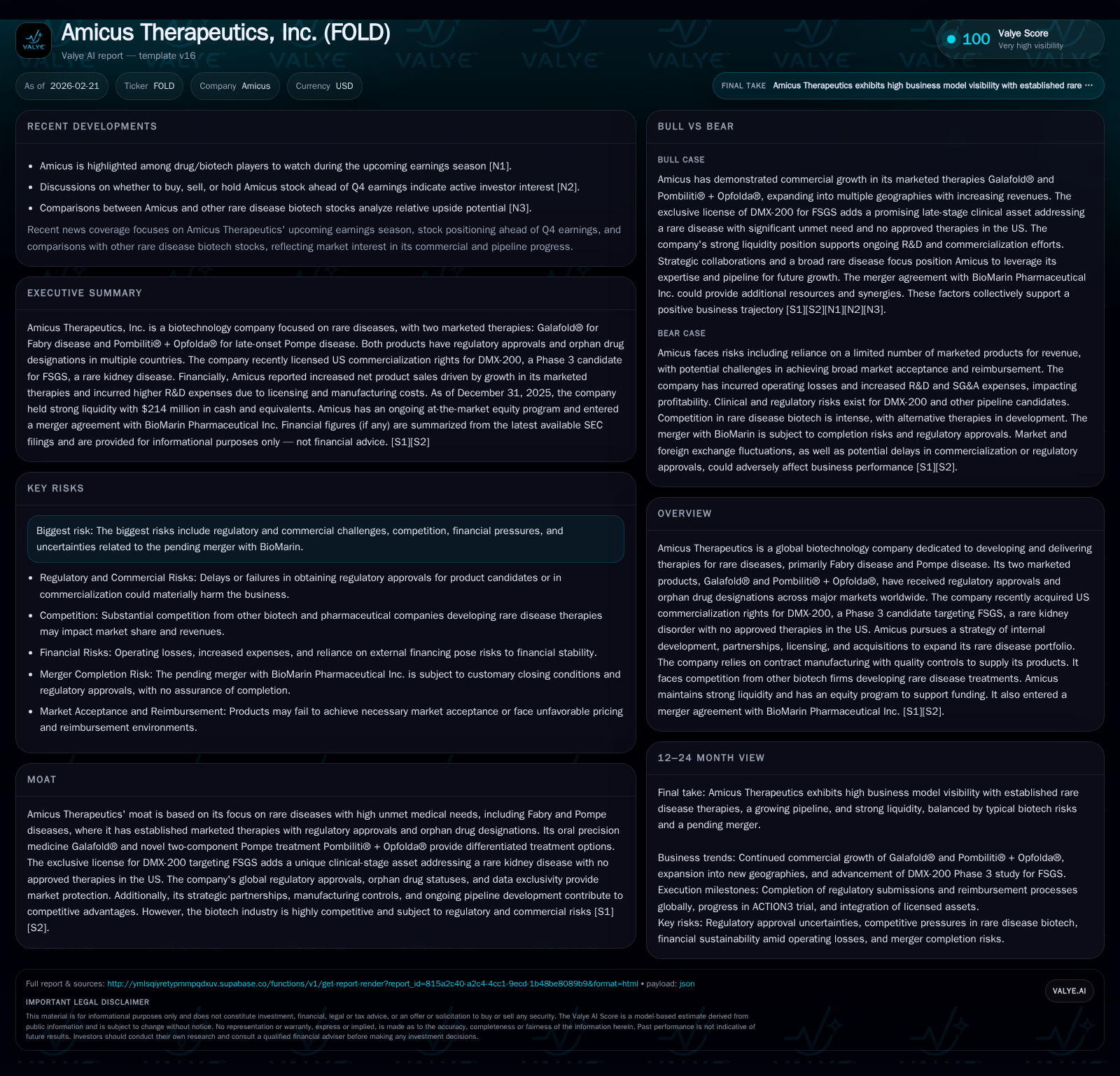
Amicus Therapeutics has demonstrated solid revenue growth driven by expanded sales of its Fabry and Pompe disease treatments, Galafold® and Pombiliti® + Opfolda®. The recent exclusive U.S. license for DMX-200, addressing focal segmental glomerulosclerosis (FSGS), adds a clinical-stage asset targeting an orphan kidney disorder with no approved U.S. therapies, enhancing its portfolio diversification. Financially, Amicus achieved a positive operating income swing and operating cash flow turnaround in 2025, supported by effective commercialization and manufacturing strategies, though net losses persist amid continued R&D investment. Going forward, regulatory milestones for DMX-200, ongoing reimbursement approvals, and merger developments with BioMarin represent key catalysts while competitive and regulatory risks remain notable.
Historical Growth Trends: Execution Behind the Revenue and Operating Income Gains
Amicus Therapeutics has shown consistent commercial traction through fiscal year 2025, primarily bolstered by strong demand for its two marketed therapies: Galafold® for Fabry disease and the two-component regimen Pombiliti® + Opfolda® for late-onset Pompe disease. Revenues have grown steadily as these therapies expand geographically and benefit from multiple orphan drug designations providing exclusivity and pricing advantages.
From a financial standpoint, management reported operating income of $32.8 million in FY2025, marking a substantial improvement over $24.9 million in FY2024 — a 31.8% year-over-year increase [F1]. This reflects both revenue growth and improved operating efficiency. Concurrently, net losses narrowed by more than half (-$27.1 million vs. -$56.1 million prior year), indicating progress toward profitability though the company remains unprofitable overall [F1]. A notable transition occurred in operating cash flow which swung from negative $33.9 million in 2024 to positive $33.1 million in 2025—a near $67 million delta evidencing improving cash generation amid scaling operations [F1]. Capital expenditures modestly declined by approximately 7% year-over-year to $3.3 million in 2025 indicating controlled investment in fixed assets during this phase of pipeline development and commercialization growth.
Historical performance (annual)
| FY | Net ($mm) | CFO ($mm) | OpInc ($mm) | Capex ($mm) | Net YoY |
|---|---|---|---|---|---|
| 2025 | -27 | 33 | 33 | 3 | +51.7% |
| 2024 | -56 | -34 | 25 | 4 | +63.0% |
| 2023 | -152 | -69 | -77 | 7 | +35.9% |
| 2022 | -237 | -167 | -212 | 4 |
Note: Omitted columns lack sufficient annual XBRL coverage in the provided tags (need ≥2 annual points): Rev, Div, Buybacks. Source: SEC companyfacts cache [F1].
Capital returns and efficiency (annual)
| FY | FCF ($mm) | ROE% |
|---|---|---|
| 2025 | 30 | -9.9 |
| 2024 | -37 | -28.9 |
| 2023 | -77 | -94.6 |
| 2022 | -170 | -192.3 |
Source: SEC companyfacts cache [F1].
*Year-over-year change percentages omitted where prior year reversed loss to gain or data incomplete.
Data source: [F1]
Commercial Portfolio Spotlight: Galafold® and Pombiliti® + Opfolda® Performance Drivers
Galafold®, Amicus’s oral precision medicine targeting amenable genetic variants of Fabry disease, remains the cornerstone of its commercial portfolio with approval across over 40 countries including key regions such as the U.S., E.U., U.K., Japan, Canada, Australia, Switzerland [S2]. The product benefits from orphan drug designation in all these major markets supporting exclusivity periods that shield it from generic competition [S2]. In the first nine months of 2025 alone, Galafold® generated consolidated revenues of approximately $371.5 million — an increase of roughly $41 million compared to the prior-year period — illustrating robust adoption trends and expanding geographic footprint driven by formulary inclusions and growing physician awareness [N14][S2].
Pombiliti® combined with Opfolda®, representing an innovative two-component enzyme replacement therapy tailored for late-onset Pompe disease patients, obtained crucial regulatory approvals across several territories including U.S., E.U., U.K., Canada, Australia, Switzerland, and Japan [S2]. The dual-action mechanism differentiates this treatment regimen within a competitive landscape dominated by traditional enzyme replacement therapies (ERTs). Amicus continues to enhance market penetration through reimbursement initiatives targeting varied international payors; regulatory dossiers remain active in multiple jurisdictions supporting longer-term uptake prospects [S2]. Both products enjoy substantial data exclusivities complementing their orphan statuses thereby creating formidable barriers to entry for follow-on biologics or small molecules targeting similar indications.
Strategic Expansion via Exclusive Licensing of DMX-200 for FSGS Treatment in the U.S.
In April 2025, Amicus strategically acquired exclusive commercialization rights within the United States for DMX-200 from Dimerix Bioscience Pty Limited—marking a pivotal move into rare kidney diseases marked by high unmet needs [S2][N1][N4]. This Phase 3-stage candidate targets focal segmental glomerulosclerosis (FSGS), a severe orphan renal disorder characterized by scarring within parts of the kidneys’ filtering units that currently lacks any approved therapeutic options domestically [S2].
Financial commitments included an upfront payment of $30 million coupled with potential milestone payments tied to development success ($75 million max), regulatory achievements ($40 million max), commercial milestones ($445 million max), and tiered royalties ranging from low-teens to low-twenties percentages on net sales in the US [S2]. This licensing deal empowers Amicus not only to fill a critical void within nephrology but also extends its leverage into synergistic future indications under a Joint Steering Committee framework established with Dimerix [S2]. Notably, the company's manufacturing responsibilities encompass all commercial-scale production costs alongside regulatory dossier maintenance post-submission—a reflection of its integrated commercialization capability.
Pipeline Prospects and Regulatory Landscape With Orphan Drug Status Advantages
Amicus’s portfolio benefits strongly from regulatory designations including orphan drug status granted to Galafold®, Pombiliti® + Opfolda®, and now DMX-200 across multiple jurisdictions such as U.S., E.U., U.K., Switzerland, Japan among others [S2][S19]. These designations provide meaningful periods of market exclusivity ranging typically from seven to ten years depending on jurisdiction that guard against direct competition while facilitating premium pricing structures generally afforded within rare disease segments.
Ongoing regulatory efforts include submissions aimed at expanding label indications or achieving fuller reimbursement coverage worldwide particularly for Pombiliti® + Opfolda®, which continues engagement with several health authorities as it penetrates new markets [S2]. Despite these advantages, Amicus must navigate inherent biotechnology risks such as variable clinical trial outcomes—including those tied to DMX-200—and evolving safety profiles that may result in delays or additional data requirements impacting time-to-market or commercial viability [S4][S6]. Competitor surveillance also remains critical as other companies explore novel pharmacologic chaperones or gene therapies potentially overlapping rare lysosomal storage disorders targeted by Amicus’s therapies [S19].
Financial Strength and Capital Allocation: Liquidity, Cash Flow, and Return Metrics Review
The company entered fiscal year-end December 31, 2025 with strong liquidity metrics highlighted by cash & equivalents nearing $214 million supported by current assets amounting to approximately $676 million against current liabilities close to $238 million yielding a solid current ratio around 2.84—a comfortable buffer for operational funding requirements [F1][S17]. Equity rose to about $274 million reflecting capital raises including those accessed via an at-the-market offering program initiated in late 2022 which allows flexible stock issuance up to $250 million total gross proceeds—about $164 million available remaining as of Q3’25—providing balance sheet strength to support research pipelines and manufacturing scale-ups without imminent refinancing concerns [S11][F1].
Operating cash flow transitioned into positive territory at $33.1 million after historically negative trends while capital expenditures contracted slightly to $3.3 million consistent with measured investments primarily focused on sustaining manufacturing capabilities rather than major new plant builds at this stage [F1]. Return on equity remains negative approximately -9.9%, largely due to net losses despite improvements; no dividends or share repurchases were disclosed indicating reinvestment orientation toward long-term innovation rather than shareholder distributions at this juncture—typical among growth-phase biotechs balancing heavy R&D spending against nascent profitability timelines [F1].
Risks, Competition, and Regulatory Hurdles Impacting Long-Term Trajectory
Amicus faces multifaceted risks predominantly structured around obtaining timely FDA approvals particularly for pipeline candidates like DMX-200 where clinical trial outcomes are uncertain as well as gaining broad market acceptance amid highly specialized physician communities for rare diseases where patient identification requires extensive genetic testing infrastructure—and supportive payer reimbursement is crucial due to high therapy costs [S4][S6]. Competitive pressures stem from larger pharmaceutical entities pursuing advances in lysosomal storage disorder treatments through enzyme replacement innovations or gene therapy platforms that could eclipse small molecule or chaperone approaches favored by Amicus; intellectual property litigation related to patents or biosimilar competition adds further layers of complexity [S19][S20].
Supply chain dependency on contract manufacturers introduces risks around capacity constraints or quality control deviations which may disrupt product availability especially given biologic components in Pombiliti® + Opfolda®. The ongoing merger process with BioMarin Pharmaceutical also injects uncertainty surrounding execution risks including potential distraction from core operations plus integration challenges impacting employee retention or partner relations—all capable of influencing financial results negatively should they materialize unfavorably near term [S16][N3].
What Comes Next: Key Milestones and Investor Watch Points Amid Merger Developments
Looking ahead into early-to-mid 2026 horizons, stakeholders should monitor several catalysts shaping Amicus’s operational narrative:
- FDA decisions regarding DMX-200’s clinical dossier progression during Phase 3 ACTION3 study completion will critically dictate timing for potential U.S market launch ambitions underpinned by significant milestone payments triggering upon favorable regulatory outcomes [N1][N4]
- Quarterly earnings releases starting Q4’25 that are expected to reflect continued revenue growth trajectories across Galafold® and Pombiliti® + Opfolda® especially as reimbursement approvals broaden globally influencing top-line velocity alongside margin expansion indicators linked to operational efficiencies observed recently [N2]
- Regulatory updates on label expansions or new market entries beyond existing approval geographies particularly for the two-component Pompe therapy where ongoing submissions may unlock sustained adoption momentum internationally [N14]
- Progress updates concerning closing timelines on the BioMarin merger agreement covering completion conditions inclusive of stockholder approvals plus regulatory clearance providing clarity on integration pathway risks or synergy realization prospects impacting mid-term outlooks [N3]
Absent explicit forward guidance on precise sales targets or timelines beyond public milestones disclosed so far—as typical within pre-merger biotech communications—market participants would do well focusing on pipeline clinical readouts alongside regulatory decisions governing reimbursement landscapes as primary drivers influencing valuation frameworks going forward.
This report provides an analytical overview based exclusively on publicly filed regulatory documents including SEC filings and reputable news sources without any personalized investment recommendations or price forecasts. Readers should conduct their own evaluation considering their risk tolerance regarding clinical trial uncertainties inherent within biopharmaceutical sectors specializing in rare diseases.
Disclaimer: This is research-only, informational analysis and not investment advice. It may include AI-generated interpretation and general industry context. Always verify important details using primary sources.

Comments