
Voya Financial Charts Future Expansion Through Multisegment Strengths and Digital Innovation
Voya leverages its diversified financial services platform and digital capabilities to support steady growth and operational efficiency.
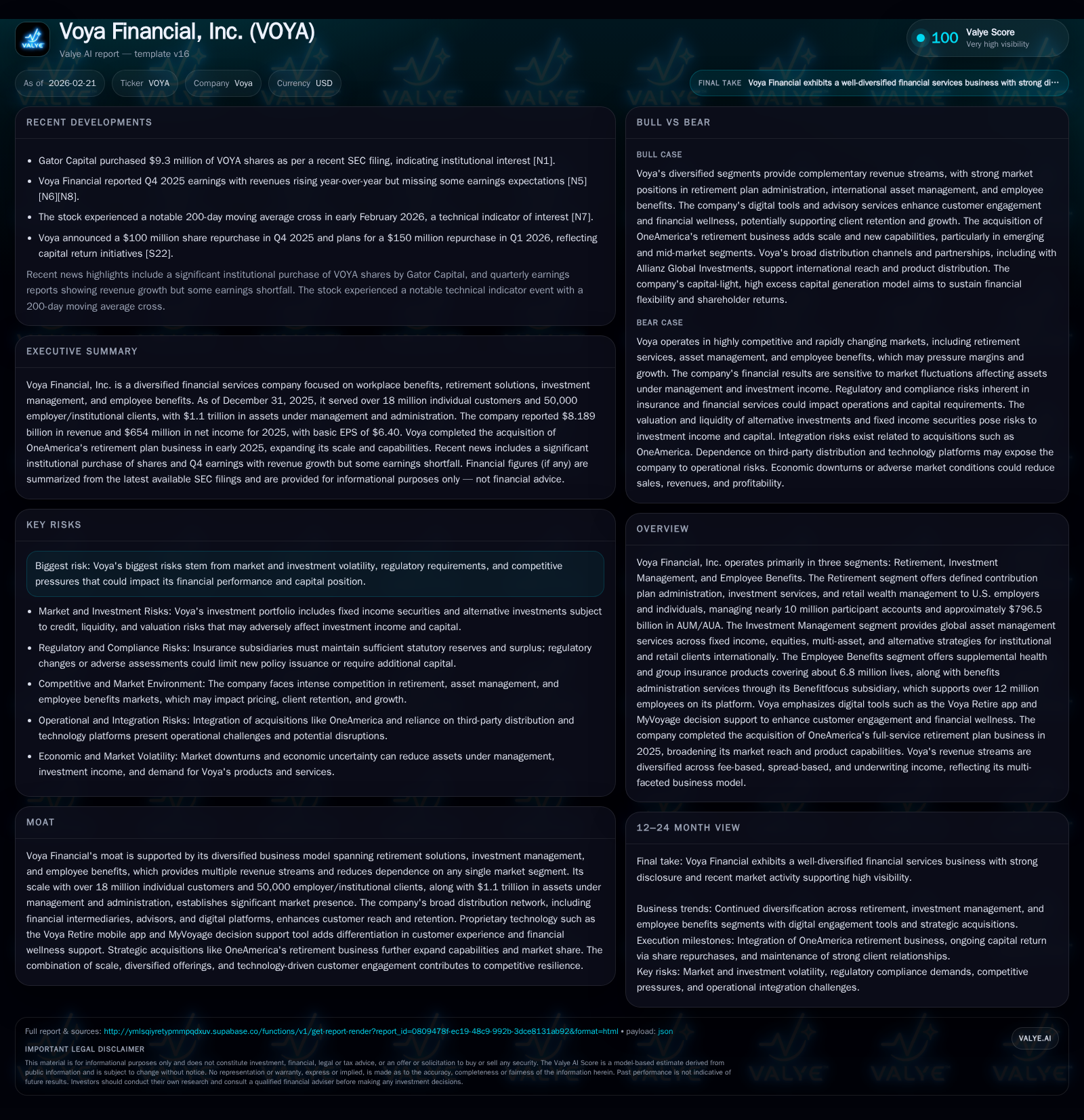
Voya Financial has built a diversified business model across Retirement, Investment Management, and Employee Benefits, underpinning steady revenue growth and solid profitability. Its scale—with $1.1 trillion in assets under management/administration and over 18 million customers—combined with strategic acquisitions and digital platforms like the Voya Retire app enhances competitive positioning. Capital allocation favors buybacks, supporting attractive returns on equity near 13%. Regulatory complexities and market volatility remain risks to monitor. The company’s future growth hinges on expanding mid-market retirement solutions, international asset management reach, and leveraging technology to deepen client engagement.
Multi-Decade Growth Fueled by Segment Diversification
Voya Financial has demonstrated a strong growth trajectory supported by its balanced three-segment business model comprising Retirement, Investment Management, and Employee Benefits. Over the past several years leading into fiscal 2025, revenue rose steadily from $5.92 billion in 2022 to approximately $8.19 billion by the end of 2025, marking an annualized increase driven by both organic expansion and strategic acquisitions such as the OneAmerica retirement business completed in early 2025 [F1][S4][S27]. Operating income reflected even more substantial gains during this timeframe, climbing from a relatively modest base of $114.5 million in 2016 to over $1 billion by 2025 — an increase exceeding 800%, indicating operational leverage despite episodic net income fluctuations which edged slightly downward to $654 million in 2025 [F1]. This performance underscores Voya's resilience deriving from diversified revenue streams across fee-based plan administration, investment advisory fees, underwriting margins on insurance products, and recurring premium flows.
The company's broad client base across employer sizes—from small startups to large public-sector institutions—and expanded product suite has strengthened customer retention while enabling more stable cash flow generation. Notably, Voya serves approximately 18 million individual relationships and more than 50,000 institutional clients within U.S. markets complemented by overseas investment offers reflecting its global footprint [S4].
Historical performance (annual)
| FY | Rev ($bn) | Net ($mm) | CFO ($mm) | Rev YoY | Net YoY |
|---|---|---|---|---|---|
| 2025 | 8.2 | 654 | 1288 | +1.7% | -1.9% |
| 2024 | 8.1 | 667 | 1345 | +9.6% | +6.7% |
| 2023 | 7.3 | 625 | 1638 | +24.1% | +22.5% |
| 2022 | 5.9 | 510 | 1352 |
Note: Omitted columns lack sufficient annual XBRL coverage in the provided tags (need ≥2 annual points): OpInc, Capex, Div, FCF. Source: SEC companyfacts cache [F1].
Capital returns and efficiency (annual)
| FY | Buybacks ($mm) | ROE% |
|---|---|---|
| 2025 | 200 | 13.2 |
| 2024 | 640 | 16.7 |
| 2023 | 369 | 14.9 |
| 2022 | 750 | 11.4 |
Source: SEC companyfacts cache [F1].
Note: Operating Income data available only for selected years; Capex data for recent fiscal years not available
Revenue Trends: Gradual Expansion Amid Market Volatility
Voya's revenue growth over recent periods reflects underlying market conditions characterized by fee-based income stability offset partially by market-sensitive earnings in the Investment Management segment which depend on assets under management (AUM) valuations subject to capital market fluctuations [F1][N4]. The company's Q4 earnings released February 3, 2026 reported revenues beating year-ago levels but slightly missing analyst earnings estimates due primarily to higher operating expenses impacting adjusted operating earnings [N4][N6]. Investment Management fees are influenced by third-party institutional client flows as well as mutual fund performance amid global rate changes and sector rotation.
Fee income accounts for a significant proportion of revenues derived from participant-based administrative fees in Retirement plans as well as underwriting margins within Employee Benefits underwriting stop-loss policies covering self-funded employer group health plans (approximately $1.6 billion in stop-loss premiums alone) [S4][S17]. This mix provides some resilience against episodes of underwriting losses or market-induced margin compression.
Segment Contributions: Retirement, Investment Management, and Employee Benefits Breakdown
The three segments deliver complementary value propositions:
Retirement: Serves
45,000 employers spanning all defined contribution plan types including corporate, governmental (457), education sector (403b), healthcare settings with nearly 10 million participant accounts managing roughly $796.5 billion AUM/AUA — including $84.7 billion proprietary assets — fueled by recordkeeping services across full-service plans, stable value options (GICs/synthetic GICs), managed account offerings, and integrated wealth management advisory through Voya Financial Advisors (VFA), which includes ~400 field advisors [S4][S5][S7][S16]. Distribution channels comprise TPAs (1000), independent brokers/advisors (15,000 wirehouse and RIAs), unaffiliated sales agents (2400 focused mainly on fixed annuities), plus digital tools such as the award-winning Voya Retire mobile application boosting participant engagement.Investment Management: Offers globally diversified asset management solutions ranging from fixed income to equities & alternatives focused primarily on institutional clients including insurance companies (+$286 billion third-party assets), retail intermediaries internationally via Allianz partnerships enhancing European/Asian reach through sub-advisory agreements; proprietary product innovation includes private credit/fixed income funds contributing towards the $100+ billion privates & alternatives AUM category while reinforcing steady management fees aligned with AUM fluctuations [S4][S26].
Employee Benefits: Encompasses supplemental health insurance products such as stop-loss coverage (third largest US writer), group life/disability insurances serving ~6.8 million covered lives together with health savings/spending account products administered via Benefitfocus platform that supports over 12 million enrolled employees offering open architecture enrollment for voluntary benefits plus decision support powered by analytic-driven MyVoyage application; premium/fee revenues totaled ~$3.6 billion as of FY25 year-end [S4][S7][S17]. Distribution leverages national/regional brokers, TPAs and technology partners complemented by an internal salesforce structured toward mid-to-large corporate markets.
This segmentation allows diversified exposure yet provides synergies—particularly where integrated benefits offerings tie into retirement planning facilitating cross-sales backed by analytics-driven guidance applications.
Capital Allocation Priorities: Buybacks Outpace Dividends, Prudent Cash Management
Capital return policies lean heavily toward share repurchases rather than dividends; notable declines in buyback magnitude reflect recalibrated capital deployment after historic peak levels around $750 million in FY22 followed by moderation to $200 million repurchased stock in FY25 [F1][N10]. Dividend payments have been nominal or suspended post-2018 reflecting prioritization of balance sheet flexibility amid reinvestment phases.
Free cash flow metrics remain robust—operating cash flow hovering above $1.2 billion annually while capex remains immaterial relative to operating liquidity confirming low capital intensity typical for financial services firms outside banking operations [F1]. Approximate return on equity stood near a healthy benchmark of ~13% signaling effective profit generation relative to shareholder equity base approaching $5 billion end FY25.
Debt markets accessed through Funding Agreement Backed Note programs tied to mortgage-backed securities provide institutional funding flexibility though they require collateral adjustments sensitive to interest rate shifts posing liquidity risk mitigated by diversified funding sources including Federal Home Loan Banks memberships [S23].
Operational Efficiency and Profitability Metrics Analysis
An analysis of profitability reveals sharp improvement at operating income levels rising from low double-digit millions several years ago to surpassing one billion dollars recently [F1], illustrating heightened operational leverage across broader fixed-cost absorption post scale expansion.
Net income narratives indicate somewhat muted growth or slight contraction (-1.9% in FY25 vs prior year) owing partly to elevated expense lines including integration costs from recent deals like OneAmerica acquisition plus non-operating items including asset impairments or tax variances flagged within quarterly disclosures [N4][S3]. Managing expense discipline will be crucial going forward given competitive pricing trends especially within Insurance underwriting components of the Employee Benefits segment.
Margin trends also reflect evolving revenue composition balancing higher fee-based recurring income against more volatile underwriting outcomes sensitive to pandemic residual claims experience or shifting regulatory landscapes impacting reserve assumptions.
Regulatory Environment and Emerging Risks Impacting Future Trajectory
Voya operates within a complex regulatory framework subjecting it to multiple overlapping federal/state laws governing insurance product design/distribution alongside fiduciary mandates under ERISA especially pertinent for retirement plan sponsors' protections [S6][S9]. Enhanced cybersecurity rules including adoption of NAIC Model Laws across at least twenty-eight states impose rigorous data protection requirements influencing IT investments and compliance overheads; New York Department of Financial Services cybersecurity mandates encapsulate stringent governance expected of insurers’ operational frameworks [S10].
Heightened scrutiny from SEC/FINRA amid Regulation Best Interest implementations affects brokerage functions embodied by VFA subsidiary requiring adherence to enhanced conduct standards impacting advice delivery models [S24]. Anti-money laundering programs mandated under Patriot Act create ongoing monitoring necessities given broker-dealer involvements including due diligence on economic sanctions compliance internationally.
Market volatility constitutes a primary risk reducing asset values thus depressing fee yields especially relevant within Investment Management; also adverse interest rate environments jeopardize credit spreads earned on stable value contract portfolios integral to Retirement product profitability presenting ongoing hedging challenges.[S12][S15]
Digital Tools and Strategic Acquisitions Enhancing Competitive Edge
Central to Voya’s differentiation efforts is investment in technology platforms designed for superior user experience spanning participant engagement through mobile apps like Voya Retire facilitating holistic financial planning along with MyVoyage decision support tools integrating benefits optimization offering comprehensive workplace benefit insights across retirement contributions plus health spending options enhancing financial wellness outcomes [S7][S16]. These digital assets contribute markedly toward sustained client retention addressing younger demographics’ expectations for anytime-anywhere access.
Acquisition of OneAmerica’s full-service retirement plan business strengthened mid-market presence broadening distribution avenues particularly adding employee stock ownership plan competencies enriching product suite serviced by dedicated wholesale teams targeting corporations under $500 million plan assets enhancing competitive positioning [S21]. Alliance transactions with Allianz Global Investors expanded international footprint injecting fresh investment strategies while leveraging Allianz’s global distribution infrastructure underpinning cross-border client acquisition capabilities.[S26]
Open architecture strategies across retirement plans allow incorporation of third-party fund families exceeding over two hundred recognized providers expanding choice while reducing dependency on proprietary funds mitigating concentration risk associated with internally-managed fund underperformance.[S19]
Future Outlook: Growth Levers and Headwinds in Focus
Looking ahead (analysis), potential catalysts supporting sustained earnings momentum include deeper penetration into emerging/mid-sized employers’ retirement plans leveraging enhanced capabilities post-OneAmerica acquisition together with broader roll-out of enriched advisory services fostering greater wallet share per participant.[N9] International expansion especially within investment management leveraging established partnerships may unlock incremental fee revenue streams complementing domestic revenues.[N13]
However, ongoing headwinds encompass margin pressures driven by industry-wide pricing competition particularly within employee benefits exacerbated by inflationary cost pressures affecting underwriting margins alongside cautious corporate clients possibly moderating benefit spend following macroeconomic uncertainties.[N10] Such dynamics necessitate continued operational efficiency focus coupled with selective innovative product development tailored toward evolving customer preferences amid tightening regulatory oversight.[S14]
Trends worth watching include net inflows/outflows into flagship Retirement plans as proxy for retention success rates; performance consistency across multi-asset management funds gauging client satisfaction; technology adoption rates measuring digital tool efficacy influencing plan participant behavior; regulatory shifts inside ERISA or cybersecurity realms potentially altering compliance cost profiles impacting P&L; lastly capital deployment strategies signaling confidence—evidenced by repurchase pace versus possible resumption or lift-off dividend initiatives reflecting underlying cash surplus projections.
This report is an analytical summary based on publicly available SEC filings ([F1],[S#]) and news reports ([N#]). It is intended solely for informational purposes without expressing any investment recommendation or advice.
Disclaimer: This is research-only, informational analysis and not investment advice. It may include AI-generated interpretation and general industry context. Always verify important details using primary sources.

Comments