
Tronox's Struggle with Profitability Highlights Financial and Market Volatility Challenges
Tronox Holdings plc faces operating losses and declining earnings despite stable cash from operations, amid commodity price volatility and heavy capital investment.
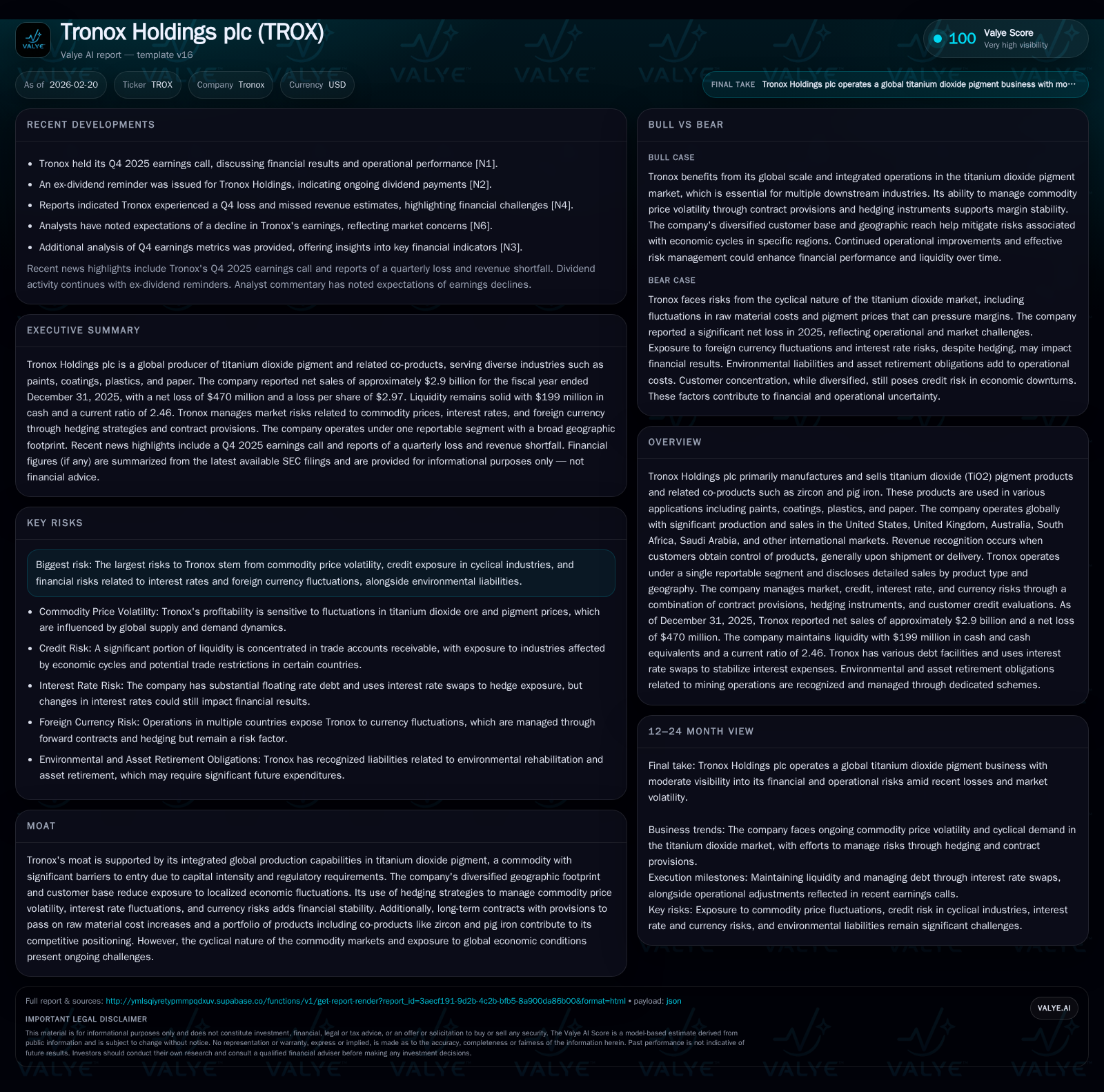
Tronox experienced a significant reversal in profitability in FY2025, swinging to a $253 million operating loss and a $470 million net loss versus prior year profits. Revenue hovered near prior levels but was insufficient to offset growing costs and impairments linked to its titanium dioxide (TiO2) pigment operations. The company’s integrated global footprint in TiO2 pigments, zircon, and pig iron provides some competitive hedge, yet it remains vulnerable to commodity price swings, cyclical demand fluctuations, and regulatory risks. Substantial capex continues to support long-term production capability but pressures free cash flow amid declining profits. Tronox’s leverage is manageable with multiple credit facilities and stable liquidity, though interest costs have risen. Future growth hinges on market recovery, cost discipline, and contract pricing that passes through raw material expenses.
Company Overview and Industry Positioning
Tronox Holdings plc operates as a globally integrated producer of titanium dioxide (TiO2) pigment products along with related co-products such as zircon and pig iron. TiO2 serves as an essential commodity input for paints, coatings, plastics, paper, and other industrial applications. Tronox’s geographic footprint is diversified across the United States, United Kingdom, Australia, South Africa, Saudi Arabia among others, positioning it to serve varied markets while managing localized risks [S9]/[S1].
The business rests on capital- and regulation-intensive processes typical for the TiO2 industry — barriers that support some moat protection. Yet the sector remains highly cyclical with revenue and profitability sensitive to fluctuations in pigment prices driven by underlying ore costs and end-market demand cycles. Tronox’s strategy includes mitigating raw material price volatility through contract provisions allowing price pass-throughs as well as formula price contracts that allocate commodity risk between the company and its customers [S1]/[S10].
Historical Performance Summary
Tronox’s financial performance has seen significant volatility over recent years largely reflecting shifts in market supply-demand dynamics for TiO2 pigments coupled with operational factors.
Historical performance (annual)
| FY | Net ($mm) | CFO ($mm) | OpInc ($mm) | Capex ($mm) | Net YoY |
|---|---|---|---|---|---|
| 2025 | -470 | 60 | -253 | 341 | -879.2% |
| 2024 | -48 | 300 | 219 | 370 | +84.8% |
| 2023 | -316 | 184 | 186 | 261 | -163.6% |
| 2022 | 497 | 598 | 458 | 428 |
Note: Omitted columns lack sufficient annual XBRL coverage in the provided tags (need ≥2 annual points): Rev. Source: SEC companyfacts cache [F1].
Capital returns and efficiency (annual)
| FY | Div ($mm) | Buybacks ($mm) | FCF ($mm) |
|---|---|---|---|
| 2025 | 48 | -281 | |
| 2024 | 80 | 0 | -70 |
| 2023 | 89 | 0 | -77 |
| 2022 | 87 | 50 | 170 |
Source: SEC companyfacts cache [F1].
Revenue figures approximate as detailed top-line not explicitly tagged; operating income is reported as us-gaap OperatingIncomeLoss [F1], [S9]
Notably,
- Operating income fell sharply into negative territory by over $250 million in FY2025 compared to prior positive results.
- Net losses deepened significantly correlating with operational headwinds.
- Cash flow from operations contracted markedly but remained positive.
- Capital expenditure remained elevated reflective of the capital intensity of maintaining production assets.
- Dividend payments were maintained though reduced; share repurchases ceased following the large buyback program concluded by FY2022.
Recent Operational Dynamics
In FY2025 Q4 earnings commentary [N1][N3], management acknowledged challenging product pricing environments where ore prices spiked faster than pigment selling prices could fully adjust due to contractual lags or market conditions. This mismatch pressured margins substantially during the period.
Further compounding profitability challenges were inventory write-downs linked to slower-moving stock influenced by weakening demand forecasts and increased raw material costs requiring valuation adjustments [S9].
On a positive note, Tronox continues leveraging contractual formula pricing provisions that enable partial transmission of higher input costs downstream — curbing margin erosion potential during volatile cost cycles [S1], though this mechanism sometimes involves timing delays impacting short-term financial results.
Capital Structure & Liquidity
Tronox maintains a complex debt structure typical for large industrial firms:
- Two major term loan facilities totaling approximately $1.6 billion mature respectively in April 2029 (2024 Term Loan Facility) and September 2031 (2024-B Term Loan Facility).
- Senior unsecured notes amounting to $1.075 billion due March 2029.
- Senior secured notes issued recently for $400 million due September 2030 bearing relatively high coupon at over 9% reflecting market conditions at issuance [F1].
Interest expense escalated with total finance costs reaching around $189 million for FY2025 driven by both volume of debt outstanding and recent rise in margin spreads especially on floating-rate debt components tied to SOFR indexation plus margins ranging from approximately 1.25%-2.75%. Noteworthy is an active revolving credit facility providing liquidity flexibility backed by inventory collateral primarily in the UK subsidiary.
At December 31, 2025,
- Total cash & equivalents stood near $199 million.
- Current assets exceeded current liabilities resulting in a healthy current ratio of approximately 2.46x signaling adequate short-term liquidity buffers.
- The company is compliant with all financial covenants associated with its borrowing arrangements [F1].
Environmental & Legal Considerations
A significant ongoing charge relates to environmental remediation liabilities primarily tied to legacy manufacturing sites such as Hawkins Point Plant in Baltimore transferred post-acquisition of Cristal's assets. The remediation provisions approximated at $41 million form part of accrued liabilities requiring funded cleanup under state oversight agreements handled jointly with Maryland Port Administration [S25][S26].
Additionally, Tronox faces legal contingencies including securities class actions alleging misstatements during early-mid 2025 though exposure size remains uncertain pending litigation resolution [S25]. These matters add layers of risk requiring close monitoring by management given potential reputational or financial impacts.
Returns & Capital Allocation Discipline
Tronox returns metrics reflect difficult recent performance:
- Estimated Return on Equity (ROE) based on FY2025 net loss relative to equity base (~$1.418 billion) approximates negative -33% underscoring current unprofitability [F1].
- Free cash flow (CFO less capex) was roughly negative $281 million constraining discretionary financing capacity beyond core operational needs.
Dividends have been cautiously retained albeit reduced indicating commitment to shareholder returns albeit scaled back due to weaker free cash generation capabilities amidst ongoing headwinds [F1]. No share repurchase activity has been reported since FY2022 reflecting prudent balance sheet preservation stance.
Future Growth Prospects & Risks
Explicit forward guidance is limited but focus areas include:
- Stabilization or recovery of TiO2 pigment prices aligning better with raw material inputs could significantly improve margins.
- Enhanced operating efficiencies or reduced fixed costs may help restore operating leverage benefits lost due to price pressures.
- Ramp-up or optimization of co-product sales (zircon/pig iron) supplements revenue diversification though these remain smaller segments [N1][S29].
- Continued marketing into growing end-user sectors including construction materials where durable paints/coatings consumption underpins demand fundamentals may aid volume growth.
Conversely constraints involve:
- Persistent commodity input cost volatility disrupting margin predictability despite hedging attempts.
- Credit risk exposure via industrial customers facing macroeconomic cyclicality impacting receivables collectibility.
- Foreign exchange risks given multinational footprint compounded by geopolitical uncertainties affecting trade flows.
- Regulatory oversight especially environmental cleanup mandates adding unforeseen or escalating costs compromising net returns [S10][S25].
Investor attention should track quarterly volumes/pricing trends alongside assessment of remediation cost trajectories and any litigation developments as key near-term milestones impacting overall financial performance.
Industry Context Analysis
The titanium dioxide pigment sector is forecasted within broader chemical commoditization cycles influenced by supply chain dynamics involving ilmenite feedstock availability concentrated geographically (notably Australia/South Africa). Environmental compliance costs are increasing globally tightening margins especially for operators reliant on aging asset bases without scale-driven cost advantages. Liquid cooling innovations or green energy transitions currently have limited direct impact on this heavy mineral processing sector; however evolving sustainability requirements could reshape future capex priorities especially regarding waste handling similar to Hawkins Point environmental controls. The ability of producers like Tronox to maintain contract structures that pass through raw material inflation remains crucial as industry participants contest pricing power via value-added service differentiation alongside standard commodity offerings.
Disclaimer: This analysis is intended solely for informational purposes based on available public filings and news up to February 20th, 2026. It does not constitute investment advice or recommendations regarding Tronox Holdings plc securities or related financial instruments.
Disclaimer: This is research-only, informational analysis and not investment advice. It may include AI-generated interpretation and general industry context. Always verify important details using primary sources.

Comments