
Cogent Communications Enhances Network Scale but Faces Profitability Challenges in 2025
Cogent's acquisition of Sprint's fiber assets broadened its network reach yet pressured margins and cash flows.
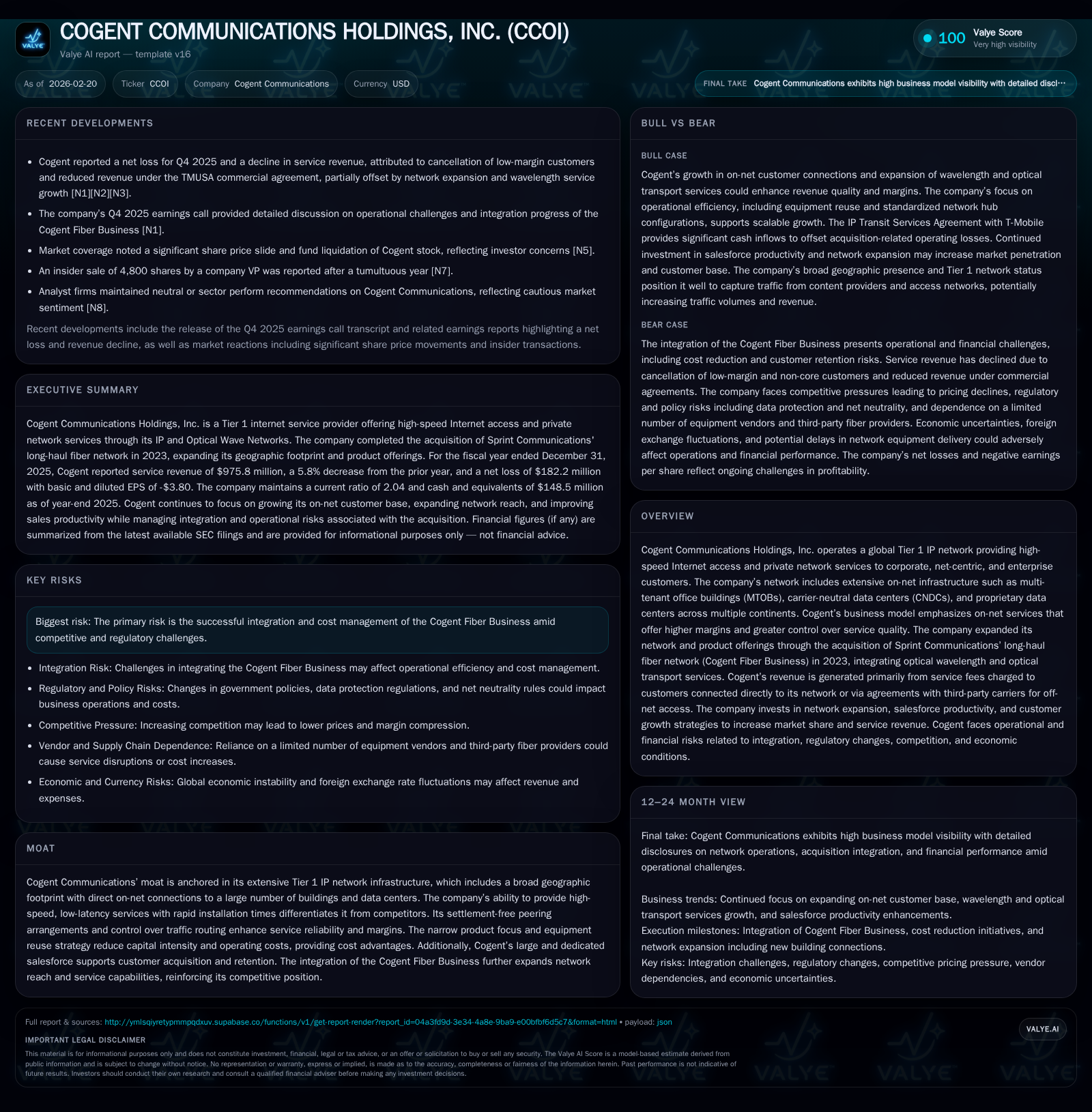
In 2025, Cogent Communications amplified its global Tier 1 IP network through the costly integration of Sprint Communications’ long-haul fiber assets. While this expansion elevated revenue opportunities especially in optical wavelength and transport services, the company grappled with sustained operating losses and declining operating cash flow amid heavy capital expenditures. Cogent maintained robust liquidity supported by contractual payments from T-Mobile US under a $700 million IP Transit Services Agreement, but leveraged capital structure metrics signal tight financial flexibility. Dividend payments remained elevated despite negative net income, reflecting management’s commitment to shareholder returns amidst challenging profitability dynamics.
Historic Financial Trajectory: Growth Drivers and Operating Income Trends
Cogent Communications’ financial trajectory over recent years reveals a firm grappling with the tension between aggressive network expansion and persistent operating losses. In FY2022, prior to its major acquisition spree, operating income was positive at $114 million [F1]. However, the strategic purchase of Sprint Communications’ long-haul fiber assets (the Cogent Fiber Business) in May 2023 has shifted the landscape dramatically.
Operating income for FY2025 stood at a loss of approximately -$101 million, yet represents a notable improvement of roughly +49% versus FY2024’s larger loss of -$198 million [F1]. This improvement stems partially from the company’s efforts to streamline operations following the acquisition alongside expanding higher-margin on-net services that leverage their enlarged footprint. Despite this favorable percentage change, absolute results remain deeply negative.
Historical performance (annual)
| FY | CFO ($mm) | OpInc ($mm) | Capex ($mm) |
|---|---|---|---|
| 2025 | -11 | -101 | 188 |
| 2024 | -9 | -198 | 195 |
| 2023 | 17 | -129 | 130 |
| 2022 | 174 | 114 | 79 |
Note: Omitted columns lack sufficient annual XBRL coverage in the provided tags (need ≥2 annual points): Rev, Net, ROE%. Source: SEC companyfacts cache [F1].
Capital returns and efficiency (annual)
| FY | Div ($mm) | Buybacks ($mm) | FCF ($mm) |
|---|---|---|---|
| 2025 | 150 | 17 | -198 |
| 2024 | 189 | 8 | -204 |
| 2023 | 182 | -112 | |
| 2022 | 170 | 4 | 95 |
Source: SEC companyfacts cache [F1].
Note: ‘Net Income’ for FY2024 is unavailable in provided tags; ‘Share Repurchases’ data absent for some years.
The fluctuation in stockholders' equity—from negative in FY2022 to positive in FY2023 and back to negative in FY2025—reflects accounting factors including goodwill impairment or debt issuance effects linked to the acquisition and capital structure changes [F1].
Sprint Fiber Acquisition: Immediate Impact and Integration Complexities
The acquisition of Sprint Communications’ U.S.-based long-haul fiber network transformed Cogent’s business operationally and financially [S1]. The purchase price was nominal ($1), but effectively accompanied by a $700 million IP Transit Services Agreement with T-Mobile US (formerly Sprint’s parent). This agreement provides Cogent with structured cash inflows: $350 million disbursed monthly ($29.2 million per month) during the initial year post-closing with further installments scheduled over subsequent months [S4][S19].
This arrangement functions as a subsidy mitigating operating losses inherent to the inherited Cogent Fiber Business—a segment historically burdened by negative cash flows due to legacy cost structures and customer churn [S4]. Through December 31, 2025 cogent received approximately $508 million under this agreement [S4].
While the infusion buffers near-term cash requirements and supports network investment plans including enhancement of optical wavelength and optical transport services essential for delivering dedicated high-bandwidth connectivity [N1][S19], it also imposes an integration challenge. Harmonizing operational processes across two previously distinct networks demands substantial management attention and capital allocation [N1]. The success hinges on cost reduction initiatives within Cogent Fiber operations while retaining revenue streams amidst competitive pressures [S1].
Operational Performance: Revenue, Margins, and Network Expansion Effects
From an operational lens Cogent’s positioning as a Tier 1 IP network operator is underpinned by its proprietary on-net infrastructure in multi-tenant office buildings (MTOBs), carrier-neutral data centers (CNDCs), and owned data centers strategically located across North America and Europe [S11][S22]. These interconnected nodes enable settlement-free peering arrangements — a critical margin-enhancing feature enabling low-cost routing of traffic without transit charges .
In FY2025 alone Cogent increased its count of on-net buildings by roughly 126 locations reaching a total of over 3,579 on-net buildings where it can provision services directly without third-party dependencies [F1][S16]. This expansion amplifies revenue potential notably from high-bandwidth wavelength services tailored for net-centric customers who demand point-to-point optical transport connectivity [S5][N1].
However growth has not been unblemished: despite gains in total customer connections deriving partly from acquired Cogent Fiber Business clients — including over 62 thousand net-centric connections — average prices per megabit have declined nearly thirty percent due to industry-wide commoditization pressures coupled with technological innovations lowering cost bases for competitors [S8][S14][N1]. Margins remain pressured accordingly.
Operating cash flow trends manifest these challenges emphatically; after generating positive operating cash flow pre-acquisition ($17.3 million in FY2023), CFO turned negative again in both FY2024 (-$8.6 million) and further downwards in FY2025 (-$10.6 million), impacted by elevated operational costs tied to integration plus significant ongoing capital expenditure maintaining network quality [F1]. Capital spending remained elevated near $188 million fueled not only by upkeep but also strategic capacity expansions targeting higher rack densities in key metro markets — an increasingly common metric signaling fiber lit building penetration potential among telco networks [F1].
Liquidity Profile and Capital Structure Amid Elevated Capex
Cogent maintains a solid liquidity cushion evidenced by its $149 million cash balance alongside a robust current ratio of approximately 2.04 as of year-end 2025 [F1], supporting short-term obligations comfortably despite stressed operating cash flows.
Long-term debt issuance has been central to funding growth initiatives including fiber acquisitions. The capital structure shows leverage metrics above typical comfort thresholds: consolidated leverage ratio exceeds six times EBITDA under certain covenant definitions although fixed charge coverage remains above twice interest obligations at period end [S6][S7][S16]. Debt maturities are staggered predominantly across medium term horizons with notable $750 million due in June 2027 inclusive of incremental notes issued during recent years facilitating refinancing and liquidity optimization [S16][S21].
Debt covenants impose constraints on additional indebtedness or restrictive payments but incorporate exceptions tied to credit metrics maintaining flexibility for planned capital investments or distributions such as dividends [S7][S27]. The success of managing this profile depends critically on reversing current negative free cash flow trends given capex’s dominating share exceeding $187 million annually versus subdued CFO generation [F1].
Capital Allocation: Dividends, Share Repurchases, and Returns Analysis
Despite recurring net losses and constrained operating profits Cogent prioritizes shareholder returns notably sustaining dividend payments above $150 million annually through fiscal year-end 2025 [F1][S15]. Concurrently share repurchases occurred but remain subdued relative to dividends totaling roughly $17 million in buybacks during FY25.
The persistence of dividends amid losses distorts traditional return metrics such as ROE which appears atypically high (~285%) due to negative equity reported most recently—a likely accounting artifact influenced by acquisition-related intangible adjustments or impairments rather than true profitability strength [F1]. Overall returns should be interpreted cautiously recognizing accounting distortions.
Capital allocation signals firm commitment toward preserving yield appeal amidst an industry environment marked by intense competition and evolving technologies demanding continual reinvestment into infrastructure expansion.
Prospective Revenue Streams and Market Positioning Post-Acquisition
Cogent’s expanded scale portends enhanced capability to monetize wavelengths & optical transport offerings addressing bandwidth-hungry net-centric clients including major content delivery networks (CDNs), ISPs (Internet Service Providers), mobile operators and other access networks requiring dedicated point-to-point high-capacity links [N1][S8]. Anticipated growth stems from leveraging denser on-net footprints encompassing corporate campuses in MTOBs combined with CNDCs facilitating rapid deployment timelines typically faster than off-net rivals reliant on leased last-mile facilities [S11].
Enterprise customer integration—particularly those Fortune-500 sized wide area network (WAN) operators acquired through Sprint Fiber—introduces new revenue dimensions albeit currently representing a smaller service mix portion due to ongoing churn management efforts [S23][N1]. Meanwhile industry-wide pricing compression mandates higher volume growth plus efficiency gains for margin recovery.
Customer networking trends also reinforce structural demand for scalable backbone infrastructure supporting emergent enterprise application migrations beyond pandemic remote work adaptations which require increasingly reliable bandwidth assurances intertwined with low latency assured by extensive settlement-free peering status that Cogent enjoys as a Tier-1 provider [S22].
Key Risks: Integration, Competition, Regulation, and Economic Sensitivities
Management explicitly highlights risks centered on the successful integration of the Cogent Fiber Business encompassing retention of acquired customers whose revenue was mixed between on-net/off-net/non-core classifications totaling approximately $39.5 million monthly upon acquisition—with lower-margin non-core entities actively being phased out—underscoring churn risk impacting financial outlooks [S8][S14][N3].[S1]
Regulatory exposures loom notably regarding maintenance of licenses essential across U.S. markets plus evolving net neutrality frameworks potentially affecting settlement arrangements or service charges imposed indirectly via Universal Service Fund contributions referenced in disclosures [S1].[N3]
Competitive intensity persists amid commoditized IP transit pricing reflected by falling per megabit average prices pressuring gross margins particularly among net-centric clientele requiring continuous service innovation differentiation leveraging their large salesforce productivity gains alongside fast provisioning cycles [N1][S5].
Additional risk sources arise from macroeconomic uncertainties affecting customer IT spending patterns coupled with potential equipment supply chain disruptions delaying critical infrastructure rollouts integral to scaling wavelength product lines prevalent throughout telecommunications metro optics segments.[S1]
Monitoring Milestones and What to Watch Ahead for Investors
Absent explicit forward guidance from management documented up to February 20th , key milestones warrant monitoring:
- Reduction trajectory of Cogent Fiber Business operating expenses relative to acquired baseline,
- Customer retention rates post-integration notable within acquired corporate/net-centric/enterprise segments,
- Improvements turning CFO positive reflecting stabilization beyond IP Transit Agreement subsidy reliance,
- Efficiency advances evidenced by capex intensity metrics aligned to incremental building adds or wavelength connections,
- Pricing evolutions balancing volume-driven growth against sector-wide price compression,
- Management commentary on regulatory license renewals plus any material changes regarding net neutrality impact assessments.
Such indicators will collectively inform sustainability prospects surrounding current trajectory bridging network scale gains toward durable profitability restoration anchored by high-margin optical transport services embedded within settlement-free peering-enabled architectures.
Disclaimer: This analysis is intended solely for informational purposes based on publicly available disclosures as of February 20th , 2026. It does not constitute investment advice or recommendations. Readers should conduct independent due diligence considering their particular circumstances before making decisions related to securities discussed herein.
Disclaimer: This is research-only, informational analysis and not investment advice. It may include AI-generated interpretation and general industry context. Always verify important details using primary sources.

Comments