
Wisconsin Electric Power's Surge in Infrastructure Investment Spurs Revenue Growth
Capital expenditures aimed at emerging technologies underpin significant 2025 financial advances amid regulatory and liquidity challenges.
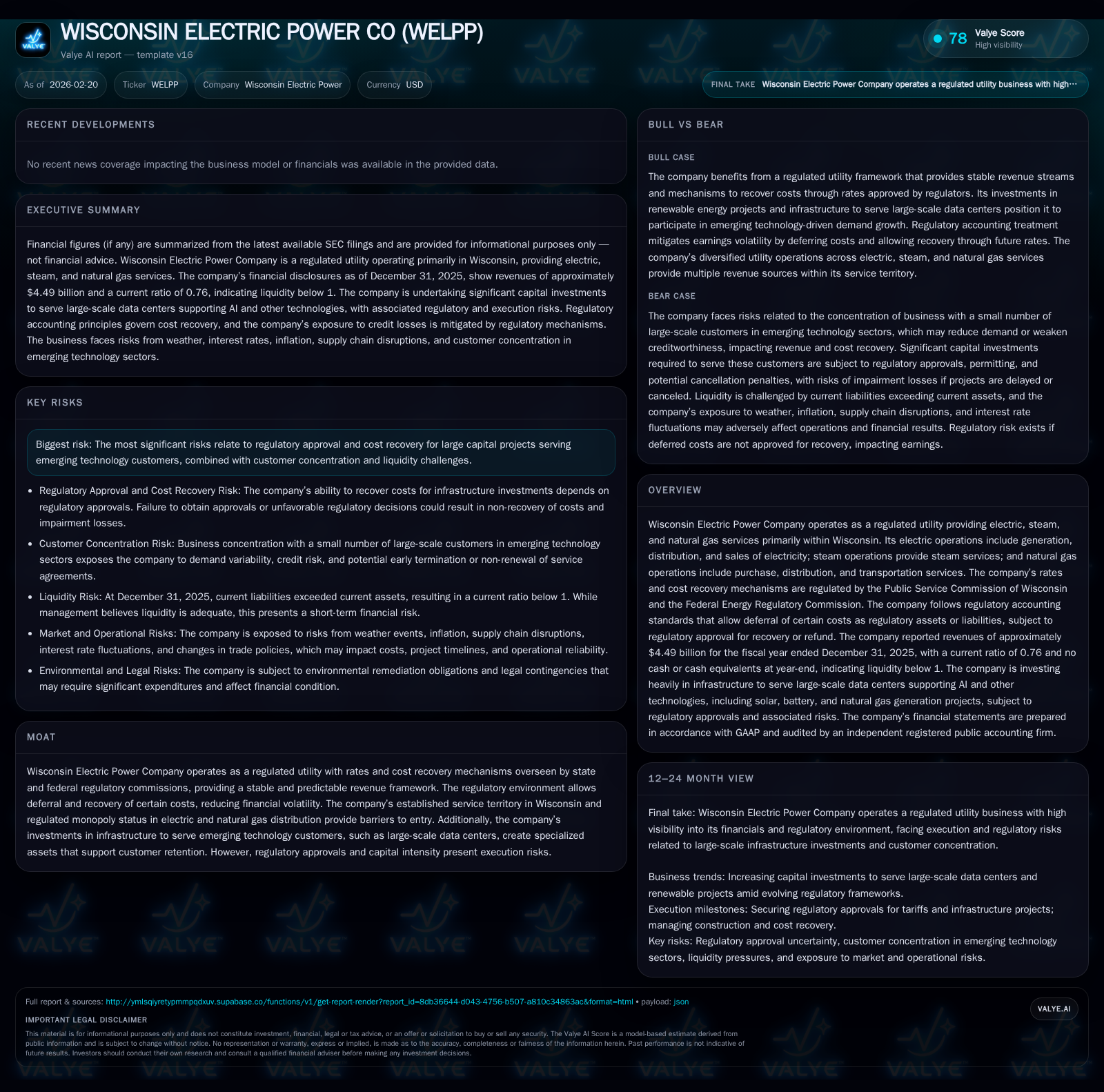
Wisconsin Electric Power Company delivered a strong revenue increase of nearly 13% in fiscal 2025, powered by rising utility margins and expanding sales volumes. This growth aligns with a dramatic 90% jump in capital spending, primarily on infrastructure serving large-scale data centers and renewable projects to meet emerging technology demand. Regulatory approvals for new tariffs and project cost recovery remain pivotal moving forward, while liquidity pressures emerge from elevated capex levels and a sub-1 current ratio. Returns appear moderate by regulated utility standards with an estimated 5.3% ROE, underscoring balanced shareholder returns amidst expansion. Monitoring tariff decisions, project execution, and regulatory asset recoveries will be essential indicators of future growth sustainability.
Robust 2025 Growth Backed by Utility Margin Expansion
Wisconsin Electric Power Company (WELPP) posted substantial top-line growth in its fiscal year ended December 31, 2025, with revenues reaching approximately $4.49 billion—a near 13% increase versus $3.98 billion in 2024 [F1][S1]. This revenue uplift was complemented by operating income climbing over 10% to $1.17 billion from $1.06 billion the prior year [F1][S1]. A key driver was an improvement in utility margin, defined internally as operating revenues net of fuel, purchased power, and natural gas costs—elements generally passed through to ratepayers under regulatory mechanisms.
Utility margin expansion signals effective cost recovery stability while accommodating increased volumes—retail electric sales rose notably across residential (+247,000 MWh), small commercial (+164,000 MWh), and large commercial/industrial classes (+78,000 MWh), totaling roughly a +482,000 MWh increase year-over-year [S1]. Wholesale sales also benefited from favorable market conditions with a +93,000 MWh increment despite some contraction in resale volumes.
Historical performance (annual)
| FY | Rev ($bn) | CFO ($mm) | OpInc ($mm) | Capex ($bn) | Rev YoY |
|---|---|---|---|---|---|
| 2025 | 4.5 | 1128 | 1171 | 2.7 | +12.9% |
| 2024 | 4.0 | 1265 | 1061 | 1.4 | -1.6% |
| 2023 | 4.0 | 939 | 1022 | 1.1 | -0.6% |
| 2022 | 4.1 | 637 | 940 | 0.9 |
Note: Omitted columns lack sufficient annual XBRL coverage in the provided tags (need ≥2 annual points): Net, Div, Buybacks, ROE%. Source: SEC companyfacts cache [F1].
Capital returns and efficiency (annual)
| FY | FCF ($mm) |
|---|---|
| 2025 | -1615 |
| 2024 | -178 |
| 2023 | -155 |
| 2022 | -293 |
Source: SEC companyfacts cache [F1].
Note: Net income annual data unavailable post-2018; operating segment net income tracked separately.
The utility margin measure helps isolate core earnings power by stripping costs largely passed through without mark-up or absorption risk.
Capital Spending Spike: Strategic Infrastructure Investments on Emerging Tech Customers
Capital expenditure escalated sharply in 2025 to $2.74 billion—nearly doubling from $1.44 billion the prior year—to fund a wave of strategic infrastructure investments [F1][S22]. This surge reflects the company's focus on bespoke assets designed specifically for Very Large Customers (VLCs), including hyperscale data centers requiring dedicated solar arrays, battery storage facilities, natural gas power plants, and upgrades to electric distribution networks.
These investments align with agreements filed under proposed VLC and Bespoke Resources tariffs submitted in March and modified October 2025 [S2][S24]. The tariffs are innovative within regulated utility practice to allocate full cost responsibility—covering power plants, distribution facilities, and transmission usage—directly onto these high-demand entities to avoid cross-subsidization of smaller customers.
The approach exemplifies 'capital intensity' inherent in modern utilities adapting to evolving technology sectors where large captive loads demand customized service models supported by segregated rate bases. Early stage upfront engineering and equipment expenditures have been expensed ahead of tariff approval—a tradeoff reflecting confidence but amplifying regulatory risk should approvals be delayed or denied.
Regulatory Approvals Central to Unlocking Future Growth Potential
Regulatory commissions govern WELPP's rates and cost recovery under Public Service Commission of Wisconsin (PSCW) guidance and FERC oversight [S1][S10]. The successful implementation of VLC/Bespoke Resource tariffs is dependent on PSCW approval; failure could trigger non-recovery risks on investments already commissioned or contracted.
The company operates under regulatory accounting (ASC Topic 980), deferring certain costs as regulatory assets pending prudence reviews that evaluate whether incurred costs are justifiable and eligible for rate base inclusion [S1][S10]. Delays or denials can convert deferred assets into impairments hitting earnings directly.
Cancellation penalties tied to bespoke project equipment orders present additional financial exposure if customer load profiles change or projects terminate prematurely despite contractual safeguards requiring reimbursement [S2]. These risks are accentuated by customer concentration within emerging tech sectors subject to fast-changing technology adoption curves.
Forecast Signals: What To Watch in Tariff Decisions and Project Outcomes
Although explicit corporate forecasts or milestone targets remain undisclosed in filings or filings summary, key near-term watchpoints include:
- PSCW decisions over VLC/Bespoke tariffs pending final regulatory hearings following initial filings through late 2025
- Construction progress status on bespoke renewable generation, battery storage installations, and natural gas-fired units supporting rapid load buildout for AI/data center customers
- Timelines for ATC transmission infrastructure upgrades necessary for serving anticipated load growth
- Recognition patterns for regulatory asset amortizations following tariff acceptance impacting cash flow timing
These events collectively shape near-to-mid term earnings trajectory—from capitalized asset additions enhancing depreciation expense burdens to achieved rate base expansions enabling margin accruals.
Capital Allocation, Liquidity Constraints, and Shareholder Returns Analysis
The capital structure presents tension between aggressive capex demands and working capital constraints evidenced by a current ratio of only approximately 0.76 at December 31, 2025—current assets of $1.36 billion versus current liabilities of $1.78 billion—and zero cash & equivalents reported at year-end [F1][S4]. The company relies heavily on commercial paper borrowings (over $680 million outstanding), supported by a revolving credit facility expanded to $800 million maturing in August 2030 [S14][S7].
Equity has expanded markedly through parent contributions totaling over $6.7 billion by end-2025 from $5.5 billion year prior—reflecting internal capital reinforcements maintaining regulatory capital structure compliance [F1][S7]. Additionally, dividends paid appear dormant post-2016 disclosures with no recent buyback activity reported [F1]. This signals prioritization of balance sheet flexibility over direct shareholder returns during this capex-intensive phase.
ROE approximates a modest ~5.3%, derived from historical net income scaled against expanded equity balances—consistent with regulated utility profiles emphasizing stable but restrained profitability given mandated rate structures limiting outsized returns despite growth undertakings [F1].
Free cash flow remains negative (-$1.62 billion), manifesting the deficit between record-high operating cash flow ($1.13 billion) and extraordinary capex outlays ($2.74 billion) [F1], underscoring funding requirements outside of operations alone.
Embedded Risks in Regulatory Environment and Large-Scale Project Execution
Primary risks emanate from the intricate regulatory environment encompassing tariff approvals hinging on prudency assessments that could retroactively disallow asset recovery or impose refunds [S10]. Large customer concentration further heightens credit exposure related to repayment obligations under payment/cancellation agreements tied to bespoke resources [S2][S12].
The company faces potential penalties if projects cancel or fail permitting—environmental remediation liabilities linked to coal plant retirements add complexity though partially offset via securitized environmental charges collected through non-bypassable fees [S21]. Interest rate sensitivity is material due to substantial variable rate short-term debt; a hypothetical +100 basis point shift could add nearly $7 million annual interest expense [S10].
Such execution risks balance scalability prospects against financial prudence mandates typical for utilities bearing infrastructural investments tied closely to fluctuating technological adoption cycles.
Segment Overview: The Dynamics of Electricity, Steam, and Natural Gas Operations
WELPP operates solely within Wisconsin across two primary segments—utility operations incorporating electric generation/distribution plus steam services concentrated predominantly in metro Milwaukee areas—and natural gas purchasing/distribution/transportation extending state-wide within regulated monopolies enforced by state/federal commissions [S3][S25].
Electric utility revenues constitute the bulk (~$3.92 billion in FY25), joined by natural gas utilities accounting for roughly $557 million reflecting rising demand against volumes growing across residential and commercial sectors alike given climatic variability [F1][S3]. Steam services serve niche industrial clients locally alongside electric offerings.
Regulatory rate-setting influences cost pass-through structures distinctly across these segments; electric margins benefit from fixed transmission charges managed via escrow accounting mechanisms addressing actual versus projected transmission expenses subject to future true-ups [S1].
Weather Sensitivity and Operational Cost Management in Utility Performance
Seasonal weather fluctuations materially impact energy consumption patterns—with above-normal summer temperatures depressing electric margin through elevated cooling demand metered intricacies while warmer winters reduce natural gas consumption negatively affecting utility margins strapped predominantly on volumetric rates [S1][S10]. Degree-day normalization practices help isolate weather-induced volatility internally.
Storm events impose restoration costs built into fixed-rate components; however, variability beyond budgeted levels threatens margin compression due to unanticipated outages causing both incremental repair costs and lost revenue periods until restored fully [S10]. Proactive rate design allocations for storm restoration indicate managerial cost containment awareness though residual exposure remains an operational challenge within regulated bounds.
Disclaimer: This report utilizes only publicly available information contained within SEC filings referenced herein and does not constitute investment advice or recommendations regarding Wisconsin Electric Power Company securities or securities of any other entity.
Disclaimer: This is research-only, informational analysis and not investment advice. It may include AI-generated interpretation and general industry context. Always verify important details using primary sources.

Comments