
Liberty Latin America’s Operating Income Recovery Constrained by Net Losses and Capital Costs
The company’s return to operating profitability in 2025 contrasts with persistent net losses amid hurricane disruptions and heavy capital expenditures.
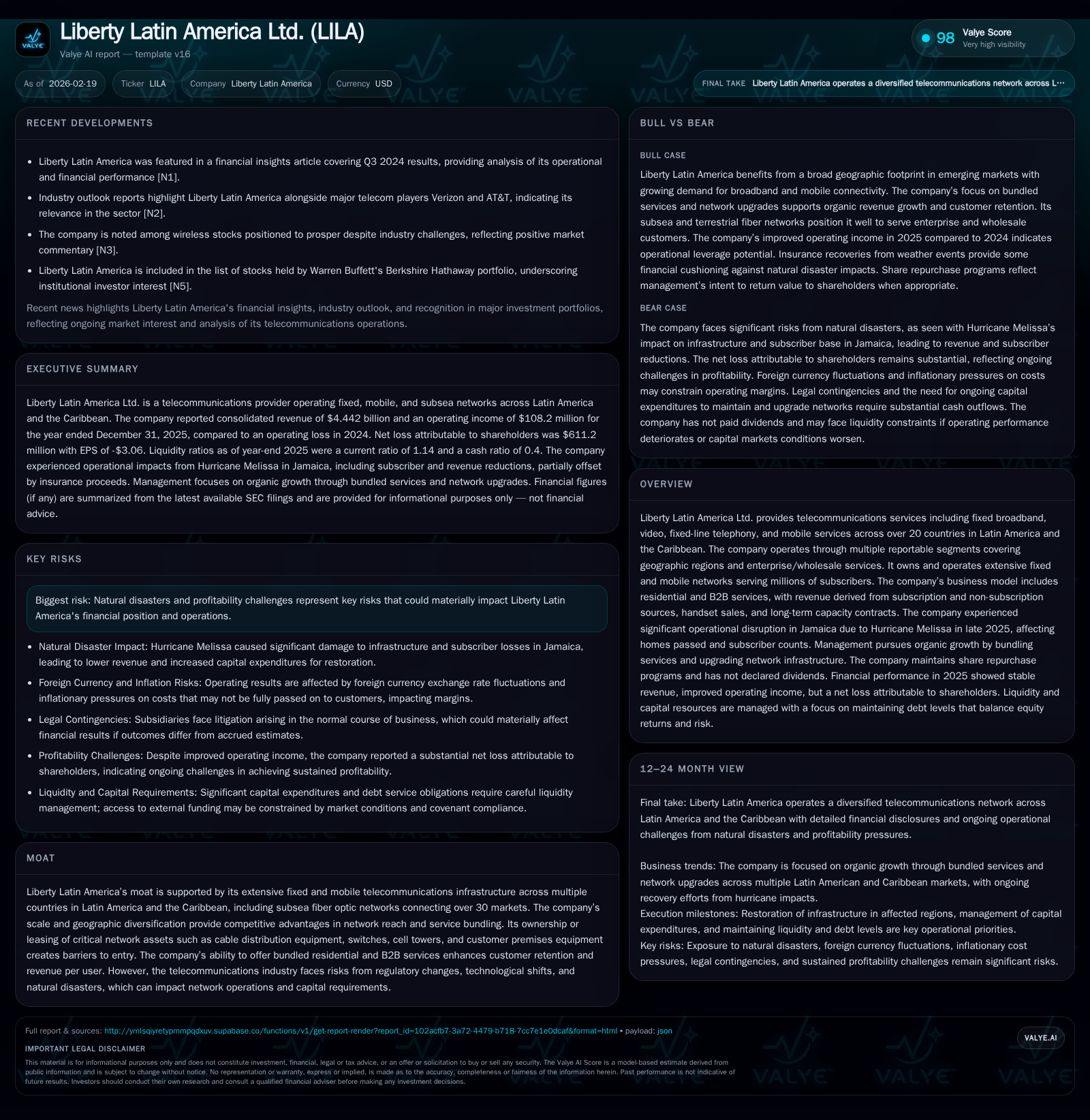
Liberty Latin America Ltd. (LILA) returned to a positive operating income of $108 million in 2025 after losing $48 million in 2024, driven by cost reductions offsetting slight revenue declines. However, net losses improved marginally to $611 million but remain substantial due to high depreciation, impairment charges, and financing costs. The firm faces headwinds from natural disasters, notably Hurricane Melissa’s disruption in Jamaica, while investing heavily in network upgrades and bundling strategies to drive organic growth. Capital allocation shows no dividends or significant buybacks in 2025, reflecting ongoing financial conservatism amid liquidity management and debt maturities.
Historical Performance Overview
Liberty Latin America Ltd. operates telecommunications services across more than 20 countries spanning Latin America and the Caribbean. The company derives revenues mainly through subscription services including fixed broadband, video, mobile telephony as well as handset sales and long-term capacity contracts targeting residential consumers and B2B clients.
The firm’s recent financial trajectory reveals considerable volatility worsened by external shocks yet shows resilience on an operational level. Notably, LILA reported operating income of negative $48 million in fiscal year (FY) 2024 which swung positively to $108 million in FY2025 — a striking improvement driven largely by expense reductions paired with stable revenues despite foreign exchange headwinds [F1][S1].
Despite this operational turnaround, net income remained deeply negative at -$611 million for FY2025, only a mild improvement relative to the previous year’s -$657 million loss. This outcome reflects ongoing non-cash charges including heavy depreciation & amortization expenses ($905 million in 2025) along with impairments related primarily to spectrum assets and operational restructuring [F1][S1][S24].
The table below summarizes Liberty Latin America's key financial markers for the last four years:
Historical performance (annual)
| FY | Net ($mm) | CFO ($mm) | OpInc ($mm) | Net YoY |
|---|---|---|---|---|
| 2025 | -611 | 806 | 108 | +7.0% |
| 2024 | -657 | 756 | -48 | -792.7% |
| 2023 | -74 | 897 | 518 | +58.1% |
| 2022 | -176 | 869 | 94 |
Note: Omitted columns lack sufficient annual XBRL coverage in the provided tags (need ≥2 annual points): Rev, Capex, Div, FCF. Source: SEC companyfacts cache [F1].
Capital returns and efficiency (annual)
| FY | Buybacks ($mm) | ROE% |
|---|---|---|
| 2025 | 0 | -110.0 |
| 2024 | 83 | -58.6 |
| 2023 | 118 | -4.2 |
| 2022 | 170 | -9.2 |
Source: SEC companyfacts cache [F1].
¹ Full capex data not available for years prior to latest disclosures; FY22 capex was ~$816 million
_Note: "Equi" stands for shareholders' equity.
Drivers Behind the Historical Trends
The positive swing in operating income for FY25 was predominantly due to concerted cost management efforts focusing on programming costs, other direct service expenses, and organizational efficiencies which offset minor organic revenue pressure compounded by FX headwinds across their multi-currency footprint [S1]. However, these gains were eroded downstream by substantial depreciation/amortization linked to the capital-intensive nature of telecommunications infrastructure assets (~$905M) as well as significant impairment charges ($618M) primarily tied to spectrum rights impacted by operational challenges.
Operational disruption was heightened during late 2025 when Hurricane Melissa directly affected Liberty's Jamaican operations causing a reduction in homes passed by their networks and subscriber churn—an illustration of the region's vulnerability to natural disasters which can sharply unsettle subscriber metrics and local revenues [N1].
Despite intense capital expenditure commitments aimed at modernization — including optical fiber deployments and mobile LTE/5G upgrades supporting bundled residential/b2b service propositions — overall physical asset increase slowed moderately (-~4.6% capex versus prior year), perhaps indicating phase completion or shift toward efficiency improvements rather than expansion alone [F1][S18].
Future Growth Prospects: Catalysts and Constraints
Liberty Latin America's future growth depends on several factors:
- Network Modernization & Bundling: Organic growth opportunities revolve around upgrading fixed broadband infrastructure towards more fiber-rich deployments coupled with advanced mobile technologies enabling higher bandwidth plans bundled with video streaming services designed to enhance customer retention levels and incremental ARPU .[S1]
- Regional Diversification: Geographic spread across diverse Caribbean countries diffuses some geopolitical/regulatory risks but also brings complexity related to FX exposure and localized regulatory regimes which occasionally impose adverse cost or pricing controls .[S9]
- Natural Disaster Risk: As demonstrated by Hurricane Melissa's impact on Jamaica operations, weather events can cause material temporary revenue deterioration or physical asset damage requiring costly repairs or capital reinvestment thereby constraining earnings stability .[N1]
- Competitive Pressures: While LILA enjoys scale benefits via extensive subsea fiber optic cables linking markets across Latin America & Caribbean islands facilitating bundled offerings against smaller competitors, price competition — especially on voice/mobile — persists requiring continuous innovation investment .[N2]
- Technology Evolution: The migration from legacy copper/fixed line networks toward pervasive fiber deployment involves material capex demands alongside advanced convergence services development that require sustained investment but underpin longer term relevance .[N3]
Forecasts & Milestones to Watch
The company does not provide explicit forward guidance within available regulatory filings or press releases but key variables pertinent for monitoring include:
- Progression of network passings restored/increased post-natural disaster downtime particularly in Jamaica.
- Metrics around subscriber additions/churn following bundling service introductions.
- Quarterly adjusted OIBDA trends tracking operating leverage gains.
- Capital expenditure pacing alongside property & equipment additions signaling expansion vs maintenance capex balance.
- Debt maturity refinancing or deleveraging actions amid current $8+ billion debt load weighted at approximately ~7% interest rates.
- Fluctuations in foreign exchange trends impacting translated earnings since many costs/revenues are non-dollar denominated.
These are areas where Liberty Latin America’s investor communications or SEC filings over the coming quarters may offer clearer directional insights .
Capital Allocation & Returns Analysis
Liberty Latin America has not paid cash dividends during recent years reflecting conservative cash retention given industry capital intensity coupled with volatile earnings patterns characteristic of multi-country telecom operators facing regulatory/risk complexity [F1][S8]. Share repurchases ceased completely in FY25 after moderate activity ($83M) during FY24 indicating a preference for balance sheet preservation.
Operating cash flow generation remains robust ($806M FY25), slightly ahead of the prior year (+6%), underpinning a sound liquidity profile despite negative net income results mostly impacted by accounting non-cash charges rather than cash burn per se [F1].
Capital expenditures decreased modestly year over year but still represent a significant portion (~14%) of revenue (although revenue not explicitly stated by the company) signifying continued investment into network infrastructure modernization critical for customer retention/growth initiatives [F1][S18].
Equity base contracted significantly from over $1.12 billion in FY24 down to roughly $556 million at FY25 end due partly to cumulative net losses eroding shareholder equity amidst absence of earnings recovery thus implying a negative approximate ROE exceeding -100% [F1]. This highlights underlying profitability pressures despite operating income improvements.
Total debt outstanding slightly increased to over $8.3 billion carrying average interest rates near ~7%, emphasizing attention required on refinancing risks over medium term maturities situated mostly beyond FY27 but concentrated within borrowing groups such as Cable & Wireless (C&W) subsidiaries as well as Liberty Puerto Rico/Costa Rica units each with specific credit facilities secured against network assets including towers and spectrum rights [F1].
Cash balances totaling nearly $784 million provide sufficient near-term liquidity cushion supported by covenant-compliant borrowing groups though constrained access exists due to legal restrictions plus potential noncontrolling interests limiting upstream dividends or intercompany loans especially amidst volatile regional currency exchange environments [F1][S15][S9].
Industry Context & Competitive Positioning
In the broader telecommunications sector serving emerging markets like those covered by Liberty Latin America, maintaining an extensive asset base encompassing fixed plant distribution equipment, switch capacity, cell site towers, customer premises equipment plus a dense subsea fiber optic footprint is essential for securing durable network effects enhancing customer lock-in via bundled service offerings integrating broadband-to-mobile playback capability across fixed IPTV/video platforms and business services lines.
Increasing penetration of fiber-to-the-home (FTTH) has become an industry priority where legacy copper or coaxial plant replacement is often mandated by consumer demand shifts towards higher symmetrical speeds needed for cloud applications or streaming media consumption—a pattern Liberty actively pursues amidst local market dynamics that vary widely between island states versus mainland territories exposing it simultaneously to FX volatility inflationary pressures documented in its filings.
Moreover, share repurchase programs commonly supplement dividend absence among telecom operators aiming to stabilize share price while conserving cash internally during reinvestment cycles—a practice visible partially here though paused given financial prudence needs.
Conclusion
Liberty Latin America Ltd.’s recent financial profile illustrates significant operational strides manifested by shifting back into positive operating income territory after loss-making preceding years overshadowed by extraordinary impairments and environmental challenges such as hurricanes disrupting critical markets like Jamaica.
Though this profit turnaround bodes well for core segment performance fueled through strategic bundling initiatives alongside network modernization efforts crucial for competing effectively within diversified LATAM/Caribbean regions along high-capacity subsea infrastructure corridors—a constellation providing defensible competitive advantage—persistent net losses hamper equity returns creating structural capital allocation constraints highlighted by absence of dividends coupled with suspended share buybacks.
Debt service obligations remain strenuous but manageable with compliance intact accompanied by prudent liquidity management amid complex foreign currency exposures underpinning operating risks deriving partly from regional socio-economic variability intertwined with global inflationary cost pressures affecting margins.
Investors should monitor upcoming quarterly releases highlighting progress on subscriber metrics post-natural calamities; capex delivery trends; adjusted OIBDA margins; refinancing activity concerning multi-billion-dollar maturities; plus evolving regulatory landscapes influencing competitive positioning critical within this fast-evolving telecommunications market.
This analysis is based solely on publicly available financial filings dated through February 19, 2026, news sources cited herein, and Valye News proprietary insights without incorporating non-public information or providing investment advice.
Disclaimer: This is research-only, informational analysis and not investment advice. It may include AI-generated interpretation and general industry context. Always verify important details using primary sources.

Comments