
Tyler Technologies Accelerates SaaS Growth While Balancing Increased R&D and Share Repurchases
The public sector IT specialist reported robust revenue gains in 2025, driven by SaaS adoption amid rising research investments and active capital return.
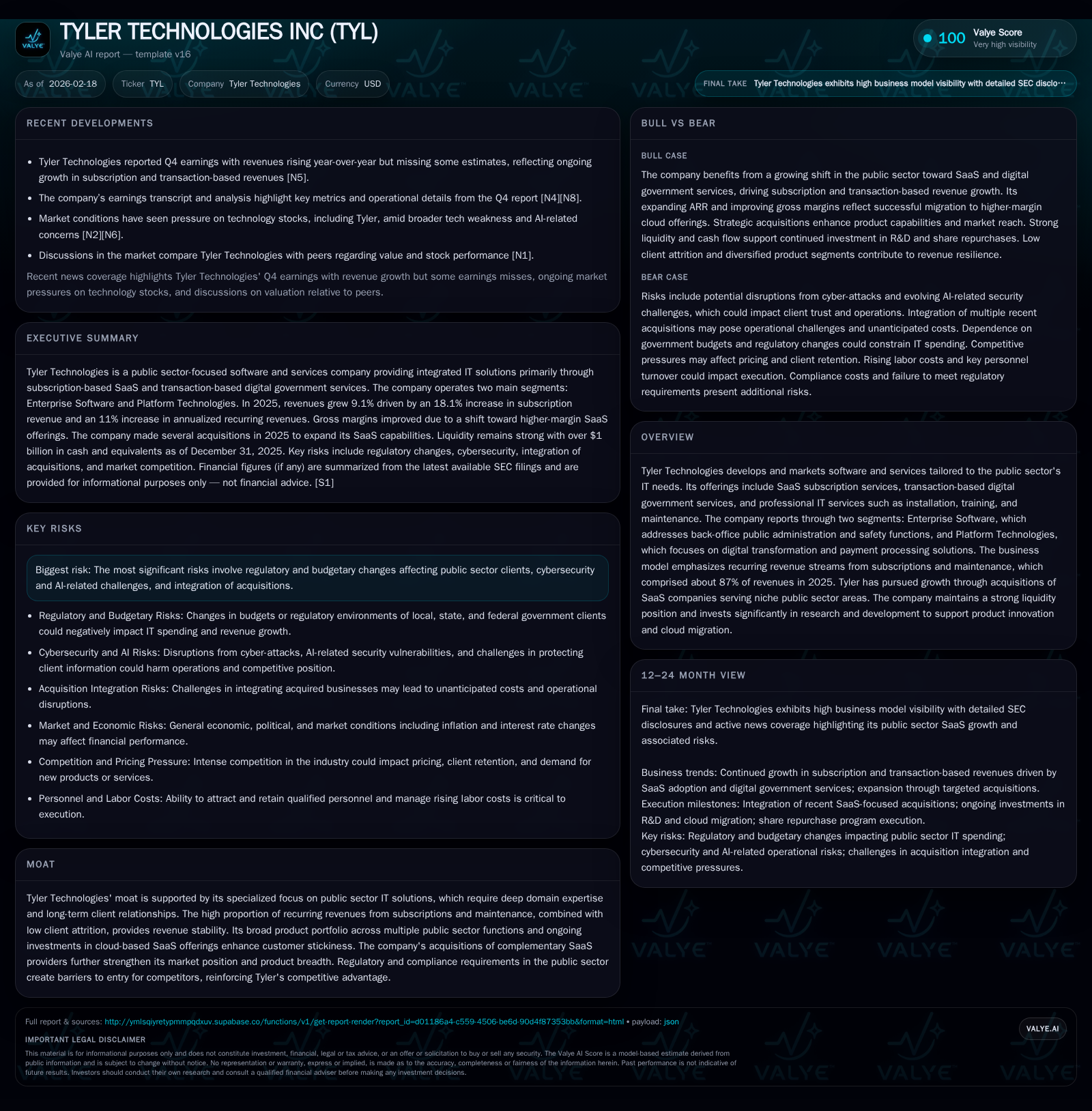
Tyler Technologies (TYL) ended 2025 with strong top-line growth of over 15%, led primarily by an 18% increase in subscription revenues fueled by the ongoing shift from on-premises to SaaS offerings. Operating income and net income also advanced meaningfully, benefiting from higher-margin revenue streams and operational efficiencies. The company invested heavily in research and development to support product innovation, particularly around cloud migration and AI capabilities, which led to a significant increase in R&D expense as a percentage of sales. Capital allocation highlights include aggressive share repurchases amounting to nearly $175 million in 2025 and maintaining a solid liquidity position exceeding $1 billion in cash and equivalents. While forward growth is anchored in the continued migration toward SaaS contracts, risks persist from governmental budget cycles, cybersecurity challenges, and integration costs of recent acquisitions. Return metrics such as ROE and dividend payments are not available from provided tags.
Company Overview
Tyler Technologies Inc (ticker: TYL) is a leading provider of specialized integrated software solutions tailored specifically for public sector clients across the United States. The company addresses mission-critical IT needs for government entities around back-office functions such as administration, courts, public safety, education, property appraisal, and records management through its Enterprise Software (ES) segment. Additionally, its Platform Technologies (PT) segment focuses on transformative digital solutions including payment processing and workflow enhancements.
Tyler’s growth strategy centers heavily on recurring revenue contracts predominantly sourced from SaaS subscription fees and maintenance services, which accounted for approximately 87% of total revenues in fiscal year 2025 [N1][S1]. The company has augmented this organic approach with selective acquisitions of niche SaaS providers specialized in various segments of the public sector.
Historical Performance and Revenue Drivers
Financial performance over recent years demonstrates consistent double-digit growth supported by secular trends toward digital government services.
Historical performance (annual)
| FY | Net ($mm) | CFO ($mm) | OpInc ($mm) | Capex ($mm) | Net YoY |
|---|---|---|---|---|---|
| 2025 | 316 | 654 | 358 | 16 | +20.0% |
| 2024 | 263 | 625 | 300 | 21 | +58.5% |
| 2023 | 166 | 380 | 219 | 21 | +1.0% |
| 2022 | 164 | 381 | 214 | 23 |
Note: Omitted columns lack sufficient annual XBRL coverage in the provided tags (need ≥2 annual points): Rev, Div. Source: SEC companyfacts cache [F1].
Capital returns and efficiency (annual)
| FY | Buybacks ($mm) | FCF ($mm) | ROE% |
|---|---|---|---|
| 2025 | 175 | 638 | 8.5 |
| 2024 | 604 | 7.8 | |
| 2023 | 0 | 360 | 5.6 |
| 2022 | 0 | 359 | 6.3 |
Source: SEC companyfacts cache [F1].
Note: Buybacks data incomplete prior to FY2024; Dividends paid not available in provided tags [F1].
The primary driver behind revenue growth was an approximate +18% increase in subscriptions revenue driven by new client wins plus conversion of existing on-premises clients to SaaS models [S20]. Tyler added over six hundred new SaaS clients while converting nearly five hundred legacy clients during the year [S20]. This transition pushed subscription revenues to about two-thirds of total revenues by FY25-end.
Traditional software licenses declined markedly (-51%) due to continued migration away from perpetual licenses towards cloud-based subscription models [S27]. Professional services decreased modestly (-8%), reflecting fewer custom developments but remaining essential for onboarding.
Gross margin expanded by approximately +2.7 percentage points to around 46.5% for FY25 compared to prior year, largely driven by the revenue mix shift towards higher-margin SaaS offerings along with operational efficiencies [S4]. Cost pressures arose from increased hosting expenses and merchant fees but were offset by margin benefits from subscription growth.
Segment Performance
Enterprise Software (ES) segment showed strong operating income growth (+21%) mainly due to subscription revenue expansion from new contracts and renewals [S23]. Platform Technologies (PT) segment experienced a slight decline (-9%) impacted by loss reserves on specific state contracts and higher merchant fees affecting margins [S23]. However, PT continued moderate subscription revenue growth.
Investment in Innovation: R&D Trends
Research & Development expense surged +73% year-over-year reaching approximately $204.6 million or about 8.8% of revenues in FY25 vs $117.9 million (5.5%) previously [S13]. This increase reflects intensified investments into cloud migration initiatives across product lines as well as embedding artificial intelligence capabilities.
Headcount in engineering/product management grew significantly from roughly 870 employees at end-2024 to about 1,368 at end-2025 [S13], highlighting scaling efforts to drive competitive differentiation through innovation.
Capital Allocation: Cash Flow & Share Repurchases
Operating cash flow was robust at approximately $653.5 million for FY25 representing a healthy increase over prior periods [F1][S14]. Capital expenditures decreased year-over-year to about $16 million [F1], resulting in free cash flow estimated near $637.5 million.
Share repurchase activity was significant with nearly $175 million deployed during FY25 under an active buyback program authorized by the Board [F1][S5]. As of February 18, 2026, roughly $885 million remains authorized for repurchase under this program [S5]. No dividends were declared or paid per available disclosures [F1].
Acquisition Strategy & Integration Outlook
During calendar year 2025 Tyler completed several bolt-on acquisitions targeting SaaS providers serving education (Edu.Link), emergency medical services (Emergency Networking), judiciary warrant systems (CloudGavel), and community development platforms (MyGov) segments within the Enterprise Software vertical [S19]. These acquisitions enhance market coverage while accelerating digital transformation capabilities.
A pending acquisition with a cash purchase price near $212.5 million was signed early February 2026 with expected closing in Q1-26 subject to regulatory approvals [S5], consistent with Tyler’s strategy of focused niche expansion.
Integration execution remains critical given domain-specific portfolio complexity; realization of synergies will be key for sustaining margin improvements beyond organic growth [S10][S26].
Financial Position & Liquidity
As of December 31, 2025 Tyler held cash and cash equivalents exceeding $1 billion alongside investment-grade securities totaling approximately $142 million [S14]. Total shareholders’ equity stood near $3.7 billion with outstanding debt around $600 million comprising convertible notes due in mid-2026 [F1][S6]. The company maintains an undrawn revolving credit facility with borrowing capacity up to $700 million providing additional financial flexibility [S16].
Industry Context & Risks
Public sector IT spending is heavily influenced by government budgets across local to federal levels creating demand variability for vendors like Tyler; however, high switching costs tied to mission-critical applications combined with regulatory compliance requirements support customer retention.
Increasing use of AI introduces both opportunities for enhanced product capabilities and risks related to cybersecurity vulnerabilities plus evolving regulatory scrutiny impacting development timelines and compliance costs [S10][N1].
Execution risks stem from integrating acquisitions effectively while managing labor cost inflation amid competitive talent markets [S10].
What To Watch Forward
- Continued double-digit growth trajectory in subscription Annual Recurring Revenue (ARR).
- Margin improvement aligned with further SaaS penetration.
- Integration success metrics reflecting contribution margins from recent acquisitions.
- Balance between M&A activity versus share repurchase cadence.
- Government budget impacts on contract renewals or new procurement timing.
- Regulatory developments affecting AI-related product compliance.
Conclusion
Tyler Technologies remains well-positioned as a public sector software leader benefiting from secular shifts toward SaaS coupled with substantial reinvestment into cloud delivery and AI innovation capabilities. Strong top-line momentum paired with improving profitability metrics is complemented by prudent capital deployment through share repurchases and ample liquidity reserves supporting strategic initiatives. Challenges persist around integration complexity plus evolving regulatory landscapes typical for government-focused technology providers.
Disclaimer: This report is for informational purposes only and does not constitute investment advice or an offer to buy or sell securities.
Disclaimer: This is research-only, informational analysis and not investment advice. It may include AI-generated interpretation and general industry context. Always verify important details using primary sources.

Comments