
Macerich’s Strategic Portfolio Optimization Shapes 2025 Performance and Forward Outlook
Macerich advanced its portfolio management and leasing efforts in 2025, driving revenue growth while grappling with profitability and debt challenges.
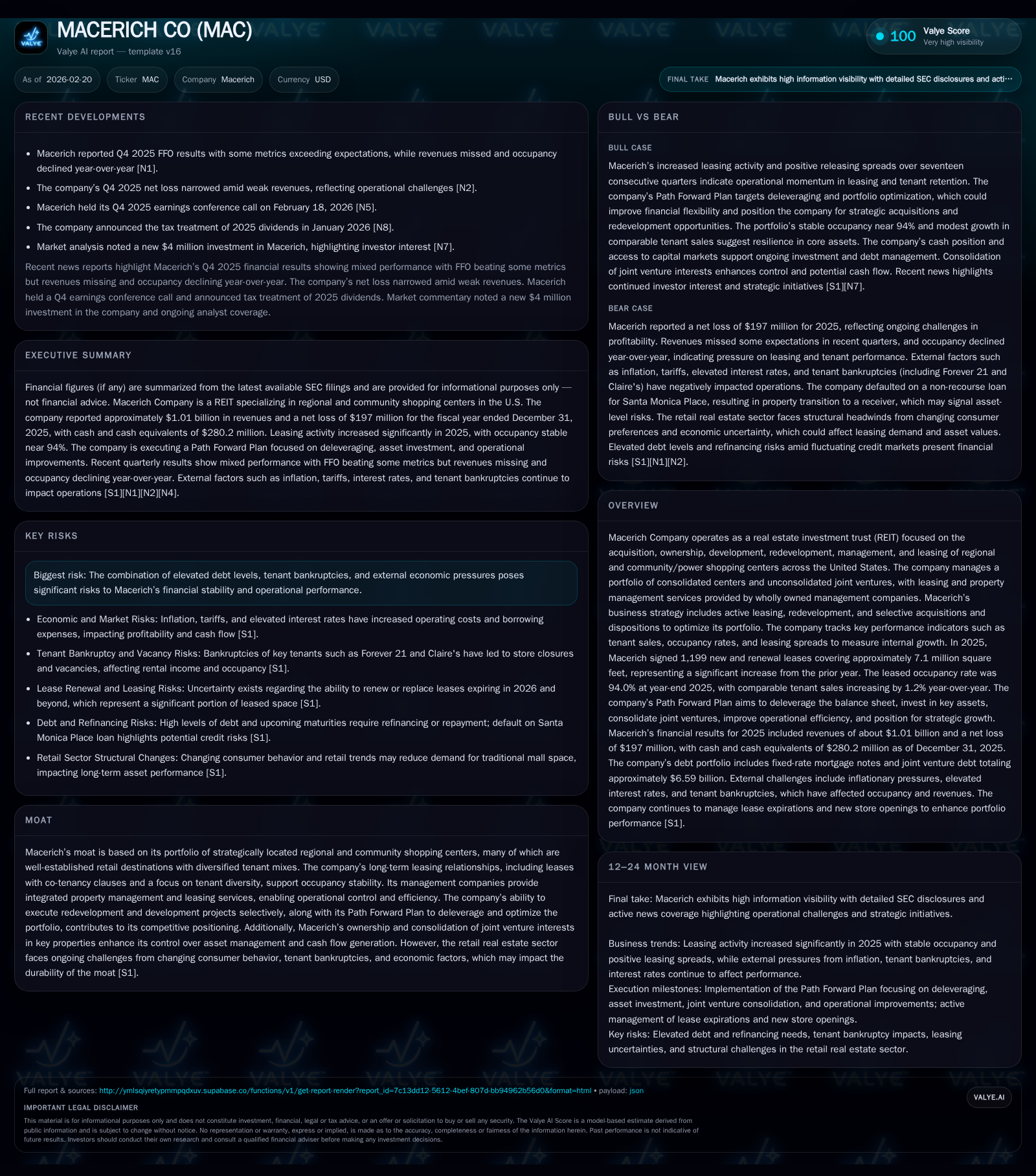
The Macerich Company emerged from 2025 with robust leasing activity, achieving a notable increase in revenue driven by selective acquisitions and redevelopment initiatives. Despite these operational successes, the company posted a net loss, reflecting ongoing financial pressures including elevated debt servicing costs and legacy loan defaults. Its capital strategy prioritizes deleveraging through asset optimization and cautious capital allocation, particularly in dividends. Going forward, Macerich’s prospects hinge on managing refinancing risks, sustaining occupancy levels amid retail sector headwinds, and effectively deploying its Path Forward Plan to stabilize returns.
Navigating Macerich’s Historical Growth Drivers: Leasing and Redevelopment Impact
Macerich’s operational fabric through 2025 demonstrated resilience marked by an active leasing landscape and targeted redevelopment schemes. The company signed approximately 1,199 new leases and renewals covering about 7.1 million square feet, reflecting a strong leasing velocity that significantly exceeded the prior year's figures [N4]. This surge underpinned a reported revenue of roughly $1.01 billion for fiscal year 2025, representing a year-over-year increase of about 10.4% from $918 million in 2024 [F1]. Such gains were undergirded by lease-up success at core properties alongside contributions from acquired centers like Crabtree Mall.
Redevelopment efforts continued to play an influential role in portfolio optimization; expenditures for development, redevelopment, expansion, and renovation stood at approximately $100 million for consolidated centers alone [S25]. This capital deployment towards enhancing tenant mix and center amenities aimed at sustaining competitive positioning within regional shopping hubs. Notably, the company’s internal growth metrics — occupancy rate held steady near 94.0% year-end with stable or positive leasing spreads — indicated effective rent-roll management despite a challenging brick-and-mortar retail environment riddled with seismic shifts toward e-commerce [S1][N4]. Leasing spreads benefited from contractual provisions such as rental step-ups aligned with market resets upon lease renewals.
Unlocking Future Growth: Selective Acquisitions, Redevelopments, and Tenant Mix Strategies
Forward-looking growth hinges on the strategic execution of Macerich’s Path Forward Plan which targets deleveraging while optimizing asset quality through curated acquisitions and selective dispositions [S13]. Key acquisitions included consolidating ownership of Freehold Raceway Mall followed by acquisition of Crabtree Mall in mid-2025 for $290 million (excluding closing adjustments) enhancing footprint in attractive markets [S15]. Concurrently, disposition activity aligned with exit from non-core assets such as Lakewood Center underscored portfolio focus refinement.
The tenant mix remains a vital lever; Macerich emphasizes diversity across retail categories to reduce vulnerability associated with co-tenancy clauses prevalent in leases—clauses that enable renters to react contractually to anchor tenant bankruptcies or vacancy [S1]. Management continues engaging tenants proactively to sustain occupancy rates amidst sector volatility. Redevelopment projects further bolster this strategy by reinventing spaces to attract experiential retail or mixed-use tenants that can command premium rents over traditional box retailers.
Key 2025 Financial Metrics: Revenue Gains Against Ongoing Profitability Hurdles
While revenue ascendancy is evident with $1.01 billion top-line reported in FY25 (~10.4% YoY growth), Macerich still confronted net losses totaling approximately $197 million — a slight deterioration from a $194 million loss the prior year [F1]. This persistent bottom-line drag illustrates structural earnings pressure despite operational improvements.
Operating cash flow showed commendable strength at $322 million for FY25 (up ~13.5% YoY), providing critical liquidity buffers crucial for debt servicing and capital reinvestment [F1]. This divergence between positive CFO trends versus net income losses stems partly from depreciation non-cash charges typical in REIT accounting as well as elevated interest expense borne out of considerable leverage.
Historical performance (annual)
| FY | Rev ($mm) | Net ($mm) | CFO ($mm) | Rev YoY | Net YoY |
|---|---|---|---|---|---|
| 2025 | 1014 | -197 | 322 | +10.4% | -1.6% |
| 2024 | 918 | -194 | 283 | +3.9% | +29.2% |
| 2023 | 884 | -274 | 296 | +2.9% | -314.8% |
| 2022 | 859 | -66 | 338 |
Note: Omitted columns lack sufficient annual XBRL coverage in the provided tags (need ≥2 annual points): OpInc, Capex, Buybacks, FCF. Source: SEC companyfacts cache [F1].
Capital returns and efficiency (annual)
| FY | Div ($mm) | ROE% |
|---|---|---|
| 2025 | 188 | -8.1 |
| 2024 | 161 | -7.0 |
| 2023 | 159 | -11.2 |
| 2022 | 186 | -2.3 |
Source: SEC companyfacts cache [F1].
Note: Operating income and ROE metrics are unavailable due to data constraints.
Capital Structure and Debt Profile: Managing Near-Term Maturities and Leverage
As of December 31, 2025, Macerich's total pro rata share of debt was approximately $6.59 billion—a sum that includes consolidated mortgage notes payable ($5.07 billion) plus its share of unconsolidated joint venture debt ($1.55 billion) [S5][S6]. The revolving credit facility provides $650 million in liquidity maturing February 1, 2027 with an extension option; no amounts were outstanding under this line at year-end [S4]. However, heavy concentrations of near-term maturities loom large: approximately $1.15 billion comes due in calendar year 2026 alone [S8].
The company has proactively refinanced or restructured eleven loans since early-2024 totaling about $2.1 billion (pro rata ~$1.9 billion), yet some material exposures remain unresolved including a defaulted mortgage loan on Twenty Ninth Street since February 6, 2026 undergoing lender negotiations [S6]. Similarly troublesome was the non-recourse loan default on Santa Monica Place transitioned to receiver control starting April 2024 [S13]. Floating-rate debt amounted to roughly $471 million exposing Macerich to interest rate volatility with hedges such as interest rate caps purchased to mitigate upward spikes beyond strike rates of around ~5% [S19][S26]. The weighted average interest rates on fixed-rate debt hovered around mid-4–5% levels while floating rate averaged ~5.62%, reflecting elevated borrowing costs amid recent rate hikes.
Dividend Policy and Capital Allocation: Balancing Shareholder Returns with Operational Needs
Despite navigating profitability headwinds and refinancing complexities, Macerich increased dividends paid to approximately $188 million for FY25 up from $161 million in FY24 — affirming sustained commitment to shareholder distributions supported by operating cash flows [F1][S14]. No share repurchases have occurred since FY2017 following suspensions tied to liquidity preservation strategies aligned with the Path Forward Plan [F1][S22].
Capital expenditures stood over $460 million combined for consolidated properties’ acquisitions ($290 million including Crabtree Mall), property improvements ($34 million), development/redevelopment ($100 million), tenant allowances ($31 million), and leasing costs [$105 million across both consolidated/joint ventures] emphasizing reinvestment over buybacks [S15]. The dividend tax treatment update announced early-2026 could bear influence on shareholder returns dynamics going forward [N9].
Red Flags and Risks: Debt Concentration, Tenant Bankruptcies, and Economic Headwinds
Risks accentuated by Macerich’s disclosures spotlight elevated leverage coupled with covenant exceptions—specifically at Santa Monica Place—introducing refinancing uncertainty that could trigger asset turnover or financial strain [S13][S4]. The operating partnership's dependence on stable rental income exposes it to potential vacant anchor spaces due to tenant bankruptcies; these events activate co-tenancy clauses allowing tenants rent abatements or terminations further eroding cash flows [S1]. Macerich noted that although bankruptcy rates remain below decade averages they continue monitoring macroeconomic factors including tariffs impacting certain tenants.
Cost pressures from inflation during FY25 manifested as heightened maintenance utilities spending and snow removal costs that rose substantially despite efforts to pass expenses onto tenants via fixed share obligations within leases; yet overall inflation impact remained negative on net property operating results [S25][S1]. These dual pressures restrain gains from leasing spreads needing close watch given current retail rent environment.
What to Watch Going Forward: Market Indicators, Occupancy Trends, and Financing Developments
Forward visibility centers largely on several key performance indicators post-2025 financial release:
- Occupancy Dynamics: A decline noted in Q4/25 occupancy highlights vulnerability requiring close follow-up amid cyclical leasing pressure seen in industry peers [N4][N3]. Rising vacancy especially linked to non-core destinations may pressure NOI.
- Lease Renewal Performance: Maintaining or improving leasing spreads will be critical to offsetting inflationary costs; watch disclosures about tenant retention especially large anchors contributing substantially to revenues (~10%) [S18].
- Refinancing Execution: Ability to resolve looming maturities outside revolving facility capacity without dilutive equity issuance will define financial stability—progress on loans presently in default negotiations like Twenty Ninth Street stands out as a bellwether [S6][N4].
- FFO Trends vs Estimates: With FFO beating some estimates yet dropping compared YoY quarters recently suggests scrutiny needed around operational earnings quality beyond accounting adjustments [N6][N4].
- Path Forward Plan Updates: Any articulations regarding targeted leverage ratios reduction trajectory or pipeline dispositions/acquisitions could signal shifts in balance sheet risk profile.
Continuous engagement with management commentary during earnings calls along with quarterly filings is advised for timely insights into these evolving factors [N2][N1].
Disclaimer: This analysis is for informational purposes only based on publicly available data as of early-2026. It does not constitute investment advice or recommendations regarding the securities discussed herein.
Disclaimer: This is research-only, informational analysis and not investment advice. It may include AI-generated interpretation and general industry context. Always verify important details using primary sources.

Comments