
Enova International’s Growth Fueled by Machine Learning and Expanding Credit Access Amid Regulatory and Funding Complexities
Enova has leveraged proprietary AI underwriting and scalable platforms to drive strong revenue and income growth while managing industry-specific risks.
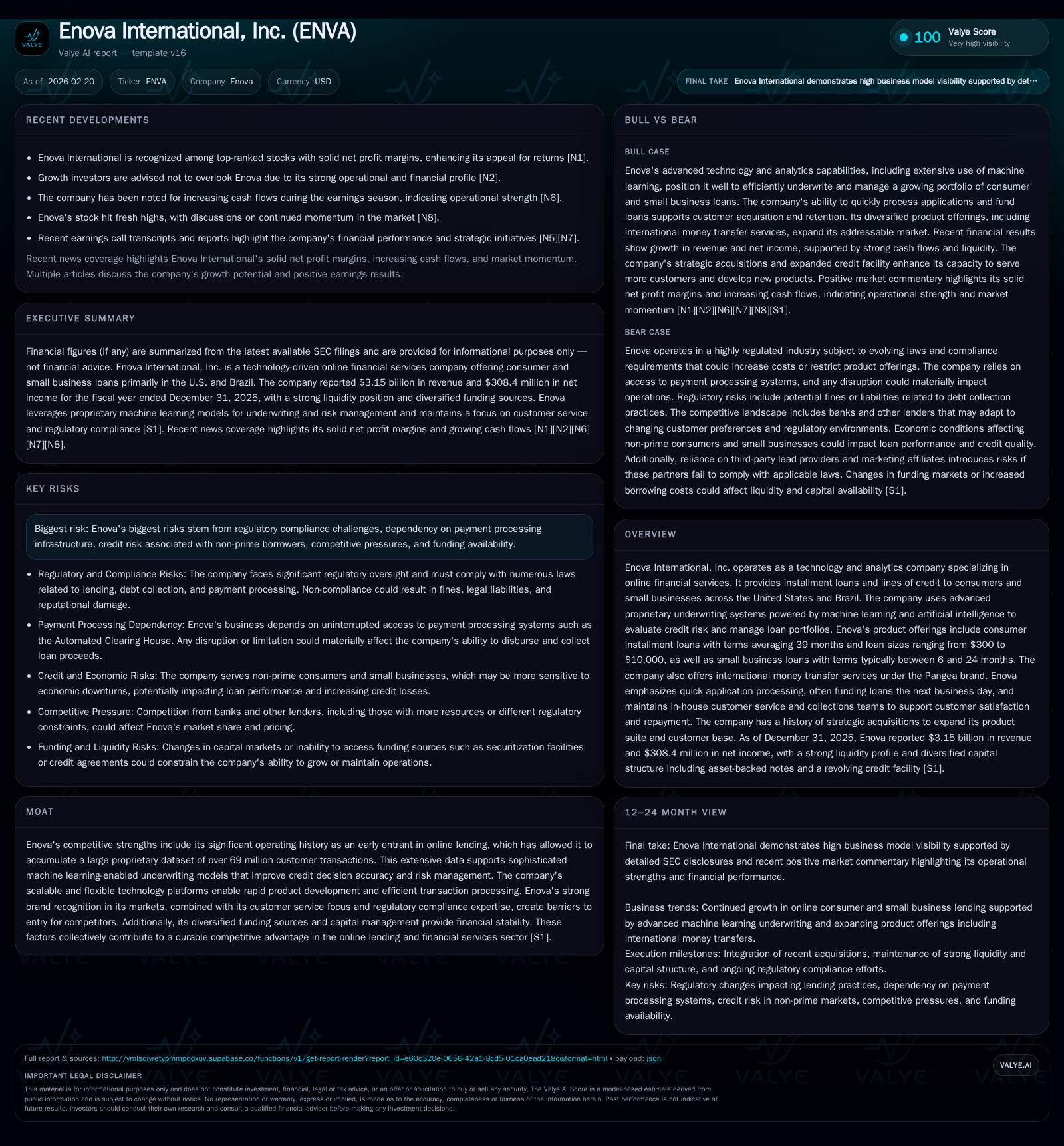
Enova International, Inc. has demonstrated robust growth in online consumer and small business lending, driven by its advanced machine learning-based underwriting and extensive proprietary data amassed over 21 years. The company’s 2025 financials reflect significant revenue increases (+18.6% YoY) and improved profitability (+47.2% net income growth), supported by diversified credit products across the US and Brazil. Enova maintains a flexible capital structure with ample liquidity but navigates risks related to regulatory compliance, funding volatility, and credit performance in non-prime segments. Its technology platform scalability and continued product innovation offer promising growth prospects amid an evolving competitive landscape.
Company Overview and Historical Growth
Enova International, Inc., a pioneer in online financial services since 2004, specializes in providing installment loans and lines of credit primarily targeted at consumers with limited access to traditional credit sources as well as small businesses across the United States and Brazil [S1]. Through the innovative application of proprietary machine learning (ML) algorithms—approximately 90% of their analytical models employ ML—the company has constructed a formidable competitive moat based on precision credit decisioning powered by a massive dataset accumulated from over 69 million customer transactions.
The company’s business spans consumer installment loans averaging about 39 months with amounts between $300 to $10,000, alongside small business installment loans with average terms around 15 months ranging up to $400,000 [S27]. Enova processes loan applications rapidly (often same or next day funding) supported by scalable tech platforms that facilitate efficient transaction throughput across desktop and mobile channels.
Table 1 summarizes key financial metrics over the past four fiscal years illustrating steady top-line expansion aided by operational leverage:
Historical performance (annual)
| FY | Rev ($bn) | Net ($mm) | CFO ($mm) | OpInc ($mm) | Rev YoY | Net YoY |
|---|---|---|---|---|---|---|
| 2025 | 3.2 | 308 | 1819 | 739 | +18.6% | +47.2% |
| 2024 | 2.7 | 209 | 1539 | 585 | +25.5% | +19.6% |
| 2023 | 2.1 | 175 | 1167 | 422 | +22.0% | -15.6% |
| 2022 | 1.7 | 207 | 894 | 384 |
Note: Omitted columns lack sufficient annual XBRL coverage in the provided tags (need ≥2 annual points): Capex, Div, FCF. Source: SEC companyfacts cache [F1].
Capital returns and efficiency (annual)
| FY | Buybacks ($mm) | ROE% |
|---|---|---|
| 2025 | 215 | 23.1 |
| 2024 | 289 | 17.5 |
| 2023 | 153 | 14.1 |
| 2022 | 143 | 17.5 |
Source: SEC companyfacts cache [F1].
Note: Capex figures are unavailable beyond FY2021; Buyback data reflects full-year amounts when available.
The growth in revenue and operating income is attributable primarily to the expansion of the loan portfolio driven by increasing consumer acceptance of online lending alternatives and Enova’s successful technology-enabled underwriting approach [S1]. Operating cash flows have consistently outpaced net income reflecting strong collections efficiency coupled with disciplined portfolio growth.
Future Growth Prospects
Enova’s future growth hinges on several interrelated factors:
Expanding product penetration: The firm continues to diversify its offerings among consumer installment loans, lines of credit (currently representing about ~60% of loan balances), and small business financing across broader geographies in the U.S. (50 states plus D.C.) and Brazil [S18]. Their agility in deploying new products leveraging the modular technology platform facilitates rapid market adaptation.
Data-driven underwriting improvements: Continuous refinement of ML models improves risk discrimination that can both reduce defaults and optimize loan pricing structures enhancing return on assets [S1]. This improvement underpins competitive advantage particularly amid tighter regulatory constraints on pricing or fees.
Technology scalability: Enova benefits from highly flexible cloud-based infrastructure enabling volume scaling without proportional cost rise; this is notable given that ~4.3 million transactions were processed in FY2025 demonstrating operational capacity for growth without major incremental infrastructure investment [S1].
Capital allocation strategies: Active management of capital through securitization notes issuance (with multiple facilities maturing through early next decade), sizable revolving credit availability ($825M with reduced interest spreads), and opportunistic share repurchases signal management’s confidence in growth trajectory balanced with shareholder returns [S4][S6][S8][S16][S22].
Growth limitations may arise from:
Regulatory environment: Compliance complexity is significant given diverse state laws affecting loan terms, disclosures, collections practices, and contract enforceability [S10][S14]. Heightened scrutiny by regulators or plaintiffs’ bar could increase compliance costs or necessitate product modifications.
Credit quality concerns: Acting largely within near-prime or non-prime borrower segments presents risks surrounding delinquency rates (noted delinquencies >30 days were approximately mid-single-digit percentages historically) which can directly affect margins especially if economic conditions deteriorate or if intensified competition forces riskier underwriting [S19].
Funding market dependencies: The company’s reliance on asset-backed securitizations accounting for substantial funding sources exposes it to capital market fluctuations; disruptions could raise borrowing costs or restrict originations without alternative liquidity solutions [S5][S6][S7][S26].
Forecasts, Milestones & What to Monitor
Though Enova does not provide explicit long-term guidance publicly beyond recent earnings releases [N2][N3], key indicators to watch include:
- Quarterly origination volumes—growth or contraction signals demand shifts.
- Portfolio credit metrics such as delinquency trends beyond historical norms.
- Progression in new product rollouts or expansion into underserved territories.
- Interest expense evolution relative to debt maturities or refinancing activity.
- Regulatory developments impacting allowable loan terms or disclosures.
- Capital allocation announcements—share buybacks vs potential dividend policy changes.
These factors collectively will determine if Enova can sustain its above-market growth pace amid competitive pressures.
Returns & Capital Allocation
Enova’s profitability metrics reveal efficient capital deployment:
- Return on equity approximated at ~23% for FY2025 derived from net income of $308 million against stockholders’ equity of approximately $1.34 billion [F1].
- Operating cash flow generation remains robust at nearly $1.82 billion annually with modest capital expenditures primarily for maintenance enhancing free cash flow (~$1.79 billion when subtracting last reported capex estimates).
- The company has instituted sizeable buyback programs exceeding $200 million annually recently but does not pay cash dividends currently as capital is prioritized for growth reinvestment alongside debt servicing [S8][F1].
Enova's capital stack optimization includes asset-backed notes with coupon rates spanning roughly from mid-5% up to low double digits tied to tranche seniority and duration with staggered maturities concentrated between late decade periods ensuring manageable refinancing schedules [S6][S7][S11]. The revolving line of credit's extension through August 2029 offers additional flexibility at attractive spreads relative to historical levels given the August 2025 amendment lowering interest rates [S4][S5].
Industry Context & Competitive Differentiation
As an early entrant establishing a proprietary loan dataset exceeding most competitors’ scale—coupled with active porting of leading-edge AI/ML techniques into underwriting—Enova enjoys a significant technical moat that barriers less developed fintech peers from replicating its risk modeling sophistication quickly [S1]. The ability to rapidly launch jurisdiction-compliant products pursuant to regulatory regimes via customizable platforms contrasts with legacy lenders constrained by manual processing inefficiencies.
In the online installment lending sector where loss ratios are typically elevated relative to prime segments due to borrower risk profiles, software sophistication partially compensates by minimizing overlosses compared with peers relying on traditional score-based models alone [Analysis: typical non-prime installment lenders experience charge-offs >15%, Enova’s digital analytics assist lowering this rate]. Likewise, their effective use of securitization vehicles mirrors best practice funding strategies prevalent among fintech lenders optimizing cost of capital while maintaining liquidity access.
Risks & Challenges Summary
Enova is exposed notably to: -- Evolving regulations imposing margin compression or operational constraints. -- Potential deterioration in borrower payment behavior during macroeconomic downturns. -- Disruption in asset-backed securities markets raising funding costs or limiting capacity. -- Legal challenges over contract enforceability especially across multi-jurisdictional frameworks. -- Technological disruptions requiring continual investment to maintain analytic edge.
Mitigating these risks requires sustained investment in compliance infrastructure, model validation rigor combined with diversification of product mix, as well as proactive liquidity management including covenant monitoring within debt agreements which currently impose operational limits on investments, indebtedness incurrence, payments distributions etc., per indenture terms detailed in filings [S12][S13][S15].
Conclusion & Outlook Considerations
Leveraging over two decades’ worth of data insights combined with scalable technology affords Enova a uniquely strong position within online finance catering primarily near-prime consumers and small businesses underserved by traditional banks. While continuing organic growth momentum appears achievable through geographic expansion and product innovation bolstered by advanced AI underwriting capabilities, credit quality vigilance together with regulatory navigation remains imperative safeguards.
Operational discipline visible through expanding profit margins alongside aggressive share repurchases highlights management’s confidence yet illustrates prudent capital stewardship amidst industry headwinds around regulatory scrutiny and funding environment uncertainties going forward.
Investors should thus focus on tracking portco origination trends versus regulatory announcements impacting product feasibility along with quarterly credit performance metrics which will presage sustainability of profit improvements beyond historical gains observed through FY2025 results disclosed last month [N2][N3][F1].
This analysis reflects information available as of February 20, 2026. It contains no investment advice nor price targets but aims to provide comprehensive insight into Enova International's operational dynamics within the online lending industry.
Disclaimer: This is research-only, informational analysis and not investment advice. It may include AI-generated interpretation and general industry context. Always verify important details using primary sources.

Comments