
National Healthcare Properties' Shift to Internal Management and Naviagting Capital Markets
National Healthcare Properties internalized management in 2024 and restructured its capital base to focus on senior housing operating properties, aiming for operational stability after prior volatility.
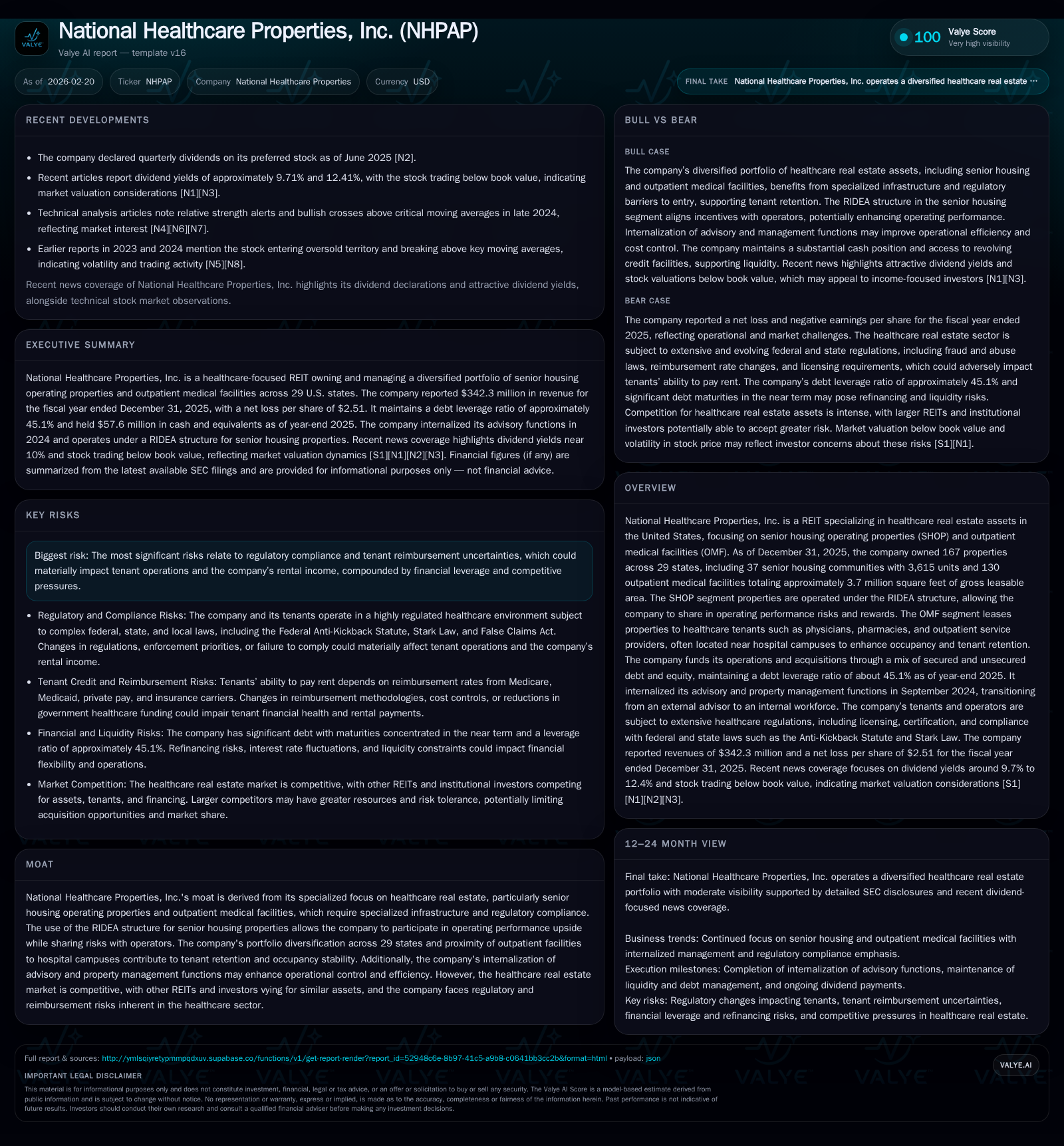
In late 2024, National Healthcare Properties (NHPAP) completed a significant operational pivot by internalizing its advisory and property management functions, accompanied by a reverse stock split. This move aimed to streamline control and reduce external fee burdens. Over 2022-2025, revenue remained relatively stable near $340 million despite notable fluctuations in operating income linked to impairments and structural shifts. The company undertook a meaningful balance sheet overhaul by establishing unsecured credit facilities totaling $550 million in December 2025, reshaping its debt maturity profile and enhancing liquidity. Strategically, NHPAP increased emphasis on its senior housing operating properties (SHOP) segment utilizing the RIDEA structure to leverage operating upside amid regulatory and reimbursement risks inherent to healthcare real estate. With ongoing challenges in capital allocation marked by negative free cash flow and cautious dividend policies, NHPAP faces key growth and refinancing milestones in the near term.
From Outsourced to Internal: Operational Transformation Since 2024
National Healthcare Properties' pivotal internalization occurred on September 27, 2024, when it brought advisory and property management functions in-house, ending reliance on Healthcare Trust Advisors LLC [S1]. This internalization was coupled closely with a reverse stock split consolidating every four shares into one, reshaping equity metrics retrospectively for all periods presented. By eliminating ongoing fees paid to external advisors and instituting a dedicated workforce, NHPAP aimed for tighter operational integration crucial in managing healthcare-specific real estate assets which demand nuanced oversight given regulatory landscapes and operator coordination needs. This transition aligns with the strategic refocus on senior housing operating properties (SHOP), where active management participation through the RIDEA structure matters materially.
Historical Performance Review: Revenue Stability Amid Operating Income Volatility
Despite volatility in earnings, revenues have generally showed resilience over the past four years. Total revenue grew moderately from $335.8 million in FY2022 to $342.3 million in FY2025 (+1.9%), peaking at $353.8 million in FY2024 before retracting ~3.3% last year [F1]. Operating income reveals a sharper narrative swing: large losses persisted through FYs 2022-24 driven by impairments or other non-cash charges—operating losses peaked at -$123.5 million in FY2024—but swung suddenly positive to $3.3 million in FY2025, marking a 102.7% improvement YoY due primarily to non-recurring factors rather than core profitability improvement.
Operating cash flow showcased significant swings that mirror underlying earnings instability—from positive CFOs near $28 million (FY2022) down into negative territory at -$79.8 million (FY2024), before rebounding again to about $7 million (FY2025). The capex data points available show moderate investment consistent with maintaining specialized healthcare infrastructure needed for SHOP and OMF properties plus some portfolio turnover activity [F1].
Capital Structure Overhaul: Debt Profile and Liquidity Position Entering 2026
One of NHPAP's most consequential moves was entering new unsecured financing arrangements in December 2025: a $400 million senior unsecured revolving credit facility alongside a $150 million senior unsecured term loan facility [S4][S6][S7]. These Credit Facilities feature flexible maturities set for late 2028 with extension options and carry average weighted interest rates near 5.94%, which after hedging instruments average down effectively to approximately 5.75% economic cost.
Total gross borrowings stand near $1 billion with net debt leverage ratio at approximately 45.1%, consistent with sector norms for specialized REITs balancing yield and leverage risks [S1],[S9]. The mortgage notes payable totaling around $375 million carry longer maturity profiles (~7+ years) but loan agreements require regular covenant tests including fixed charge coverage ratios, tangible net worth minimums, maximum leverage ratios (secured/unsecured), and liquidity floors such as maintaining minimum cash balances ($12.5M required on secured term loans) [S6],[S8].
The new unsecured facilities replaced older secured term loans due in early 2026 easing rollover risk short-term while enhancing liquidity via borrowing bases tied to approximately $867 million of qualifying real estate collateral under the credit facilities’ lending parameters [S7]. This structural refinement gives NHPAP additional runway for acquisition activity or opportunistic dispositions.
Segment Focus: The Strategic Emphasis on Senior Housing Operating Properties
NHPAP’s portfolio strategy has increasingly focused on senior housing operating properties under the RIDEA model—a distinct approach that allows the REIT to lease qualified healthcare properties through its taxable REIT subsidiary while partnering with eligible independent contractors operating the communities [S1],[S26]. As of December 31, 2025, NHPAP owned a total of 167 properties geographically scattered across 29 states: specifically, 37 SHOP communities with over 3,600 units constituting one segment; alongside another segment of roughly 130 outpatient medical facilities comprising nearly 3.7MSF of gross leasable space.
This dual-segment approach leverages differentiation between asset types—SHOP assets benefit from shared operational performance uplift or downside reflecting management’s active role in resident care delivery economics; OMFs contribute stability through long-term leases with physicians’ offices and ancillary medical service providers often colocated near hospital campuses enhancing tenancy durability [S1],[S26].
Navigating Regulatory and Market Risks in Healthcare REITs
NHPAP operates amid complex regulatory environments affecting its tenant operators significantly. The company identifies reimbursement risk arising from fluctuating Medicaid/Medicare payment policies that directly impact operators’ cash flows—and therefore rent-paying capacity—as well as adverse impacts from audits or enforcement actions relating to federal fraud statutes such as the False Claims Act or Stark Law violations potentially leading to payment suspensions or penalties [S19],[S20],[S21],[S23].
Moreover, government investigations into tenant compliance can induce rent collection delays or retroactive adjustments reducing rental income reliability over uncertain timelines subject to protracted appeals. Competitive pressures from other healthcare real estate investors amplify asset acquisition costs affecting future yield prospects [S23]. These factors combined emphasize importance of comprehensive risk controls around tenant credit quality monitoring within this niche sector.
Capital Allocation Trends: Dividends, Buybacks, and Cash Flow Realities
The company maintains regular dividend payments on both its common shares and preferred stock series consistent with REIT distribution requirements though specifics on payout ratios relative to Funds From Operations (FFO) are not directly disclosed [F1],[S22]. While no common stock buybacks have been enacted recently since at least FY2022, preferred stock repurchases were initiated under an open program yielding retirements of Series A & B preferred shares totaling several hundred thousand shares during FY2025 at average prices approximating mid-$15 range per share.
Financially, despite modest positive CFO in FY2025 (~$7M), significant capital expenditures (circa $28M aggregated) outpace cash generation resulting in negative free cash flow nearing -$9.8M aligning with a low single-digit negative return on equity estimated around -3.5% due mainly to prior impairment-related earnings distortions [F1]. Such figures imply limited flexibility for aggressive shareholder returns expansion absent operational improvements or capital recycling – underscoring cautious stance on allocations going forward.
Outlook for Growth: What to Monitor Beyond Reported Forecasts
Absent explicit company forward guidance currently available, observers should track several key indicators signaling prospective performance trajectories:
- Refinancing status of Fannie Mae Secured Debt maturing November 2026 remains critical given substantial principal outstanding approaching $335M against tight coverage covenants ;
- Lease rollover schedules particularly within SHOP assets under RIDEA involving operator contract renewals could impact Net Operating Income growth opportunity;
- Continued execution of targeted acquisitions focused primarily on high-quality senior housing operating communities vis-à-vis opportunistic dispositions sculpting a more optimized portfolio footprint;
- Operator financial health metrics including ability to manage reimbursement volatility will strongly influence NOI sustainability. Monitoring these levers will provide insight into whether NHPAP grows sustainably while managing inherent sector regulatory challenges effectively.
Summary Table: Key Financial Metrics and Year-over-Year Dynamics
Historical performance (annual)
| FY | Rev ($mm) | CFO ($mm) | OpInc ($mm) | Rev YoY |
|---|---|---|---|---|
| 2025 | 342 | 7 | 3 | -3.3% |
| 2024 | 354 | -80 | -124 | +2.3% |
| 2023 | 346 | 22 | -5 | +3.0% |
| 2022 | 336 | 28 | -32 |
Note: Omitted columns lack sufficient annual XBRL coverage in the provided tags (need ≥2 annual points): Net, Capex, Div, Buybacks, FCF, ROE%. Source: SEC companyfacts cache [F1]. Net income data insufficient for recent years; Capex data unavailable consistently
Disclaimer: This analysis is based solely on information filed with the SEC up to February 20, 2026 ([F1], [S1–S29]). It includes analytical observations but does not constitute investment advice or recommendations regarding National Healthcare Properties’ securities.
Disclaimer: This is research-only, informational analysis and not investment advice. It may include AI-generated interpretation and general industry context. Always verify important details using primary sources.

Comments