
Cboe Global Markets Leverages Clearing Network Amid Executive Overhaul
Cboe’s 2025 financial strength and leadership transitions highlight its strategic positioning amid dependencies on critical clearing infrastructure.
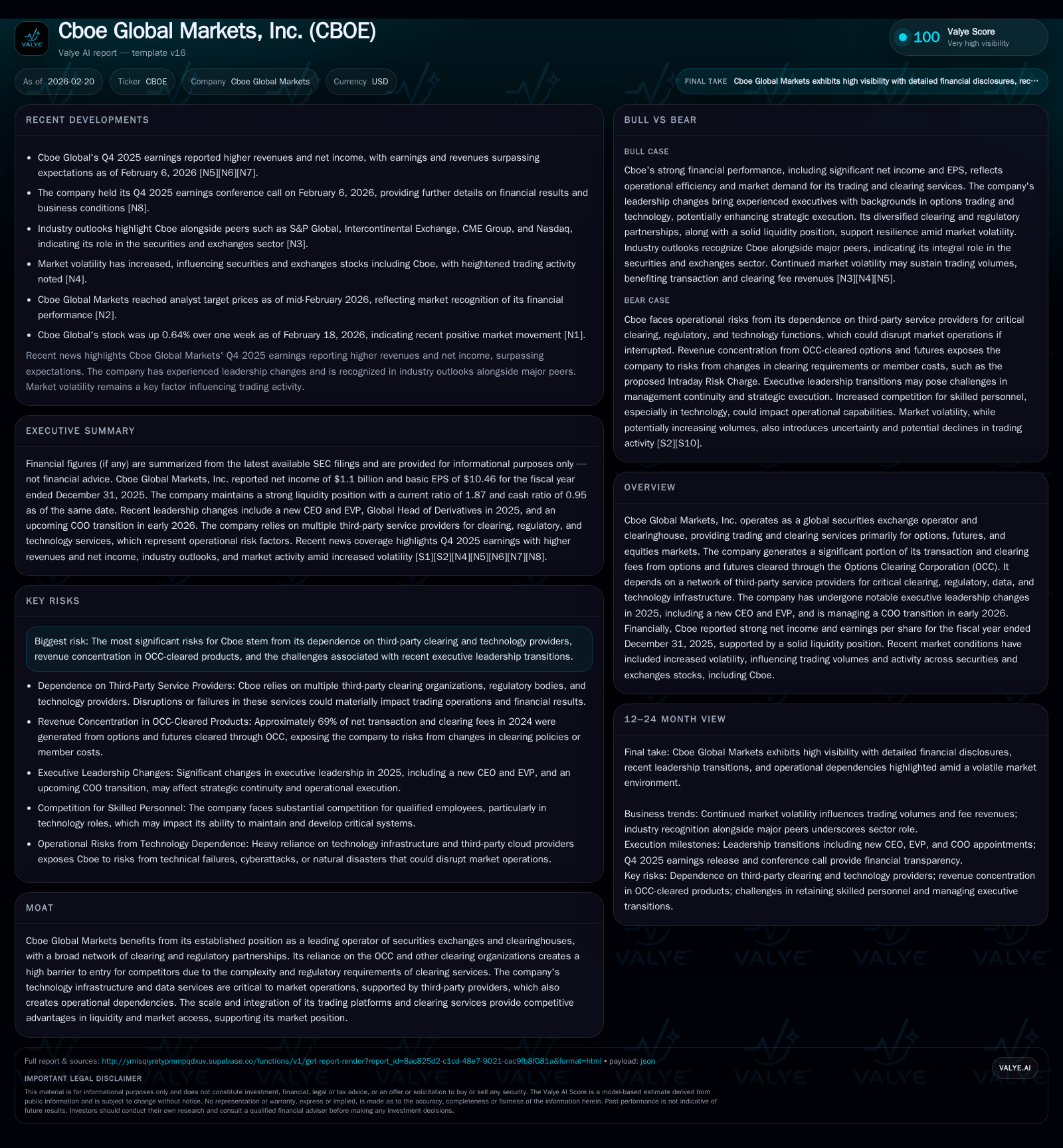
In 2025, Cboe Global Markets demonstrated robust financial performance driven primarily by volatility-fueled trading volumes and a resilient options clearing franchise. The company navigated significant executive leadership changes, including a new CEO and EVP of Derivatives, alongside an impending COO transition that underscores organizational risk and succession complexity. Cboe’s dependence on the Options Clearing Corporation (OCC) and third-party technology providers forms both a competitive moat and a source of operational vulnerability. Capital deployment reflects disciplined balance among dividends, share repurchases, and moderate capex increases. Looking ahead, growth hinges on expansion into new products and markets, tempered by regulatory challenges and infrastructure dependencies.
Solid Growth Trajectory Fuels Market Confidence
Cboe Global Markets closed the fiscal year ending December 31, 2025 with remarkable financial gains. Revenue surged dramatically to approximately $2.23 billion — a leap attributable to increased volatility that lifted trading activity across options and futures markets. Operating income rose by 33.6%, reaching $1.47 billion while net income more than doubled year-on-year to hit $1.1 billion, equating to an impressive approximate ROE of 21.4% based on equity of $5.14 billion [F1]. Operating cash flow expanded commensurately by nearly 60%, reaching over $1.75 billion.
This growth spike is consistent with sector-wide trends where volatility-driven trade flows have spiked fee-based revenues for exchanges specializing in derivatives products [N1][N3]. The bulk of Cboe’s transaction fees flow from options and futures cleared through the Options Clearing Corporation (OCC), which generated roughly 69% of net transaction and clearing fees in 2024 — likely increasing in step with volume gains [S6]. The sustained leverage of its clearing franchise underpins the company’s ability to capitalize on episodic spikes in market turbulence.
Historical performance (annual)
| FY | CFO ($mm) | OpInc ($mm) | Capex ($mm) |
|---|---|---|---|
| 2025 | 1753 | 1467 | 71 |
| 2024 | 1101 | 1098 | 61 |
| 2023 | 1076 | 1058 | 45 |
| 2022 | 651 | 490 | 60 |
Note: Omitted columns lack sufficient annual XBRL coverage in the provided tags (need ≥2 annual points): Rev, Net, ROE%. Source: SEC companyfacts cache [F1].
Capital returns and efficiency (annual)
| FY | Div ($mm) | Buybacks ($mm) | FCF ($mm) |
|---|---|---|---|
| 2025 | 67 | 1682 | |
| 2024 | 249 | 205 | 1040 |
| 2023 | 224 | 84 | 1031 |
| 2022 | 209 | 101 | 591 |
Source: SEC companyfacts cache [F1].
*Note: Revenue numbers include reclassifications for comparability due to segment restatements.
The revenue jump largely results from acquisitions integrated between FY16–FY17 combined with organic volatility-related trade volume surges seen most notably in late CY25 earnings releases [N3][N13]. This expanding profit base sets the stage for continued capital return potential while funding technology investments.
Leadership Evolution: Navigating Executive Transitions
Throughout the past year, Cboe underwent notable executive leadership changes that recalibrate its strategic management team but also inject short-term transitional risks.
The appointment of a new CEO as of May 7, 2025—with concurrent assumption of President duties by August—and a newly installed EVP responsible globally for Derivatives beginning October marked critical leadership refreshes [S2][S12]. Further reinforcing this turnover is the announced retirement of longtime COO Chris Isaacson effective March 6, 2026; his successor Scott Johnston brings experience at Akuna Capital and major trading firms but will confront integration challenges early in office [S24][S25][S26].
These leadership changes occur amid challenging talent retention dynamics within technology-heavy sectors where competition for specialists is intense given industry wage inflation and evolving human capital demands [S12][S19]. The risk lies not only in continuity of strategy execution but also seamless knowledge transfer amid these pivotal roles managing complex clearing operations.
Dependency on OCC and Third-Party Infrastructure: A Double-Edged Sword
Cboe’s entrenched reliance on third-party clearing organizations—chiefly the Options Clearing Corporation—is both core to its competitive advantages and poses systemic operating risks.
Nearly seven-tenths of Cboe's transaction fees derive from OCC-cleared derivatives products like SPX options, placing concentration risk squarely on this provider's operational stability: any failure or change in terms could sharply affect trade execution volumes or disrupt business continuity [S6][S7]. Recent regulatory disclosures reveal OCC’s plan to implement an "Intraday Risk Charge" aimed at mitigating margin credit risk intraday starting September ’25—this margin add-on charge may raise clearing costs ensuring tighter risk governance but potentially depress trading activity due to cost pass-throughs impacting liquidity providers' economics [S10].
Beyond OCC, ancillary third-party entities such as FINRA CAT LLC (handling consolidated audit trail data), cloud service operators hosting disaster recovery backups/data transmission nodes, and routing firms integral to trade flow also underpin the platform’s ecosystem integrity [S4][S7]. Malfunctions or cessation by any party could force Cboe into halt scenarios or delays with cascading impact on reputational standing or regulatory penalties.
Practitioner-level vocabulary describing these dependencies includes "clearing member accounts," "trade routing reliability," "intraday margin add-ons," highlighting the intricate plumbing enabling effective markets but also flagging vulnerabilities inherent in outsourcing critical components.
Volatility as a Catalyst for Trading Volume and Revenue Gains
As recognized by industry observers tracking securities exchanges broadly, elevated volatility through late ‘25 materially propelled trading activity at derivative-centric venues such as Cboe Global Markets [N12][N8].[N7]
Periods of heightened price swings stimulate hedging demand among institutional and retail investors alike—thus increasing contract volumes traded through Cboe’s suite of equity options/futures products resulting in higher transaction fee accruals vital to revenue growth models intrinsic to exchange operators.
This correlation between market turbulence driving top-line growth amidst cyclical episodes serves as both boon during upswing intervals but also caps growth reversion when volatility subsides—increasing the importance of diversification strategies.
Capital Allocation Priorities: Balancing Buybacks, Dividends, and Capex
Cboe maintains a prudent capital deployment stance leveraging strong free cash flow generation ($1.68 billion estimated FCF) by directing resources across dividend distributions ($249 million paid in ‘24), controlling share repurchase programs which declined noticeably from $205 million in ‘24 to approximately $67 million executed in ‘25 signaling tactical moderation, while incrementally boosting capital expenditures invested into core platforms from $61 million moving toward $71 million year over year [F1][S24][S25][S26].
This mixture suggests management focus remains solidly targeted at balancing shareholder returns amidst investing sufficiently in technology infrastructure vital for sustaining uptime, scaling capacity and meeting evolving regulatory standards affecting system robustness.
Operational Risks and Regulatory Headwinds to Monitor
Cboe’s operational risk profile prominently features vulnerabilities linked to outsourced cloud providers whose availability supports real-time data dissemination plus offsite backups—a failure scenario risks data loss or delayed confirmations damaging credibility; protective cybersecurity investments thus remain essential safeguards [S7].
On regulation fronts, expense burdens escalate related to implementation costs around Consolidated Audit Trail (CAT) compliance incurred through collaborative moves involving FINRA CAT LLC; ongoing scrutiny by SEC extends across disclosure obligations adding legal contingencies [S4][S14][S27].
Separately, OCC margin reforms such as "Intraday Risk Charge" impose cost structures influencing intermediary incentives with potential downward pressure on volumes binding directly back into fee revenues—a dynamic requiring vigilant business modeling adjustments capturing margin add-on impact nuances pervasive among clearance-dependent exchanges [S10].[S27]
Future Growth Horizons: Opportunities Amid Industry Complexity
Management commentary coupled with industry outlooks signal aspirations for extending product breadth within derivatives—potential expansion into new asset classes or international geographies represent natural avenues albeit subject to execution complexity inherent with multifaceted licensing regimes plus infrastructure scalability demands [N10][N11].
Key themes include enhancing 'market access' through integrated platform offerings facilitating cross-asset execution solutions aimed at broadening participant bases thereby cushioning against cyclicality rooted solely in volatility-reliant revenues.
Analyzing Financial Forecasts and Key Milestones Ahead
While explicit forward guidance remains limited per recent filings/releases—a common stance allowing flexibility—investors should prioritize monitoring metrics sensitive to pricing power shifts reflecting volume/volatility movements post-Q4 ‘25 earnings releases alongside regulatory rule-making updates particularly around clearing margin frameworks or CAT-related compliance obligations that may adjust cost bases or fee structures subtly yet materially over ensuing quarters [N9].
Continual executive leadership stabilization following transitions will further serve as intangible milestones critically intertwined with strategic delivery consistency.
Disclaimer: This analysis summarizes publicly available information without providing investment advice or recommendations. It draws upon reported financial data and regulatory filings current as of February 20, 2026.
Disclaimer: This is research-only, informational analysis and not investment advice. It may include AI-generated interpretation and general industry context. Always verify important details using primary sources.

Comments