
CONECTISYS CORP: From Dormant Shell to Potential Acquisition Vehicle
An analytical review of Conectisys Corporation’s transformation from a long-inactive entity to an acquisition-focused shell company.
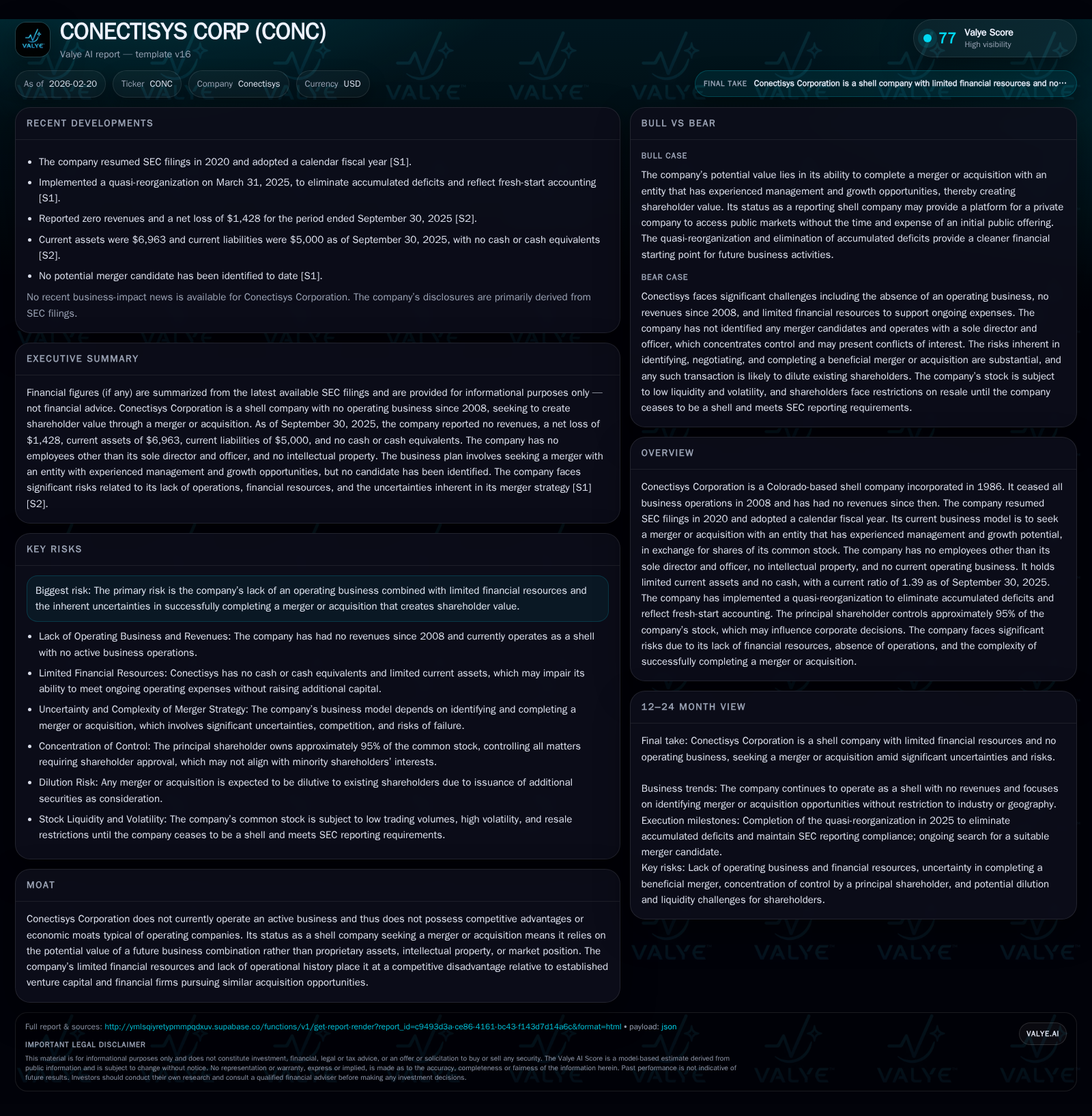
Conectisys Corporation ceased operations in 2008 after winding down its automatic meter reading business and remained dormant with no revenues until resuming SEC filings in 2020. The company executed a quasi-reorganization recently to eliminate historical accumulated deficits, resetting its balance sheet as it pivots toward identifying merger or acquisition candidates. With minimal financial resources, no operating business, and a controlling shareholder owning about 95% of shares, Conectisys faces substantial challenges competing with better-resourced entities for acquisitions. Key metrics to monitor include the formation of acquisition pipelines, capital raises to cover operating expenses, and potential dilution effects associated with a future business combination.
Historical Overview: Legacy and Dormancy Since 2008
Conectisys Corporation's history dates back to its incorporation in Colorado in 1986 under the name Coastal Financial Corp. It underwent successive name changes before settling on Conectisys Corporation in 1995. The company's original line of business involved developing a low-cost automatic meter reading (AMR) solution until it ceased all business activities in 2008 [S1][S21]. Since then, Conectisys has recorded no revenues, maintaining a dormant status for over a decade.
After discontinuing operations, Conectisys resumed SEC reporting only recently, filing Form 10-K for its fiscal year ended September 30, 2020. It also switched its fiscal year-end to a calendar basis and brought its filings up to date by early 2026 [S1][S3]. This extended dormancy period highlights the lack of ongoing operational activity and absence of any direct market engagement during that time.
Financial Status and Quasi-Reorganization Impact
Financial disclosures confirm that Conectisys owns nominal assets with extremely limited liquidity. As of September 30, 2025, the company reported current assets of $6,963 against current liabilities totaling $5,000, yielding a modest current ratio of approximately 1.39 [F1]. However, it held no cash or equivalents at prior year-ends, reflecting severely constrained working capital resources [F1].
A critical event occurred on March 31, 2025: Conectisys executed a quasi-reorganization under fresh-start accounting guidance pursuant to ASC Topic 852-20 [S4]. This accounting maneuver effectively eliminated accumulated deficits that had built up over prior years—mostly stemming from activities predating the cessation of operations in 2008. The reorganization involved issuing common shares to satisfy amounts owed to consultants and officers, revaluing liabilities, and issuing shares for cash equal to prior issuances [S4]. As a result, shareholders’ equity returned to positive territory after years of deficit balances—a necessary step before pursuing new business activity given regulatory and financial requirements.
Revived Business Model: Strategy Focused on Acquisition Opportunities
Post-dormancy, Conectisys pivoted from any product development focus to becoming an acquisition platform or shell company [S1][S21]. Its stated strategy is to identify private or public entities with experienced management teams that possess growth prospects. The company intends to attempt mergers or acquisitions where consideration primarily consists of common stock issuance [S1][S7]. This approach is broadly permissive regarding industry sector or geography given it faces no restriction on target selection [S21].
Nonetheless, Conectisys acknowledges significant constraints: it lacks internal operating revenue streams and must first raise additional debt or equity financing simply to cover ongoing operating costs such as regulatory compliance and due diligence expenses [S1][S6]. Moreover, successful integration post-acquisition involves many risks ranging from retaining management talent at acquired firms to assuming unforeseen liabilities—a challenge for inexperienced operators [S11].
Constraints and Market Position: Competitive Disadvantages Amid Limited Resources
Critical competitive disadvantages afflict Conectisys compared with more established financial sponsors or venture capital firms actively engaging in similar acquisition pursuits [S11]. Foremost among them is the near-total absence of personnel beyond the sole director/officer who maintains limited bandwidth owing to other commitments [S9]. Furthermore, there are no intellectual property assets or operational infrastructure which might otherwise serve as value propositions during transaction negotiations [S11].
Liquidity remains sparse; Conectisys holds nominal working capital precluding meaningful investment initiatives without outside financing [F1][S3]. The controlling shareholder's approximately 95% ownership stake further concentrates governance but may give rise to conflicts between controlling interests versus minority shareholders’ preferences [S12]. Lastly, the company faces dilution risk inherent in issuance of substantial new shares typical when completing reverse mergers—factors that can depress existing shareholder percentages materially post-transaction [S8][S14].
Capital Structure, Debt Extinguishment, and Liquidity Assessment
At cessation in 2008, the company carried sizeable liabilities including accounts payable around $383K; accrued compensation exceeding $2.4 million (owed solely to board members); convertible notes payable aggregating over $6.6 million plus related interest [S3][S5]. These obligations originated primarily from related-party financings controlled by former management figures now subject to SEC enforcement actions.
By approximately end-of-2017 these legacy debts were legally extinguished—courts cited statutory limitations barring collection efforts across jurisdictions including New York and California statutes of limitation [S3][S5]. Consequently, accumulated deficits decreased sharply by roughly $9.59 million following extinguishment accounting entries [S5]. This cleanup cleaned the balance sheet considerably but did not restore operational capability given absence of cash flows.
Summary Table: Selected Financials (USD)
Historical performance (annual)
| FY |
|---|
| 2021 |
Note: Omitted columns lack sufficient annual XBRL coverage in the provided tags (need ≥2 annual points): Rev, Net, CFO, OpInc, Capex, Div, Buybacks, FCF, ROE%. Source: SEC companyfacts cache [F1]. *Note: Q3-2025 data are quarterly figures; full fiscal year data not available. *Capex, dividends paid and share repurchases data are not available in provided tags [F1].
Future Growth Hooks and Uncertainties in Securing Business Combinations
Currently, Conectisys has neither identified nor formally engaged any prospective merger partner or acquisition candidate [S1][S8]. Without defined industry focus or target criteria beyond general management experience and growth potential prerequisites [S12], investigation efforts remain exploratory.
The scarcity and intense competition for attractive acquisition opportunities compound this challenge—as does limited internal due diligence capacity—raising legitimate doubt about timely success [S11][S19]. Prospective investors or observers should monitor progress indicators such as announcements regarding:
- Target pipeline development,
- Capital raising activity to fund pursuit efforts,
- Initiation/execution milestones on merger agreements,
- Changes in management structure following eventual transactions.
Failure to maintain sufficient liquidity during this investigatory phase risks operational discontinuity before any deal closure can be achieved.
Capital Allocation Policies: Absence of Dividends and Buybacks
With essentially nil operating income or free cash flow generation historically or currently [F1], Conectisys understandably pays no dividends nor conducts share repurchase programs [S4][S7]. All available resources are presumably being conserved for facing transactional costs associated with merger activities.
This concentration of capital deployment toward operational expense coverage rather than shareholder return is consistent with typical shell companies whose main value realization event is completion of a transformative business combination rather than ongoing income distributions.
Valuation Watchpoints: Metrics to Monitor Going Forward
Given the reset shareholders’ equity base post-quasi reorganization coupled with persistent net losses though small in magnitude recently (-$1.43K quarterly net loss as of Sept. 2025)—calculation of traditional return on equity yields misleadingly positive ratios (~13.6%) but lacks practical significance absent actual earnings power or sustained operations [F1].
Key valuation-related metrics for scrutiny include:
- Equity fluctuations reflecting new share issuances associated with merger consideration,
- Net income trajectory assuming future operational activity begins,
- Degree of dilution impacting existing shareholders from equity-financed acquisitions,
- Disclosure quality surrounding transaction terms post-announcement.
Transparency around these metrics will be crucial given potential impacts on investor ownership percentages and overall corporate governance shifts.
Disclaimer: This analysis provides an overview based solely on publicly available company filings without recommending any investment action. Readers should conduct further due diligence considering individual circumstances before considering exposure related to CONECTISYS CORP shares.
Disclaimer: This is research-only, informational analysis and not investment advice. It may include AI-generated interpretation and general industry context. Always verify important details using primary sources.

Comments