
SouthState Bank’s Expansion and Earnings Surge Highlighted by Strategic Acquisition
The Independent acquisition propelled SouthState Bank’s 2025 earnings, boosting loans, deposits, and geographic reach while emphasizing disciplined capital and liquidity management.
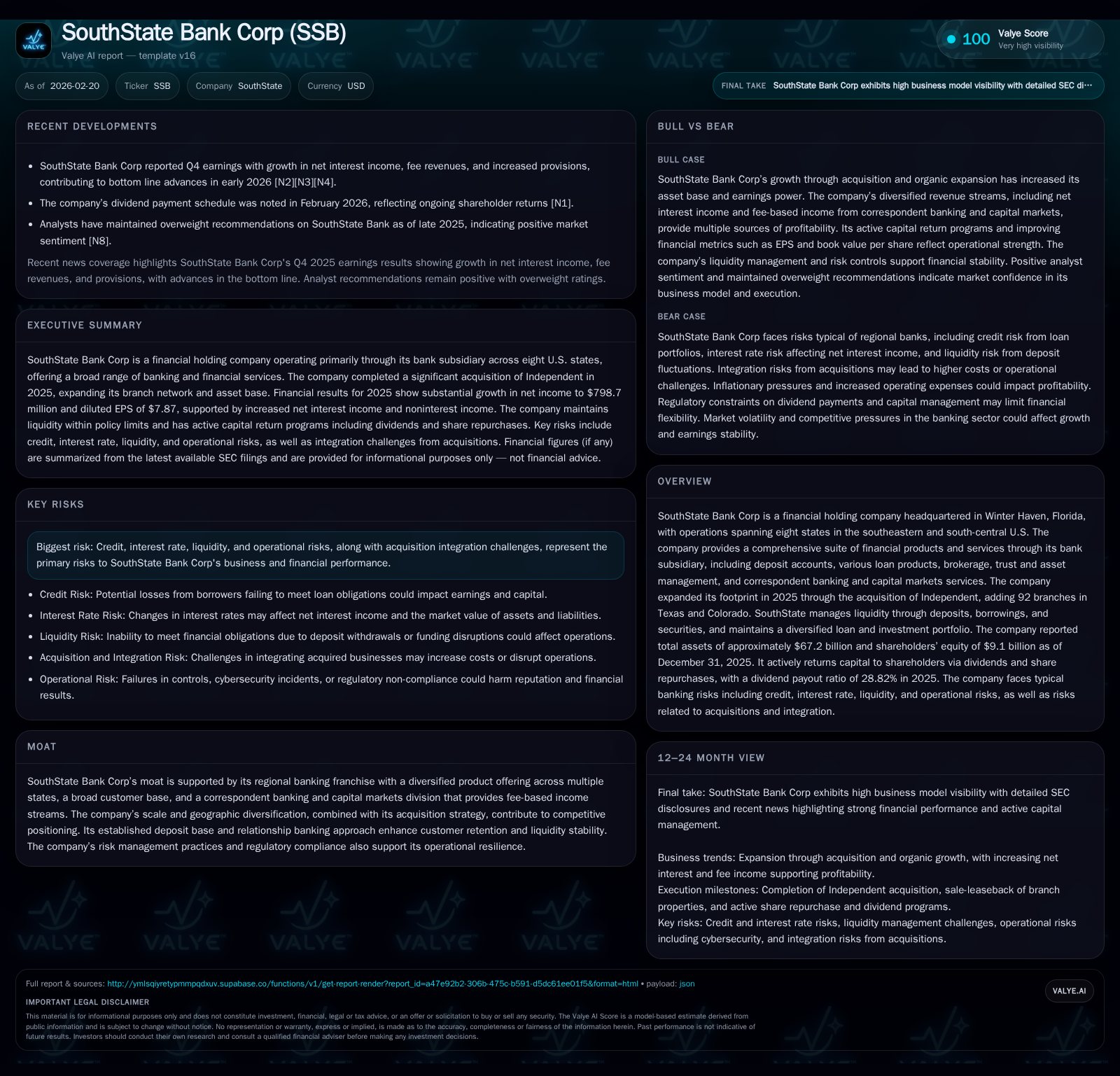
SouthState Bank Corp’s 2025 marked a pronounced financial inflection point driven largely by its acquisition of Independent, which contributed over $9.7 billion in loans and 92 new branches across Texas and Colorado. This inorganic growth combined with robust organic loan expansion led to a near 50% increase in net income year-over-year. Revenue diversification through fee-based correspondent banking and asset management services complemented net interest income gains, while prudent risk management addressed elevated provisions amid challenging credit conditions. Capital allocation remained shareholder-friendly with meaningful buybacks and dividend increases, supported by strong liquidity buffers underpinning ongoing operational flexibility.
Transformational Growth in 2025 Backed by Acquisition and Organic Loan Expansion
SouthState Bank Corp’s financial profile transformed markedly in fiscal year 2025 as net income soared to $798.7 million, a striking increase of 49.3% from $534.8 million earned in the prior year [F1]. The primary catalyst was the January 1, 2025 acquisition of Independent, which contributed approximately $9.7 billion in loans—a more than threefold increase from pre-acquisition levels—and brought an additional 92 branch locations primarily across Texas and Colorado [S1][S4].
Beyond wholesale portfolio additions from the merger, SouthState also achieved substantial organic loan growth: its non-acquired loan portfolio expanded by nearly $5 billion (about +16.9%), reflecting both new originations and renewal activities within existing relationships [S4]. This combination of acquired assets and steady organic growth underpinned the robust net income leap that overshadowed modest rises in operating expenses.
Additionally, total assets ballooned to roughly $67.2 billion at year-end 2025 compared to about $46.4 billion at the end of 2024—reflecting the larger balance sheet from both acquisition-related inflows and ongoing balance sheet expansion [S21]. Compared with prior years where net income gains hovered at low single digits or stable levels, the infusion of scale fundamentally reset SouthState’s earning capacity.
Revenue Drivers: Focus on Net Interest Income Growth and Fee-Based Income Diversification
A notable driver of revenue was growth in net interest income (NII), which benefited significantly from both the increased loan book and higher investment securities balances following Independent’s integration [N1][S26]. The company strategically managed its net interest margin (NIM) through asset-liability management practices designed to optimize yield curves amidst fluctuating rates, including replacement of higher-cost local deposits with lower-cost brokered deposits where advantageous [S6][S7].
Beyond core lending margins, SouthState deepened its fee-based income streams derived principally from its correspondent banking division—offering clearing services, bond accounting, international wires—and capital markets operations centered on fixed income security sales commissions and hedge advisory fees [S15]. These noninterest revenues added stability to earnings by reducing dependency exclusively on interest spread fluctuations—a relevant factor given rising provision levels signaling cautious credit outlooks.
Expanding Footprint: Integration of Independent Acquisition and Geographic Reach Extension
The integration of Independent extended SouthState’s footprint into major new markets of Texas and Colorado through the addition of 92 branches—significantly broadening its geographic presence well beyond its traditional southeastern base spanning Florida, South Carolina, Georgia, North Carolina, Alabama, Tennessee, and Virginia [S1][S27]. This extension not only increased deposit gathering capabilities but also introduced fresh relationship banking opportunities within burgeoning commercial real estate and business loan markets common to these western states.
Operationally, the acquisition enabled cross-selling synergies for wealth management, brokerage, trust services as well as enhanced correspondent banking scale—an increasingly important profit diversifier for regional banks seeking sustainable fee revenues beyond traditional lending cycles.
Risk Navigation: Provisions Uptick Amid Credit and Interest Rate Environment Challenges
Credit quality management emerged as a key priority during 2025 amid macroeconomic uncertainties. The Company recorded a provision for credit losses totaling $119.8 million—significantly elevated versus prior periods—which aligns with cautious underwriting philosophy amid interest rate volatility and inflationary pressures impacting borrower cash flows [N1][S17].
SouthState employs robust allowance estimation methodologies incorporating discounted cash flow models leveraging probability of default (PD) and loss given default (LGD) parameters adjusted for forward-looking economic scenarios. Notably, despite rising provisions, loan charge-offs remained within historical norms reflecting disciplined risk selection post-acquisition integration [S17][S24].
Interest rate risk also features prominently—SouthState's asset-liability committee monitors reprice risk inherent in mismatched maturities between fixed/inflation-sensitive loans versus deposits and wholesale funding instruments. Included are embedded option risks such as prepayment or early withdrawal behaviors typical in consumer deposit products which can compress NIM or increase funding cost volatility [S6][S13].
Forward-Looking View: Strategic Priorities and Market Opportunities to Monitor
While explicit guidance remains limited beyond historical results disclosed up to December 31, 2025, several milestones warrant attention going forward. These include continued smooth integration progress for Independent's operations ensuring retention of acquired relationships; steadfast deposit growth especially focusing on granular retail balances versus higher-cost brokered components; metrics around NIM sustainability amid a rising interest rate environment; plus monitoring credit trends given heightened reserves this past year [N5] (analysis).
Management’s focus on evolving product offerings tailored for commercial customers as well as mortgage production leveraging secondary market sales dynamics may present avenues for future revenue enhancement within prevailing economic cycles. Additionally, ongoing capital deployment strategies targeting accretive share repurchases balanced against reserve-building would be indicative signals of confidence.
Capital Allocation Excellence: Share Repurchases, Dividend Policies, and Returns on Equity
Capital management remains a standout aspect of SouthState’s shareholder value approach. In fiscal year 2025 alone, the Company repurchased approximately $235.8 million worth of common stock under an authorized repurchase program enhancing per-share metrics post-acquisition dilution effects [F1][S9]. Concurrently dividends paid rose sharply from around $163 million in 2024 to over $231 million in 2025—a reflection of growing earnings power and confidence in recurring cash flow generation.
Equity grew correspondingly to exceed $9 billion by year-end 2025 from about $5.9 billion a year prior due predominantly to the equity issuance for Independent purchase plus strong retained earnings accumulation [F1][S18]. This equity base supports regulatory capital buffers well above minimum requirements as noted by CET1 capital ratios near double-digit territory (around 11-12%) despite balance sheet expansion effects post-merger.
Calculated return on equity for fiscal 2025 approximates an efficient ~8.8%, balancing accretive profitability with deliberate reinvestment efforts—a metric consistent with leading regional bank peers managing growth through disciplined capital redeployment strategies.
Liquidity Strength: Stability Through Granular Deposits, Brokered Funding, and Wholesale Facilities
Liquidity frameworks benefitted immensely from steady core deposit inflows paired with prudent use of brokered deposits carefully kept below internal caps (~6.9% brokered share vs policy max 15%), underscoring a stable retail-heavy funding mix bolstered by ~$55.1 billion total deposits at December-end versus $38 billion one year prior—most increment attributed directly to acquisition deposits [$15+ billion] plus organic increases mainly in money markets & time deposits categories [S6][S7].
Additionally available contingency funding sources are robust: federal home loan bank lines totaling $5.7 billion remain untapped along with Federal Reserve discount window capacity exceeding ~$11 billion; liquid securities pledgable amounting near $2.4 billion complement immediate liquidity buffers effectively counterbalancing uninsured deposit exposures displaying coverage ratios exceeding regulatory comfort thresholds (102% excluding collateralized) [S8].
This capital discipline combined with size-consistent wholesale facility access positions SouthState advantageously versus regional peer groups potentially exposed to greater liquidity fragility when faced with rapid deposit runoff or market dislocations.
Historical Financial Performance Summary
Historical performance (annual)
| FY | Net ($mm) | CFO ($mm) | Capex ($mm) | Net YoY |
|---|---|---|---|---|
| 2025 | 799 | 301 | 70 | +49.3% |
| 2024 | 535 | 512 | 36 | +8.2% |
| 2023 | 494 | 547 | 39 | -0.4% |
| 2022 | 496 | 1731 | 18 |
Note: Omitted columns lack sufficient annual XBRL coverage in the provided tags (need ≥2 annual points): Rev, OpInc. Source: SEC companyfacts cache [F1].
Capital returns and efficiency (annual)
| FY | Div ($mm) | Buybacks ($mm) | FCF ($mm) |
|---|---|---|---|
| 2025 | 231 | 236 | 231 |
| 2024 | 163 | 17 | 476 |
| 2023 | 156 | 16 | 508 |
| 2022 | 147 | 119 | 1713 |
Source: SEC companyfacts cache [F1]. Note: Operating Income & Revenue unavailable; YoY computed where data allows.
Disclaimer: This report is based solely on publicly available filings as of February 20, 2026 ([F1], [N#], [S#]) without forward-looking investment recommendations or price targets.
Disclaimer: This is research-only, informational analysis and not investment advice. It may include AI-generated interpretation and general industry context. Always verify important details using primary sources.

Comments