
Daily Journal Corporation’s Evolution: Balancing Legal Publishing Heritage with Justice Software Expansion
Daily Journal Corp juxtaposes its traditional legal newspaper roots with expanding government justice software while facing industry secular pressures.
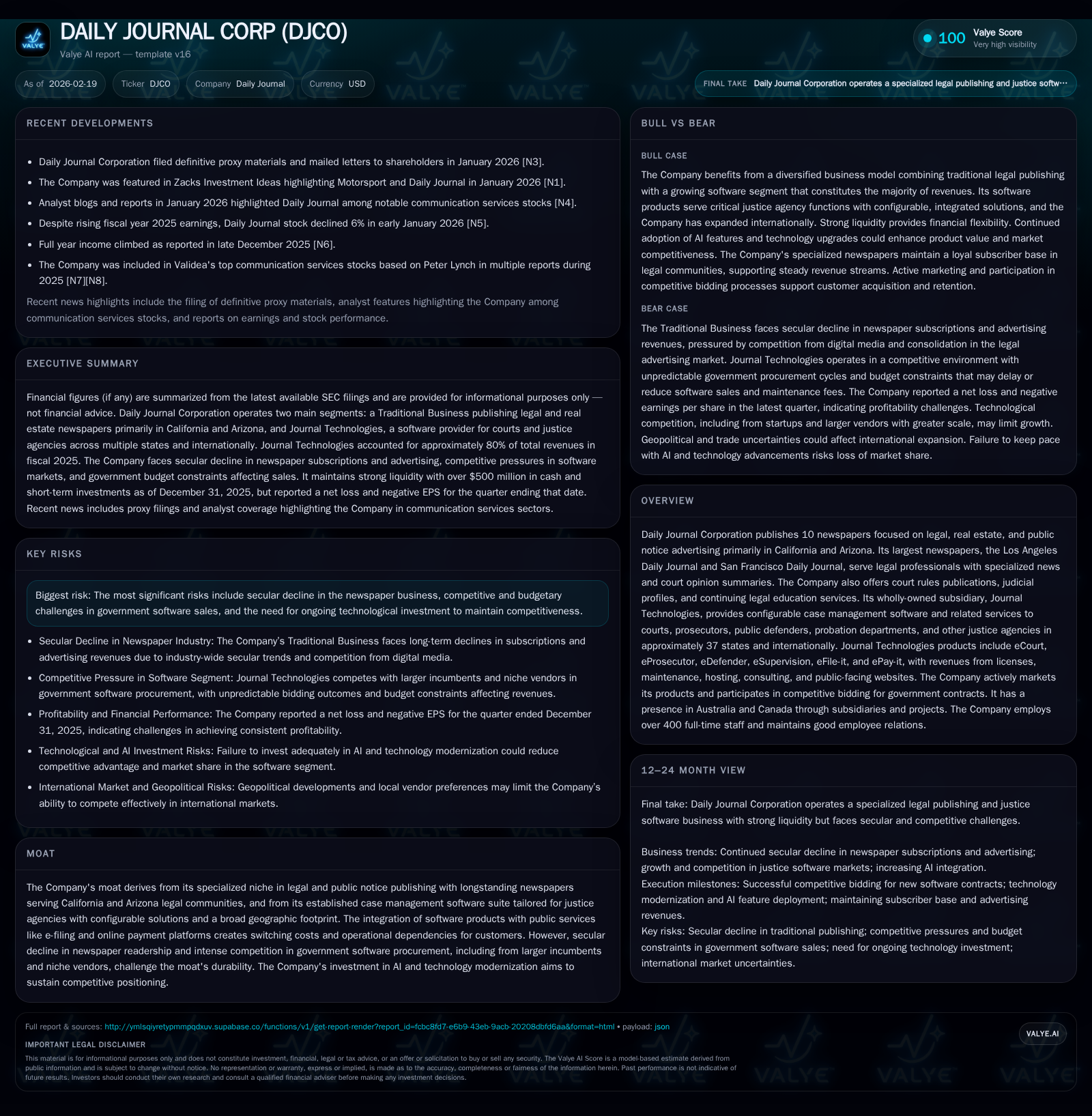
DAILY JOURNAL CORP operates a dual business model combining century-old legal newspapers largely serving California and Arizona markets with an aggressively scaling case management software subsidiary, Journal Technologies. Financial trends from FY2017 to FY2025 reveal robust revenue growth driven primarily by software, offsetting secular declines in print media. Profitability routed through operating income and net income showed meaningful improvement alongside operating cash flow expansion and minimal capital expenditure. Future growth hinges on expanding software contracts across ~37 states and international projects, balanced against ongoing challenges in newspaper advertising revenues and competitive government IT procurement environments. Awareness around AI adoption, contract milestones, and capital structure metrics will be critical.
Historical Revenue and Profit Growth Driven by Dual Segments
Daily Journal Corporation’s financial trajectory over recent years underscores a strategic pivot from traditional print publishing toward software-driven justice technology. From FY2017 through FY2025, revenue expanded notably by approximately 21% year-over-year as of the latest full fiscal year reported [F1]. This revenue uptick was chiefly fueled by Journal Technologies Inc., the Company’s wholly owned software subsidiary supplying case management systems to courts and justice agencies nationally and internationally.
Operating income mirrored this trend robustly, posting a monumental increase of over 134% in FY2025 compared to prior year levels [F1]. This surge evidences higher-margin software sales overtaking the diminishing contributions from the legacy newspaper operations. Net income similarly improved by nearly 44% year-over-year to reach positive territory at the fiscal year-end despite some quarterly net losses showing volatility attributable to timing effects or non-cash charges [F1].
Cash flow analysis reveals dramatic improvements as well—operating cash flow expanded by more than fifteen thousand percent from negative territory to $13.3 million in FY2025 [F1]. Capital expenditures remained negligible (sub-$10k), highlighting an operating model with comparatively minimal asset investment demands consistent with scalable SaaS delivery.
Historical performance (annual)
| FY | Net ($mm) | CFO ($mm) | OpInc ($mm) | Capex ($) | Net YoY |
|---|---|---|---|---|---|
| 2025 | 112 | 13 | 10 | 8000 | +43.6% |
| 2024 | 78 | 0 | 4 | 49000 | +264.1% |
| 2023 | 21 | 15 | 7 | 86000 | +128.4% |
| 2022 | -76 | -5 | 2 | 36000 |
Note: Omitted columns lack sufficient annual XBRL coverage in the provided tags (need ≥2 annual points): Rev, Div, Buybacks. Source: SEC companyfacts cache [F1].
Capital returns and efficiency (annual)
| FY | FCF ($mm) | ROE% |
|---|---|---|
| 2025 | 13 | 28.7 |
| 2024 | 0 | 28.0 |
| 2023 | 15 | 10.7 |
| 2022 | -5 | -42.2 |
Source: SEC companyfacts cache [F1].
Note: Revenue values for years other than FY2017 are not disclosed in provided tags; key operating metrics are shown when available.
Traditional Legal Publishing: Enduring Strength Meets Secular Challenges
The Company’s traditional publishing arm remains deeply embedded within the legal ecosystems of California and Arizona through ten specialized newspapers including flagship titles like the Los Angeles Daily Journal (established in 1888) and San Francisco Daily Journal (established in 1893) [S1][S14]. These publications provide targeted coverage focused on law-related news including court opinions summaries spanning California Supreme Court decisions to federal appellate rulings [S16]. Subscribers gravitate towards these niche products for their authoritative reporting catering explicitly to lawyers and judges.
However, secular decline is palpable across all print media sectors including legal notice advertising—the segment’s primary revenue stream—fuelled by shifts toward digital alternatives and evolving regulatory frameworks around public notices [S12][S16]. Paid subscription numbers have contracted modestly; for example combined paid subscribers of The Daily Journals totaled roughly 5,687 as of September 2025 [S16]. Commercial advertising increasingly competes with digital platforms while consolidation in legal market advertisers pressures display ad volumes [S11][S12]. Despite these headwinds,the Company continues leveraging its deep specialization to maintain relevance but acknowledges ongoing pressure on publishing revenue sustainability.
Journal Technologies: Scaling Justice Software Solutions Across States and Internationally
Journal Technologies represents the growth engine within Daily Journal Corp’s portfolio. Focused on configurable case management solutions tailored for courts and justice agencies—including prosecutor offices and probation departments—its product lineup includes eCourt™, eProsecutor™, eDefender™, and eSupervision™ [S10][S14]. Complementary public-facing platforms such as eFile-it™ enable electronic filings while ePay-it™ facilitates online payment of traffic citations [S10].
This subsidiary serves government customers across approximately 37 U.S. states along with international deployments including ongoing initiatives in Australia involving four installation projects and active presence in British Columbia via Journal Technologies (Canada), Inc., operational since August 2022 [S1][N6]. Revenue streams stem from license fees for software usage plus maintenance contracts generating recurring revenues; hosting services contracted mostly through AWS GovCloud provide additional service layers [S10]. The configurable nature of the platform permits adaptation across multiple justice domains facilitating broad applicability that creates switching costs for agency users.
These government contracts are subject to formal competitive bidding processes common in the public IT space where incumbency advantages often favor entrenched vendors delivering statewide integrations [S6][N6]. Nonetheless,journal Technologies has grown its footprint meaningfully over recent years supporting a majority share of total Company revenues now exceeding three quarters as of FY2025 [S13].
Competitive Environment and Innovation Imperatives in Court Case Management
The judicial technology market operates within a concentrated vendor environment where long-term incumbents hold sway particularly for large statewide procurements. While Daily Journal strives to gain traction in these complex contract bids leveraging its technologically configurable solutions,it faces competitors boasting established execution track records perceived as lower risk by procurement officials [S6]. Additionally,the vendor ecosystem includes smaller specialized firms focusing on budget-sensitive municipal agencies offering less feature-rich but simpler hosted options [S6].
Innovation is critical; AI-enabled functionalities have entered the sector early with many rivals aggressively integrating machine learning tools enhancing document review automation,court scheduling,and predictive analytics capabilities [S6][N6]. Daily Journal has initiated AI adoption within some products but recognizes it must accelerate investments further across R&D pipelines to avoid obsolescence [S6]. COVID-19 pandemic effects on government budgets have complicated procurement dynamics creating potential delays or fee deferrals especially within consulting engagements impacting short-term growth prospects [S10][S12].
Capital Deployment Strategy: Liquidity, Debt Management, and Shareholder Returns
The Company maintains substantial liquidity supported by marketable securities supplementing cash generated from operations plus conservative debt usage primarily via margin loans collateralized against investment accounts [S7][S26]. In fiscal years ended September 30 of both 2024 and 2025,the firm utilized proceeds from sales of securities combined with operating cash flow surpluses to reduce outstanding margin loan balances from approximately $27.5 million down to $22 million progressively [S7][S9]. This deleveraging underlines prudent balance sheet stewardship.
Dividend payments or share buybacks are not explicitly disclosed within XBRL tags or recent SEC filings; proxy statements reviewed do not indicate recurring distributions suggesting retained earnings may fund ongoing technological development or future expansion investments rather than direct shareholder returns at this time [S18][S19][S21][F1]. Overall,the capital allocation pattern conveys liquidity sufficiency coupled with careful debt management prioritizing financial flexibility amidst uncertain external conditions.
Financial Performance Review: Profitability,Cash Flow,and Return on Equity Trends
Profitability measures reflect marked improvement aligned with increased contributions from higher-margin software segments offsetting shrinking publishing profitability factors. Operating income margins expanded dramatically contributing positively to net income improvements which turned sharply positive at the latest fiscal year-end after prior volatility including negative results noted notably in FY2022 [-$75.6 million] versus FY2025 $112 million net income gain – this might reflect non-operating items or accounting peculiarities warranting detailed reconciliation beyond high-level metrics[F1][N3].
Operating cash flows converted strongly positive reaching $13.3 million followed by minimal capex underscore operational leverage consistent with the scalable SaaS model employed by Journal Technologies[F1]. Using reported net income versus shareholders’ equity at ~$391 million end-FY2025 yields an approximate ROE near 28.7%, signaling effective deployment of capital resources generating high shareholder value despite print legacy headwinds[F1].
Future Growth Drivers and Operational Constraints from SEC Filings and Market Commentary
Forward-looking prospects lie principally within further scaling of justice technology platforms domestically plus pursuit of international installations such as ongoing Australian projects alongside early Canadian market engagement[F1][N6][S4][N3]. Intensified AI integration aimed at bolstering product competitiveness represents a pivotal focus area responding to shifting client expectations amid rival innovation surges[S6][N3].[N3] proxy materials express continued commitment toward technology modernization but caution signals linger regarding potential restrained government budgets impacting new contract awards[S4][S8]. Monitoring contract renewal rates alongside expansion into smaller municipal clients via simplified hosted solutions could meaningfully influence growth trajectory but remain uncertain budget-dependent variables.
Key Milestones to Monitor: Contract Wins , AI Integration ,and Geographic Expansion
Key catalysts include announcements of significant statewide contract awards validating ability to scale complex deployments overcoming incumbent advantages[N6],progress reports regarding successful AI-driven feature deployments enhancing competitive differentiation[S1],and tangible expansion outside core U.S markets evidenced by new multi-project progress updates from Australia or Canada subsidiaries[S14][N1]. Given competitive unpredictability inherent in public justice IT procurement cycles monitoring win/loss ratios plus customer satisfaction indicia are imperative leading indicators guiding valuation perspectives.
Disclaimer:
This analysis is for informational purposes only based on publicly available sources without investment recommendations or price forecasts. Financial data should be reviewed considering accounting definitions within SEC filings; readers should perform additional due diligence before any decision-making.
Disclaimer: This is research-only, informational analysis and not investment advice. It may include AI-generated interpretation and general industry context. Always verify important details using primary sources.

Comments