
Genuine Parts Co Battles Headwinds While Expanding Footprint in 2025
An aggressive acquisition strategy boosts Genuine Parts’ revenues even as pension charges and credit risks weigh heavily on profits.
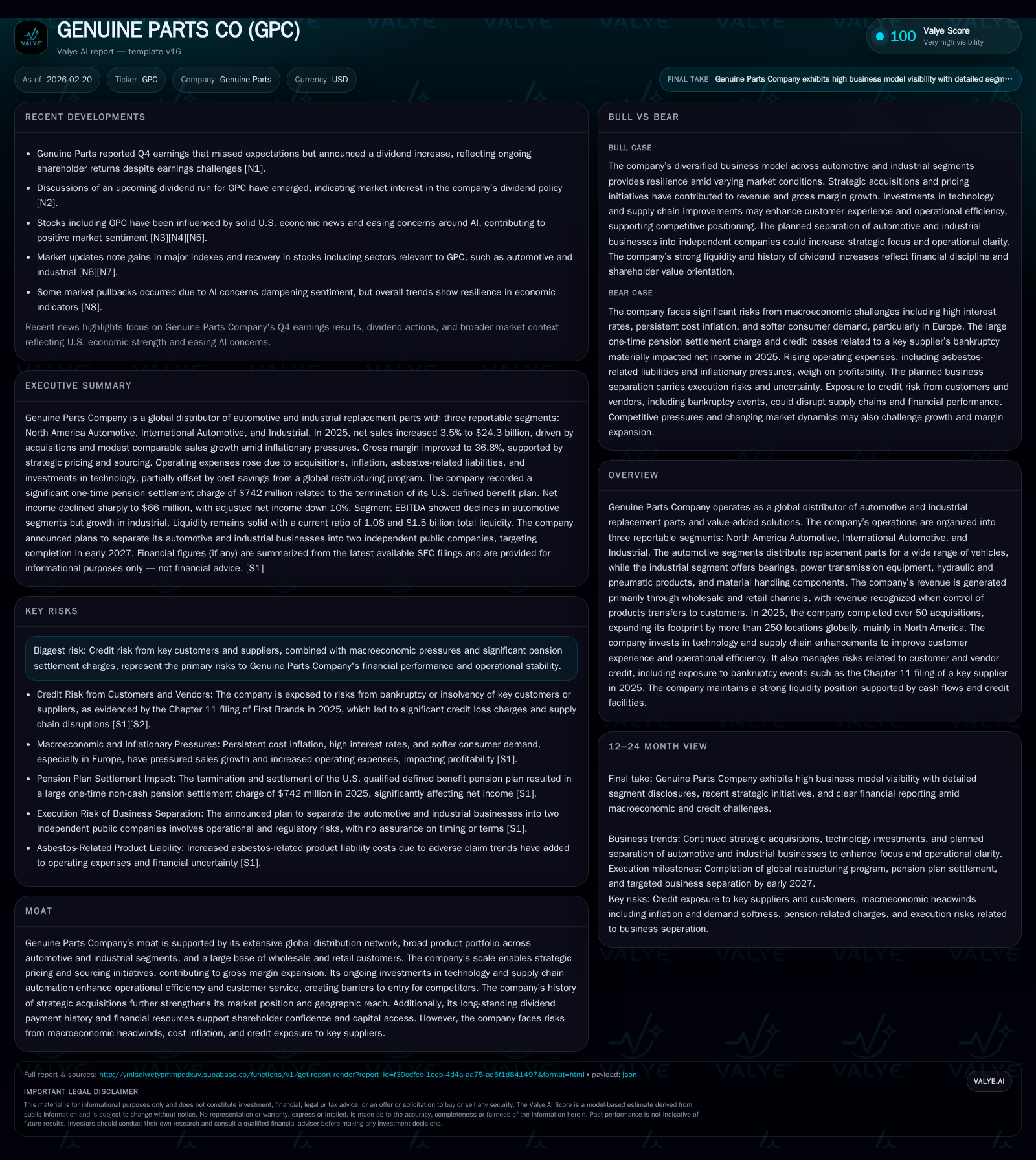
Genuine Parts Company (GPC) executed over 50 acquisitions in 2025, adding roughly 250 locations and driving a 3.5 percent revenue increase despite ongoing macroeconomic challenges and supply chain pressures. However, net income collapsed by nearly ninety-three percent compared to 2024, primarily due to a non-cash $742 million pension settlement charge and elevated interest expenses. While industrial segment margins improved slightly, automotive product lines experienced EBITDA margin compression amidst softer consumer demand and inflationary cost pressures. GPC retained its dividend growth streak but paused share repurchases amid constrained free cash flow, maintaining a sound liquidity position with a current ratio of approximately 1.08 and compliance with debt covenants. Investors should monitor acquisition integrations, credit exposures from vendor bankruptcies, and margin recovery efforts in upcoming quarters.
Robust Acquisition Activity Propels Revenue Growth in 2025
Historical performance (annual)
| FY | Net ($mm) | CFO ($mm) | Capex ($mm) | Net YoY |
|---|---|---|---|---|
| 2025 | 66 | 891 | 470 | -92.7% |
| 2024 | 904 | 1251 | 567 | -31.3% |
| 2023 | 1317 | 1436 | 513 | +11.3% |
| 2022 | 1183 | 340 |
Note: Omitted columns lack sufficient annual XBRL coverage in the provided tags (need ≥2 annual points): Rev, OpInc. Source: SEC companyfacts cache [F1].
Capital returns and efficiency (annual)
| FY | Div ($mm) | Buybacks ($mm) | FCF ($mm) |
|---|---|---|---|
| 2025 | 564 | 0 | 421 |
| 2024 | 555 | 150 | 684 |
| 2023 | 527 | 261 | 923 |
| 2022 | 496 | 223 |
Source: SEC companyfacts cache [F1].
In the fiscal year ended December 31, 2025, Genuine Parts Company markedly expanded its operational footprint, completing over fifty acquisitions that added more than 250 locations globally [S1][N1]. The majority of these deals targeted the North America Automotive segment, focusing primarily on acquiring independent NAPA stores across the United States—a core channel within GPC’s wholesale distribution network known for its expansive reach among automotive repair shops.
Strategically, these acquisitions not only bolstered geographic coverage but also enhanced portfolio diversification with inclusion of Benson Auto Parts in Canadian markets—Ontario and Quebec—offering broader product assortments [S4]. This footprint expansion contributed an estimated incremental net sales uplift of approximately 2.2 percent in aggregate for the year.
Supporting organic growth were comparable store sales increases of roughly 0.9 percent that incorporated a price inflation effect estimated near two percentage points due partly to tariff-related input cost pass-throughs [S1]. These pricing initiatives leveraged the company’s scale advantages to partially offset cost headwinds impacting unit economics across segments.
Collectively, these factors lifted consolidated net sales by $813 million or 3.5 percent year-over-year to $24.3 billion [S1]. The blend of acquisition-driven growth with modest organic gains through inflation-adjusted comparable sales underlines GPC’s dual-channel emphasis through wholesale independence (e.g., NAPA independents) complemented by retail enhancements.
Analyzing the Severe Net Income Contraction Despite Sales Gains
Despite the revenue advance, Genuine Parts experienced a dramatic contraction in GAAP net income from $904 million in 2024 down to just under $66 million in 2025—a decline of about ninety-two point seven percent [F1][S1]. This steep drop owes overwhelmingly to a significant non-cash pension settlement charge totaling approximately $742 million recognized upon terminating its U.S.-qualified defined benefit plan during late-2025 [S16][S1]. This one-time accounting event accelerated recognition of previously deferred actuarial losses into earnings.
Net interest expense also increased materially by nearly seventy percent year-over-year from about $97 million to $164 million due largely to higher average borrowing costs associated with new debts drawn for acquisitions and working capital purposes [S1][S9]. These financing expenses compounded profit pressures.
However, when excluding this extraordinary charge from pension settlement along with other discrete items like credit loss provisions related to vendor bankruptcies, adjusted diluted EPS fell only nine point seven percent—from $8.16 to $7.37—indicating core operational resilience is better than headline GAAP figures suggest [S1][F1]. This distinction between statutory net income plummet versus relatively moderate adjusted EPS decline underscores the importance of separating transient accounting impacts from ongoing business trends.
Segment Performance: Shifts in Automotive and Industrial Dynamics
Segment-level analysis reveals divergent trends across Genuine Parts’ major reporting categories:
North America Automotive: Net sales rose modestly by around three point three percent benefiting largely from acquisitions (approximately two point six percentage points) with remaining growth driven by price increases amidst flat or slightly declining comparable unit volume [S4]. EBITDA declined six point one percent resulting in margin compression from seven point eight percent down to seven point one percent as operating expenses grew faster than revenues [S21][S17]. Cost inflation within personnel wages, freight logistics bottlenecks, and supply chain sourcing challenges adversely affected profitability metrics.
International Automotive: This segment posted a five point four percent sales increase led again by acquisitions (about three point three percentage points) alongside weaker consumer demand globally, especially across European markets grappling with high inflationary environments [S4][S1]. EBITDA decreased approximately four point two percent while margins slipped from ten point two down to nine point three percent as tariffs and elevated operating expenses pressured earnings [S21][S8].
Industrial: Contrasting automotive performance was the Industrial segment exhibiting steady demand supported partially by price realization and sourcing efficiency gains resulting in a four point zero percent EBITDA increase alongside a thirty basis point margin expansion up to twelve point nine percent despite continued U.S manufacturing contraction monitored via PMI data [S21][S8].
This landscape reflects prevailing macroeconomic headwinds yet underscores industrial end-markets' relative strength fueled by value-added product lines such as bearings, power transmission components, hydraulic/pneumatic supplies catering to maintenance/replacement needs [S4].
Cost Inflation, Inflationary Pricing, and Margin Development
Gross profit increased approximately four point nine percent year-over-year driven primarily by revenue growth plus benefits from ceased inventory write-downs seen prior year (notably no $62 million inventory charge repeat) alongside strategic tariff-induced price elevation programs [S10]. Gross margin improved fifty basis points to thirty-six point eight percent compared with thirty-six point three last year indicating successful partial absorption of raw material cost increases through pricing agility.
Operating expenses grew disproportionately at +9.4% outpacing gross profit expansion due principally to rising personnel-related costs including healthcare subsidies, rent escalations due to lease renewals, freight demands premiums heightened by logistics complexity post-acquisitions as well as increased depreciation & amortization charges (+31.9%) reflecting recent investment & integration activities [S10][S22]. An asbestos-related product liability charge also intensified selling administrative expense line items by about $103 million following adverse claim trends impacting accruals provisionally [S10][S6][S7].
The overall operating leverage effect was negative leading North America Automotive & International Automotive segments into EBITDA margin compression territory while Industrial benefited somewhat from cost discipline.
Key Risks: Credit Exposure, Pension Charges, and Legal Liabilities
A significant risk exacerbating near-term earnings volatility stemmed from credit exposure tied to First Brands Group’s September 2025 Chapter 11 bankruptcy filing—a long-standing vendor underpinning automotive parts supply chains [S16][S2]. Consequent reserve provisioning included a substantial $151 million impairment recognized against trade receivables reflecting expected credit losses due to uncertain reimbursement prospects.
Moreover, asbestos-related litigation remains an unresolved legacy risk requiring complex discounted actuarial modeling predicated on claim frequency assumptions and joint/several liability legal frameworks varying state-by-state across the U.S., contributing an increase in accruals totaling roughly $107 million during the year bringing total measured liabilities close to $317 million—discounted at just above four point one eight percent [S7][S5][S6]. Substantial insurance recoveries partially mitigate overall exposure but ongoing claims backlog introduces uncertainty impacting operating expense volatility.
The one-time pension settlement charge discussed earlier represents another pivotal financial risk factor albeit now removed entirely following plan termination effectively closing future obligations while crystallizing historic unamortized actuarial losses into net income impact during fiscal year-end accounting [S16].
Capital Allocation Patterns: Dividends Up, Buybacks Paused
Reflecting confidence in long-term fundamentals despite short-term earnings strain Genuine Parts sustained shareholder distributions including a three percent raise in quarterly dividends during FY2025 marking the sixty-ninth consecutive year of increasing dividends since going public [S13][N8]. Total dividend payments approached $564 million representing continued prioritization of stable returns amidst profit challenges.
Conversely share repurchase activity halted completely relative to prior years which saw purchases totaling about $150 million in FY2024 amidst cautious preservation of liquidity amid declining cash flows related mostly to lower net income & working capital fluctuations linked with first brand fallout [F1][S24][N1]. This signals prudent capital management balancing investments versus returning cash amid more volatile underlying performance.
Free cash flow remained positive at approximately $421 million after capex expenditure ($470 million) necessary for ongoing technology upgrades supporting supply chain automation efforts enhancing operational efficiency and customer digital experience enhancement programs [F1][S18][N1].
Liquidity Position and Balance Sheet Resilience
As of December 31, 2025 GPC held cash balances totaling around $477 million coupled with undrawn revolver capacity near $1.1 billion yielding total available liquidity around $1.5 billion providing ample cushion for funding working capital needs including supply chain finance programs backed by supplier collateral arrangements reviewed quarterly [F1][S9][S19][N1].
The current ratio calculated stands near an adequate level of approximately 1.08 reflecting current assets exceeding current liabilities marginally as both have grown harmoniously amid expansion activities though vigilance is warranted given sizeable accounts payable related borrowings tied into commercial paper notes now outstanding at about $343 million alongside short-term revolving line draws [$600M] [F1][S19].
Total debt increased moderately climbing toward almost $4.8 billion due mostly to incremental borrowings supporting acquisition funding combined with commercial paper utilized for refinancing maturing senior notes; however GPC remains compliant with all covenant thresholds underpinning BBB-/Baa1 rated unsecured debt base featuring weighted average borrowing costs elevated marginally above four percent consistent with market conditions for investment-grade corporates exposed moderately above rate cycles recently experienced [F1][S9].
Outlook and Milestones to Monitor in Upcoming Quarters
While explicit company guidance remains undisclosed currently investors should monitor several key metrics signaling operational health including:
- Integration execution progress for newly acquired independent dealerships especially within North American automotive channel implying continued roll-up advantages or potential dilutive risks depending on synergies achieved.
- Resolution trajectory for vendor credit exposures evolving from First Brands bankruptcy case influencing future bad debt reserves or receivables recoverability given materiality disclosed.
- Success of margin restoration strategies aimed at offsetting ongoing personnel inflationary pressures leveraging technology investments introduced recently enhancing labor productivity metrics.
- Comparable store sales trends reflecting consumer discretionary spending propensity particularly within European automotive markets exposed amid soft demand environments compounded by macroeconomic uncertainty.[N2][N3][N4]
- Industrial segment order intake correlating with broader U.S manufacturing PMI improvements forming potential bottoming signal supportive of incremental market share capture opportunities.
Absent formal forward-looking statements evaluating these operational indicators will be critical for understanding Genuine Parts’ trajectory through mid-2026 as it strives toward sustainable profit normalization balancing legacy claim liabilities alongside ambitious growth aspirations.
Disclaimer: This analysis is based exclusively on publicly available information including SEC filings and market reports as referenced herein. It does not constitute investment advice or recommendations.
Disclaimer: This is research-only, informational analysis and not investment advice. It may include AI-generated interpretation and general industry context. Always verify important details using primary sources.

Comments