
Phillips 66 Strengthens Refining Edge with Strategic Midstream Expansion
The integration of WRB Refining LP assets supports Phillips 66's expanded operational scale and cash flow resilience amid market volatility.
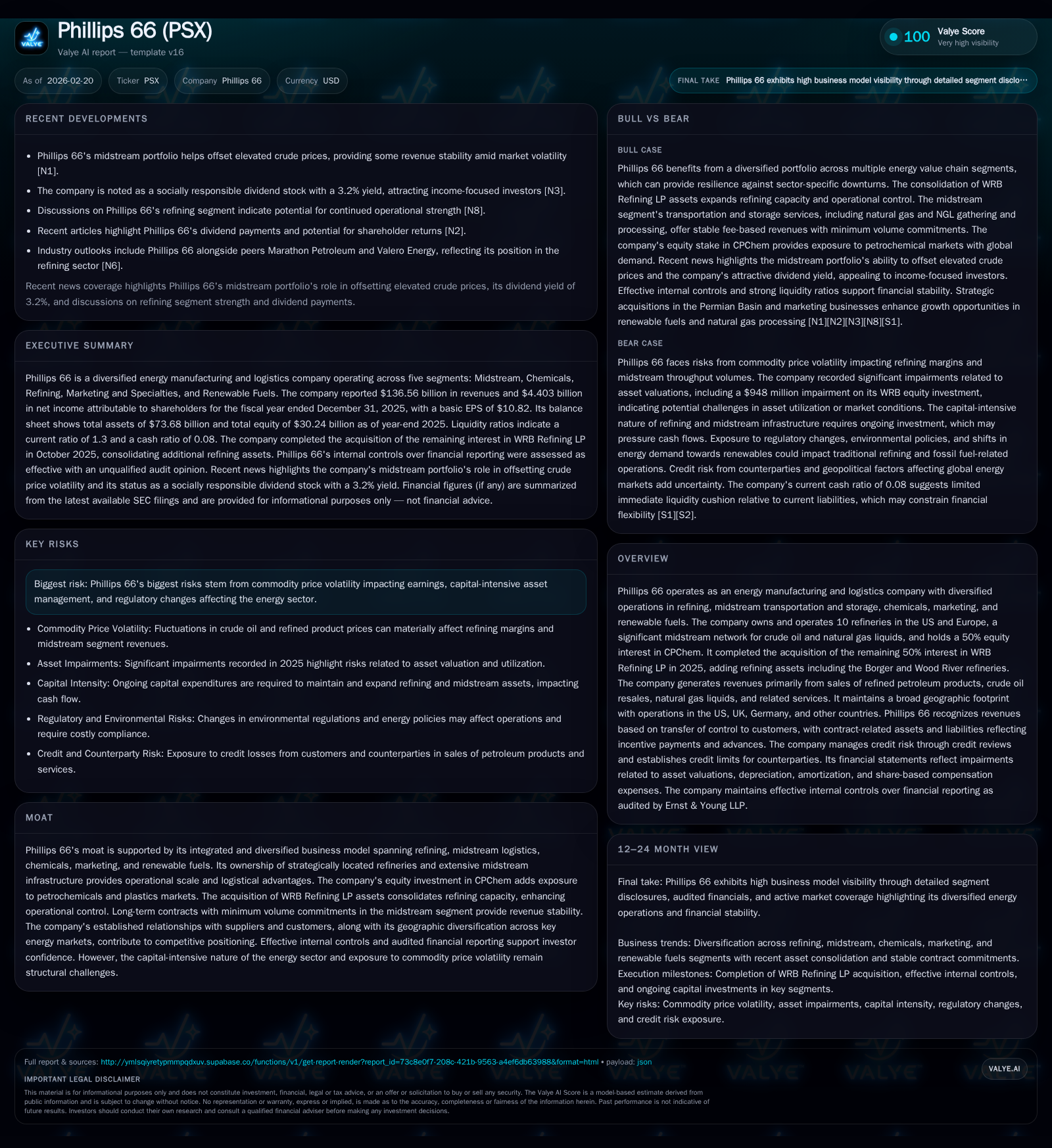
Phillips 66 posted a notable net income recovery in FY2025, doubling its profitability year-over-year to $4.4 billion, buoyed by the acquisition and consolidation of WRB Refining LP assets. This strategic expansion enhanced refinery utilization and margin capture, while its midstream operations delivered steady fee-based revenues through minimum volume commitment contracts mitigating commodity price swings. The company's equity stake in CPChem and renewable fuels segments provides diversification beyond refining, complemented by strong liquidity and disciplined capital allocation with dividends totaling over $1.9 billion and share repurchases exceeding $1.2 billion in 2025. Regulatory compliance including EPA consent decrees remains a managed risk backdrop. Looking forward, operational integration, evolving regulatory landscapes, and market demand shifts will be key growth drivers to monitor.
2025 Results: Earnings Bounce Back with Operational Scale
Historical performance (annual)
| FY | Net ($bn) | CFO ($bn) | Net YoY |
|---|---|---|---|
| 2025 | 4.4 | 5.0 | +108.0% |
| 2024 | 2.1 | 4.2 | -69.8% |
| 2023 | 7.0 | 7.0 | -36.4% |
| 2022 | 11.0 | 10.8 |
Note: Omitted columns lack sufficient annual XBRL coverage in the provided tags (need ≥2 annual points): Rev, OpInc, Capex, FCF. Source: SEC companyfacts cache [F1].
Capital returns and efficiency (annual)
| FY | Div ($mm) | Buybacks ($bn) | ROE% |
|---|---|---|---|
| 2025 | 1922 | 1.2 | 15.1 |
| 2024 | 1882 | 3.5 | 7.7 |
| 2023 | 1882 | 4.0 | 22.9 |
| 2022 | 1793 | 1.5 | 37.4 |
Source: SEC companyfacts cache [F1].
Phillips 66 reported a substantial rebound in net income for FY2025, posting $4.4 billion compared to $2.12 billion in FY2024, more than doubling year-over-year performance [F1]. This sharp improvement stemmed primarily from the integration of WRB Refining LP assets acquired fully in 2025 including the Borger and Wood River refineries, which expanded refining capacity significantly [N3][S1]. Operating cash flow also increased by approximately 18%, reaching $4.96 billion, reflecting both stronger margin capture and enhanced volume throughput across segments [F1]. The company's return on equity stabilized near a solid 15%, indicative of efficient capital deployment within a volatile macro environment [F1]. These gains were supported by increased utilization rates at key refineries along with midstream logistics contributions that collectively leveraged cost of goods sold (COGS) dynamics favorably.
Refining Segment Transformation: Impact of WRB Acquisition
The strategic acquisition of the remaining 50% interest in WRB Refining LP completed in early 2025 marked a milestone for Phillips 66’s refining portfolio, bringing Borger and Wood River fully under direct control [N3][S1][N10]. This consolidation not only bolstered processing capacity but enabled improved refinery utilization management — allowing Phillips 66 to optimize feedstock slates and enhance operational synergies across its broader US refining network [N10]. Enhanced control reduced reliance on third-party arrangements prevalent in joint ventures, thus improving margin transparency and lowering downstream operating expenses by capturing integration efficiencies.
Refinery utilization rates trended upward post-acquisition amid recovering demand, delivering stronger throughput volumes despite ongoing sector headwinds including periodic maintenance closures elsewhere in the system. Integration efforts aligned workflows on reliability enhancements and catalyst optimization supporting more consistent yield patterns favoring light product outputs which command higher market value. These factors contributed to an overall positive trajectory for refining margins while upgrading Phillips 66’s resilience against cyclical commodity price swings.
Midstream Portfolio Defense Against Crude Price Volatility
Phillips 66’s midstream segment played a pivotal role in cushioning earnings susceptibility inherent to upstream market fluctuations during 2025. The company’s extensive pipeline network for crude oil and natural gas liquids operates under long-term contracts that include minimum volume commitments with fixed pricing components etched through at least the mid-2030s horizon [N3][S15][F1]. This structural contract design introduces considerable revenue stability irrespective of short-term commodity price shocks.
This business model yields steady fee-based income streams that reinforce operating cash flows alongside the more variable refining earnings. Notably, Phillips 66 has augmented receivables securitization capacity to $1.25 billion as part of its diversified working capital management strategy enhancing liquidity buffers against market disruptions [S6][S7]. Such layering of logistics assets also facilitates optimized product routing thus reducing costs while maximizing throughput efficiency across geographic touchpoints.
Chemicals and Renewables: Diversification for Long-Term Growth
Beyond the core refining and midstream operations, Phillips 66 maintains a significant foothold in chemicals via its approximately 50% stake in Chevron Phillips Chemical Company (CPChem) [S1]. Exposure to petrochemical markets introduces a beneficial cyclical diversification vector given differing demand drivers compared to fuel products.
Moreover, Phillips 66 has made concerted investments into renewable fuels segments aligning with shifting regulatory imperatives favoring lower carbon intensity fuels. Growth here is supported by federal incentives stimulating renewable feedstocks adoption as well as incremental capex toward biofuel production expansions documented in management commentary . This segment stands out as a strategic hedge against potential tightening environmental regulations impacting traditional hydrocarbons.
Capital Structure, Liquidity, and Debt Management Overview
Phillips 66 showcases robust liquidity positioning anchored by a $5 billion revolving credit facility with maturity extended through February 2029 plus options for increase or renewal subject to lender consents [S4][S5]. The company operates a commercial paper program backed by this facility currently with about $200 million outstanding at year-end reflecting prudent short-term debt utilization relative to total capitalization limits.
Further enhancing flexibility is the Receivables Securitization Facility recently enlarged from $500 million to $1.25 billion supporting working capital needs through sale of receivables to bankruptcy-remote subsidiaries pledging collateral against borrowings [S6][S7]. Such securitization arrangements reduce reliance on traditional debt while optimizing balance sheet efficiency.
Long-term debt maturities have been managed pro-actively; notably, the floating rate term loan outstanding at mid-2024 was prepaid fully by end-2025 releasing near-term refinancing risk [S8]. Additionally, Phillips 66 issued junior subordinated notes totaling $2 billion due 2056 at favorable fixed coupons strengthening hybrid capital structure layers without immediate cash burden [S18].
Capital Allocation: Dividends, Buybacks, and Return on Equity Trends
Reflecting strong free cash flow generation post-acquisition integration, Phillips 66 maintained steady dividend payments totaling approximately $1.92 billion during FY2025 while deploying $1.21 billion toward share repurchases—down notably from prior years’ elevated buyback levels signaling capital discipline aligned with business fundamentals [F1][N4][N5]. Dividend yield consistency near 3.2% underlines shareholder return focus balanced against reinvestment needs.
This calibrated approach helped sustain a respectable return on equity near 15%, validating efficient equity usage amid ongoing sector cyclicality [F1]. Buyback tapering may suggest management prioritizing liquidity conservation given lingering uncertainties around commodity price trajectories or capex outlooks tied to greenfield projects.
Regulatory Environment and Legal Headwinds in Environmental Compliance
Phillips 66 faces ongoing regulatory scrutiny centered on environmental mandates enforced primarily through EPA consent decrees tied to Federal Clean Air Act compliance at its U.S.-based refineries [S1][S9]. These agreements impose stringent emissions controls entailing possible stipulated penalties contingent on violations detected during routine reporting.
The company also contends with active litigation stemming from alleged Clean Water Act breaches particularly relating to wastewater permitting at its Los Angeles refinery complex—a material but managed exposure given current legal posture including trial outcomes pending further appeals processes [S1].
Risk management protocols incorporate comprehensive internal controls over reporting coupled with accrual buffers calibrated to reasonably estimable remediation costs consistent with industry norms mitigating unexpected financial impact potential while maintaining operational continuity.
Future Growth Catalysts and Sector Challenges to Monitor
Looking ahead, Phillips 66’s growth orientation hinges on successful operational leverage realization from the WRB asset integration alongside continued ramp-up within midstream throughput volumes benefiting from contractual volume floors extending into the next decade [N3][N10][S26].
Renewable fuels segment expansion backed by favorable regulatory tailwinds—including Inflation Reduction Act provisions—represent incremental upside avenues complementing petrochemical earnings diversity facilitated via CPChem’s broad product portfolio exposure. Capital expenditures targeting margin-enhancing projects and modernization initiatives will be critical for sustaining refinery competitiveness amid tightening production cost curves [S25].
Conversely, potential caps on growth arise from inherent capital intensity constraints especially as energy transition-related investments compete for allocation amidst fluctuating crude oil pricing environments that directly influence refining spreads. Ongoing geopolitical uncertainties affecting supply-demand balances could amplify volatility challenging forecast assumptions.
Monitoring environmental regulatory developments remains essential given their capacity to drive compliance expenditures or limit operational flexibility impacting utilization rates. Finally, maintaining optimal leverage ratios within covenant thresholds will remain a priority balancing financial prudence with competitive investment needs under prevailing economic conditions.
Disclaimer: This analysis is prepared exclusively for informational purposes derived from publicly available filings and news sources as of February 20, 2026. It does not constitute investment advice or an endorsement of any security or sector strategy.
Disclaimer: This is research-only, informational analysis and not investment advice. It may include AI-generated interpretation and general industry context. Always verify important details using primary sources.

Comments