
Boyd Gaming's Dynamic Performance and Capital Strategy Unpacked
A contrast between soaring net income and shrinking operating income spotlights Boyd Gaming's evolving financial landscape in 2025.
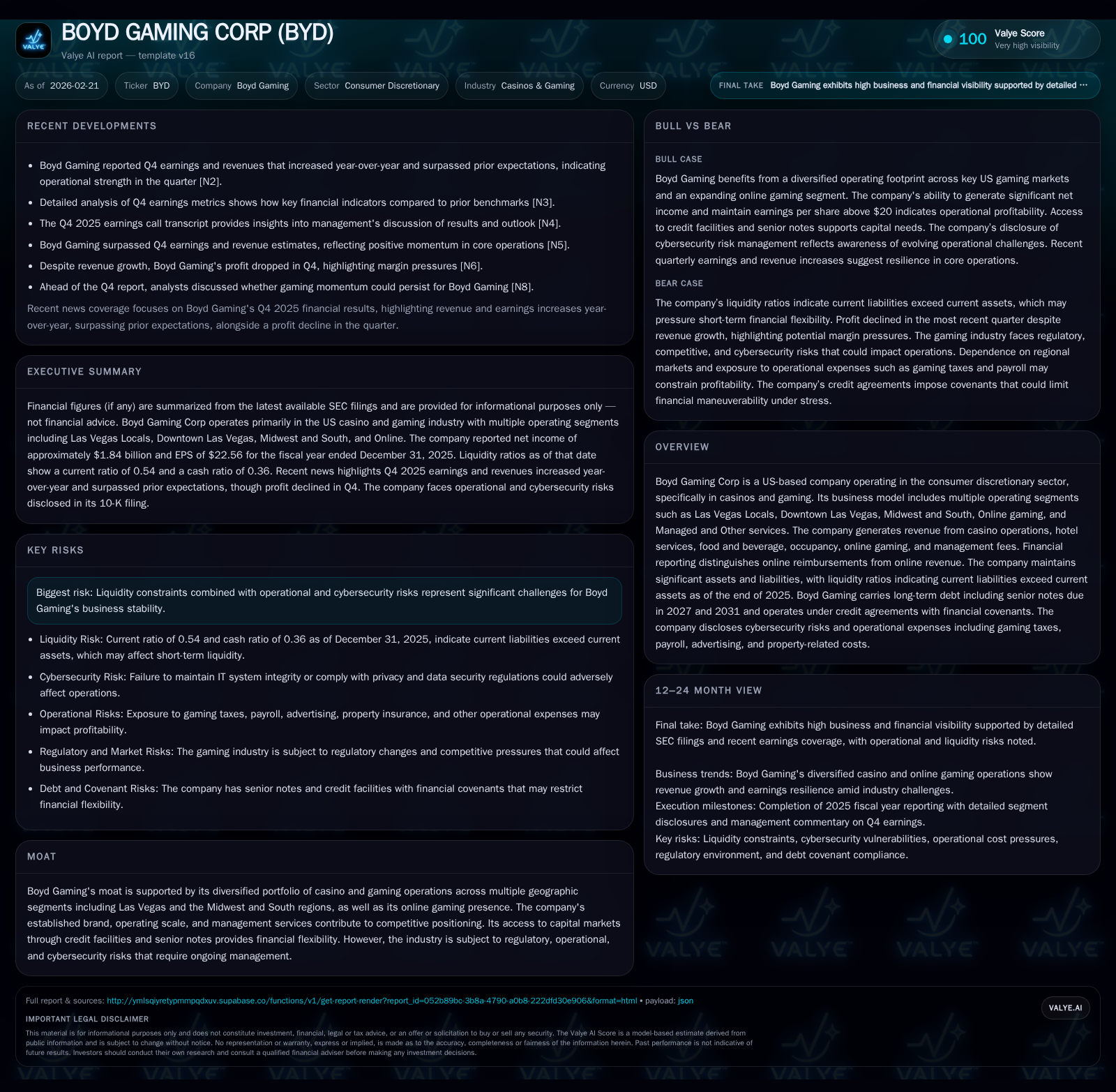
Boyd Gaming reported a striking 219% jump in net income for fiscal 2025, reaching $1.84 billion, despite a 19% drop in operating income to $748 million. This divergence stems from non-operating gains and debt-related factors, amid increased operational costs including gaming taxes and payroll. The firm's capital strategy included aggressive share repurchases totaling over $778 million and higher capital expenditures focused on property upgrades. However, liquidity constraints are accentuated by a current ratio of 0.54 and sizeable long-term debt maturing in 2027 and 2031, necessitating cautious covenant monitoring and cash flow management. Segment-wise, diversified revenues from Las Vegas locals, Midwest & South, and growing online gaming highlight both growth opportunities and regulatory cost pressures.
Earnings Evolution: Revenue and Income Trends Through 2025
Boyd Gaming exhibited a paradoxical earnings profile for fiscal year 2025. While operating income contracted by nearly one-fifth (-19.3%) to $748 million, its net income soared by a remarkable 218.9% to approximately $1.84 billion [F1]. This dramatic net income escalation juxtaposed with declining operating earnings signals significant influence from non-operating items—such as favorable debt refinancing effects or one-time gains—beyond core casino operations.
The following table summarizes key annual financials from FY2018 through FY2025 with YoY percentage changes where calculable:
Historical performance (annual)
| FY | Net ($mm) | CFO ($mm) | OpInc ($mm) | Capex ($mm) | Net YoY |
|---|---|---|---|---|---|
| 2025 | 1843 | 977 | 748 | 588 | +218.9% |
| 2024 | 578 | 957 | 928 | 400 | -6.8% |
| 2023 | 620 | 915 | 902 | 374 | -3.0% |
| 2022 | 639 | 976 | 981 | 269 |
Note: Omitted columns lack sufficient annual XBRL coverage in the provided tags (need ≥2 annual points): Rev. Source: SEC companyfacts cache [F1].
Capital returns and efficiency (annual)
| FY | Div ($mm) | Buybacks ($mm) | FCF ($mm) |
|---|---|---|---|
| 2025 | 58 | 778 | 388 |
| 2024 | 63 | 686 | 557 |
| 2023 | 64 | 413 | 541 |
| 2022 | 48 | 542 | 707 |
Source: SEC companyfacts cache [F1].
Note: Revenue figures for recent years were not disclosed within the provided tags; therefore, they are omitted.
Operating cash flow remained fairly consistent around $976 million in 2025, supporting substantial capex growth of nearly 47% YoY focused on asset enhancements [F1].
Underlying Factors Driving Historical Growth and Operational Shifts
Boyd Gaming’s operational dynamics reflect shifts at both the property level and corporate initiatives impacting margins.
Gaming taxes, payroll expenses, utilities, advertising, property insurance, and other operational costs have inflated overall expense burdens [S1]. These are standard cost categories forming part of "other segment expenses" beyond direct casino wins or hotel occupancy revenues [S1]. The company’s discussion highlights that these costs pressure property-level EBITDA margins—commonly referred to as the gaming flow-through metric which measures incremental profit from additional gaming revenue after variable expenses.
Notably, Boyd’s adoption of clearer reporting distinguishing "online reimbursements" from online gaming revenue better isolates true top-line growth from pass-through items reimbursed by partners rather than earned revenue [S22][N2]. This change affects comparability but clarifies revenue quality within its rapidly growing online segment.
Four primary segments shape Boyd’s top-line performance: Las Vegas Locals, Downtown Las Vegas, Midwest & South operations, Online gaming presence, and Managed services including third-party management fees—all presenting varying margin profiles based on regional regulatory environments and consumer habits [S19][S22][N2].
Emerging Liquidity Constraints and Debt Profile Analysis
Liquidity ratios at year-end 2025 reveal stress points; total current assets ($531 million) fall significantly short of current liabilities ($979 million), yielding a low current ratio near 0.54—a level indicative of balance sheet tightness regarding short-term obligations [F1][S5].
Boyd holds substantial long-term debt including senior notes due December 2027 ($475 million face value) and June 2031 ($475 million face value), supplemented by revolving credit facilities governed under stringent covenants making EBITDA leverage ratios critical for compliance [S5][S6][S7][N3].
The recently amended credit agreement features an "accordion" provision allowing further borrowing contingent on maintaining a Consolidated First Lien Net Leverage Ratio below specified thresholds (e.g., not exceeding around 3x EBITDA) while mandating annual amortizations starting mid-2027 plus excess cash flow sweeps prepaid if leverage breaches occur [S6][S9]. Interest rates float based on SOFR or base rates plus margins determined by leverage tiers.
This layered debt structure requires vigilant covenant monitoring amid operational volatility as short-term liquidity constraints could pressure working capital management.
Diversified Segment Contributions Including Online Gaming Highlights
Revenue diversification across segments provides resilience yet entails unique challenges:
- Las Vegas Locals: Anchored by loyal regional clientele generating stable casino win flows but facing rising payroll and regulatory tax burdens.
- Downtown Las Vegas: Historical flagship venues experiencing competitive pressures yet benefiting from tourist traffic.
- Midwest & South: Varied state regulations influence margin variability; some properties benefit from newer market entries.
- Online Gaming: Rapidly expanding segment with notable revenue growth; however, online reimbursement accounting adjustments emphasize the need for granular margin tracking separate from gross wagers passed through partners [S22][N2].
- Managed Services: Fees earned by managing properties owned by third parties contribute steadily without direct exposure to gambling wins volatility.
Segmental EBITDAR analysis—earnings before interest, taxes, depreciation/amortization, rent—helps isolate operating profitability trends geographically but is not directly disclosed here.
Capital Allocation: Share Repurchases, Dividends, and Investment Spend
Boyd Gaming aggressively pursued shareholder returns in fiscal 2025 via stock buybacks totaling approximately $778 million excluding applicable excise taxes—a significant increase versus past years ($686M in 2024; $413M in 2023) [F1][S3]. Concurrently declared dividends reflected stability with a quarterly dividend rate solidifying at $0.20 per share payable April 15, 2026 [S3]. Dividend payments approximated $58 million for the year.
Capex surged nearly 47% to $588 million focused on property refurbishments and technology enhancements indicating prioritization of experiential quality to sustain customer engagement amid competitive landscapes [F1].
The company’s return on equity stood impressively high at around 70.7%, suggesting efficient deployment of invested capital albeit influenced partly by leveraged balance sheet effects given rising debt levels [F1].
Regulatory and Cybersecurity Risks Impacting Stability
Comprehensive risk disclosures emphasize tightening regulatory scrutiny impacting gambling operations across jurisdictions where Boyd operates—with frequent licensing renewals alongside gaming tax revisions challenging profitability assumptions [S4][S8][S21].
Cybersecurity risks receive detailed attention due to reliance on complex IT infrastructures supporting digital wagering platforms alongside traditional operations [S4][S21]. Failures or breaches could disrupt operations or erode trust requiring robust internal controls embedded across IT governance frameworks.
These considerations form ongoing priorities given the sensitive nature of customer data handled within online gaming segments especially as regulatory data privacy regimes tighten nationally in the US.
Forward View: Key Milestones and Financial Covenants to Monitor
While explicit milestones or forward guidance were not available from the provided tags or news sources, key expectations revolve around:
- Sustaining quarterly EBITDA momentum amid rising cost pressures primarily within Las Vegas locals and online segments [N7].
- Compliance with amended credit facility covenants requiring annual amortization commencing mid-2027 plus potential excess cash flow prepayments if leverage thresholds are breached [S6].
- Monitoring segment-specific revenue performances particularly within online gaming where reimbursement separation impacts margin evaluation [N2][S22].
- Tracking free cash flow generation capacity balancing elevated capex spending against shareholder returns remains critical for ongoing financial health.
In sum, Boyd Gaming’s fiscal 2025 portrays a complex financial trajectory blending strong bottom-line results buoyed by non-operating gains against constraining operational earnings challenged by rising costs and liquidity tightness compounded by notable long-term debt maturities requiring judicious financial stewardship moving forward.
This analysis is based solely on publicly available data references cited herein without any investment recommendations or price forecasts.
Disclaimer: This is research-only, informational analysis and not investment advice. It may include AI-generated interpretation and general industry context. Always verify important details using primary sources.

Comments