
Ovintiv Inc. Recalibrates Growth Strategy After Industry Volatility
Ovintiv adapts its capital discipline and operational flexibility to stabilize returns amid shifting commodity cycles.
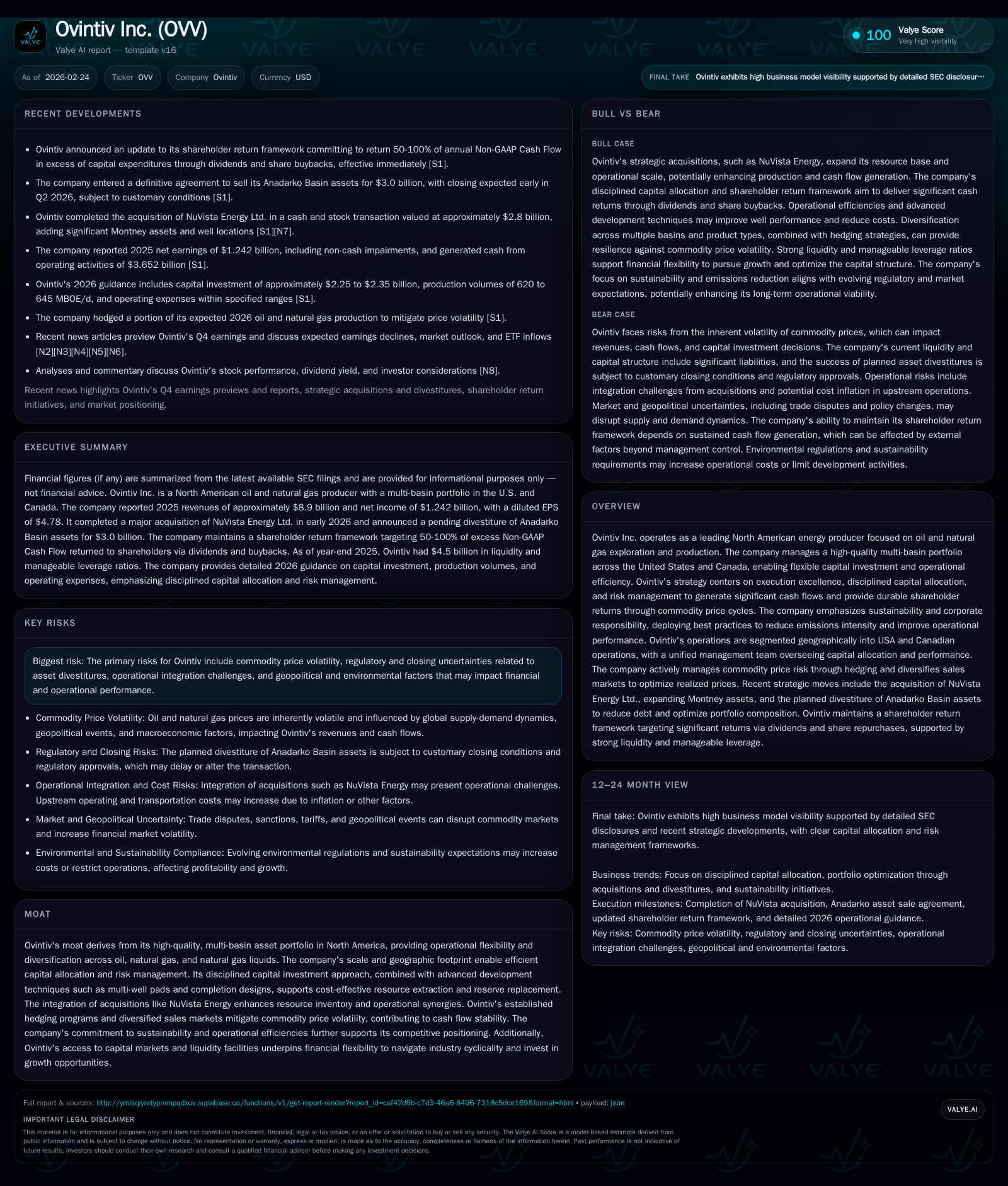
Ovintiv stands out for its multi-basin North American footprint, integrating assets across the US and Canada to optimize capital allocation and manage commodity price risks. Despite a revenue contraction in 2025, the company improved net income and maintained robust cash flow through cost efficiencies and operational leverage. The acquisition of NuVista Energy broadens Ovintiv’s resource base but presents integration complexities amid volatile natural gas markets. Moving forward, disciplined capital spending focused on high-margin production, combined with strategic hedging and sustainability efforts, positions Ovintiv to navigate regulatory uncertainties and market fluctuations while sustaining shareholder returns through dividends and an active buyback program.
Track Record of Growth and Operational Shifts Through 2025
Ovintiv’s performance in the recent fiscal years underscores the challenges of a volatile energy sector balanced against disciplined management approaches. Revenue for the year ended December 31, 2025, stood at $8.91 billion, down 2.7% from $9.15 billion in 2024 [F1]. The decline was primarily driven by commodity price weakening across oil and natural gas markets, compounded by evolving production mix dynamics across the company’s dual North American geographic segments.
Operating income experienced a more pronounced contraction of 28.4%, falling to $1.13 billion from $1.58 billion, reflecting margin pressures as well as elevated costs associated with operational shifts [F1]. Notably, despite this top-line pressure, net income rose by over 10% to reach $1.24 billion—signaling that Ovintiv successfully leveraged cost controls and operational efficiencies such as reserve replacement strategies and enhanced well completion spacing to maintain profitability [F1].
Operating cash flow remained resilient at $3.65 billion but dipped marginally by nearly two percent year-over-year due to reduced revenue but efficient working capital management [F1]. Capital expenditures were prudently scaled back by nearly seven percent to $2.15 billion, emphasizing selective investment prioritizing high-return basins within its portfolio.
Historical performance (annual)
| FY | Rev ($bn) | Net ($bn) | CFO ($bn) | OpInc ($bn) | Rev YoY | Net YoY |
|---|---|---|---|---|---|---|
| 2025 | 8.9 | 1.2 | 3.7 | 1.1 | -2.7% | +10.4% |
| 2024 | 9.2 | 1.1 | 3.7 | 1.6 | -15.9% | -46.0% |
| 2023 | 10.9 | 2.1 | 4.2 | 2.9 | -12.7% | -42.7% |
| 2022 | 12.5 | 3.6 | 3.9 | 3.9 |
Note: Omitted columns lack sufficient annual XBRL coverage in the provided tags (need ≥2 annual points): Capex. Source: SEC companyfacts cache [F1].
Capital returns and efficiency (annual)
| FY | Div ($mm) | Buybacks ($mm) | FCF ($bn) |
|---|---|---|---|
| 2025 | 308 | 307 | 1.5 |
| 2024 | 316 | 597 | 1.4 |
| 2023 | 307 | 426 | 1.4 |
| 2022 | 239 | 719 | 2.0 |
Source: SEC companyfacts cache [F1]. -16% | 2025 | 8.91 | -2.7% | 1.13 | -28.4% | 1.24 | +10.4% | 3.65 | -1.9% | 2.15 | -6.8%
Source: SEC filings [F1]
This financial trajectory showcases Ovintiv’s capacity to adapt through operational leverage while managing cost structures effectively amidst industry headwinds.
Capital Structure Strength: Managing Debt Amid Expansion
Financial discipline remains central to Ovintiv's strategy as it navigates expansion initiatives such as the recent NuVista acquisition alongside ongoing operational funding needs.
As of the end of fiscal year 2025, total long-term debt including current portions stood at approximately $5.20 billion versus equity of $11.20 billion supporting a debt-to-capitalization ratio near a moderate ~32%, or more conservatively approximately 22% when adjusted for cumulative historical impairments per covenant definitions [S4],[S6],[S19]. This level comfortably complies with financial covenants capped at a maximum of 60%, providing a solid buffer amid potentially adverse market scenarios.
Liquidity is ample with about $4.5 billion available comprising committed revolving credit facilities ($3.5B), uncommitted demand lines ($125M), cash reserves ($35M), and access to a recently arranged two-year Term Credit Agreement for approximately $1.2 billion dedicated to funding the NuVista acquisition [S4],[S5],[S7],[S8]. Importantly, the Term Credit facility remained undrawn at year-end but was drawn upon closing of NuVista early in February.
The company operates under investment-grade credit ratings which underpin its favorable borrowing terms with revolving facilities maturing late in the decade (December 2029). No revolver borrowings were outstanding at December-end, though commercial paper issuance totaled roughly $351 million as part of short-term funding strategies [S6],[S13],[S14]. This prudent liability tenor management aligns with long-term financial health preservation while enabling opportunistic capital deployment.
NuVista Acquisition: Strategic Fit and Integration Challenges
In late November 2025, Ovintiv entered into a transformative acquisition agreement for NuVista Energy Ltd., closing officially on February 3, 2026 [N7],[S4],[S7]. The transaction involved approximately C$1.6 billion in cash financed via the aforementioned Term Credit Agreement along with issuance of near-30 million new Ovintiv common shares representing significant equity dilution [N7],[S10].
NuVista's asset base complements Ovintiv's existing multi-basin portfolio by deepening Canadian exposure particularly within Montney shale plays—enhancing diversification across hydrocarbon types (oil, natural gas liquids (NGLs), natural gas) and geological basins that confer flexible capital allocation capabilities during fluctuating commodity prices ,[S29].
Integration efforts will focus on harmonizing drilling schedules, optimizing multi-well pad layouts shared across overlapping fields, consolidating administrative functions under unified corporate governance frameworks, and leveraging combined best practice operating protocols aimed at realizing synergies highlighted during deal announcement phases . However, such integration carries risks tied to aligning different corporate cultures, systems consolidation timelines, workforce integration issues, potential regulatory approvals hurdles linked to Canadian investment conditions as well as ongoing global energy market volatility impacting merger-related expectations [S20],[N7].
Future Growth Outlook: Commodity Price Risks and Basin Diversification
Ovintiv projects total production between roughly 620-645 MBOE/d for full year fiscal '26 emphasizing liquids-weighted output — including about ~205-212 Mbbls/d oil/condensate plus NGL volumes near ~80-85 Mbbls/d alongside natural gas output around ~2000-2100 MMcf/d levels [S18]. This output mix targets maximizing margin-rich hydrocarbon extraction amid uncertain global commodity pricing environments.
The company employs prudent hedging programs locking significant volumes of midstream sales contracts at pre-agreed price points to enhance near-term cash flow predictability alongside mitigating downside risk from natural gas price softness noted in recent earnings previews forecasting Q4 earnings declines compared with earlier quarters [N2],[N3],[N4],[N5]. These hedges serve as critical stabilizers facilitating stable dividend coverage and disciplined free cash generation even when spot prices are volatile.
Diversification benefits from geographic spread alleviate basin-specific regulatory or infrastructure constraints that might otherwise impair continuous production or profitability — underscoring a core moat claim around multi-well pad efficiency gains utilized across shale plays enabling consistent reserve replacement rates critical for long-term sustainability .[F1]
Investor Returns: Dividends, Share Repurchases, and ROE Analysis
Returning value to shareholders remains a stated board priority with quarterly dividends sustained at $1.20 per share annually representing about $308 million disbursed during FY25—roughly flat compared to prior years suggesting stable payout policy aligned with cash flow patterns [F1],[S9],[S21].
Ovintiv's Normal Course Issuer Bid (NCIB) renewal authorizes repurchases up to approximately 22 million shares (around ten percent of public float) over an annual period starting October '25 through October '26; however actual buyback activity slowed toward late FY25 with no shares purchased reported during Q4 under this program [S9]. This discretionary approach correlates with prevailing commodity price uncertainty impacting share price levels making executions less opportune.
The company’s trailing ROE hovers just above eleven percent calculated from net income relative to shareholders’ equity indicating moderate profitability typical among integrated exploration & production firms balancing operational capex intensity against cyclical risks [F1].
Overall capital allocation mixes stable dividends supplemented opportunistically by buybacks during constructive market windows consistent with documented shareholder return framework targeting committing between half to full excess non-GAAP cash flows beyond capex back to investors [S23].
Operational Efficiencies: Multi-Well Pads and Completion Innovations
Operational modernization lies at the heart of Ovintiv’s moat — employing advanced multi-well pad development strategies that reduce per-well costs while maximizing reservoir contact via optimized lateral lengths and carefully calibrated frac stage intensities tailored basin-by-basin for maximal recovery efficiency .
These engineering enhancements reduce drilling cycle times improving reserve replacement ratios critical for sustaining long-term production profiles despite overall lower capital expenditures compared to prior years [F1]. Such innovations also yield environmental benefits through minimized surface disturbance footprint per BOE produced fitting into broader sustainability goals discussed later.
Cultural emphasis on continuous improvement fosters knowledge exchange catalyzing best-in-class drilling/completion designs—tools that maintain project economic viability even when commodity prices compress margins temporarily which happened notably in FY25 operations narratives.
Sustainability Initiatives Impacting Long-Term Competitiveness
Far from rhetoric alone, Ovintiv integrates measurable emission intensity reduction targets within its operational playbook underscoring commitment to carbon footprint lowering mandated increasingly by regulatory regimes spanning U.S.-Canadian jurisdictions.,[S20]
These initiatives involve methane leakage minimization programs utilizing enhanced detection technologies combined with accelerated decommissioning of legacy infrastructure emitting disproportionately. Sustainability also intertwines with cost containment efforts since controlling emissions coincides with more efficient resource usage lowering operating expense per BOE.
Such proactive environmental diligence aids risk mitigation from potential regulatory penalties or forced production curtailments enhancing investor confidence amid growing ESG scrutiny affecting capital access globally.
Key Risks: Regulatory, Market Volatility, and Integration Headwinds
Ovintiv faces multifaceted risk exposure emblematic of mid-cap E&P operators navigating complex externalities beyond purely geological uncertainties.[S20] Commodity price swings remain paramount — sudden oil or natural gas price declines can compress margins abruptly undermining free cash flow generation despite hedging bandwidth limitations requiring vigilance.[N8] Regulatory environment risk is acute given ongoing scrutiny over asset divestitures complicating timely closure potentially delaying synergy realization or necessitating expensive concessions during negotiated deals such as Anadarko divestiture referenced indirectly.[S20] Integration challenges loom following NuVista acquisition encompassing cultural alignment difficulties plus system consolidation overheads that can distract management focus or inflate costs beyond initial forecasts if not managed prudently.[N7], valye_report_excerpt] Geopolitical disruption risks include supply chain interruptions affecting field equipment delivery schedules or fluctuating import tariffs influencing capex execution timelines impacting planned production ramp-ups.[S20] These risks collectively mandate disciplined capital deployment balancing growth aspirations against preserving balance sheet resilience integral to sustainable shareholder return funding capacity.
What to Watch: Upcoming Milestones and Financial Indicators
Market participants should watch Q1-Q2 earnings releases closely for early signs of post-NuVista integration financial impacts including realized synergies' contribution versus transitional expenses.[N1], [N3] Monitoring execution under NCIB share repurchase plans will provide signals on management's conviction regarding equity valuations supporting buyback activations aligned with future cash flow trajectories.[N10], [S9] Capital investment pacing relative to forecasted guidance ($2.25–$2.35B for full year ’26 focused on liquids-rich assets) coupled with realized unit operating costs will indicate how effectively efficiency programs translate into margin improvements after cyclic downturns.[S18] Commodity hedge portfolio updates released quarterly will be critical for assessing stabilization mechanisms underpinning free cash flow reliability amidst volatile natural gas benchmarks.[N2] [S18] Lastly regulatory developments related particularly to asset sale approvals or environmental compliance standards may materially influence medium-term strategic flexibility.[S20] Analysis of these metrics cumulatively will shed light on Ovintiv's capacity to recalibrate growth precisely without compromising financial discipline or shareholder return objectives amidst evolving industry conditions.
Disclaimer: This analysis is prepared solely for informational purposes based on publicly available data and company disclosures as of February 24, 2026 ([F1], [N#], [S#]). It is not investment advice nor a recommendation regarding Ovintiv Inc.'s securities.

Comments