
Labcorp’s Financial Surge and AI Advancements Fuel Laboratory Services Leadership
Labcorp's robust 2025 earnings growth, operational efficiencies, and integration of AI technology reinforce its commanding position in the diagnostics sector.
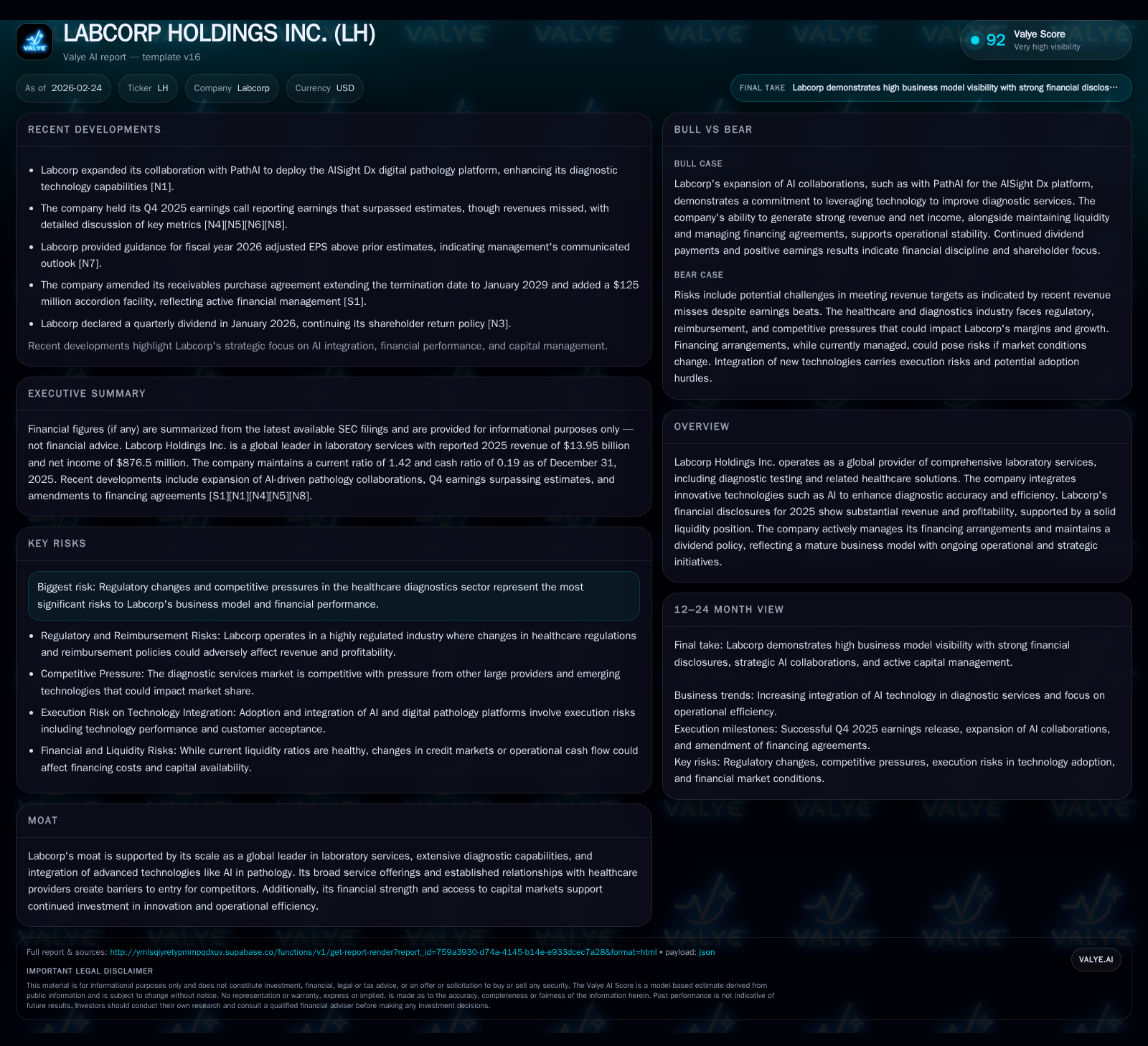
Labcorp Holdings Inc. reported a significant rebound in revenue with a 7.2% year-over-year increase in 2025, paired with a marked 27.4% growth in operating income, highlighting improved operating leverage and cost control. Strategic expansion of its AI capabilities through partnerships like PathAI enhances diagnostic accuracy and workflow efficiency, strengthening its competitive moat. The company actively manages capital structure through receivables financing amendments and balance between dividends and share repurchases, supporting healthy cash flow generation and an approximate 10.2% ROE. Regulatory factors remain critical risks, but Labcorp’s ongoing innovations and financial discipline position it well to maintain leadership in a complex healthcare environment.
Revenue and Profit Trends: From Recovery to Growth Acceleration
Labcorp posted revenues of $13.95 billion for fiscal 2025, marking a healthy 7.2% increase from the $13.01 billion recorded in FY2024 [F1]. This reflects a meaningful rebound after preceding years of uneven performance attributable partly to pandemic fluctuations across testing volumes. Operating income advanced sharply by 27.4% to $1.38 billion from $1.09 billion the prior year, signaling enhanced operational leverage as expenses grew more slowly than revenues [F1]. The net income also improved significantly by 17.5%, climbing to $876.5 million from $746 million [F1]. The outsized growth in operating profit compared with revenue underscores better cost management and productivity gains.
Historical performance (annual)
| FY | Rev ($bn) | Net ($mm) | CFO ($mm) | OpInc ($mm) | Rev YoY | Net YoY |
|---|---|---|---|---|---|---|
| 2025 | 14.0 | 877 | 1641 | 1385 | +7.2% | +17.5% |
| 2024 | 13.0 | 746 | 1586 | 1087 | +7.0% | +78.5% |
| 2023 | 12.2 | 418 | 1328 | 726 | ||
| 2021 | 14.9 | 1279 | 1956 | 1774 |
Note: Omitted columns lack sufficient annual XBRL coverage in the provided tags (need ≥2 annual points): Capex. Source: SEC companyfacts cache [F1].
Capital returns and efficiency (annual)
| FY | Div ($mm) | Buybacks ($mm) | FCF ($mm) |
|---|---|---|---|
| 2025 | 241 | 450 | 1206 |
| 2024 | 243 | 250 | 1096 |
| 2023 | 1000 | 874 | |
| 2021 | 1100 | 1474 |
Source: SEC companyfacts cache [F1].
Note: Some historical YoY percentages omitted where insufficient data points.
Technology Leadership: Expanding AI's Role in Diagnostics
Labcorp continues to deepen its technological edge by expanding collaboration with PathAI to deploy the AISight Dx digital pathology platform [N8][S1]. This platform utilizes advanced machine learning algorithms to enhance diagnostic precision by automating pathology image analysis—a crucial differentiator in reducing turnaround times and improving test reliability within clinical workflows.
This integration exemplifies Labcorp’s strategic move into 'digital pathology solutions' that align with current sector trends emphasizing AI-powered diagnostics for early disease detection and personalized medicine support [N8]. The synergy between Labcorp’s scale and PathAI’s cutting-edge technology fortifies barriers against emerging diagnostic startups.
Operating Performance Evolution: Margin Expansion and Cost Efficiency
The operating margin expansion evident in FY2025 stems from disciplined cost controls alongside growing economies of scale as Labcorp increases test volumes under optimized processes [F1][N1]. Despite revenue growth, capital expenditures declined by 11.3%, easing pressure on free cash flow generation [F1]. Specifically, capex lowered from $489.9 million in FY2024 to $434.5 million in FY2025 without impeding innovation investments, likely reflecting prioritization of technology platforms over heavy facility expansions.
Free cash flow approximated $1.21 billion (operating cash flow minus capex), supporting flexible capital deployment for dividends and buybacks while preserving liquidity buffers.
Growth Catalysts and Industry Challenges: Company-Specific Drivers
Labcorp’s growth is propelled by expanding AI-enhanced testing services that improve client outcomes and workflow efficiency [N9][S4]. Additionally, launching new service lines targeting oncology biomarkers and genetic diagnostics aids revenue diversification [N9]. However, reimbursement rate uncertainties stemming from Medicare/Medicaid policy shifts impose constraints on topline growth potential [S4][S5]. Emerging competition from specialized diagnostics firms also intensifies market pressures.
These dynamics require tactical balancing of innovation-led differentiation against regulatory hurdles that could dampen margins or restrict test adoption pacing.
Capital Structure Dynamics: Debt Refinancing and Liquidity Enhancements
In January 2026, Labcorp amended its receivables purchase agreement extending the funding line maturity date through January 26, 2029, alongside adding a committed $125 million accordion facility increasing capacity up to $825 million [S7][S8][S12]. Removal of the prior SOFR spread adjustment marginally reduces interest expense volatility under benchmark rate fluctuations.
Receivables financing remains a key working capital tool providing short-term liquidity without impacting the consolidated debt profile directly since Labcorp Receivables LLC is a separate creditor entity [S8]. These refinements demonstrate proactive liability management strengthening balance sheet resilience amid clinical volume cycles.
Shareholder Returns: Dividend Commitments and Share Repurchase Patterns
Labcorp sustained its dividend at $0.72 per common share quarterly declared early 2026—the Board reaffirming its commitment to consistent shareholder payouts amidst growth investments [S6][S9][S13]. Share repurchases escalated substantively in FY2025 totaling approximately $450 million compared with $250 million the prior year [F1], evidencing confidence in free cash flow adequacy.
Together these measures support an approximate return on equity of around 10.2%, balancing rewarding shareholders while retaining sufficient internal funds for strategic initiatives [F1]. Volatility in buyback program sizes may reflect tactical flexibility aligned with market conditions.
Near-Term Outlook: Guidance Insights and Key Milestones to Track
While explicit forward guidance beyond adjusted EPS outlook was limited at earnings release [N14], management projected adj. EPS above consensus estimates for fiscal 2026—signaling confidence in continued profitability improvements through efficiency gains and expanding service portfolio [N14][N7].
Key upcoming milestones include quarterly earnings releases where performance versus estimates will clarify trajectory sustainability alongside progress reports on expanded AI platform deployments impacting margin structure.
Regulatory Environment and Risk Considerations in Diagnostics
The regulatory landscape remains a critical risk vector for Labcorp due to evolving compliance requirements including Medicare/Medicaid reimbursement reforms impacting pricing structures [S4][S5]. Legal proceedings disclosed are managed with insurance coverage but expose potential operational uncertainties [S20]. Compliance risk extends across clinical lab certifications essential for operating licenses.
Rapid advancements by niche competitors further stress need for continuous innovation investment balanced against regulatory adherence costs.
Conclusion: Strategic Positioning for Sustained Competitiveness
Labcorp’s financial results for fiscal year 2025 underscore a successful reacceleration phase combining revenue growth with substantial profitability enhancement through operating leverage and prudent cost management [F1][N1]. Its strategic embrace of AI technologies like the AISight Dx platform deepens competitive moats within laboratory diagnostics services bolstered by scale advantages and extensive client relationships.
Capital structure optimizations including receivables financing amendments provide financial flexibility supporting ongoing innovation cycles while maintaining stable shareholder remuneration via dividends and opportunistic buybacks—contributing to a disciplined capital allocation framework.[S7][S9]
Regulatory challenges necessitate vigilant risk oversight amidst reimbursement uncertainty but are counterbalanced by Labcorp’s leading market position reinforced through technology investment pathways essential for future-proofing diagnostic capabilities amid rapid healthcare evolution.
This analysis is intended solely for informational purposes based on publicly available filings and news as of February 24, 2026; it does not constitute investment advice or recommendations regarding Labcorp Holdings Inc.
Disclaimer: This is research-only, informational analysis and not investment advice. It may include AI-generated interpretation and general industry context. Always verify important details using primary sources.

Comments