
Host Hotels & Resorts Navigates Cyclical Luxury Lodging Demand with Stable Cash Flows and Capital Discipline
Host Hotels & Resorts operates a primarily U.S.-based luxury hotel portfolio under long-term management contracts, generating stable cash flows but facing cyclical demand sensitivity and debt-related constraints.
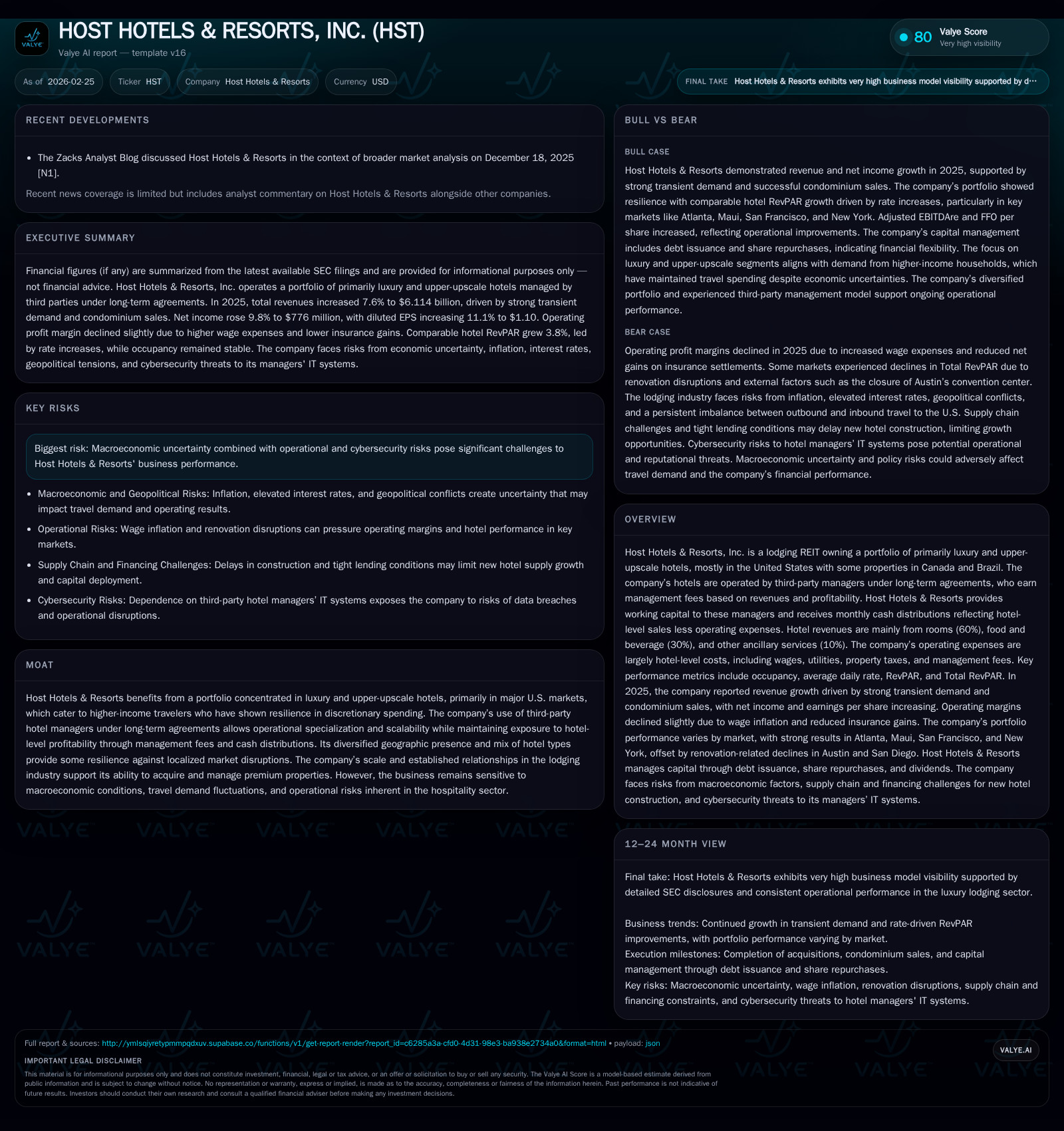
Host Hotels & Resorts, a leading lodging REIT focused on luxury and upper-upscale hotels, reported largely stable financial results in 2025 with revenues near prior peak levels and operating income slightly down amid cost pressures. The company’s portfolio is concentrated in the U.S. with modest international exposure. Looking ahead, moderate RevPAR growth of 2.0–3.5% is expected in 2026 amid ongoing inflation and supply constraints. Host maintains disciplined capital allocation with $623 million in dividends and $205 million in share repurchases in 2025, balanced against approximately $5.1 billion of indebtedness that imposes leverage-related restrictions. Fixed costs and economic cyclicality remain key risks impacting operational flexibility.
Company Overview and Business Model
Host Hotels & Resorts operates as a real estate investment trust (REIT) focused on ownership of luxury and upper-upscale hotels predominantly in the United States, supplemented by properties in Canada and Brazil [S1][S4]. The company's portfolio targets affluent business and leisure travelers who generally maintain discretionary travel budgets compared to other lodging segments.
The company employs a third-party management model whereby hotels are operated under long-term agreements with management companies that earn base and incentive fees linked to revenue and profitability [S4]. Host Hotels provides working capital for hotel-level expenses such as wages, utilities, property taxes, and other operating costs before receiving monthly cash distributions representing net operating results excluding depreciation.
Hotel revenues are primarily derived from room rentals (about 60%), food & beverage sales including group functions (approximately 30%), and ancillary services such as resort fees or parking (around 10%) [S4]. Corresponding hotel operating expenses are labor-intensive: rooms expenses constitute roughly 18%, food & beverage about 24%, other departmental/support expenses near 29%, plus management fees around 5% of revenues [S19].
Historical Financial Performance
Host Hotels demonstrated resilient top-line results maintaining revenues near prior peak levels despite macroeconomic challenges since the pandemic period:
Historical performance (annual)
| FY | Net ($mm) | CFO ($mm) | OpInc ($mm) | Net YoY |
|---|---|---|---|---|
| 2025 | 765 | 1510 | 855 | +9.8% |
| 2024 | 697 | 1498 | 875 | -5.8% |
| 2023 | 740 | 1441 | 827 | +16.9% |
| 2022 | 633 | 1416 | 775 |
Source: SEC companyfacts cache [F1].
Note: Some line items are omitted where multi-year comparability is limited in the structured SEC XBRL dataset; trend columns are shown only when comparable history exists.
Capital returns and efficiency (annual)
| FY | Div ($mm) | Buybacks ($mm) | ROE% |
|---|---|---|---|
| 2025 | 623 | 205 | 11.7 |
| 2024 | 737 | 107 | 10.5 |
| 2023 | 547 | 182 | 11.2 |
| 2022 | 150 | 27 | 9.4 |
Source: SEC companyfacts cache [F1].
Revenues held steady through recent years with a slight decline into fiscal year-end 2025 consistent with shifts reported in earnings transcripts [N1][N3]. Operating income declined modestly (-2.3%) reflecting inflationary cost pressures offsetting stable revenue trends [F1]. Net income rose nearly ten percent on favorable tax treatments and reduced non-operating charges.
Operating cash flow remained strong with slight growth (+0.8%), highlighting robust hotel-level cash generation balanced against capital expenditure needs [F1]. The company increased shareholder returns significantly over recent years with dividends more than quadrupling since FY2022 alongside accelerated share repurchases totaling $205 million in FY2025 at average prices near $15-$16 per share [F1][S7][S18].
Future Growth Outlook
Host Hotels anticipates full-year comparable hotel revenue per available room (RevPAR) growth between approximately 2.0% to 3.5% for calendar year 2026 driven primarily by sustained demand from luxury transient customers who remain relatively insulated from broader economic volatility [S9][N12]. This forecast incorporates ongoing elevated inflation above Federal Reserve targets constraining consumer discretionary spending.
New supply additions are expected to remain below historical averages due to financing challenges amid higher interest rates combined with supply chain disruptions related to tariffs—factors which moderate competitive pressures within key markets where Host holds assets [S9]. However, localized above-average development activity could increase competition selectively.
Risks include macroeconomic headwinds such as recession concerns, geopolitical instability affecting travel patterns, wage-driven cost inflation especially for labor-intensive operations, cyber security risks, travel restrictions including immigration policy changes impacting inbound tourism, and the inherent cyclicality of business travel important to many portfolio properties [S12][S14][S28].
Operationally, reliance on third-party managers introduces variability tied to their performance incentives and constraints in adjusting staffing levels within relatively inflexible labor markets [S19][N1].
Capital Structure and Returns
As of December 31, 2025, Host Hotels carried approximately $5.1 billion of total debt subject to covenants restricting incremental borrowings or dividend payments absent compliance with specified leverage ratios and fixed charge coverage metrics [S5][S8][S17]. Fixed costs including debt service obligations, property taxes, insurance premiums, utilities, wages, and benefits limit operational flexibility since these expenses do not scale down promptly if revenues decline [S17].
The REIT structure requires distribution of at least ninety percent of taxable income annually limiting internal capital retention for acquisitions or expansions thus emphasizing external financing access for growth initiatives or portfolio optimization [S22]. Liquidity remains adequate with consolidated cash balances approximating $770 million at year-end plus available revolving credit facilities though refinancing timing requires close monitoring [F1][S25].
Capital allocation prioritizes shareholder returns via consistent quarterly dividends totaling $623 million in FY2025 alongside share repurchases aggregating $205 million during the year executed under an active buyback program [F1][S7][S18].
Industry Positioning and Competitive Landscape
Host Hotels leverages scale advantages managing a premier collection of upscale city-center and resort properties predominantly affiliated with marquee brands attracting affluent clientele segments that have demonstrated resilience relative to economy-tier chains during downturns [S21]. Third-party operators provide scalable hospitality expertise without diluting ownership control.
The luxury lodging segment is highly competitive involving other lodging REITs with similar tier assets alongside major branded chains competing for loyalty program members as well as boutique independent operators emphasizing unique guest experiences [S21]. Distribution channels continue evolving rapidly with online travel agencies (OTAs) and meta-search platforms increasingly employing AI-driven algorithms challenging direct bookings thereby pressuring margins through commission fees.
New supply without commensurate demand increases could dilute occupancy rates; however current pipeline development remains subdued primarily due to financing hurdles delaying openings especially among upper-tier projects critical for Host's market presence [S9][N13].
Key Metrics And Operational Insights
Management focuses on key industry KPIs including occupancy rates, average daily rate (ADR), RevPAR (revenue per available room), commission expense ratios related to booking channels, and total RevPAR including ancillary revenues—metrics informing price mix shifts or volume changes underlying profitability dynamics relevant for incentive fee calculations affecting Host’s fee-based economics [S19].
Portfolio diversification across mature U.S. gateway cities plus select resort locations mitigates regional socio-economic variability risks while exposing vulnerabilities linked to extreme weather events recently observed (e.g., hurricanes impacting Florida resorts) or temporary international travel advisories reducing inbound tourism volumes [S1][S28].
What To Watch: Analysis
Absent detailed published guidance beyond the provided RevPAR outlook range for calendar year 2026 [S9], investors should monitor quarterly occupancy trends alongside ADR movements reflecting demand composition shifts between group bookings versus higher-yielding transient travelers critical for margin expansion or contraction. Liquidity positioning relative to upcoming debt maturities coupled with capital allocation decisions will signal management's confidence level. Technological adoption influencing booking channel mix or enhancing guest experience may offer operational leverage though execution risks persist. Legal proceedings disclosed present no material financial impacts currently beyond typical operational risks faced by large hospitality owners [S14].
Host Hotels & Resorts stands poised balancing stable yet moderate growth inherent in upscale lodging against external financial headwinds requiring ongoing strategic agility spanning capital markets access, cost containment efforts, portfolio optimization through selective asset dispositions—as demonstrated recently ([N13])—and focus on core market strengths.
This analysis is based solely on publicly disclosed information up to February 25, 2026 including SEC filings and recent news reports without use of non-public data or investment opinions.
Disclaimer: This is research-only, informational analysis and not investment advice. It may include AI-generated interpretation and general industry context. Always verify important details using primary sources.

Comments