
Fidelity Wise Origin Bitcoin Fund's Exposure Balances Growth Potential and Regulatory Complexities
The Fund offers direct bitcoin exposure through a grantor trust structure amid a volatile and evolving regulatory landscape.
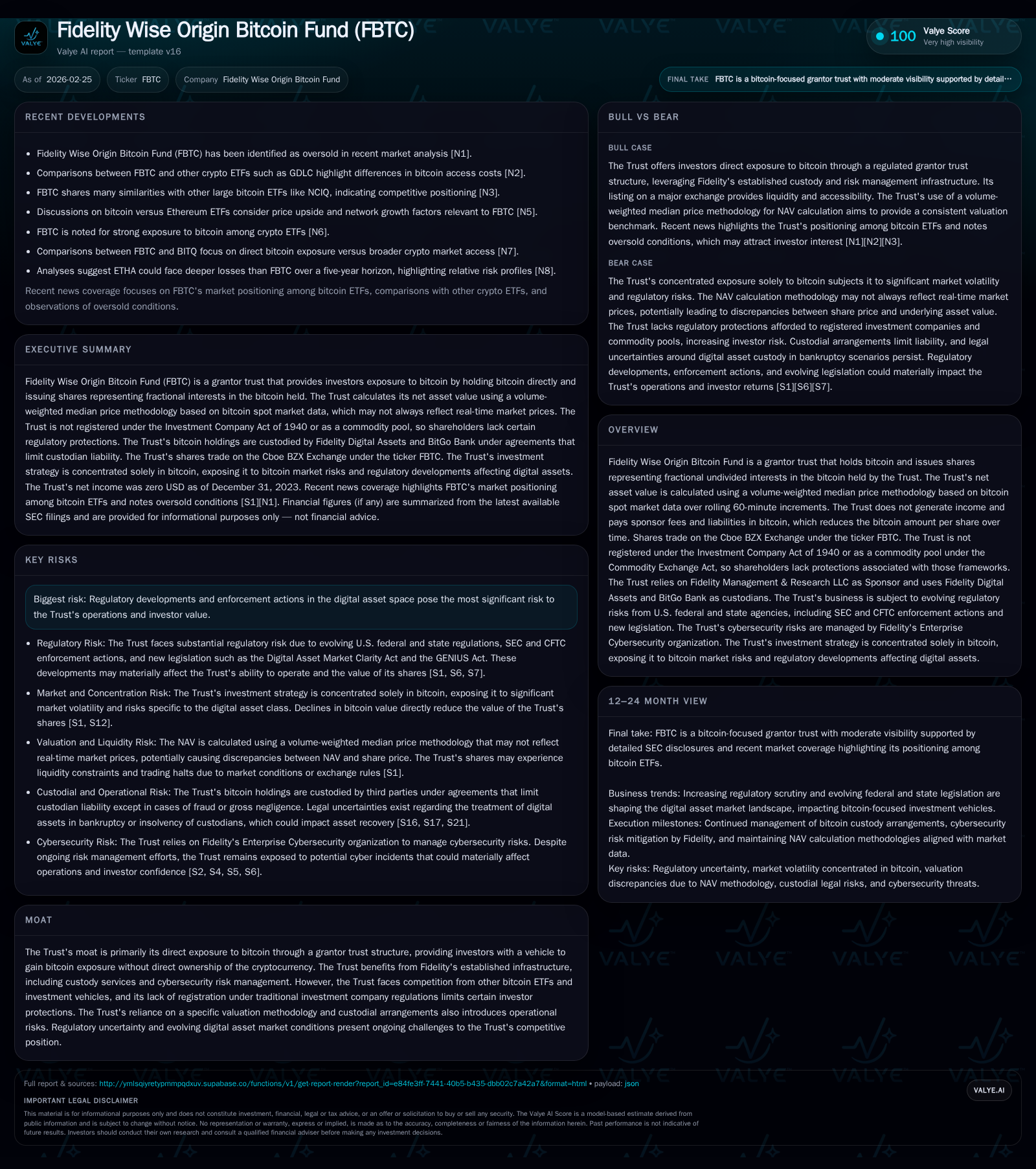
Fidelity Wise Origin Bitcoin Fund (FBTC) provides investors fractional interests in bitcoin held within a grantor trust, leveraging Fidelity's custody and operational infrastructure. Past growth has been driven by increasing demand for bitcoin exposure via regulated securities, but the trust's net asset value and investor returns are inherently tied to bitcoin spot price volatility and diminished by sponsor fees paid in bitcoin. Looking forward, regulatory uncertainties, including SEC enforcement actions and evolving legislation, present significant risks that may impact the Fund’s operations and market value. Operational milestones hinge on regulatory clarity and market stability, while capital allocation shows substantial share repurchases amid negative operating cash flows reflecting fund activities rather than traditional business operations.
Background and Business Model
Fidelity Wise Origin Bitcoin Fund (FBTC) functions as a grantor trust that holds bitcoin directly. Investors gain exposure to BTC via shares that represent fractional undivided interests in the Trust's bitcoin holdings. Unlike ETFs or mutual funds registered under traditional investment laws, FBTC operates outside these frameworks and thus does not benefit from attendant investor protections [S1]. The Trust’s net asset value (NAV) is computed using a volume-weighted median price (VWMP) methodology based on spot market data over rolling sixty-minute intervals. This approach smooths short-term price swings but may lag real-time market movements, especially in volatile conditions [S1].
Historical performance (annual)
| FY | CFO ($bn) |
|---|---|
| 2025 | -0.1 |
| 2024 | -11.7 |
| 2023 | 0.0 |
Source: SEC companyfacts cache [F1].
Note: Some line items are omitted where multi-year comparability is limited in the structured SEC XBRL dataset; trend columns are shown only when comparable history exists.
Capital returns and efficiency (annual)
| FY | Buybacks ($bn) |
|---|---|
| 2025 | 9.8 |
| 2024 | 3.8 |
| 2023 |
Source: SEC companyfacts cache [F1].
FBTC shares trade on Cboe BZX Exchange, providing investors access to bitcoin exposure without requiring direct management or custody responsibilities.
Historical Performance and Financial Overview
Since inception, FBTC’s growth has largely mirrored demand for invested bitcoin exposure via regulated products. However, because it holds bitcoin only and does not generate operational revenue or income—no net income was reported for FY2023—the Fund's financial activity primarily reflects changes in assets under management rather than earnings [F1].
The following table summarizes key financial metrics from recent years:
| FY | Equity (USD bn) | OpCF (USD mn) | Buybacks (USD mn) |
|---|---|---|---|
| 2023 | 0 | 0 | |
| 2024 | 18.8 | -11,705 | 3,833 |
| 2025 | 17.6 | -128 | 9,794 |
Net income remained at zero throughout these periods, consistent with the Fund's structure [F1]. The large negative operating cash flows primarily represent cash movements linked to asset inflows/outflows or operating expenses such as custodian fees rather than earnings-derived operations [F1]. Notably, substantial buybacks reflect Fidelity’s capital return initiatives despite no dividend distributions.
Growth Drivers and Constraints
FBTC's growth potential is closely aligned with interest in bitcoin investment vehicles and broader digital asset adoption trends. Its direct holding structure appeals to investors seeking precise bitcoin exposure minus custody complexities associated with self-managed cryptocurrency holdings [N7].
Conversely, this structure faces limitations:
- Sponsor fees are paid in bitcoin derived from the Trust’s holdings; this gradual attrition reduces underlying BTC per share over time.
- The VWMP NAV calculation methodology can diverge from market prices during rapid price fluctuations affecting secondary market trading spreads.
- Competition from other crypto ETFs and trusts offering diverse fee structures, strategies, or derivatives exposure competes for investor capital [N2][N3].
- The absence of standard investor protections due to nonregistration limits appeal among risk-averse institutional participants.
Regulatory Environment: A Pivotal Factor
Regulatory developments constitute the principal risk influencing FBTC's future viability. The digital asset sector has experienced extensive regulatory scrutiny across multiple fronts:
- The SEC has pursued enforcement actions against leading trading platforms like Coinbase, Binance, and Kraken alleging unregistered securities exchange operations [S8][S10]. Although these actions do not explicitly target bitcoin itself as a security, they impact infrastructure supporting digital asset liquidity.
- Enactment of federal laws such as the CLARITY Act and GENIUS Act in 2025 establish foundational frameworks whose specific implications for FBTC remain uncertain [S25].
- Potential future requirements for registration under securities or commodity laws could precipitate structural changes or force termination if compliance proves impractical [S17][S26].
- Cross-jurisdictional regulatory variance across major markets including EU, China, UK, Japan amplify legal complexity [S17].
- Cybersecurity threats also pose operational risk; Fidelity employs rigorous third-party audits and cybersecurity frameworks but residual risk persists given industry-wide vulnerability to attacks [S29].
These factors collectively underscore a landscape where legislative clarity will shape FBTC's operational parameters going forward.
Outlook: Milestones and Monitoring Points
Explicit guidance on upcoming milestones from FBTC or its Sponsor is limited. Key indicators to monitor include:
- Regulatory rulemaking progress at the SEC regarding crypto exchange-traded products; final rules could enable standardized offerings or impose novel constraints.
- Legislative developments implementing or amending national digital asset statutes.
- Market acceptance shifts reflecting evolving cost-benefit balances among competing BTC investment vehicles.
- Operational enhancements by Fidelity custodians or changes in fee structures impacting net returns to shareholders.
- Continued surveillance of NAV calculation efficacy during periods of elevated volatility.
Capital Allocation and Return Profile
Unlike traditional funds generating distributable income, FBTC exhibits a unique capital flow profile:
- Net income remains zero due to passive holding status [F1].
- Operating cash flow swings align with non-operating activities—such as investor subscriptions/redemptions—and costs related primarily to custody services [F1].
- Significant repurchase programs indicate Fidelity’s preference for returning capital by reducing outstanding shares rather than dividends or reinvestment strategies [F1].
- Reported approximate ROE is effectively zero given negligible net income relative to stockholders’ equity levels.
This reflects an investment vehicle more akin to a commodity holding entity than a profit-generating company.
Competitive Positioning Nuances
FBTC’s moat centers on its linkage directly to underlying bitcoin holdings combined with Fidelity’s robust infrastructure:
- Custodial partnerships with industry leaders Fidelity Digital Assets and BitGo Bank enhance security assurances relative to smaller players [S3].
- However, competition includes other established trusts like Grayscale Bitcoin Trust (GBTC), ETFs offering futures-based exposures (e.g., BITO), and newer issuers rivaling fee efficiency and liquidity profiles [N2][N3][N7].
- Lack of formal investment company registration precludes certain safeguards that institutional investors may require, potentially limiting adoption in regulated portfolios.[S24]
Conclusion
The Fidelity Wise Origin Bitcoin Fund provides investors direct BTC exposure within a structured trust framework leveraging Fidelity's trusted brand and capabilities. While it offers compelling access benefits compared with spot market ownership complexities, its performance correlates tightly to underlying Bitcoin price dynamics offset by declining BTC per share through fee mechanisms. Regulatory uncertainty looms as a critical determinant of future operating conditions and competitive viability. Investors must weigh FBTC’s structural features against inherent digital asset volatility and ongoing government scrutiny.
Disclaimer: This analysis is intended solely for informational purposes without providing investment advice or recommendations. It is based on disclosed company data as of early 2026 combined with industry context without speculative assumptions beyond sourced evidence.
Disclaimer: This is research-only, informational analysis and not investment advice. It may include AI-generated interpretation and general industry context. Always verify important details using primary sources.

Comments