
Nicolet Bankshares Doubles Down on Community Roots and Acquisition Strategy
Examining how Nicolet's community banking ethos and MidWest One merger propel its growth and shape operational priorities amid sector challenges.
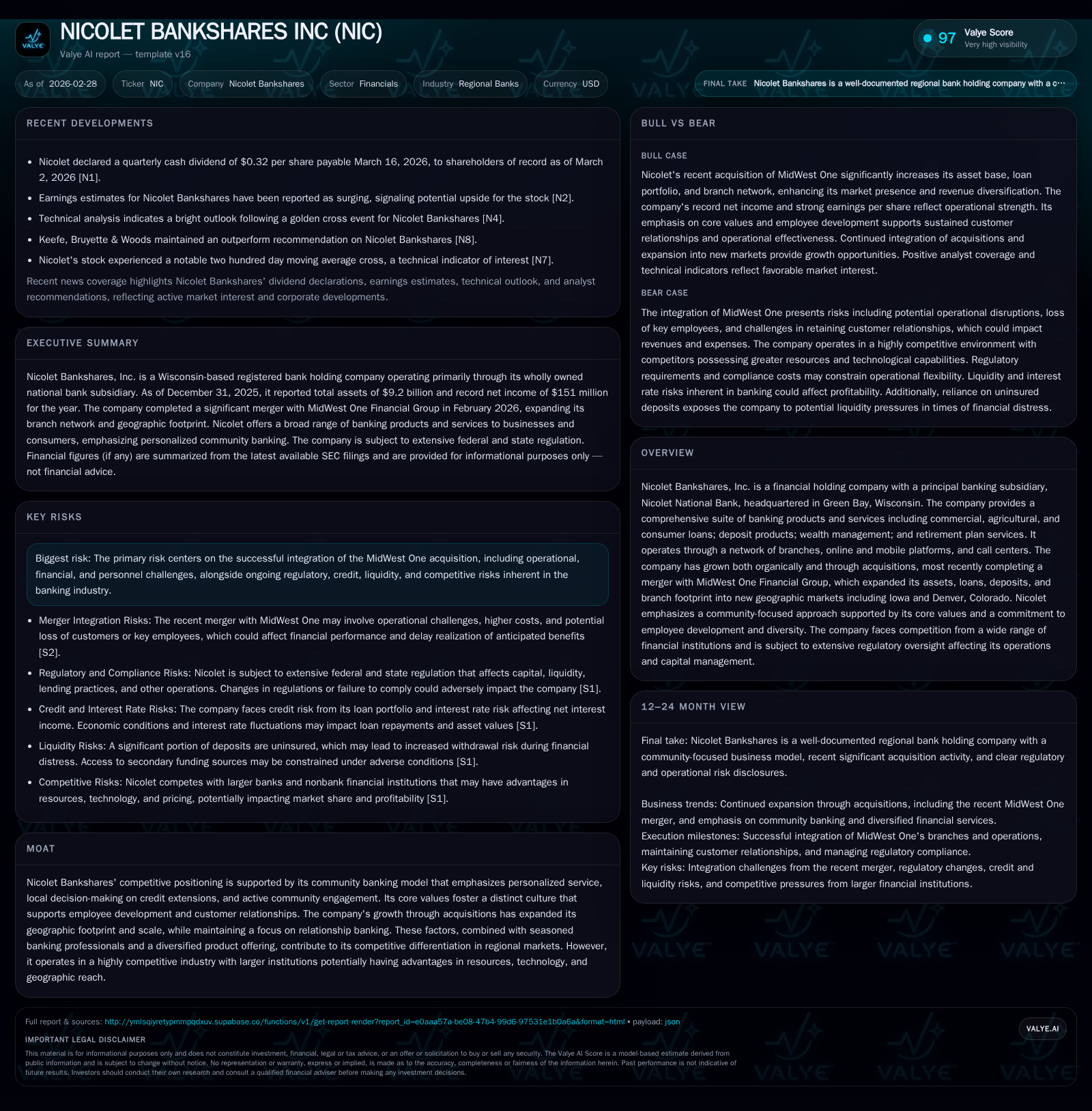
Nicolet Bankshares delivered record profitability in 2025, growing net income by roughly 21.5% year-over-year to $151 million, underpinned by organic growth and a transformative acquisition of MidWest One. The merger expanded Nicolet's geographic presence into Iowa and Denver, diversifying its Midwestern footprint. The company's community bank model—with local credit decision-making and personalized service—remains a core competitive advantage, though integration risks from the recent acquisition pose execution challenges. Capital allocation balances rising dividends and robust buybacks alongside maintaining strong equity capital, supporting an approximate 12% return on equity. Going forward, close monitoring of loan growth, customer retention, and synergy realization will be critical for sustaining momentum.
Record Profitability Fueled by Organic Growth and Strategic Acquisition
Nicolet Bankshares reported record net income of $150.7 million for fiscal year 2025, representing a significant increase from prior years — more than doubling from $61.5 million in 2023 and up approximately 21.5% compared to $124.1 million in 2024 [F1]. This growth was driven by solid organic expansion across commercial, agricultural, and consumer lending segments alongside the contribution from the acquisition of MidWest One Financial Group completed in February 2026 [S1],[S3].
The MidWest One transaction added approximately $6 billion in assets as of December 31, 2025 to Nicolet’s balance sheet immediately before closing, materially increasing loan balances and deposits while expanding the branch network from 57 to 114 locations [S3],[S4]. Both organic growth initiatives and strategic acquisitions have been key drivers behind these robust financial results.
Community Banking Differentiators Amid Competitive Regional Landscape
Nicolet’s strategy centers on a community banking model focused on relationship-driven service supported by nimble local credit underwriting authority. Credit decisions are made close to customer communities enabling tailored solutions not easily replicated by larger institutions with centralized processes [S1],[S4].
The company’s core values — Be Real, Be Responsive, Be Personal, Be Memorable, Be Entrepreneurial — shape a culture that fosters employee development and customer loyalty. Experienced bankers embedded within their markets support this approach, enhancing client trust especially among small- to medium-sized businesses within Wisconsin, Michigan, Minnesota — regions now joined by Iowa and Denver post-acquisition [S4].
This positioning helps differentiate Nicolet against competitors who may have technological or pricing advantages but lack localized decision-making agility.
Merger Integration Risks Highlighted in Regulatory Disclosures
Despite anticipated scale benefits from the MidWest One merger, regulatory filings underscore risks including potential disruption to customer relationships during system integrations, unforeseen expenses beyond initial synergy estimates, and possible loss of key personnel essential to client continuity [S2],[S3],[S29].
Reconciliation of differing governance philosophies between legacy boards and management teams adds complexity that could delay unified strategic focus or operational efficiencies [S2]. While the merger closed as planned in early 2026 [S3], effective integration execution remains critical to meeting market expectations [N1],[N4].
Expanded Geographic Footprint Diversifies Market Risk
Before acquiring MidWest One, Nicolet concentrated operations primarily within Wisconsin, Michigan, and Minnesota serving owner-managed companies and individuals [S4]. The expansion into Iowa’s central/eastern regions and Denver introduces geographic diversification but also new competitive dynamics presented by larger banks with greater resources.
These markets offer opportunities for cross-selling wealth management and retirement services alongside banking products but require adaptation to different client expectations outside the traditional Midwest footprint.
Capital Allocation Balances Shareholder Returns with Balance Sheet Growth
Nicolet’s capital management balances shareholder returns with strengthening capital buffers amid asset growth post-merger. Dividends increased to $18.7 million in fiscal 2025 from $16.5 million in 2024 reflecting alignment with earnings growth [F1],[S22]. Concurrently, share repurchases rose substantially to $76.5 million last year compared with prior modest levels indicating confidence in valuation while maintaining regulatory capital compliance [F1],[S24].
Equity capital stood at approximately $1.26 billion at year-end 2025 supporting leverage capacity while sustaining well-capitalized status under regulatory guidelines [F1],[S11]. The approximate return on equity was near 12%, underscoring efficient deployment of shareholder funds amid expanding scale.
Financial Performance Snapshot
Historical performance (annual)
| FY | Net ($mm) | CFO ($mm) | Net YoY |
|---|---|---|---|
| 2025 | 151 | 154 | +21.5% |
| 2024 | 124 | 134 | +101.7% |
| 2023 | 62 | 108 | -34.7% |
| 2022 | 94 | 117 |
Source: SEC companyfacts cache [F1].
Capital returns and efficiency (annual)
| FY | Div ($mm) | Buybacks ($mm) | ROE% |
|---|---|---|---|
| 2025 | 19 | 77 | 12.0 |
| 2024 | 17 | 10 | 10.6 |
| 2023 | 11 | 2 | 5.9 |
| 2022 | 61 | 9.7 |
Source: SEC companyfacts cache [F1].
Operating cash flow has trended upward alongside net income resulting in roughly $149 million free cash flow after capital expenditures in FY2025 [F1]. Capital spending remains modest relative to cash generation supporting dividend sustainability.
Outlook: Monitoring Integration Progress Amid Competitive Pressures
Key factors shaping near-term prospects include successful merger integration capturing expected cost/revenue synergies without eroding core customer relationships—a central execution risk highlighted in filings [N1],[N4],[S2]. Organic loan growth will also be critical across commercial and consumer portfolios amid evolving economic conditions impacting credit quality given portfolio concentration in commercial-related loans (~77%) tied closely to manufacturing and agriculture sectors [S13].
Capital deployment discipline balancing buybacks against dividends warrants observation should acquisition-driven balance sheet expansion accelerate beyond current plans [F1],[N1]. Competitive pressures remain from larger banks leveraging technology investments which could trigger deposit migration risk—particularly given about one-third uninsured deposits that elevate liquidity volatility under stress scenarios [S25].
Maintaining alignment between community-focused relationship banking culture while scaling efficiently through acquisitions frames the fundamental challenge ahead for management.
This analysis is based exclusively on publicly filed documents as of February 28, 2026 including SEC filings ([S#]) companyfacts data ([F1]) supplemented with relevant news articles ([N#]). It aims to provide an informative overview without recommending any investment action.
Disclaimer: This is research-only, informational analysis and not investment advice. It may include AI-generated interpretation and general industry context. Always verify important details using primary sources.

Comments