
Universal Insurance Holdings Fuels Growth Through Strategic Digital Expansion and Risk Discipline
UVE has leveraged a multi-channel distribution strategy, rigorous underwriting, and capital prudence to accelerate earnings amid Florida’s challenging homeowners insurance market.
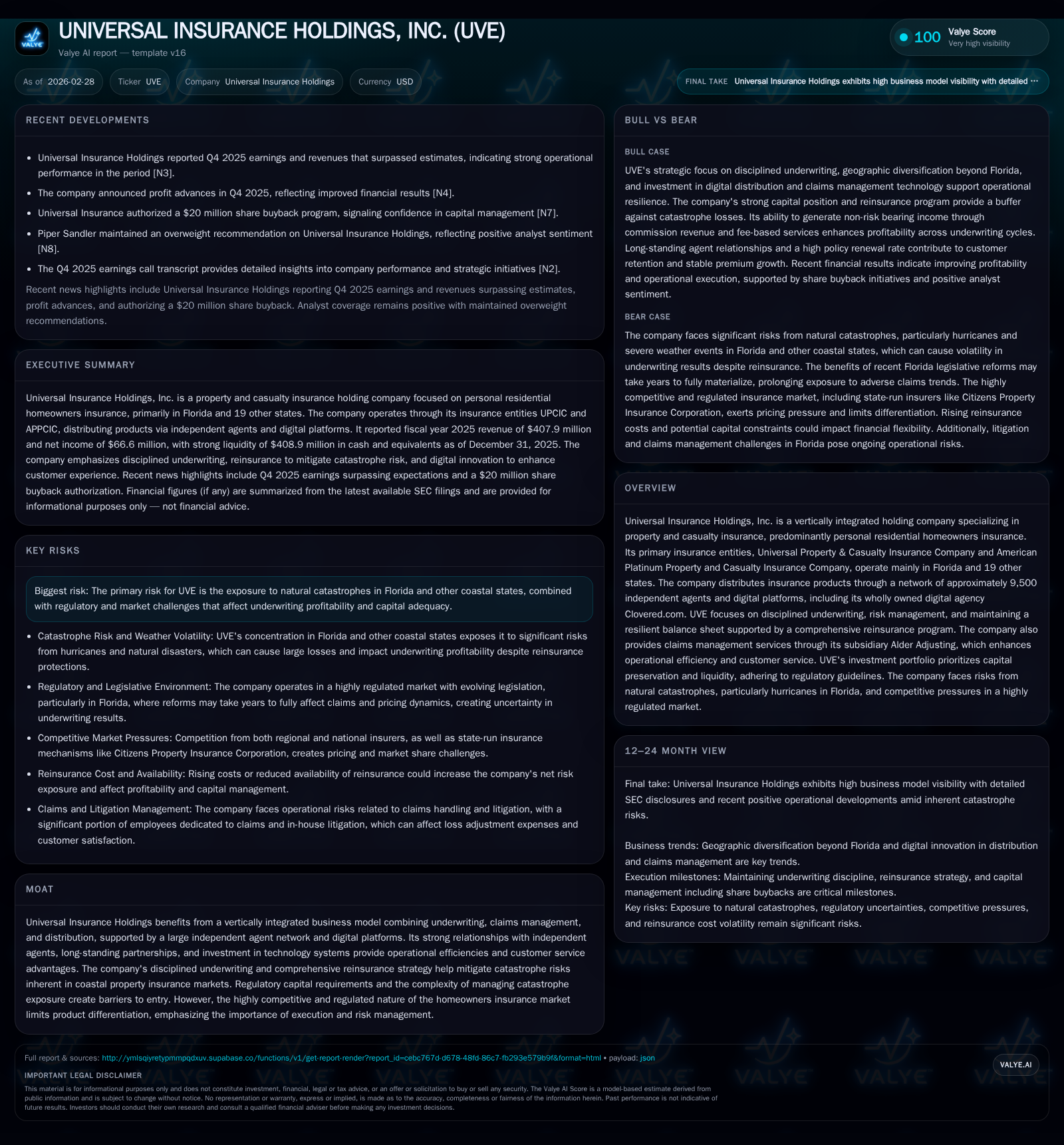
Universal Insurance Holdings (UVE) posted a 6% revenue increase in FY2025 alongside a net income surge exceeding 1000% year-over-year, reflecting disciplined risk management and operational innovation. Its vertically integrated model synergizing independent agents with digital platforms like Clovered.com has enhanced premium growth while preserving underwriting rigor in catastrophe-prone coastal markets. Capital structure management, including a robust reinsurance program and active share repurchases funded by strong operating cash flow, supports resilient financial footing. Monitor UVE’s debt maturity in late 2026 and regulatory trends as potential near-term catalysts impacting performance.
From Volatility to Earnings Momentum: UVE’s Historical Growth Drivers
Universal Insurance Holdings, Inc. has demonstrated marked improvement in financial performance through a cycle characterized by natural catastrophe risk inherent to its core Florida-focused homeowners insurance portfolio. Annual revenues grew from $330.4 million in FY2022 to $407.9 million in FY2025—a trajectory culminating in a 6% increase from 2024 to 2025 alone [F1]. This growth resulted primarily from disciplined premium rate adjustments amid a competitive market and expanding policy count driven by bolstered distribution channels.
The turning point is most pronounced in net income where UVE’s results soared from a modest $6 million in FY2024 to $66.6 million in FY2025—a more than tenfold increase year-over-year [F1]. This leap reflects a combination of enhanced underwriting profit through optimized risk selection and loss adjustment expense control, alongside an improving investment yield environment supporting realized gains.
Operating cash flow surged nearly 178% over the same period, from approximately $137 million to over $381 million in FY2025, underscoring robust premium collections and efficient claim processing cycles that preserve liquidity reserves critical for catastrophe exposure [F1]. Capex spending moderated by roughly 40%, illustrating an operational shift towards sustaining digital investments rather than heavy infrastructure outlays.
Historical performance (annual)
| FY | Rev ($mm) | Net ($mm) | CFO ($mm) | Capex ($mm) | Rev YoY | Net YoY |
|---|---|---|---|---|---|---|
| 2025 | 408 | 67 | 381 | 4 | +6.0% | +1006.5% |
| 2024 | 385 | 6 | 137 | 7 | +2.5% | -69.9% |
| 2023 | 375 | 20 | 71 | 4 | +13.7% | -20.4% |
| 2022 | 330 | 25 | 325 | 5 |
Source: SEC companyfacts cache [F1].
Capital returns and efficiency (annual)
| FY | Div ($mm) | Buybacks ($mm) | FCF ($mm) |
|---|---|---|---|
| 2025 | 22 | 22 | 377 |
| 2024 | 22 | 22 | 130 |
| 2023 | 23 | 22 | 67 |
| 2022 | 24 | 12 | 320 |
Source: SEC companyfacts cache [F1].
Table: The above figures use values reported for fiscal years ending December; net income volatility highlights shifting waves of catastrophe claims experience.
Digital Agency Expansion and Independent Agent Network Synergy
UVE's vertically integrated distribution operates through about 9,500 independent agents primarily across Florida and surrounding states, complemented by the digital agency Clovered.com—its wholly owned platform featuring relationships with some three dozen carrier partners [S1][N1]. This hybrid approach offers a strategic advantage: it leverages local agents’ deep community relationships crucial for personal residential homeowners insurance while simultaneously capturing digitally native consumers seeking streamlined quote-to-bind journeys.
Clovered.com supports multi-carrier quoting enabling price competitiveness while retaining underwriting criteria discipline by routing submissions through carefully managed agent networks or specialized staff brokers where necessary [S27]. This blended model increases premium volumes without sacrificing underwriting quality or brand integrity—a vital equilibrium given the opaque risk profiles traditionally associated with coastal property markets.
Management commentary from recent earnings notes the importance of enhancing customer touchpoints and modernizing back-end technology stacks to improve speed and accuracy of quote issuance as well as claims servicing via integrated digital tools—a priority reflected by increased efficiency measures reported last quarter [N1].
Underwriting Disciplines Amid Regulatory and Catastrophe Headwinds
The company maintains stringent underwriting standards augmented by sophisticated risk assessment tools aimed at managing loss adjustment expense within tight parameters essential for sustaining consistent profitability amid the high volatility of hurricane-exposed portfolios [S13][F1]. The Insurance Entities consistently seek underwriting profits defined as earned premiums net of losses, loss adjustment expenses, policy acquisition costs, and other operating expenses—an objective critical when considering cyclical catastrophe frequency.
Integral to UVE's risk mitigation is its comprehensive reinsurance program that covers multiple layers of potential losses with attachment points calibrated to protect statutory surplus while balancing cost effectiveness [S4][S12]. Notably, during FY2025 no hurricanes exceeded the company’s reinsurance attachment point, mitigating large payout risks that impacted prior years [S19].
Regulatory oversight also shapes UVE's approach; compliance with NAIC’s risk-based capital requirements ensures excess statutory capital buffers that safeguard policyholder obligations despite elevated claims cycles inherent to coastal exposures [S17][S21]. With RBC ratios comfortably exceeding minimum thresholds, UVE navigates complex state regulatory frameworks while balancing growth ambitions.
Claims Operations Innovation Fueling Customer Experience and Efficiency
Claims management is centralized partially through Alder Adjusting, UVE’s wholly owned subsidiary focused on handling claims expediently and reducing leakage from inflated or protracted settlements [S1][N1]. Vertical integration here provides dual benefits: improved cost controls on loss adjustment expenses and elevated customer satisfaction through faster resolution times.
Employing digital claims applications facilitates real-time status updates for policyholders leveraging proprietary workflows that reduce friction points common in property damage events—often intensifying during hurricane seasons. This capability supports stronger agent relationships by enhancing their ability to provide timely status feedback externally while optimizing internal resource deployment.
Capital Structure, Debt Management, and Reinsurance Backstops
UVE's capital resources advanced notably as stockholders’ equity expanded from approximately $373 million at end-2024 to over $551 million by end-2025 due largely to retained earnings accumulation supported by record net income levels offset partially by treasury stock purchases [F1][S4][S7]. Total debt slightly decreased from about $101 million to around $100 million thanks to scheduled principal repayments on senior unsecured notes issued at a fixed coupon of 5.625%, maturing November 30, 2026.
Debt-to-total capital ratio improved materially—from about 21% down to roughly 15%—reflecting deleveraging intrinsic to capital buildup through profitability rather than new leverage assumptions [S7]. Liquidity remains robust with cash and equivalents increasing nearly 58% year-over-year to approximately $409 million as of December 31, 2025, providing flexibility for claims settlement spikes or strategic initiatives including share repurchases.
The reinsurance program remains pivotal for balancing catastrophe exposure risks against capital adequacy—the company benefits also from cash advance provisions under treaties providing upfront liquidity post-event claims payments [S12][S19]. Such features align well with prudent asset-liability management underpinned by investment portfolio quality rated at an average of A+ credit standing across holdings primarily composed of fixed-income securities with durations focused near the medium term (~3.6 years), minimizing interest rate sensitivity [S16][S20].
Capital Allocation Strategy: Dividends, Buybacks, and Shareholder Returns
Aligning capital stewardship with shareholder wealth objectives, UVE maintained dividend payments close to $22 million annually throughout recent years even amid earnings fluctuations—underlining commitment to consistent returns alongside growth reinvestment needs [F1][S6]. Share repurchases have been material: over $42 million combined across two active repurchase programs completed or underway through end-2025 funded predominantly from operating cash flows totaling $381 million last fiscal year making free cash flow generation approximately $377 million after capex deductions [F1][S9].
The board has shown active discretion extending buyback authorizations post-2025 evidencing confidence in underlying cash generation strength while balancing available liquidity against upcoming debt maturities—executing purchases opportunistically given market conditions with typical pricing between $31-$34 per share reported recently (Q4’25 execution) [S6]. This measured approach supports price stability while optimizing equity capital structure absent material growth acquisitions requiring alternative funding sources.
What to Watch: Near-Term Catalysts and Risk Factors Ahead
Key upcoming milestones include the maturity of $100 million senior unsecured notes due November 30, 2026; management continues evaluating repayment versus refinancing options weighing current interest rate environments relative to corporate credit risk profile improvements borne out by affirmed insurer financial strength 'A' ratings from Demotech and Kroll ratings agencies [S7][S15].
Regulatory dynamics in Florida remain fluid as legislatures review catastrophe insurance frameworks amidst social inflation concerns impacting litigation costs related to coverage disputes—a material risk highlighted explicitly via legal proceedings disclosures though currently estimated as immaterial loss contingencies but warrant ongoing surveillance given potential for escalation [S13][S26].
Natural catastrophe incidence represents perennial exposure necessitating close monitoring particularly hurricane season severity relative to reinsurance attachment points which buffer but do not eliminate residual losses potentially impacting underwriting results sharply if breached unexpectedly [N4][F1]. Lastly, continued scale-up and refinement of digital distribution channels including Clovered.com present both growth opportunities and execution challenges given rising consumer expectations around omni-channel seamlessness.
Disclaimers: This analysis is based exclusively on publicly available filings up to February 28, 2026 ([F1],[N#],[S#]) without any speculative assumptions or forward-looking guidance beyond stated company disclosures or explicitly cited sources. It does not constitute investment advice or recommendations.
Disclaimer: This is research-only, informational analysis and not investment advice. It may include AI-generated interpretation and general industry context. Always verify important details using primary sources.

Comments