
Trade Desk’s Revenue Growth Slows as Margin Pressure and Client Concentration Risks Intensify
Trade Desk expands in connected TV and international markets but faces margin compression and client spending headwinds.
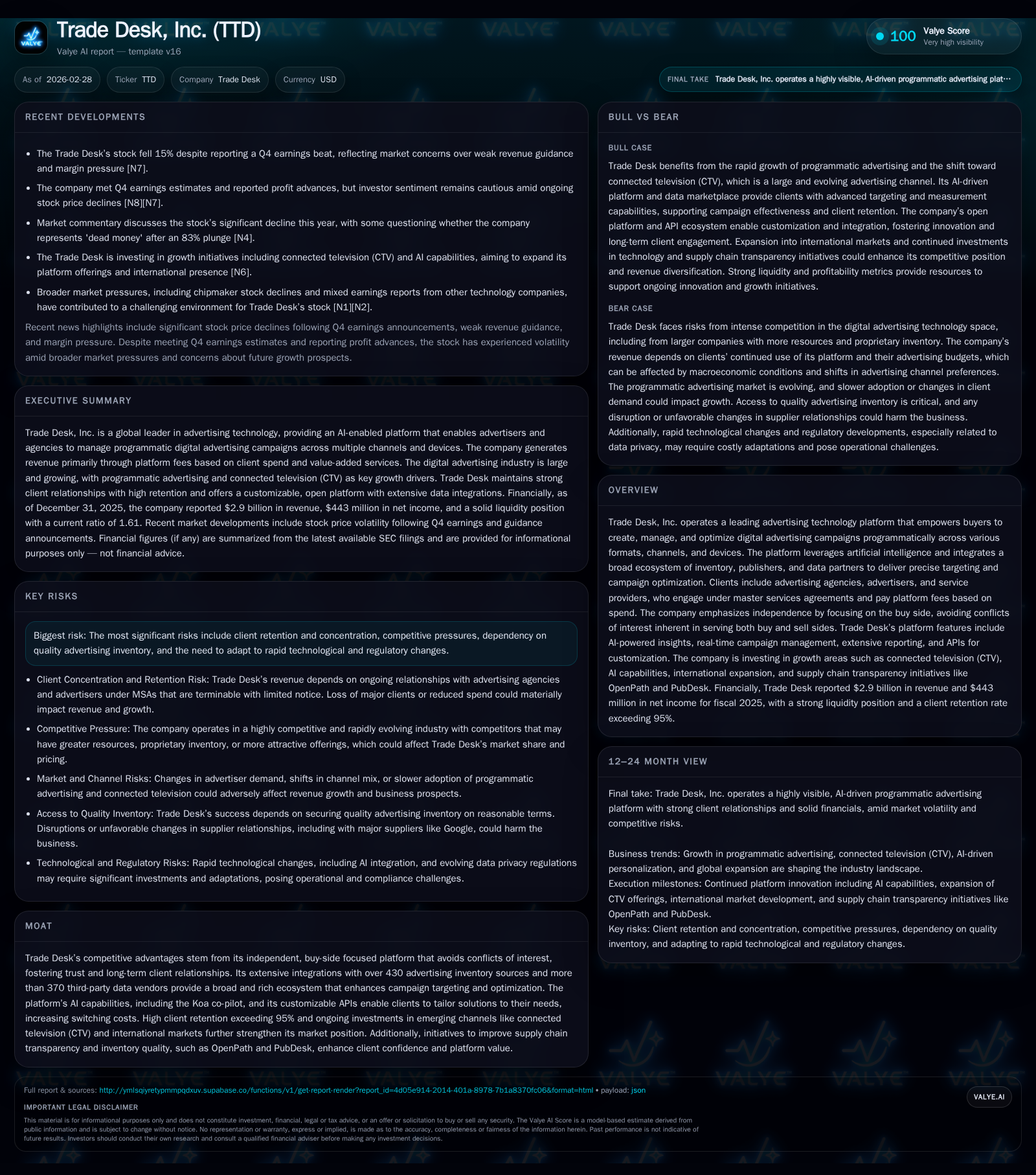
Trade Desk, Inc. delivered robust operating income growth in 2025 with strong cash flow generation, driven by programmatic advertising demand. However, recent revenue guidance signals slower top-line growth amid margin pressures and elongated client spending cycles. The company’s strategic focus on connected TV (CTV), international expansion, and AI-driven platform enhancements underpin its growth prospects but are tempered by rising competition and regulatory challenges. Capital allocation remains shareholder-friendly with significant buybacks that have mitigated dilution despite sustained investments in R&D and infrastructure.
Historical Performance and Growth Drivers
Trade Desk has exhibited strong growth over the past four years on the back of accelerating adoption of programmatic digital advertising. Operating income climbed from approximately $114 million in 2022 to nearly $589 million in 2025, an impressive compound increase reflecting successful scaling and operating leverage [F1]. Net income similarly advanced from $54 million in 2022 to over $443 million most recently [F1]. Organic expansion was fueled by increased client spend on the platform, driven by its broad ecosystem connectivity—over 430 integrated advertising inventory sources and more than 370 third-party data vendors—as well as AI-enhanced targeting and optimization tools [S1][S10].
Operating cash flow growth has been robust as well, rising from about $549 million in 2022 to almost $993 million in 2025 [F1], supporting capital expenditures that doubled to $197 million last year as the company invests heavily to enhance technology infrastructure [F1][S17]. The resultant free cash flow nearing $796 million reflects a strong cash-generative business model.
Historical performance (annual)
| FY | Net ($mm) | CFO ($mm) | OpInc ($mm) | Capex ($mm) | Net YoY |
|---|---|---|---|---|---|
| 2025 | 443 | 993 | 589 | 197 | +12.8% |
| 2024 | 393 | 739 | 427 | 98 | +119.7% |
| 2023 | 179 | 598 | 200 | 47 | +235.2% |
| 2022 | 53 | 549 | 114 | 84 |
Source: SEC companyfacts cache [F1].
Capital returns and efficiency (annual)
| FY | Buybacks ($mm) | FCF ($mm) | ROE% |
|---|---|---|---|
| 2025 | 1380 | 796 | 17.8 |
| 2024 | 235 | 641 | 13.3 |
| 2023 | 647 | 552 | 8.3 |
| 2022 | 465 | 2.5 |
Source: SEC companyfacts cache [F1].
Note: Buybacks include significant repurchase activities aimed at offsetting employee dilution.
Industry Positioning and Competitive Moats
Trade Desk distinguishes itself through its independent buy-side focus that avoids conflicts of interest present in platforms serving both buyers and sellers. This fosters trust among advertising agencies and advertisers who represent the bulk of its customer base [S1][S10]. Its extensive ecosystem integration provides access to a wide range of inventory across device types including desktop, mobile, connected TV (CTV), streaming devices and digital out-of-home advertising—key channels experiencing rapid programmatic adoption [S1][S10].
AI capabilities like the Koa co-pilot enhance campaign decisioning while offering clients deep customization via APIs that raise switching costs [S1]. Client retention exceeds a high watermark of over 95%, underpinned by master services agreements typically lasting one year with auto-renewals but terminable with limited notice [S12][S13].
Competitive pressures however remain intense from large tech companies expanding their ad platforms as well as newer entrants leveraging AI-driven marketing technology innovations [S12]. Trade Desk’s ability to continually evolve its technology stack and extend into emerging segments such as audio advertising is critical for maintaining differentiation [N11][S12].
Growth Prospects and Strategic Initiatives
Trade Desk’s management emphasizes several growth catalysts:
- Connected TV Expansion: Recognizing the shift away from linear TV toward streaming platforms accessible via smart TVs or devices like Roku or Fire Stick creates a massive addressable market tailwind. CTV’s blending of entertainment and internet delivery supports data-driven ad targeting that Trade Desk’s platform excels at managing [S1][S13].
- International Market Penetration: The company targets major developed markets including UK, Germany and France alongside large Asian economies such as China and India which present meaningful upside given increasing digital media consumption outside the U.S. [S13].
- AI-Driven Personalization: Continued investment in AI enables more predictive targeting and scaled automation critical for superior media buying outcomes especially within privacy-first regulatory environments where direct user data access diminishes [S1][S12].
- Supply Chain Transparency Initiatives: Programs like OpenPath improve quality assurance around inventory authenticity which addresses buyer concerns around fraud or brand safety in programmatic environments [S1].
Challenges include potential saturation points among agency clients limiting ad budget allocations through Trade Desk’s platform alongside competitive fee compression [S12]. Regulatory shifts concerning data privacy could also threaten certain targeting capabilities or increase compliance costs [S20].
Recent Results and Outlook Signals
While Trade Desk beat Q4 earnings estimates recently highlighting operational resilience [N4], it concurrently issued weaker revenue guidance accompanying margin pressure warnings that triggered a sharp stock price reaction [N2][N3][N9]. The softened outlook reflects client spend moderation impacting top-line momentum amid macroeconomic uncertainties. Close monitoring of upcoming quarterly guidance will be essential to gauge whether these trends persist or stabilize.
Returns and Capital Allocation Discipline
Trade Desk delivered approximately an estimated return on equity (ROE) of around 17.8% based on latest net income relative to equity book value [F1], illustrating effective capital utilization.
The firm aggressively returned capital via share repurchases totaling roughly $1.4 billion during fiscal year 2025 after progressively increasing authorization limits earlier in the year to offset dilution from stock-based compensation grants related to ongoing hiring in sales/tech roles required for growth execution [F1][S7][S16]. Dividend distributions are not reported indicating reinvestment primarily occurs through repurchases.
Liquidity remains strong with over $658 million held in cash plus substantial short-term investments ensuring flexibility; no debt balance was outstanding at year-end under a revolving $450 million credit facility maturing mid-2026 which also enjoys ample unused capacity ($445 million availability net of letters of credit) compliant with covenants [F1][S4][S6][S11].
Risks Summary
Key risks identified include:
- Client Concentration: Two holding companies represented about thirty percent of gross billings in 2025 making revenue somewhat dependent on these sizable clients who can terminate or reduce spending with limited notice [S10][S13].
- Competitive Intensity: Rapid innovation cycles plus new entrants threaten Trade Desk’s market share unless it continues investing heavily in platform features while managing margin dynamics carefully [S12].
- Inventory Quality Dependencies: Reliance on supply-side partners requires constant vigilance on fraud mitigation amidst evolving market actors affecting advertiser confidence [S1][S20].
- Litigation Exposure: Ongoing privacy-related class actions and shareholder derivative suits raise potential legal costs though currently management assesses no material financial exposure beyond defense expenses .
- Regulatory Environment: Increased scrutiny globally around data usage presents persistent compliance burdens with uncertain operational impacts going forward [S20].
Analytical Outlook Considerations
Absent explicit long-term guidance within filings or releases post-Q4 results [N3], key indicators to watch include:
- Revenue trajectory over next quarters relative to conservative guidance amid macroeconomic headwinds.
- Margin stability given cost increases related to R&D efforts especially in AI development.
- Success metrics for CTV ad spend penetration versus legacy platforms.
- International revenue growth momentum as expansions mature.
- Changes in client concentration or contract terms that might affect visibility.
Given the high level of capitalization required for technology leadership combined with aggressive shareholder returns through buybacks balancing dilution impacts—investors should also monitor capital efficiency ratios such as ROE alongside free cash flow yields from operating activities net capex investment.
This report summarizes public filings from Trade Desk Inc., recent market news articles through early February 2026 along with SEC-sourced financial statements up to fiscal year-end December 31, 2025. It aims solely to outline historical performance drivers alongside current strategic positioning without offering investment advice or projections beyond stated company disclosures.
Disclaimer: This is research-only, informational analysis and not investment advice. It may include AI-generated interpretation and general industry context. Always verify important details using primary sources.

Comments