
Semnur Pharmaceuticals' Financial Struggles and Strategic Crossroads in 2025
Semnur Pharmaceuticals faces a pivotal moment with substantial 2025 losses and liquidity challenges shaping its future trajectory.
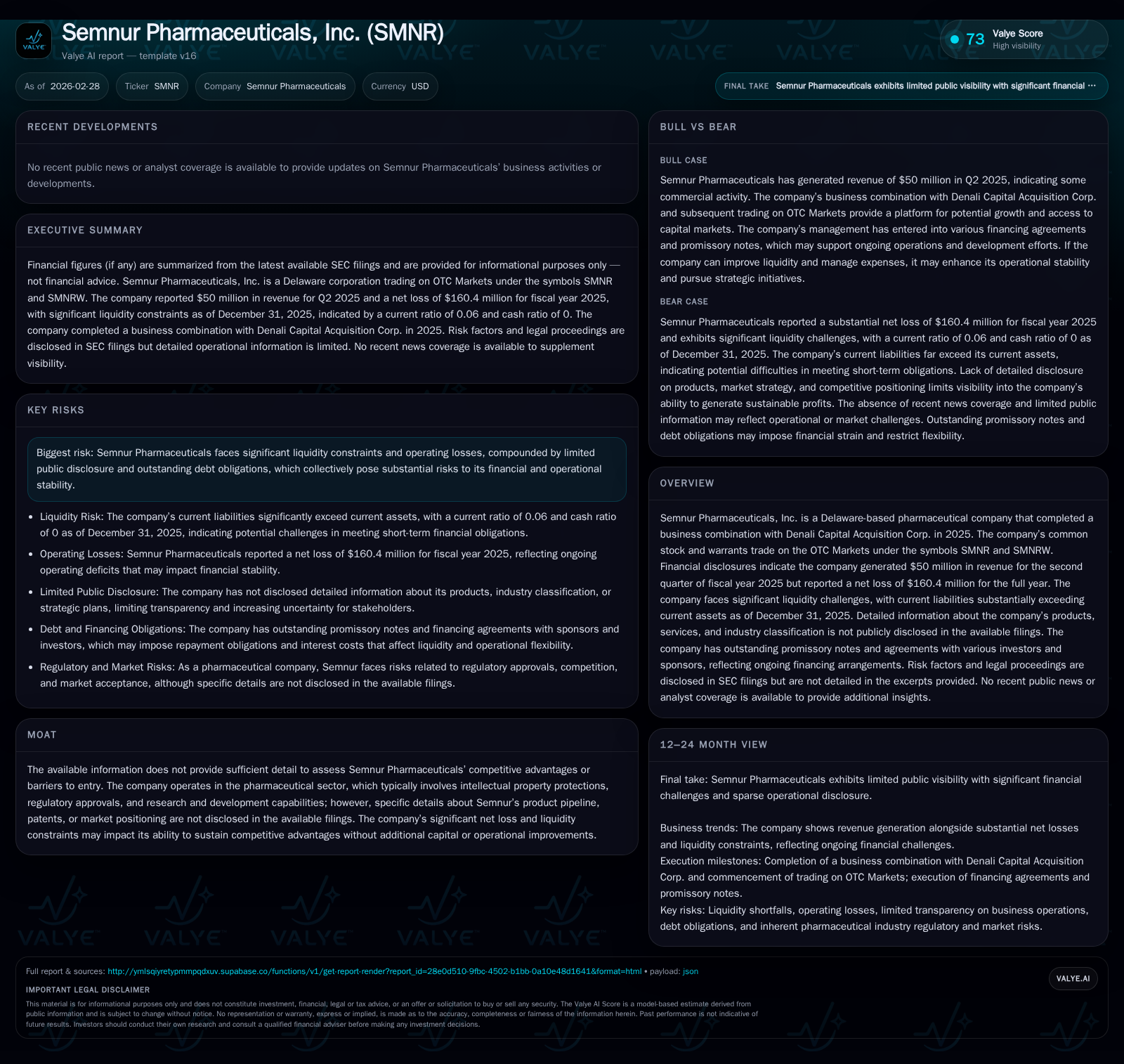
Semnur Pharmaceuticals reported a stark net loss of $160.4 million in fiscal year 2025 despite $50 million revenue in Q2 2025, reflecting severe profitability pressures. The company’s liquidity ratio at 0.06 highlights critical short-term solvency concerns amid current liabilities surpassing current assets by a wide margin. Complex debt instruments, including convertible promissory notes and sponsor obligations, increase financial strain. Limited public disclosure on product pipelines clouds growth visibility, leaving strategic recovery dependent on successful capital raises and operational improvements.
Revenue and Loss Trajectory: From Breakthroughs to Setbacks
Semnur Pharmaceuticals’ financial performance in fiscal year 2025 reflects acute challenges enveloping the company. Despite generating $50 million in revenue for the second quarter of FY25 [F1], the company registered an astronomical net loss of $160.4 million for the full year ending December 31, 2025 [F1]. This loss dwarfs the comparatively modest deficits posted in prior years — net loss was approximately $1.67 million in FY24 and even a slight profit of $632 thousand recorded in FY23 [F1]. Operating income has plummeted correspondingly, registering a -$160.4 million figure for FY25 compared to around -$1.6 million the prior year [F1].
This steep margin erosion portrays a firm grappling with overwhelming costs relative to its revenue base. While $50 million revenue signals some commercial traction or milestone achievement within the business combination period post-merger, expenses related to restructuring, R&D intensification without material product approvals disclosed publicly, administrative overheads, and possible one-time charges have crushed profitability.
Historical performance (annual)
| FY | Net ($mm) | CFO ($mm) | OpInc ($mm) | Net YoY |
|---|---|---|---|---|
| 2025 | -160 | -6 | -160 | -95781.8% |
| 2024 | 0 | -1 | -2 | -126.5% |
| 2023 | 1 | -1 | +250.8% | |
| 2022 | 0 | 0 |
Source: SEC companyfacts cache [F1].
Capital returns and efficiency (annual)
| FY | Buybacks ($mm) | ROE% |
|---|---|---|
| 2025 | 773.1 | |
| 2024 | 43 | 1.6 |
| 2023 | 41 | -7.6 |
| 2022 | 12.8 |
Source: SEC companyfacts cache [F1].
Liquidity Crisis: Analyzing Current Assets versus Mounting Liabilities
Liquidity constraints impose immediate operational risks on Semnur. The company's balance sheet at December 31, 2025 reveals current assets totaling approximately $596,000 against staggering current liabilities of about $10.17 million [F1]. This yields an extremely low current ratio of ~0.06, indicating that Semnur possesses only six cents in short-term assets for every dollar of short-term obligations [F1].
Such an imbalance signals potential difficulties funding everyday operations—paying suppliers, employees, or vendors—and servicing near-term debts. Pharmaceutical companies amid development phases often rely heavily on ongoing financing rounds due to uneven cash flows; however, Semnur’s position suggests urgency in either raising additional capital or restructuring debts to maintain solvency [S10], [S14].
Capital Structure and Debt Obligations Amid New Financing Instruments
On the financing front, Semnur's capital structure is burdened by multiple complex promissory notes and convertible instruments entered into around or before its business combination closing [S10], [S14], [S16]. Agreements such as the Sponsor Note issued post-merger come with strict payment terms including acceleration clauses triggering full immediate repayment upon subsequent large financings or defaults [S10]. These arrangements typically bear punitive interest rates—in Semnur’s case around 10% per annum during default periods—to incentivize timely payment but add leverage pressure.
Other investor agreements (e.g., with FutureTech Capital LLC and US Tiger Securities) involve promissory notes that replace previously owed consideration via negotiated settlements that combine cash payments and new debt issuances [S10], [S14]. Such instruments reflect typical growth-stage pharma financing complexity where blending equity concessions with debt-like repayments attempts to balance dilution against capital needs.
The aggregate effect is an elevated cost of capital and looming repayment obligations which could exacerbate liquidity stress if operational cash flows remain negative.
Operational Cash Flow Trends and Their Effect on Sustainment
Examining operating cash flow trends offers insight into underlying business sustainability absent external funding. Semnur recorded an operating cash outflow (CFO) of approximately -$5.87 million for FY25—a sizable increase from past negative values of -$753 thousand (FY24), and steady negative flows since FY22 [F1]. The near sevenfold deterioration year-over-year (-678.8%) underscores escalating cash burn intensity.
This trend suggests that despite reported revenues, internal cost conversion to liquid funds remains inefficient — possibly due to upfront R&D expenditures, overhead expansion after business combination costs, or working capital misalignment.
For pharmaceutical companies without large marketed product portfolios disclosed publicly—as appears the case here—this pattern aligns with typical biotech development stages but also signals urgent pressure to extend runway through fresh capital infusion or operational restructuring.
Limited Public Disclosures: Unpacking Risks Without Full Visibility
A critical challenge evaluating Semnur arises from scant disclosure regarding its product pipeline, patent holdings, or precise market focus beyond generic pharmaceutical sector identification [S1], [S3], [S6]. This opacity inhibits detailed competitiveness or moat analysis traditionally centered on intellectual property strength or regulatory barriers.
The company’s SEC filings emphasize extensive risk factors largely tied to financial instability—liquidity limitations compounded by debt burdens—and absence of material changes in litigation status as of late-2025 filings [S3], but offer minimal granularity on clinical development milestones or health authority interactions.
From a sector perspective, this lack of transparency adds layers of risk primarily because uncertainty in pipeline viability can accelerate investor skepticism amidst acute financial stress.
Strategic Outlook: What the Company Signals About Future Growth
Semnur does not provide explicit guidance on future revenue growth drivers nor definitive milestones publicly available yet; no news releases or SEC forward-looking statements detail pipeline launches or regulatory filings post-business combination [N/A].
Analysis: Absent concrete catalysts disclosed by management, key variables for future performance hinge on successfully navigating financing rounds—which may include equity issuances or convertible debt offerings—and managing operative burn rates tightly. Stakeholders must monitor quarterly earnings reports closely for updates on expense trends and any voluntary announcements related to clinical progress or partnership deals that could shift growth trajectories.
Capital Allocation: Buybacks, Dividends, and Returns Assessment
Historically, Semnur engaged in substantial share repurchases pre-business combination totaling over $40 million annually during FY23 and FY24 despite incurring losses [F1]. This buyback activity indicates prior attempts at capital return amid changing corporate strategy but contrasts sharply with recent enormous losses that rendered such practices unsustainable.
There have been no dividends paid on common stock since the merger transaction completion; dividend policy explicitly ties potential payout decisions to earnings availability and overall financial conditions controlled by board discretion [S8].
Returns metrics are difficult to interpret given the company's negative equity position (-$20.75 million at FY25-end) alongside massive net losses producing an anomalous calculated ROE exceeding +773% driven by denominator sign effects rather than underlying profitability merits [F1]. This highlights profound financial distress rather than actual value generation.
Milestones and Watchpoints: Key Events to Monitor for Recovery
Looking forward, several crucial developments warrant attention:
- Upcoming maturity dates and payment deadlines related to promissory notes from sponsors and investors (e.g., Sponsor Note installments starting October 2025) that could trigger acceleration clauses if unmet [S10], [S21]
- Possible announcements regarding equity raises or convertible debt financing aimed at remedying liquidity imbalance given very low current ratio
- Potential regulatory filings or clinical trial updates if forthcoming that might provide tangible growth catalysts beyond financial restructuring efforts
- Any shifts in share ownership structure due to domestication effects post-merger could influence governance dynamics affecting strategic decisions [S11],[S22]
- Legal proceedings appear limited currently but remain important if sensitivities arise given high financial leverage and operational risks disclosed consistently across filings [S3],[S6]
Disclaimer: This report is based solely on public SEC filings up to February 28, 2026 and does not constitute investment advice. It intends to analyze factual financial data and disclosures without speculating beyond provided documents.
Disclaimer: This is research-only, informational analysis and not investment advice. It may include AI-generated interpretation and general industry context. Always verify important details using primary sources.

Comments