
Independent Bank Corp’s Strategic Acquisition Drives 2025 Growth and Operational Shifts
The 2025 acquisition of Enterprise Bancorp expanded Independent Bank Corp’s scale and altered its financial and operational profile in a competitive New England banking market.
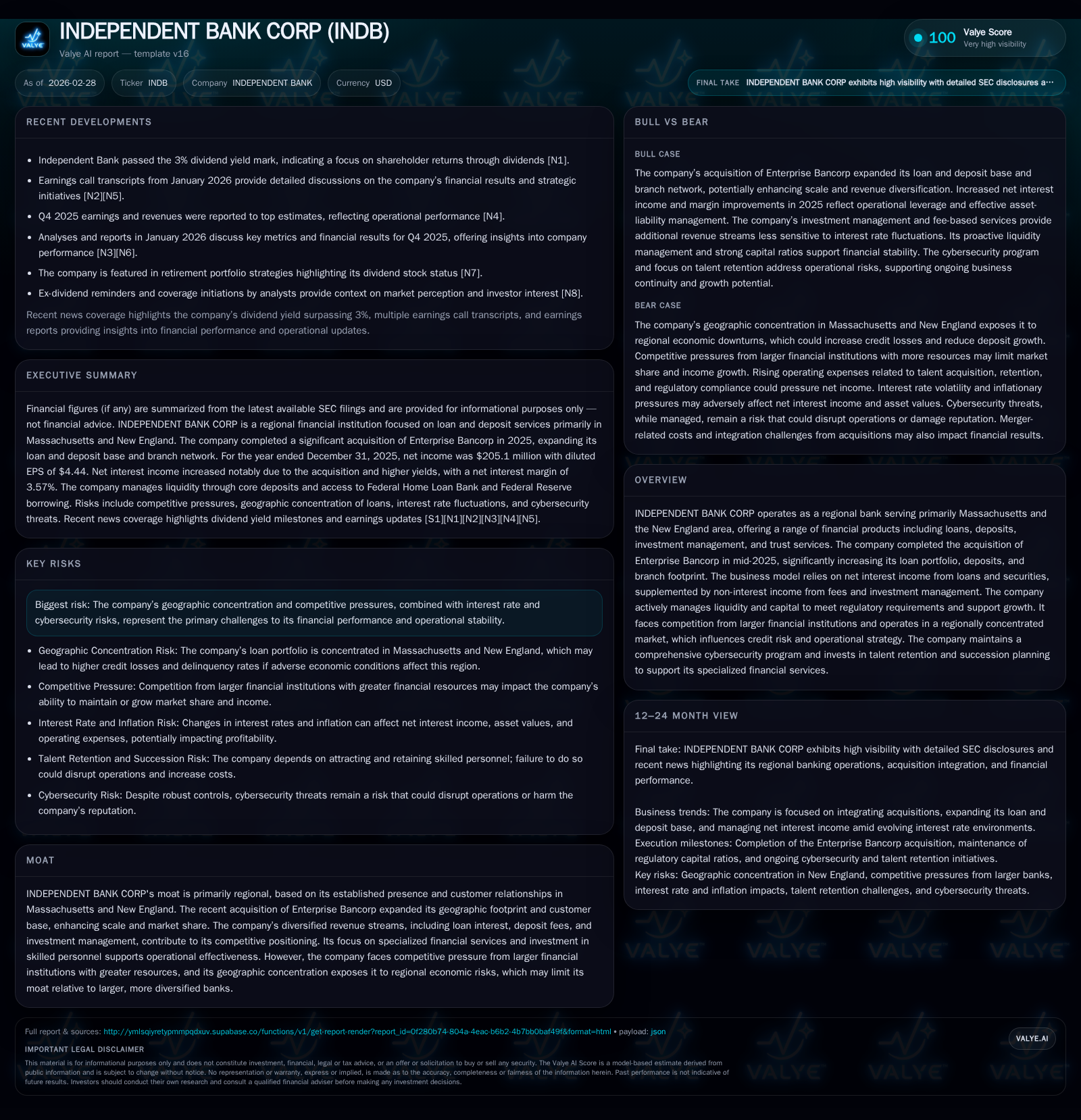
INDEPENDENT BANK CORP (INDB) significantly reshaped its footprint and financial trajectory through the mid-2025 acquisition of Enterprise Bancorp, adding $3.9 billion in loans and $4.4 billion in deposits along with 27 branches. The consolidation underpinned a 6.8% rise in net income for FY2025 despite merger-related costs and credit loss provisions. Operating cash flow grew by over 9%, while capital expenditures declined sharply as integration progressed, bolstering free cash flow materially. However, the company remains exposed to regional economic risks inherent to its Massachusetts-New England concentration, which impacts credit quality considerations amid evolving interest rate and inflation dynamics. Liquidity management leveraged increased borrowings including a $300 million subordinated debt raise, maintaining strong capital ratios well above regulatory minima. Dividend payouts exceeded $100 million, supported by robust earnings and cash flows, alongside measured share repurchases. Retention of specialized talent and a reinforced cybersecurity posture remain central to sustaining its regional moat amid intensifying competition from larger financial institutions.
Acquisition Catalyst: Expanding Market Presence in New England
INDEPENDENT BANK CORP (INDB) markedly expanded its regional footprint through the acquisition of Enterprise Bancorp on July 1, 2025 [S7]. This transaction brought approximately $3.9 billion of loans and $4.4 billion of deposits into INDB’s balance sheet at fair value, alongside an increase of twenty-seven new branch locations primarily across northern Massachusetts and southern New Hampshire [S7]. The scale-up strengthened INDB's existing presence in Massachusetts and enhanced market share within the New England corridor—a regionally concentrated area that defines INDB's competitive moat [S1].
The acquisition provided immediate growth in franchise assets but also intensified challenges linked to geographic concentration since the enlarged portfolio remains closely tied to the performance of local economies [S1]. Competitive pressures from larger institutions with broader resource bases persist as a structural limitation on expanding beyond this regional focus effectively [S1]. Still, the augmentation was strategically impactful as it diversified revenue streams within loan categories and deposit sources, facilitating operational synergies across an extended branch network.
Financial Performance Trends: Growth Drivers and Year-on-Year Evolution
Following the transaction closure midway through 2025, INDB reported net income growth leveraging both incremental revenue and operating efficiencies. According to SEC-filed annual data [F1], net income for FY2025 reached $205.1 million—an increase of 6.8% over the prior year’s $192.1 million despite notable merger-related charges:
Historical performance (annual)
| FY | Net ($mm) | CFO ($mm) | Capex ($mm) | Net YoY |
|---|---|---|---|---|
| 2025 | 205 | 251 | 12 | +6.8% |
| 2024 | 192 | 230 | 20 | -19.8% |
| 2023 | 240 | 277 | 16 | -9.2% |
| 2022 | 264 | 421 | 22 |
Source: SEC companyfacts cache [F1].
Capital returns and efficiency (annual)
| FY | Div ($mm) | Buybacks ($mm) | FCF ($mm) |
|---|---|---|---|
| 2025 | 104 | 61 | 239 |
| 2024 | 96 | 31 | 209 |
| 2023 | 98 | 189 | 261 |
| 2022 | 94 | 140 | 399 |
Source: SEC companyfacts cache [F1].
The rebound followed a period of declining profits since FY2022 largely attributed to integration costs totaling approximately $39.6 million pre-tax alongside a significant provision for credit losses ($34.5 million pre-tax) linked to acquired non-Purchased Credit Deteriorated (non-PCD) loans [S7]. The company's ability to grow net income despite these headwinds signals operational adjustment success.
Lower capital expenditures in FY2025 reflect disciplined spending as integration phases concluded or optimized [F1], supporting better cash flow metrics discussed below.
Earnings Quality and Cash Flow Profile After the Merger
Operating cash flow advanced materially on a year-on-year basis (+9.2%) reaching approximately $251 million in FY2025 per [F1], notably outpacing net income growth which highlights solid underlying earnings quality.
Simultaneously capex declined sharply by over 40%, from roughly $20.4 million in FY2024 down to $12.1 million in FY2025 [F1]. This reduction bolsters free cash flow (CFO minus capex), estimated at about $239 million for FY2025—a strong liquidity position supporting both balance sheet growth and shareholder return activities.
This free cash generation provides essential funding flexibility particularly important during periods of regulatory scrutiny or when navigating potential tighter economic conditions within their focused markets.
Regional Concentration and Emerging Credit Risk Considerations
INDB’s loan portfolio remains substantially concentrated within Massachusetts and greater New England [S1]. Approximately all loans originated are secured by properties or businesses operating primarily within this geography [S1]. This concentration exposes INDB directly to localized economic downturns including shifts impacting real estate values or business solvency.
Recent inflation moderation continues amid uncertainty regarding Federal Reserve interest rate policy direction post mild rate cuts late in 2025 [S1]. Persistent inflation could drive sustained higher rates which would impact investment securities values with longer maturities more acutely than floating-rate instruments.
Credit risk management processes incorporate comprehensive monitoring utilizing ten-point risk rating systems specific to commercial loans emphasizing early delinquency detection aligned with sector-native underwriting practices [S17]. However adverse developments such as increasing unemployment or downward pressure on property values particularly affect collateral quality and borrower repayment capacity [S1]. Such factors remain central risks influencing future earnings stability.
Future Growth Outlook Anchored by Integration and Market Conditions
While explicit management forecasts have not been publicly disclosed beyond official filings [N1][S3], strategic priorities emphasize successful synergy realization from the Enterprise acquisition alongside focused organic growth leveraging scale benefits.
Macroeconomic uncertainties including interest rate environment volatility invite caution; regulatory compliance demands constrain overly aggressive expansions but also protect capital adequacy [S3]. The company’s ability to deploy enhanced branch footprint capability efficiently will be critical for sustaining incremental revenue gains.
Execution metrics such as deposit retention rates post-merger or commercial loan underwriting standard adherence represent key indicators for stakeholders tracking progress beyond annual reporting windows.
Capital Structure and Liquidity Strategy
INDB maintains a robust liquidity framework combining diversified funding sources:
- Core retail deposits increased significantly post-acquisition totaling over $20 billion at December 31, 2025 [S14];
- Federal Home Loan Bank borrowings decreased modestly due to paydowns but remain an important contingent funding component backed by pledged loans/securities valued at billions [S4];
- A subordinated debt issuance raised $300 million early in calendar year 2025 providing long-term capital support ahead of integration expenditures [S4][S6];
- Access lines such as Federal Reserve borrowing capacity augment contingency options ensuring resilience against liquidity shocks [S4][S14].
Capital ratios at fiscal year-end indicate Common Equity Tier 1 capital around 14.3%, well above regulatory minimums providing a solid buffer for ongoing lending growth or absorbing unexpected losses without compromising solvency [S10]. Tier 1 leverage ratio similarly shows conservative positioning near or above double-digit percentages evidencing prudent balance sheet management amid rapid expansion.
Shareholder Returns: Dividend Policy and Share Repurchase Activity
Dividend distributions demonstrated consistency aligned with accrued earnings quality; dividends paid rose slightly year-over-year exceeding $103 million (~50% payout ratio) keeping yields above notable benchmark levels referenced in market commentary [F1][N7]. This reflects balancing shareholder income demands alongside reinvestment needs during transitional expansion phases.
Share repurchases resumed after slowed activity during merger peak cost periods with nearly $61 million spent on buybacks during FY2025 compared to ~$31 million prior year—indicating confidence in capital excess yet measured disposition given acquisition-related leverage [F1]. This cadence aligns with common regional bank strategies adapting quickly to changing liquidity or valuation environments.
Talent Management and Cybersecurity: Sustaining Competitive Moat
INDB allocates focused attention towards attracting and retaining specialized professionals critical for sustaining its service differentiation—particularly commercial credit risk analysts adept at navigating local market intricacies along with expert stewardship of investment management functions [S1][N1]. Success here mitigates execution risk related to loan underwriting quality or customer relationships vital for organic growth continuity.
Cybersecurity investments are emphasized continuously addressing increasing digital threats posing operational disruption risks intrinsic to financial institutions regardless of size [S1]. Maintaining rigorous controls protects customer data integrity fostering trust—a tangible intangible moat increasingly relevant as fintech innovation proliferates among competitors.
Historical Performance Overview
| Fiscal Year Ended December 31 | Net Income (USD) | Operating Cash Flow (USD) | Capital Expenditures (USD) | Dividends Paid (USD) | Buybacks/Repurchases (USD) |
|---|---|---|---|---|---|
| 2022 | $263.8M | $421.2M | $22.1M | $93.7M | $139.9M |
| 2023 | $239.5M | $277.0M | $15.8M | $98.0M | $188.9M |
| 2024 | $192.1M | $229.9M | $20.4M | $96.2M | $31.0M |
| 2025 | $205.1M | $251.2M | $12.1M | $103.9M | $60.8M |
This table illustrates INDB’s recent financial trajectory reflecting integration impacts as well as core operational trends driving returns.
This analysis is for informational purposes only and does not constitute investment advice.
Disclaimer: This is research-only, informational analysis and not investment advice. It may include AI-generated interpretation and general industry context. Always verify important details using primary sources.

Comments