
Inogen Inc’s Recovery Blueprint: Reconciling Growth with Persistent Losses
Inogen shows steady revenue recovery but continues to grapple with operating losses amid strategic expansions and regulatory challenges.
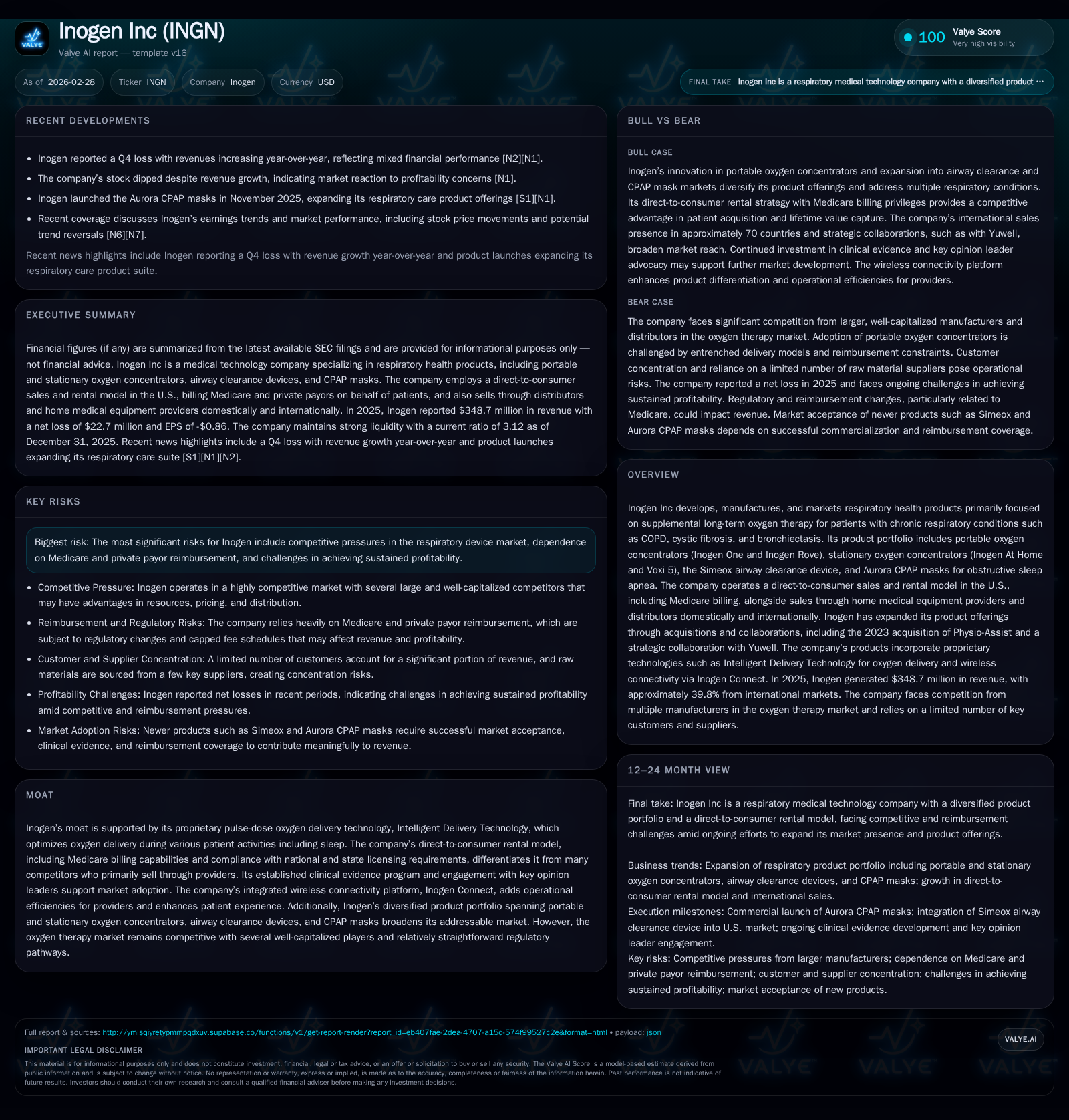
Inogen Inc has achieved modest revenue growth after a sharp downturn in 2022, driven by portfolio expansion and sustained direct-to-consumer operations. However, persistent operating losses and net income deficits extend concerns about profitability amid increasing Medicare dependency and heightened regulatory scrutiny. The company's proprietary pulse-dose oxygen delivery technology and recent acquisition of Physio-Assist underpin its competitive positioning and market diversification efforts. Watch for developments in reimbursement policy, integration milestones, and potential cost containment as key inflection points.
Historical Revenue Trajectory and Operating Income Evolution
Inogen Inc’s financial trajectory over the past four years depicts a recovering top line following a pronounced decline in 2022. Revenue dropped from $377 million in FY2022 to $316 million in FY2023 before edging upward to $349 million by FY2025 — a modest turnaround marked by a 3.9% increase year-over-year between FY2024 and FY2025 [F1]. This rebound has been accompanied by a notable contraction in operating losses from a staggering -$109 million loss in FY2023 to -$30 million at the close of FY2025.
The net income mirrors this pattern with losses improving by more than one-third since FY2023 but remaining at a negative $22.7 million. The firm’s ability to narrow these losses suggests management is actively addressing cost structures and enhancing operational efficiencies; however, profitability remains out of reach at this stage [F1].
Cash flows signal an uneven recovery; operating cash flow reversed from negative territory (-$37.5 million) in FY2022 to positive $5.9 million in FY2024 but declined again to negative $11.2 million for FY2025 — indicative of volatile operational cash productivity possibly due to working capital adjustments or fluctuating collections [F1]. Capital expenditures have softened from prior years, standing at roughly $2.5 million most recently.
Historical performance (annual)
| FY | Rev ($mm) | Net ($mm) | CFO ($mm) | OpInc ($mm) | Rev YoY | Net YoY |
|---|---|---|---|---|---|---|
| 2025 | 349 | -23 | -11 | -30 | +3.9% | +36.6% |
| 2024 | 336 | -36 | 6 | -43 | +6.4% | +65.0% |
| 2023 | 316 | -102 | -3 | -109 | -16.3% | -22.3% |
| 2022 | 377 | -84 | -38 | -85 |
Source: SEC companyfacts cache [F1].
Capital returns and efficiency (annual)
| FY | FCF ($mm) | ROE% |
|---|---|---|
| 2025 | -14 | -11.8 |
| 2024 | 3 | -20.6 |
| 2023 | -8 | -50.0 |
| 2022 | -41 | -28.2 |
Source: SEC companyfacts cache [F1].
This table underscores Inogen's progression from deep operational deficits toward narrower losses alongside challenging cash flow dynamics [F1].
Pulse-Dose Oxygen Delivery Technology as a Differentiator
At the core of Inogen’s competitive advantage lies its proprietary Intelligent Delivery Technology that facilitates pulse-dose supplemental oxygen therapy tailored according to various patient activities such as rest or sleep [S1]. This technology improves therapeutic efficacy while enhancing portability—attributes highly prized among individuals managing chronic respiratory diseases like COPD.
Pulse-dose delivery yields not only clinical benefits but also market moat characteristics by differentiating Inogen’s portable oxygen concentrators from conventional continuous-flow devices prevalent among competitors. While other players have begun adopting direct-to-consumer sales models, many lack Inogen’s integrated rental infrastructure coupled with the complex regulatory accreditations required for Medicare billing [S25].
Nonetheless, the field is intensifying competitively with larger rivals leveraging bundled offerings and deeper R&D budgets; thus Inogen must continually innovate its platform while defending its intellectual property landscape against patent challenges as noted in risk disclosures [S25].
Expansion of Product Portfolio: Acquisitions and Collaborations Impact
Growth initiatives have become more aggressive through strategic acquisitions and collaborations that expand both product scope and international reach [S1, S2]. The purchase of Physio-Assist SAS in September 2023 extended Inogen’s airway clearance device lineup—adding complementarity to its supplemental oxygen offerings—while the early-2025 collaboration with Jiangsu Yuyue Medical Equipment & Supply Co., Ltd (Yuwell) aims at amplifying research capabilities and facilitating intensified penetration into Chinese markets.
Though such moves open new addressable markets—domestically via expanded respiratory product segments and overseas through licensing partnerships—they inherently introduce integration complexity risks including sustaining uniform compliance standards across jurisdictions and preserving innovation pipelines from dilution or delays [S15]. Financially, intangibles tied to acquired technology assets add amortization burdens potentially weighing on profitability near-term.
Risks Embedded in Medicare Dependency and Regulatory Environment
A critical vulnerability for Inogen stems from its reliance on Medicare reimbursement streams which comprised approximately 59% of rental revenues as of mid-2025 [S5]. Given that nearly one-tenth of total company revenue hinges on these programs, any changes in government pricing policies or coverage determinations could materially impact cash inflows.
Regulatory scrutiny extends beyond payor contracts; Inogen operates under intense federal oversight encompassing FDA medical device clearances plus compliance with healthcare fraud and abuse statutes including Stark Law and Anti-Kickback statutes governing marketing and billing practices . Failure or perceived non-compliance carries risk of severe penalties comprising exclusion from Medicare programs which would critically impair revenue generation capacity.
Internationally, stringent pricing controls particularly within Europe compress margins compared to U.S operations where competitive bidding introduces volatility [S20], underscoring geopolitical dimensions impacting profitability.
Channel Strategy: Direct-to-Consumer Model Versus Distribution Partners
Unlike many competitors focused solely on provider sales channels, Inogen maintains a hybrid strategy where direct-to-consumer rentals supported by Medicare billing accreditation forms a major pillar alongside traditional sales through home medical equipment (HME) providers and distributors domestically and abroad [S5].
This approach enables tighter control over customer acquisition costs via prescriber engagement combined with immediate billing efficiencies—translating to enhanced patient experience through integrated wireless monitoring platforms like Inogen Connect . However, it also exposes the company to credit risks inherent in receivables management stemming from distributor relationships.
Such dual-channel complexity demands sophisticated inventory management and compliance frameworks as well as balancing price sensitivity given varying payor contracts across channels.
Financial Health Analysis: Cash Flows, Capital Expenditure, Liquidity, and Debt Levels
While liquidity remains robust—reflected by a strong current ratio approximating 3.12 at year-end FY2025—the company’s free cash flow profile remains negative due principally to persistent cash burn inclusive of operating losses eclipsing capex spend currently capped at around $2.5 million annually indicating restrained expansion spending amid fiscal caution [F1].
The disparity between healthy balance sheet metrics against ongoing negative operating cash flow invites attention toward sustainable cash generation mechanisms possibly linked with improved lease asset utilization or enhanced payor terms negotiation; current liabilities remain significantly below current assets allowing manageable short-term obligations defense despite cyclical pressures.
No significant indebtedness has been reported suggesting conservative leverage usage which affords strategic flexibility albeit encouraging operational breakeven sooner rather than later.
ROE and Shareholder Value: Dividend and Buyback Considerations
The latest annualized return on equity registers around -11.8%, affirming the challenge Inogen faces converting invested capital into shareholder profit reflective of ongoing business investment phase combined with margin pressures [F1]. There is no indication of dividend payments or share repurchase programs reflecting scarce distributable earnings thereby aligning capital allocation towards reinvestment for growth or debt containment if any externally sourced.
Milestones To Watch: Integration, Reimbursement Adaptation, Clinical Validation
Looking ahead through early-2026 lens amid recent earnings reports showing mixed investor sentiment despite modest revenue gains advises monitoring several critical vectors: successful integration of Physio-Assist products; progress commercializing collaborative respiratory technologies via Yuwell partnership targeting Chinese entry; evolving reimbursement policy reforms especially Medicare updates; clinical study outcomes helping solidify market acceptance; cost discipline amid rising lead generation expenses attributable partially to competitive intensity all warrant close observation [N1,N2,N7].
Future quarterly earnings releases will therefore be pivotal gauges for assessing trajectory towards sustainable growth offsetting persistent losses which remain primary focal points for stakeholders balancing optimism on innovation-driven opportunity against structural margin headwinds.
This analysis is based exclusively on publicly available information as of February 28, 2026, including SEC filings and recent news reports; it does not constitute investment advice or recommendations.
Disclaimer: This is research-only, informational analysis and not investment advice. It may include AI-generated interpretation and general industry context. Always verify important details using primary sources.

Comments