
Acushnet Holdings’ Brand Strength and Operational Discipline Define 2025 Performance
Acushnet balances growth in core golf equipment and apparel brands with margin pressures amid evolving market dynamics.
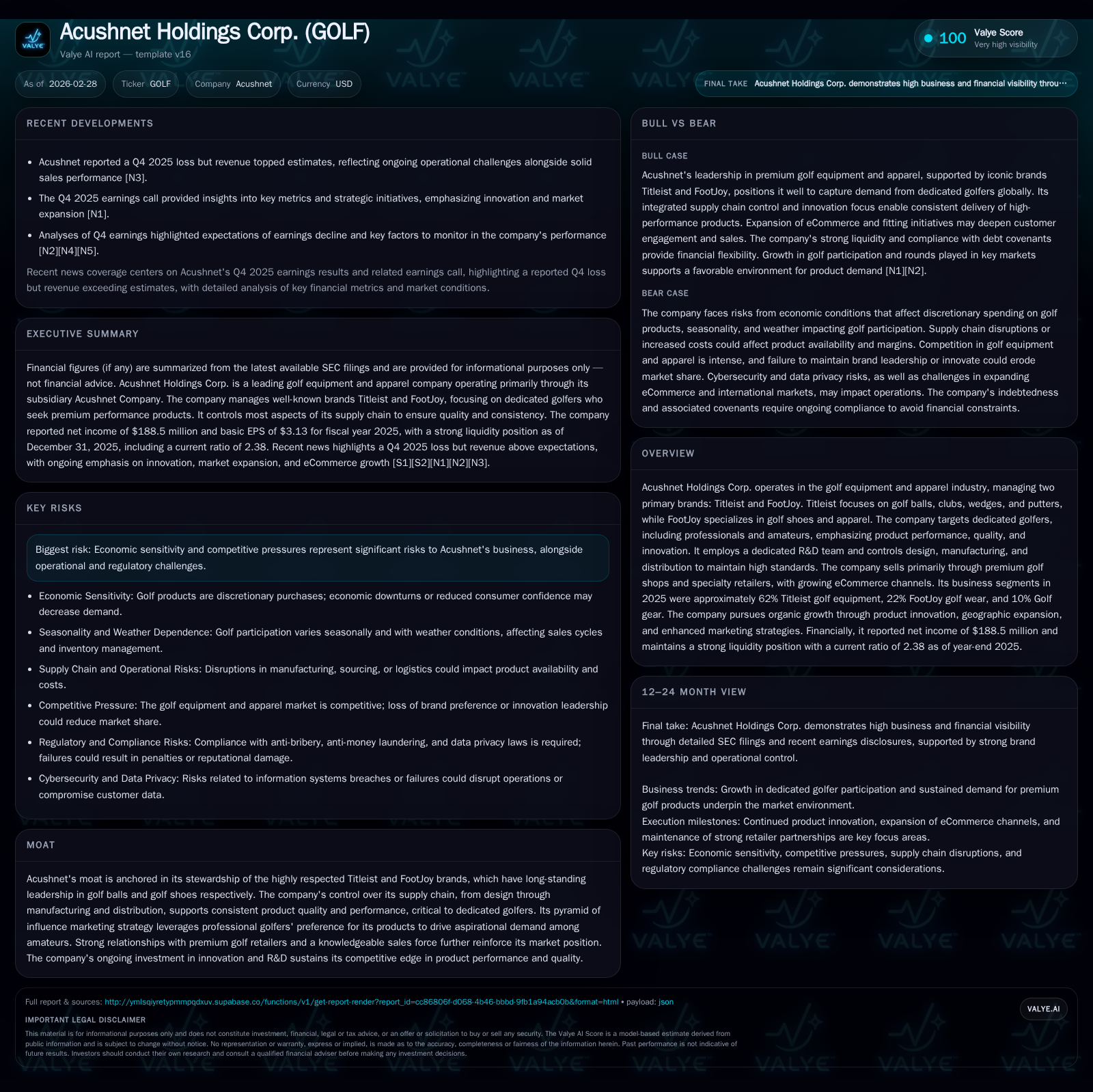
Acushnet Holdings Corp., steward of premium golf brands Titleist and FootJoy, reported solid revenue growth in 2025 driven by sustained demand from dedicated golfers and ongoing innovation. Despite a 4.7% rise in sales to approximately $2.56 billion, the company faced compressions in operating and net income, reflecting margin pressures and operational cost challenges. The firm's disciplined capital allocation, marked by substantial share buybacks and steady dividends, underscores commitment to shareholder returns even as cash flow contracted. Acushnet’s carefully managed supply chains, expert retail partnerships, and product development cadence position it to navigate competitive and economic headwinds while monitoring key risks such as consumer discretionary spending sensitivity.
Brand Heritage and Market Positioning Power Acushnet's Golf Equipment Leadership
Acushnet Holdings Corp.'s enduring moat is deeply rooted in its stewardship of two iconic brands: Titleist in golf equipment and FootJoy in golf apparel. These names are synonymous with performance excellence among dedicated golfers—a target segment characterized by avid play and willingness to pay premium prices for quality products [S4][F1]. The company's integrated control over design, manufacturing, packaging, and distribution underpins consistent quality standards critical to this discerning customer base.
The operational model employs distinct supply chains for each product category to maintain agility and stringent quality oversight. Importantly, approximately 200 specialized R&D professionals—including scientists, chemists, engineers, and technicians—drive a cadence of innovation that aligns tightly with golfers' natural equipment replacement cycles [S4]. This synchronization ensures product relevance at launch while supporting the company's leadership positions.
Acushnet's marketing leverages a pyramid of influence strategy: it secures top professional golfers' preferences to validate performance claims that cascade aspirational appeal down to amateur players. The company’s sales force extends beyond traditional roles; associates are trained as golf experts who cultivate trusted relationships with premium retail partners such as on-course shops and specialty outlets [S4]. This expertise fosters effective merchandising that highlights product benefits tailored to dedicated golfers’ expectations.
Historical Financial Performance: Revenue Uptick with Margin Pressures in 2025
Financially, Acushnet delivered revenue of approximately $2.56 billion in FY2025—marking a solid +4.7% increase year-over-year from prior levels [F1]. This top-line growth reflects successful product introductions across core categories (Titleist balls/clubs/wedges/putters and FootJoy footwear/apparel) combined with expansion into geographies like Japan, Korea, EMEA regions where golfing participation is growing [N1][S23].
Despite revenue gains, operating income saw a modest decline of -1.6% to around $299 million in 2025 versus $304 million the prior year [F1]. This contraction stems from margin compression due partly to higher input costs amid inflationary pressures and incremental expenses related to innovation launches and marketing investments reinforced during the year [N3]. Net income was more impacted at -12%, registering roughly $189 million versus $214 million previously [F1].
Operating cash flow also softened significantly; FY2025 generated roughly $194 million compared to $245 million in FY2024 (-20.7%), reflecting increased working capital needs or timing variances in receivables/payables [F1]. Capital expenditures remained stable near $74 million annually supporting plant upkeep and production capability [F1]. Combining these elements yields free cash flow around $120 million for the year—underscoring ongoing operational discipline despite earnings pressure.
Historical Financials Summary Table
Historical performance (annual)
| FY | Net ($mm) | CFO ($mm) | OpInc ($mm) | Capex ($mm) | Net YoY |
|---|---|---|---|---|---|
| 2025 | 189 | 194 | 299 | 74 | -12.0% |
| 2024 | 214 | 245 | 304 | 75 | +8.0% |
| 2023 | 198 | 372 | 285 | 75 | -0.4% |
| 2022 | 199 | -68 | 282 | 61 |
Source: SEC companyfacts cache [F1].
Capital returns and efficiency (annual)
| FY | Div ($mm) | Buybacks ($mm) | FCF ($mm) |
|---|---|---|---|
| 2025 | 56 | 212 | 120 |
| 2024 | 54 | 173 | 170 |
| 2023 | 52 | 334 | 296 |
| 2022 | 52 | 189 | -129 |
Source: SEC companyfacts cache [F1].
*Revenue for FY2023 not available from provided data.
Numbers rounded for presentation; YoY denotes percent change from prior fiscal year.
Innovation Pipeline Aligning with Dedicated Golfers’ Replacement Cycles
Acushnet's R&D rigor is central not only for maintaining performance leadership but also for matching the typical lifetime replacement patterns of dedicated golfers. Their innovation pipeline includes frequent product refreshes within Titleist balls—long recognized as tour favorites—and extends through clubs employing proprietary materials/processes designed for enhanced distance and forgiveness [S4][S17].
In wedges, the Vokey Design team offers an expansive lineup accommodating diverse swing styles via multiple lofts, grinds, bounces, finishes—supporting customization through programs like Wedgeworks [S20]. Putters under Scotty Cameron continue evolving both aesthetically and functionally aided by direct consumer engagement platforms such as online customization shops.
FootJoy's footwear innovations blend fitment improvements with climatic adaptations suitable for global markets. The brand complements its technical advancements with digital content aimed at generationally newer segments (millennials/zennials), supporting product trial initiatives wherever feasible [S17][N1].
Such methodical new product introductions reflect a deep understanding of “equipment cadence”—the rhythm at which serious golfers upgrade gear—and help insulate Acushnet against brand erosion from competitors leveraging alternative technologies or aggressive pricing.
Retail and Distribution Strategy: Driving Demand through Expertise and Premium Partnerships
Unlike mass-market approaches dominant in many sporting goods sectors, Acushnet pursues a ‘route to market’ strategy focused on premium golf shops worldwide—on-course clubhouses and specialty retailers favored by dedicated players [S4]. This selective channel engagement enables superior sell-through rates by ensuring that products are expertly merchandised alongside fitting services.
Key sales associates double as local golf authorities who guide retail partners on consumer education covering ball fitting profiles or club customizations enhancing buyer satisfaction. These relationships effectively deepen brand trust that translates into repeat purchases.
Innovative golfer engagement adds fitting/trial initiatives for balls, clubs, shoes—allowing customers hands-on experience before committing—an increasingly important tactic given rising consumer expectations around personalized performance solutions [S15]. Furthermore, expanding eCommerce complements physical retail exposures without diluting premium positioning.
This strategic partnership model leverages professional golfer endorsements but moves beyond simple sponsorship into active collaboration among shop staff professionals who influence purchase decisions daily.
Balancing Growth Drivers with Economic Sensitivities and Industry Competition
Golf equipment consumption remains economically sensitive given its recreational discretionary nature; swings in macroeconomic confidence can dampen spending especially among non-dedicated segments [S10][N5]. While participation numbers have shown resilience—with U.S rounds played up approximately +1% annually against pre-pandemic levels—the sector must contend with cyclical volatility induced by inflationary pressures affecting consumers’ wallets.
Competition intensifies particularly from large sporting brands entering premium golf niches using technology or scale advantages that challenge Acushnet’s traditional stronghold areas [N5][S21]. Raw material procurement also remains a concern amid fluctuating costs or supply chain disruptions which may limit flexibility or raise production expenses unpredictably.
To offset these headwinds, Acushnet pursues international market penetration strategies prioritizing established locations like Japan/Korea/EMEA while cautiously exploring emerging markets offering longer-term growth trajectories [S11]. Marketing refinements targeting millennial/Gen Z demographics along with women players aim at broadening the sport’s appeal beyond its historical demographic base.
Capital Allocation Review: Strong Buybacks and Dividends Despite Operating Cash Flow Decline
Despite softer earnings metrics in FY2025, Acushnet demonstrated continued commitment to capital return policies favored by shareholders via dividends totaling more than $56 million alongside aggressive stock repurchases exceeding $211 million over the same period [F1][S5][S6].
Operating cash flow contractions (-20.7%) contrasted with steady capex outlays (~$74 million), resulting in positive free cash flow around $120 million—a signal of disciplined expenditure management amidst profitability pressures.
Balance sheet strength remains evident through a current ratio exceeding 2.3x supported by current assets above $1 billion versus current liabilities near half that level at year-end reporting [F1][S9]. Long-term liabilities include revolving credit facility borrowings around $530 million complemented by senior unsecured notes maturing between now and mid-2030s—all covenants fully complied as per latest regulatory filings [S5][S6][S9][S14].
This financial posture affords flexibility for opportunistic reinvestment or potential acquisitions aligned with core business growth axes such as expanding clothing/apparel footprint or augmenting gear offerings.
Forward Visibility: Key Milestones, Risks, and Monitoring Indicators for Investors
Looking ahead into early-to-mid-2026 performance horizon based on recent earnings call insights [N1], Acushnet plans continued innovation-driven launches paced to fit golfers’ equipment adoption tendencies across core segments including balls/clubs/shoes/apparel.
Investor attention should focus on several vectors:
- Speed and success of new product rollouts measured by sell-through velocities at premium retail partners;
- Progress in digital consumer engagement initiatives underlying retail channel expansion;
- Margin trajectory moving past current compression influenced by input cost management effectiveness;
- Leverage profile relative to credit facility limits amid changing interest rate environments;
- Broader economic indicators impacting discretionary expenditure particularly U.S./Japan/EU golfer participation rates.
Risks remain anchored primarily on the cyclicality tied to economic variables affecting leisure spending patterns plus intensifying competition injecting pricing pressures [N5] alongside operational hazards involving raw material availability or regulatory compliance constraints noted across various filings [S21][S22].
Given these factors coupled with demonstrated brand loyalty strengths exemplified most notably by Titleist being the #1 ball on professional tours worldwide for over three-quarters of a century—as well as FootJoy’s eight-decade leadership shoes position—Acushnet’s operational discipline offers grounded optimism despite near-term margin challenges.
This report was prepared solely for informational purposes without providing investment advice or recommendations.
Disclaimer: This is research-only, informational analysis and not investment advice. It may include AI-generated interpretation and general industry context. Always verify important details using primary sources.

Comments