
Carlyle Group's Asset Growth and Capital Distribution Offset Revenue Pressure in 2025
AUM expansion and targeted buybacks highlight Carlyle's strategic balance amid volatile financial markets.
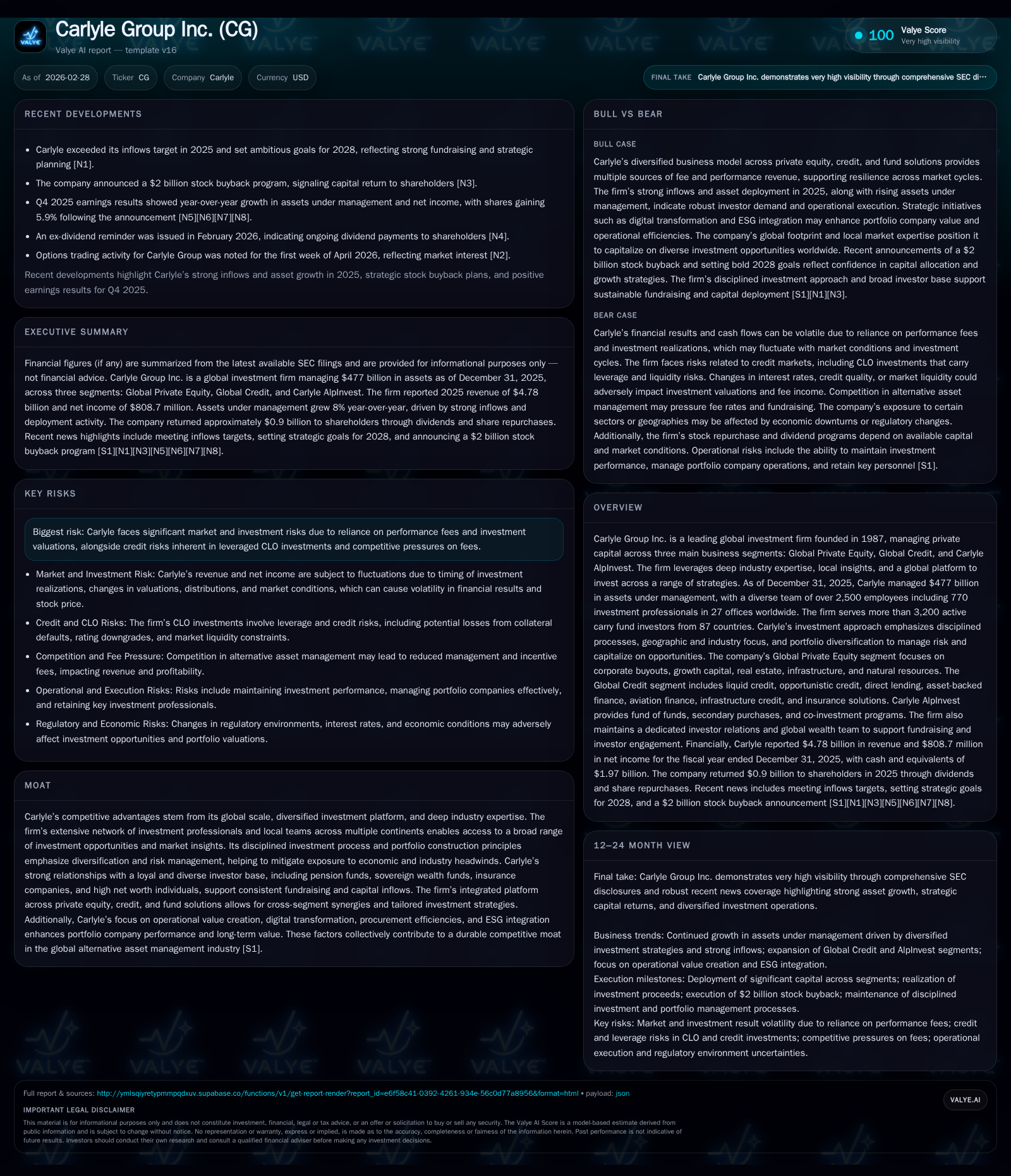
Carlyle Group Inc. delivered mixed financial results in 2025, with assets under management rising 8% to $477 billion, driven by strong inflows across private equity, credit, and AlpInvest platforms. Despite top-line revenue declining nearly 12% year-over-year to $4.78 billion, the firm maintained profitability with $809 million net income and returned about $1.2 billion to shareholders via dividends and share repurchases. Increased deployment activity and fundraising successes support growth prospects but operating cash flow turned sharply negative, reflecting fund-level capital movements and investment cycles. Carlyle’s scale, diversified platform, and deep industry expertise underpin its market position while ongoing risks include regulatory scrutiny, competitive pressures, and market volatility impacting valuation and fee generation.
Company Overview and Historical Performance
The Carlyle Group Inc., established in 1987, is a leading global investment firm managing private capital through three main segments: Global Private Equity (GPE), Global Credit (GC), and Carlyle AlpInvest (AlpInvest). As of December 31, 2025, the firm managed approximately $477 billion in assets under management (AUM), representing an 8% increase over the previous year’s $441 billion [F1][S1]. The rise largely resulted from significant inflows totaling $53.7 billion during the year—a 32% increase from 2024—offsetting headwinds from fluctuating market valuations.
The employee base totals over 2,500 globally with about 770 investment professionals across 27 offices on four continents [S1]. The firm's investor base is notably diverse with more than 3,200 active carry fund investors spanning 87 countries.
In terms of reported financials, revenues registered at $4.78 billion for FY2025, marking a decline of nearly 12% from FY2024 where revenue was $5.43 billion [F1]. Net income fell by approximately 21% year-over-year to $808.7 million from over a billion dollars the prior year [F1]. Operating cash flow showed a steep downturn signaled by negative $3.28 billion in FY2025 compared to negative $759 million previously, influenced by complex timing of investments within their funds [F1]. Capital expenditures modestly increased by about 28%, reaching $99 million.
Historical performance (annual)
| FY | Rev ($bn) | Net ($mm) | CFO ($bn) | Capex ($mm) | Rev YoY | Net YoY |
|---|---|---|---|---|---|---|
| 2025 | 4.8 | 809 | -3.3 | 99 | -11.9% | -20.7% |
| 2024 | 5.4 | 1020 | -0.8 | 78 | +83.1% | +267.7% |
| 2023 | 3.0 | -608 | 0.2 | 67 | -33.2% | -149.7% |
| 2022 | 4.4 | 1225 | -0.4 | 41 |
Source: SEC companyfacts cache [F1].
Capital returns and efficiency (annual)
| FY | Div ($mm) | Buybacks ($mm) | FCF ($bn) |
|---|---|---|---|
| 2025 | 505 | 687 | -3.4 |
| 2024 | 503 | 555 | -0.8 |
| 2023 | 498 | 204 | 0.1 |
| 2022 | 444 | 186 | -0.4 |
Source: SEC companyfacts cache [F1].
Note: Operating cash flow includes fund-level capital deployment effects which can distort GAAP figures for asset managers.
Segment Performance Drivers
Global Private Equity
Within the GPE segment, Carlyle increased deployment activity to $10.4 billion while realizing proceeds of approximately $18.2 billion in FY2025 [S1]. Fundraising contributions came notably from its tenth U.S. real estate fund "CRP X" and sixth Asia buyout fund "CAP VI," along with broad engagement in life sciences platforms and recurring investments into its evergreen real estate offering "CPI" [S1]. Successful initial public offerings during the year spanned geographies including Japan (Orion Breweries), India (Hexaware), and the U.S. (Medline), evidencing the geographic diversification strategy.[S1]
Global Credit
Assets under management for Global Credit increased by around 10% YoY to $211 billion [S1], reflecting inflows of about $28.3 billion which significantly fueled deployment at nearly $30 billion for the year—over double compared to earlier periods [S1]. Their CLO business was particularly active with nine new CLO issuances totaling around $4.8 billion [S1]. Moreover, the Global Capital Markets strategy contributed over $206 million through advisory fees—the highest recorded—strengthening diversified revenue streams.[S1][N1]
Carlyle AlpInvest
AlpInvest achieved a substantial AUM uplift of about 20%, reaching approximately $102 billion fueled by close to $18 billion of fresh inflows primarily concentrated in secondaries & portfolio finance funds as well as new products CAPS and CAPM strategies [S1]. Deployment totaled around $14.2 billion, demonstrating consistent capital recycling within this segment [S1].
Future Growth Prospects
Carlyle’s growth outlook centers on continued asset raising momentum fueled by specialized fund launches across private equity sectors including real estate and life sciences as well as expanded credit platforms addressing direct lending and CLO structuring demands [N6][S1]. The firm’s broad geographic presence gives it a vantage point on global private markets opportunities though it also faces risks linked to macroeconomic uncertainty affecting valuation multiples especially in sectors exposed to geopolitical or inflationary pressures [S1][S19].
Digitization efforts at portfolio companies combined with ESG integration remain strategic cornerstones aimed at unlocking operational efficiencies and mitigating risks inherent in private market investing [S15]. However, competitive pressures from other global asset managers including sovereign wealth funds and emerging specialized credit players could constrain pricing power or access to high-quality deals [S19][S22]. Regulatory developments particularly from the SEC targeting fee structures and transparency standards may impose additional compliance costs that could affect net profitability [S9][S11][N6].
Monitoring will focus on how Carlyle manages valuation volatility’s impact on performance fees—a key revenue driver—and sustains fundraising traction amid evolving investor mandates favoring tailored risk-return profiles.
Returns & Capital Allocation
CFO swings into negative territory indicate significant investment activity typical for alternative asset managers cycling capital deployment against realizations [F1]. Despite this working capital strain, Carlyle returned approximately $1.19 billion to shareholders during FY2025 through dividends ($505 million) plus share repurchases ($686 million)—a noticeable step up versus prior periods reflective of strong free cash generation from operations at the fund level or balance sheet optimization initiatives [F1][N8].
The firm maintains a solid equity base around $7.06 billion, producing an approximate ROE near 11.5% for FY2025 based on net income-to-equity ratio calculations [F1]. Leverage use details underscore typical private equity holding company dynamics including access to debt markets evidenced by recent senior unsecured bond issuance supporting liquidity needs [S12][S14].
Capital allocation decisions indicate disciplined shareholder engagement while balancing reinvestment into growth areas like digital operations support and sustainable investment frameworks.
Risks & Market Environment
Important cautionary points include reliance on fee income tied closely to valuations that are vulnerable during economic downturns or market dislocations; volatility driven by geopolitical tensions such as supply chain disruptions near Taiwan Strait poses specific regional risk factors impacting exposure in Asian portfolios [S1][S9]. Additionally, regulatory scrutiny focusing on disclosure practices, allocation conflicts among funds’ investors, and cost transparency is intensifying globally raising compliance burdens [S9][S10].
Competition continues intensifying with various financial institutions diversifying into alternatives with potentially lower cost structures or proprietary deal access reducing opportunities available solely via third-party managers like Carlyle [S19][S22]. Also noteworthy are credit market conditions affecting direct lending yields or CLO financing economics that bear directly on the Global Credit segment's profitability profile.
Conclusion & What to Watch - Analysis Perspective
Looking ahead into mid-2026 and beyond, investor attention should focus on quarterly results showing fundraising momentum continuation especially for subsequent closes of flagship funds; cash flow evolution as investments mature toward realization phases; operating expense control amid higher compliance demands; fee-related earnings sensitivity given public market valuation fluctuations; strategic deployment execution focusing on differentiated asset classes such as life sciences or real assets; potential expansions in emerging geographies; plus how share repurchase programs align with stock price performance.
Any meaningful shifts in macroeconomic conditions or regulatory landscape may influence both incremental capital raising ability across sovereign/institutional clients as well as fair value determination driving performance revenues.
Carlyle epitomizes scale-enabled diversification blending broad global reach with sector-specialized expertise maintaining competitive advantage through its integrated platform approach across private equity, credit, and fund solutions.
This analysis is provided solely for informational purposes based on publicly available data as of early 2026 without any recommendation related to securities offered by Carlyle Group Inc.
Disclaimer: This is research-only, informational analysis and not investment advice. It may include AI-generated interpretation and general industry context. Always verify important details using primary sources.

Comments