
Fidelity Ethereum Fund’s Volatile Ether Exposure Hinges on Regulatory Evolution and Market Dynamics
The fund offers investors access to ether price movements via a grantor trust structure, facing significant regulatory and market risks.
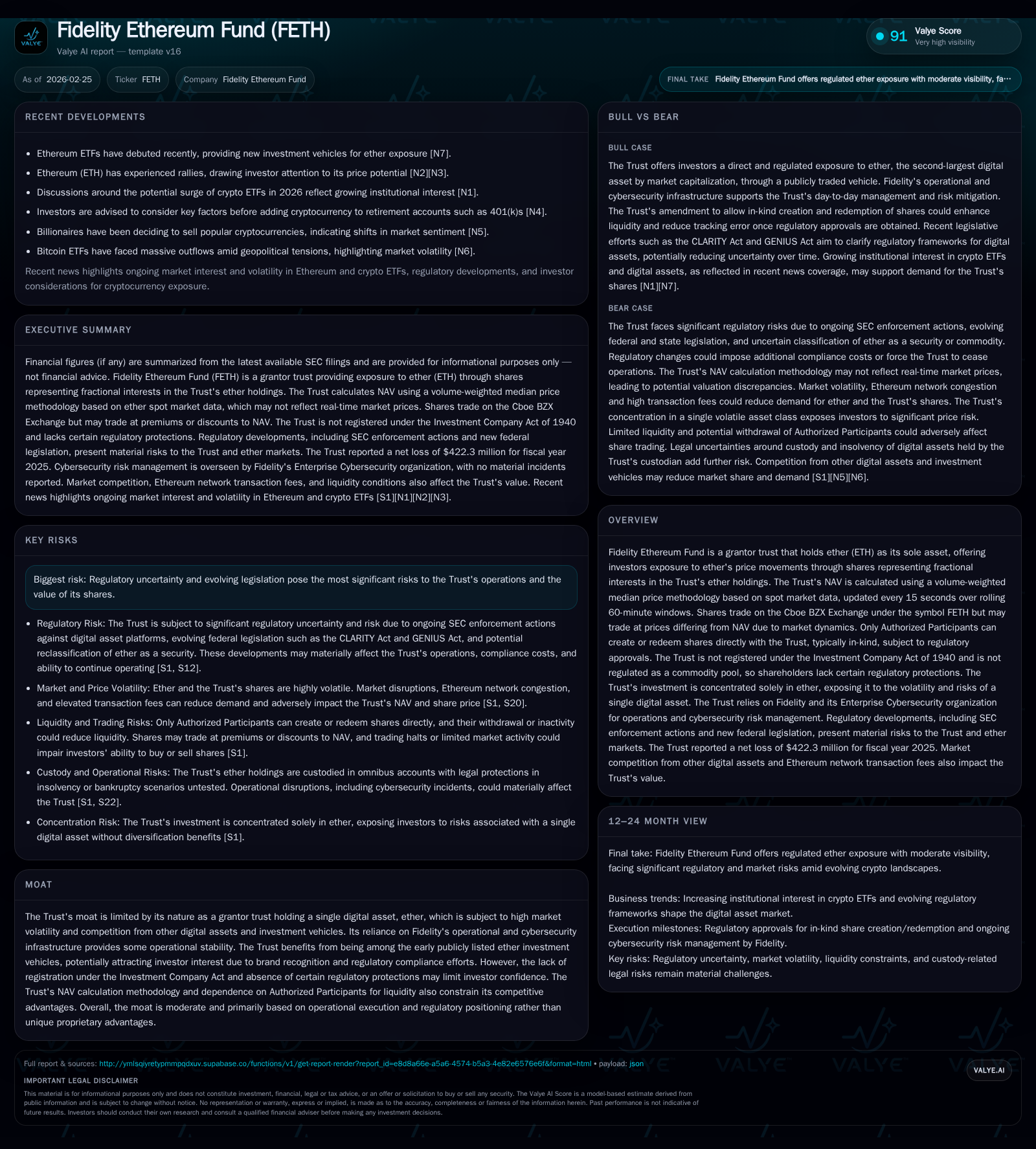
Fidelity Ethereum Fund (FETH) is a single-asset grantor trust holding ether exclusively, providing exposure to ether's price through tradable shares. Its reliance on Fidelity's operational infrastructure affords some stability, but the fund remains vulnerable to ether’s inherent price volatility and an uncertain regulatory environment marked by ongoing enforcement actions and potential legislative changes. The Trust’s NAV is calculated via a volume-weighted median price methodology, with shares trading on the Cboe BZX Exchange, though prices may diverge from NAV due to market factors. Operating losses have widened sharply in 2025 alongside high repurchase activity, underscoring challenges in capital returns amid volatile market conditions.
Business Model and Historical Performance
Fidelity Ethereum Fund operates as a grantor trust holding exclusively ether (ETH) as its sole asset. Investors gain indirect exposure to ether’s market price by purchasing shares representing fractional interests in the Trust’s underlying holdings. The shares trade publicly on the Cboe BZX Exchange under the ticker “FETH.” Unlike actively managed funds, the Trust does not engage in trading strategies or hedging, maintaining static holdings of ether which directly expose shareholders to the full spectrum of ether’s volatility [S1].
The value of the Trust's holdings is determined through a volume-weighted median price (VWMP) methodology, calculated every 15 seconds over rolling 60-minute windows—derived from spot market data across multiple eligible ether exchanges [S1]. This approach smooths short-term pricing but may lag real-time trades or deviate from spot prices on individual venues. Therefore, while NAV updates frequently, market dynamics can cause share prices to trade at premiums or discounts relative to NAV.
From a financial standpoint, FETH has experienced sharply worsening operating results over recent years. Net income declined steeply from a loss of approximately $9 million in fiscal year 2024 to a sizable net loss of $422 million in fiscal year 2025 [F1]. Operating cash flow improved marginally yet remained strongly negative at about -$1.04 billion in 2025 versus -$1.55 billion in 2024 [F1]. Meanwhile, equity grew from $1.57 billion at end-2024 to $2.21 billion by end-2025 [F1], supported notably by substantial repurchase programs: share buybacks surged from $187 million in 2024 to $3.26 billion in 2025 [F1].
Historical performance (annual)
| FY | Net ($mm) | CFO ($mm) | Net YoY |
|---|---|---|---|
| 2025 | -422 | -1039 | -4533.0% |
| 2024 | -9 | -1550 |
Source: SEC companyfacts cache [F1].
Note: Some line items are omitted where multi-year comparability is limited in the structured SEC XBRL dataset; trend columns are shown only when comparable history exists.
Capital returns and efficiency (annual)
| FY | Buybacks ($bn) | ROE% |
|---|---|---|
| 2025 | 3.3 | -19.1 |
| 2024 | 0.2 | -0.6 |
Source: SEC companyfacts cache [F1].
Financial data highlights extreme net losses and substantial buyback activity reflecting capital allocation choices amidst volatile crypto market conditions [F1].
NAV Calculation and Trading Dynamics
The Trust's NAV relies heavily on its VWMP methodology which references spot markets for ether prices yet may not capture intraday events occurring outside its rolling time window [S1]. This design reduces susceptibility to erratic trades but also introduces timing mismatches between NAV and exchange-traded share prices. Investors should anticipate that share prices can diverge materially from NAV during episodes of high volatility or market stress.
Creation and redemption transactions by Authorized Participants facilitate arbitrage opportunities that typically keep market prices close to NAV. However, reliance on a limited number of Authorized Participants can impair liquidity if these participants withdraw or reduce involvement—a risk underscored by competition with other ether investment vehicles and evolving regulatory oversight over broker-dealers engaged in crypto asset activities [S24][S25][S26].
Regulatory Uncertainty as Core Risk
Regulatory risk represents arguably the most significant overhang for FETH’s continued viability and valuation profile. Although ether itself has not been formally classified as a security by the SEC, ongoing enforcement actions against major crypto trading platforms such as Coinbase, Binance, and Kraken have unsettled digital asset markets [S5][S7][S9]. These actions focus on allegations that certain platforms operated unregistered securities exchanges or broker-dealers.
Furthermore, various authoritative bodies including the SEC, CFTC, DOJ, FinCEN, and state regulators are intensifying scrutiny around digital asset custody, trading practices, compliance frameworks, and potential money transmission licensing requirements [S16][S19][S21]. The recently launched SEC Crypto Task Force aims to develop clearer regulatory frameworks but uncertainty remains acute.
Legislative proposals introduced by Congress targeting stablecoins and digital asset market structure also add layers of unpredictability; their outcomes could reshape access for funds like FETH or require costly compliance upgrades potentially triggering terminations or liquidations in adverse scenarios [S14][S19][S22].
Internationally, disparate regulatory approaches—from restrictive regimes in China and Russia to evolving frameworks within the EU—pose additional geopolitical risks that may impact ether adoption and cross-border flows [S21][S22].
Market Volatility Impact on Performance
Ether’s price behavior has been notably volatile since inception with dramatic bull runs followed by severe corrections documented over several years [S1]. The Trust inherits this volatility unmitigated as it holds ether outright without active management or hedging options.
Given that some large holders possess significant concentrations of ether wallets aggregating meaningful percentages of total supply, their trading decisions can heavily impact short-term liquidity and price swings [S17]. Coupled with susceptibility to technological glitches or forks within the Ethereum network protocol itself—governed by decentralized consensus—the fundamental risk profile remains elevated.
Capital Allocation and Returns
Despite steep operating losses registered in recent periods, Fidelity has pursued aggressive share buybacks totaling over $3 billion in fiscal 2025 alone—a marked increase from $187 million spent in prior year [F1]. This contrarian commitment to repurchase activity amid market turmoil may reflect confidence founded on structural advantages such as Fidelity-brand recognition or attempts to support secondary market pricing.
However, reported Return on Equity stands negative at approximately -19% for 2025 (net income divided by equity), illustrating absence of profitability at present levels [F1]. Operating cash flows remain deeply negative though improved somewhat compared with prior periods; capital investment specific figures are unavailable but are likely minimal given grantor trust constraints precluding active asset management or reinvestment strategies [F1][S24].
Dividend distributions are not anticipated given structure and performance characteristics; tax liabilities arising from pass-through treatment place further considerations on shareholder returns [S29].
Operational Risk Considerations
The fund leverages Fidelity’s cybersecurity infrastructure extensively but remains exposed to risks associated with digital asset custody including cyberattacks, thefts facilitated by blockchain pseudonymity, software vulnerabilities within associated networks and third-party vendor breaches [S23][S25]. Fidelity employs continuous monitoring programs integrating threat intelligence drawn from broad agency partnerships which provides operational resilience yet cannot entirely eliminate threat vectors.
Outlook and Monitoring Factors (Analysis)
Looking ahead through an analytical lens rather than explicit guidance—which is absent—the evolution of regulatory clarity will be pivotal for FETH’s growth prospects or potential contraction. An adverse designation of ether as a security or onerous regulatory mandates could force restructuring or liquidation scenarios detrimental to shareholders.
Conversely, broader institutional acceptance of crypto assets coupled with stabilization or appreciation in ether prices would enhance NAV trajectories and possibly invite inflows boosting scale effects.
Liquidity conditions governed by Authorized Participant engagement should be closely watched given implications for premium/discount spreads and trading ease. Market sentiment driven by network upgrades (e.g., Ethereum protocol enhancements), competition among crypto ETFs/products, technological disruptions or shifts in macroeconomic conditions affecting risk appetite will also influence performance dynamics.
Summary
The Fidelity Ethereum Fund represents a structurally straightforward but inherently high-risk vehicle providing direct exposure to one of crypto’s leading digital assets via a grantor trust model. Its historical financials reveal heavy operating losses amidst an unstable pricing backdrop influenced heavily by ether's notorious volatility. Regulatory uncertainty towers large as both domestic enforcement actions against exchanges and pending legislation loom over digital asset investing frameworks nationwide. While Fidelity offers operational stability through its cyber defense programs and industry stature, fundamental investor protections remain limited given lack of registration under traditional investment company acts. Capital allocations toward substantial repurchases suggest active balance sheet management though returns remain deeply negative. Shareholders face systemic risks including liquidity dependence on Authorized Participants, cyber threats, concentrated token ownership implications, plus unpredictable regulatory shifts impacting access and viability. Prospective investors must watch regulatory developments closely along with ethereum network governance milestones and broader market trends dictating demand for digital assets.
This analysis is based solely on publicly filed documents as of February 25, 2026 ([F1], ) without inference beyond disclosed facts. It does not constitute investment advice.
Disclaimer: This is research-only, informational analysis and not investment advice. It may include AI-generated interpretation and general industry context. Always verify important details using primary sources.

Comments