
Invesco Ltd Faces Profit Volatility While Boosting Liquidity and Shareholder Returns
This analysis reviews Invesco's recent financial fluctuations, capital strategies, and outlook amid a challenging asset management industry.
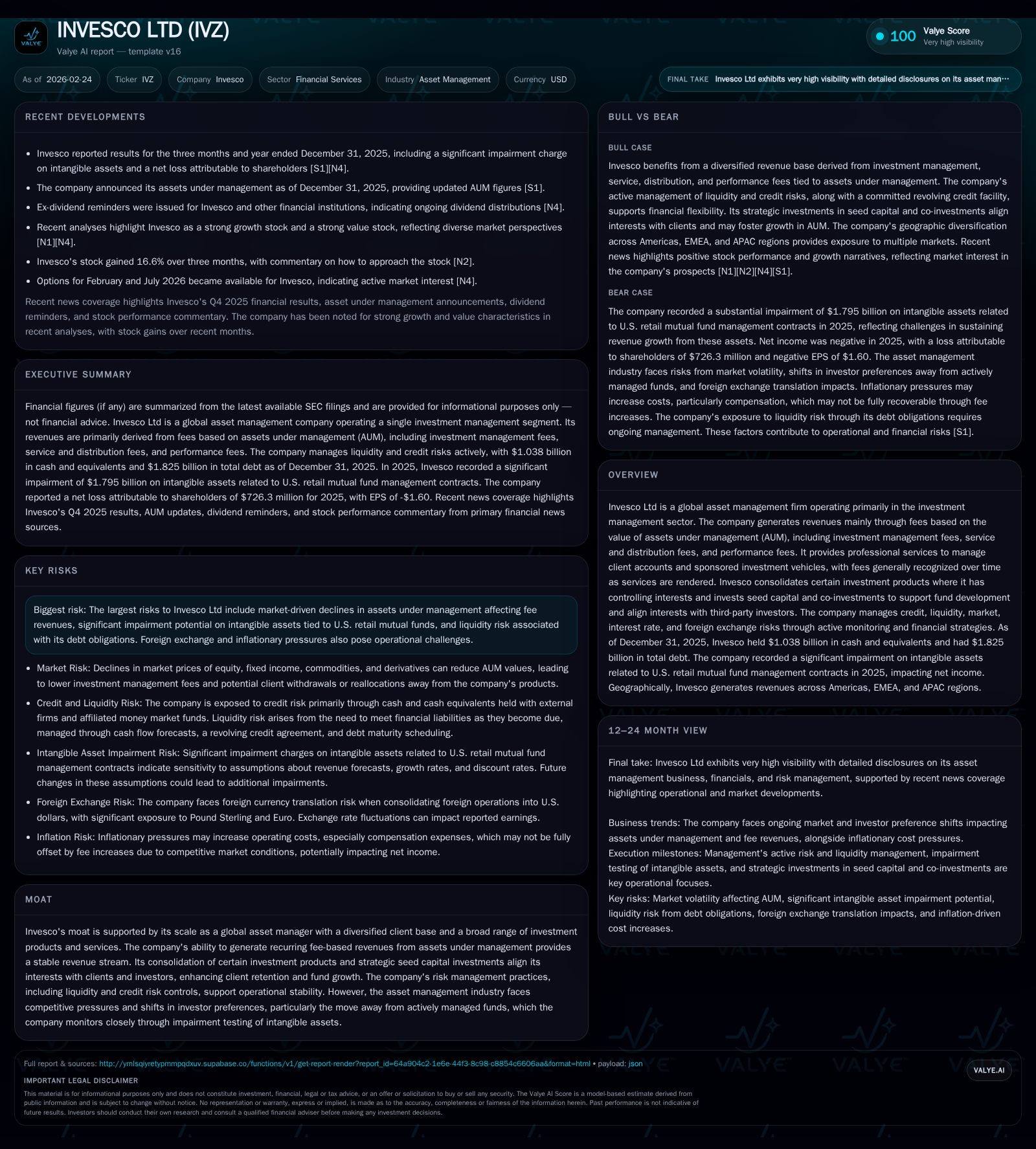
Invesco Ltd experienced pronounced swings in profitability over recent years, marked by a sharp transition from operating losses in 2023 to positive operating income in 2024 before reverting to a significant loss in 2025. Despite this volatility, the firm maintains strong liquidity with over $1 billion in cash and equivalents and has actively pursued shareholder returns via dividends and share repurchases. Challenges persist from intangible asset impairments related to U.S. retail mutual funds and competitive pressures driven by shifts toward passive investing. The company's capital structure includes considerable debt managed through staggered maturities and conservative credit agreements, providing buffers against liquidity risk. Key growth drivers include strategic seed investments aligning interests with clients and ongoing product diversification efforts. The company’s board recently authorized a $1 billion share repurchase plan with no expiration date, signaling confidence in capital deployment amid earnings variability [S3].
Episodic Earnings Swing: A Look Back at Financial Performance and Drivers
Invesco Ltd's financial performance over recent years has been marked by significant volatility reflecting broader industry headwinds alongside company-specific challenges. Revenues have remained relatively stable, ranging from approximately $5.1 billion in 2015 to about $5.3 billion as of the latest available data in FY2018, indicating modest growth constrained by fee pressures and fluctuations in assets under management (AUM) [F1].
Operating income has exhibited pronounced swings: from a loss of roughly -$434.8 million in FY2023 to a positive operating income of $832 million in FY2024, before declining sharply again to an operating loss of -$695.7 million in FY2025 [F1]. This volatility is largely driven by substantial impairment charges on intangible assets — notably management contracts associated with U.S. retail mutual funds — which totaled approximately $1.8 billion during FY2025 as detailed in company disclosures [S13]. These impairments reflect changing investor preferences away from actively managed products, resulting in downward revisions to goodwill and intangible asset valuations.
Revenue Streams and Operating Income Dynamics
Invesco’s core revenues are primarily derived from investment management fees based on AUM, supplemented by service fees and performance-related fees for select funds [S14]. This fee structure inherently ties revenue generation to market valuations and fund flows, exposing the company to cyclical earnings risks aligned with macroeconomic conditions.
Operating costs have been affected by inflationary pressures—especially compensation expenses—which represent a major portion of total costs [S1]. The competitive environment limits the company’s ability to fully offset these increased expenses through pricing adjustments, compressing margins further. Similar margin pressures have been observed among peers such as T. Rowe Price, underscoring sector-wide cost challenges [N6].
Balancing Act: Risk Factors Shaping Growth Prospects
Market-driven declines in AUM remain a critical risk factor given their direct impact on fee-based revenues [S1]. Furthermore, the sizeable intangible assets related to U.S. retail mutual fund management contracts are subject to ongoing impairment testing amidst structural shifts favoring passive investment strategies — a potential source of future non-cash charges if adverse trends persist [S11][S13].
Liquidity risk is managed through staggered debt maturities and committed revolving credit facilities; however, the company carries $1.825 billion of total debt requiring active oversight [S5][S6]. Inflationary cost increases add complexity that may pressure net income unless mitigated by operational efficiencies or pricing power.
Capital Deployment: Dividends, Share Repurchases, and Debt Profile
Despite profit variability, Invesco has demonstrated commitment to shareholder returns, paying approximately $377 million in common stock dividends during FY2025—a steady increase over prior years—and repurchasing about $124 million of shares the same year [F1]. The board's February 2026 authorization of a new $1 billion share repurchase plan without expiration underscores proactive capital allocation amid earnings uncertainty [S3][S21].
Return on equity approximates 4.4%, reflecting subdued profitability against equity levels influenced by earnings fluctuations; nevertheless, cash flow generation remains strong with free cash flow near $1.44 billion after capital expenditures totaling around $84 million for FY2025 [F1].
Debt comprises unsecured senior notes, term loans, and revolving credit facilities with borrowing capacity extended through May 2030 bearing floating interest rates tied to SOFR plus modest spreads (~1–1.25%), supporting manageable financing costs while maintaining covenant compliance [S5][S6][S13]. This staggered maturity approach aids liquidity risk mitigation.
Liquidity Buffers and Debt Maturity Approaches
The company held over $1 billion in cash and equivalents at year-end 2025 providing coverage against its debt obligations totaling approximately $1.825 billion across multiple instruments including senior notes and term loans [F1][S5]. Proactive liquidity management includes regular cash flow forecasting combined with dialogue with financing partners aimed at preventing liquidity shortfalls under volatile market scenarios [S7]. Interest rate exposure is predominantly floating via SOFR linkage with narrow margins enabling predictable interest expense within defined risk parameters.
Growth Catalysts: Strategic Initiatives Amid Industry Headwinds
Looking ahead, Invesco targets growth through product diversification beyond traditional active funds into alternative asset classes supported by seed capital investments that align the firm's interests closely with clients', enhancing retention prospects amid active fund outflows [N7][N9]. These strategic moves aim to counterbalance industry-wide attrition toward passive investment vehicles.
Recent news highlights improved investor sentiment following Q4 adjusted earnings beats relative to peers like Apollo Global Management and T. Rowe Price who faced margin pressure from rising expenses—suggesting opportunity for Invesco if it can stabilize costs while expanding fee-generating AUM [N1][N6][N9][N12].
What to Monitor Next: Key Indicators and Milestones Ahead
Key upcoming milestones include quarterly earnings releases focusing on adjusted EPS trends excluding volatile impairment items as well as execution progress on share repurchases given their impact on per-share metrics [S14]. Further scrutiny of intangible asset impairment assumptions will be critical for assessing sustainability within U.S. retail fund segments [S13]. Regulatory developments affecting fund registration or distribution globally could materially influence operational flexibility [S11], while net new money inflows/outflows remain a vital barometer validating growth strategies amid competitive dynamics highlighted by analysts [N9][S14].
Historical Financial Performance Summary (USD millions)
Historical performance (annual)
| FY | Net ($mm) | CFO ($mm) | OpInc ($mm) | Capex ($mm) | Net YoY |
|---|---|---|---|---|---|
| 2025 | 1525 | -696 | 84 | ||
| 2024 | 538 | 1190 | 832 | 69 | +261.2% |
| 2023 | -334 | 1301 | -435 | 164 | -148.8% |
| 2022 | 684 | 703 | 1318 | 193 | -50.9% |
Note: Omitted columns lack sufficient annual XBRL coverage in the provided tags (need ≥2 annual points): Rev. Source: SEC companyfacts cache [F1].
Capital returns and efficiency (annual)
| FY | Div ($mm) | Buybacks ($mm) | FCF ($mm) |
|---|---|---|---|
| 2025 | 377 | 124 | 1441 |
| 2024 | 372 | 79 | 1121 |
| 2023 | 358 | 188 | 1137 |
| 2022 | 335 | 510 |
Source: SEC companyfacts cache [F1]. Note: Revenue figures for recent years after FY2018 not available from provided tags.
Disclaimer: This report is intended solely for informational purposes reflecting publicly available data and regulatory filings without offering any investment advice or recommendations.
Disclaimer: This is research-only, informational analysis and not investment advice. It may include AI-generated interpretation and general industry context. Always verify important details using primary sources.

Comments