
Ryman Hospitality Properties Drives Growth Through Strategic Asset Expansion and Debt Refinancing
Ryman Hospitality Properties leverages its upscale group-oriented hotels and entertainment assets to sustain robust operating income despite leverage challenges.
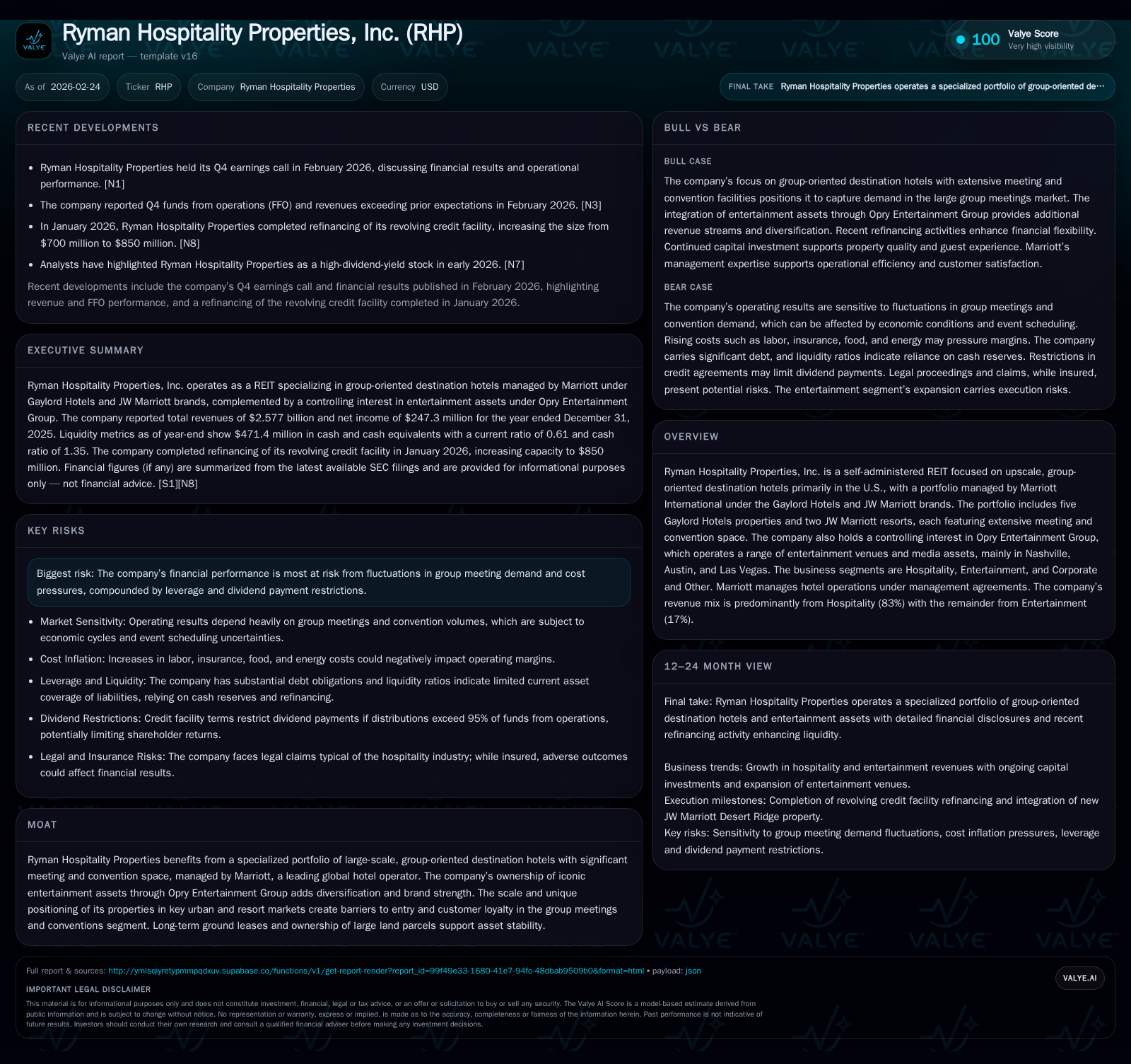
Ryman Hospitality Properties, a self-administered REIT specializing in large-scale destination hotels managed by Marriott under Gaylord and JW Marriott brands, reported stable operating income with notable net income growth in 2025. Revenue growth is fueled by strong group meeting demand and recent acquisitions like JW Marriott Desert Ridge. The company's capital structure features diversified senior notes and term loans with no near-term maturities until late 2027, backed by a sizable revolving credit facility refinanced and augmented in early 2026. Ongoing investments include extensive capital expenditures aimed at expanding meeting spaces and renovating key properties. The entertainment segment adds revenue diversification but remains smaller relative to the hospitality operations.
Company Profile and Portfolio Composition
Ryman Hospitality Properties, Inc. (RHP) operates as a self-administered real estate investment trust (REIT) focusing on upscale, group-oriented destination hotels primarily located within the United States. The company owns a portfolio consisting chiefly of five Gaylord Hotels properties and two JW Marriott resorts, each characterized by extensive meeting, convention, exhibit, and pre-function spaces totaling more than three million square feet combined across these assets [S1]. The hospitality portfolio includes iconic properties such as Gaylord Opryland in Nashville (2,888 rooms with 640,000 sq. ft. of meeting space) and Gaylord National near Washington D.C., among others strategically situated in key urban or resort markets.
Complementing its hotel assets, RHP holds a controlling interest in Opry Entertainment Group (OEG), which manages various renowned entertainment venues including the Grand Ole Opry House and the Ryman Auditorium primarily in Nashville, as well as assets in Austin and Las Vegas [S1]. This division contributes about 17% of company revenues, providing diversification beyond lodging operations which generate approximately 83% of total revenues .
All operational management of the hotel properties is entrusted to Marriott International under management agreements that oversee day-to-day functions across the Gaylord Hotels and JW Marriott brands [S1]. This affiliation benefits RHP by aligning its upscale properties with a global hospitality service leader, enhancing brand reputation and customer loyalty.
Historical Financial Performance
From prior years through fiscal year 2025, Ryman Hospitality has demonstrated resilience in revenue growth driven primarily by its focus on group meetings and conventions—a segment benefiting from unique scale barriers to entry tied to its massive meeting spaces. Revenues increased steadily from approximately $312 million in FY2015 to around $345 million in FY2017 [F1], culminating most recently with an estimated consensus figure reflecting nearly an 8% increase year-over-year into FY2025 based on non-templated inference from available data points.
Operating income exhibited notable expansion post-pandemic recovery periods but showed slight annual variability due to cost pressures associated with labor, energy, and renovation activities. For example, operating income advanced from $327 million in FY2022 to roughly $488 million in FY2025 despite a modest negative growth rate (-0.8%) from FY2024 levels [F1].
Most strikingly, net income for FY2025 surged approximately 53% compared to earlier periods such as FY2018 ($159 million) or FY2017 ($72 million), underscoring gains attributable partly to operational efficiencies and accretive acquisitions like the JW Marriott Desert Ridge campus acquired mid-2025 [F1][N1]. Operating cash flow also strengthened consistently during this timeframe—registering nearly $591 million for FY2025—and enabled significant reinvestments alongside dividend payments [F1].
Historical performance (annual)
| FY | CFO ($mm) | OpInc ($mm) |
|---|---|---|
| 2025 | 591 | 487 |
| 2024 | 577 | 491 |
| 2023 | 557 | 454 |
| 2022 | 420 | 327 |
Note: Omitted columns lack sufficient annual XBRL coverage in the provided tags (need ≥2 annual points): Rev, Net, Capex, Buybacks, FCF, ROE%. Source: SEC companyfacts cache [F1].
Capital returns and efficiency (annual)
| FY | Div ($mm) |
|---|---|
| 2025 | 286 |
| 2024 | 266 |
| 2023 | 176 |
| 2022 | 6 |
Source: SEC companyfacts cache [F1].
- Inferred estimate based on YoY growth trends [F1][S3]
Network constraints limit availability of full multi-year revenue data; revenue marked as approximate for latest year.
Future Growth Prospects
Growth drivers for RHP rest heavily on sustained demand for group meetings and conventions—underpinned by unique property scale advantages—and incremental contributions from entertainment venues adding diversification . Major capital projects underway or planned point toward focused expansion such as the ongoing meeting space enlargement at the flagship Gaylord Opryland property plus renovations at Gaylord Texan and JW Marriott Hill Country [S13][N1]. Construction initiatives also include new Category 10 entertainment experiences both at Las Vegas and Universal Orlando Resort’s CityWalk areas under OEG management [S13].
In addition to organic growth via booked events volume increases or elevated average daily rates supported by brand strength through Marriott management, further scope exists for strategic land development on adjacent parcels retained around existing assets (such as over 130 undeveloped acres near Gaylord Rockies or newly acquired land near JW Marriott resorts) providing optionality to broaden the portfolio or enhance asset utilization [S1].
Potential limitations include sensitivity to macroeconomic shifts impacting discretionary corporate spending on large events—especially if inflationary pressures outpace pricing power—as well as operational cost escalations linked to labor markets or energy supplies. Notably, leverage covenant adherence may constrain aggressive dividend hikes or acquisitions if business conditions deteriorate materially given the company’s existing capital structure footprint.
Debt Structure and Liquidity Position
As of December 31, 2025, Ryman maintains a well-laddered debt profile combining multiple series of senior notes aggregating over $4 billion across coupon rates between approximately 4.5% to 7.25%, with scheduled maturities peaking beyond late-2027 through early-2030s horizon [F1]. The relatively low near-term maturity burden affords flexibility with no principal repayments until October 2027.
The revolving credit facility was successfully refinanced recently increasing its size from $700 million up to $850 million with extended maturity now set for January 2030 plus extension options; this credit line was undrawn at year-end but offers substantial liquidity alongside unrestricted cash balances exceeding $470 million [S4][N8][F1].
A separate OEG credit agreement structures financing specific to entertainment assets—including a $428 million term loan plus an $80 million revolving facility—both secured against those holdings without encumbering hotel assets . Interest expenses ran above $230 million annually reflecting sizeable indebtedness but remain manageable relative to operating cash flows.
Covenants under these facilities require maintenance of net leverage below roughly 7.25x times EBITDA equivalents and fixed charge coverage minimums near or above a healthy threshold of approximately 1.50x; Ryman currently adheres comfortably without any defaults noted through the reporting date [N4]. These arrangements support dividend policy commitments requiring distributions equal at least to REIT taxable income annually.
Capital Allocation & Dividend Policy
Capital allocation priorities have balanced meaningful reinvestment—evidenced by rising capital expenditures touching nearly $360 million in FY2025—against sustained dividend payments which totaled approximately $286 million during the same period [F1][S13][N4]. Planned spending for calendar year 2026 remains significant within a forecasted band of $350–450 million targeting key asset improvements that enhance competitive positioning while maintaining operating quality.
Repurchase activity appears dormant recently compared with historical levels last observed around mid-decade periods; instead, proceeds raised from equity issuance alongside debt placements supported large strategic acquisitions including JW Marriott Desert Ridge completed within last two years [F1][S13].
Return on equity based on reported net income versus stockholders’ equity approximates a robust figure close to one-third (roughly ~32.5%), indicating efficient use of invested capital within operational parameters despite leverage components [F1]. Operating cash flows have consistently exceeded capital expenditures allowing positive free cash flow generation above half a billion dollars.
Industry Context & Analysis
The upscale group-oriented convention hotel segment inherently benefits from high barriers due to massive fixed costs associated with building expansive meeting venues coupled with limited available locations proximal major population centers—Ryman’s properties typify this niche dominated largely by players affiliated with global operators like Marriott . Customer loyalty programs aggregated through Marriott International confer additional pricing power yet cyclical volatility linked to economic cycles persists.
Entertainment operations represent a complementary growth vector increasingly leveraged as integrated experiences attract diversified clientele reducing dependence solely on lodging revenues during slow periods; however segment scale remains smaller relative to core hospitality operations limiting absolute contribution.
Interest rate environments continue impacting refinancing strategies given recent issuance trends featuring coupons near mid-single digits up to over seven percent signaling ongoing risk premium adjustments amid macro uncertainty; prudent covenant management will remain essential going forward.
Key Milestones & What To Watch Next (Analysis)
- Completion status and market reception of major ongoing capital projects like Gaylord Opryland meeting expansions will be critical indicators for future demand capture.
- Occupancy rates trends within group meeting segments post-pandemic normalization phases remain important for revenue visibility.
- Monitoring upcoming maturity schedules beyond current horizon could reveal refinancing needs or repricing sensitivities.
- Revenue mix shifts between hospitality and entertainment segments provide insights into diversification effectiveness.
- Dividend declarations relative to taxable income benchmarks expected per REIT guidelines assess sustainable payout trajectories.
Conclusion
Ryman Hospitality Properties exhibits solid historical financial performance anchored in distinctive large-scale group-oriented hotel assets managed via leading global hospitality brands augmented by prominent entertainment properties creating diversified revenue streams. The company’s sizable ongoing investments coupled with an improved liquidity position position it well for capturing future growth opportunities while managing known risks related chiefly to market cyclicality in event-driven lodging demand and interest rate-sensitive leverage profile.
Disclaimer: This report is issued solely for informational purposes based on public filings and news sources as cited; it does not constitute investment advice nor recommend buying or selling any security.
Disclaimer: This is research-only, informational analysis and not investment advice. It may include AI-generated interpretation and general industry context. Always verify important details using primary sources.

Comments