
Regions Financial Corp Balances Loan Portfolio Restructuring with Strong Capital Returns
Regions Financial navigates strategic lending runoff and competitive pressures while sustaining robust profitability and shareholder distributions.
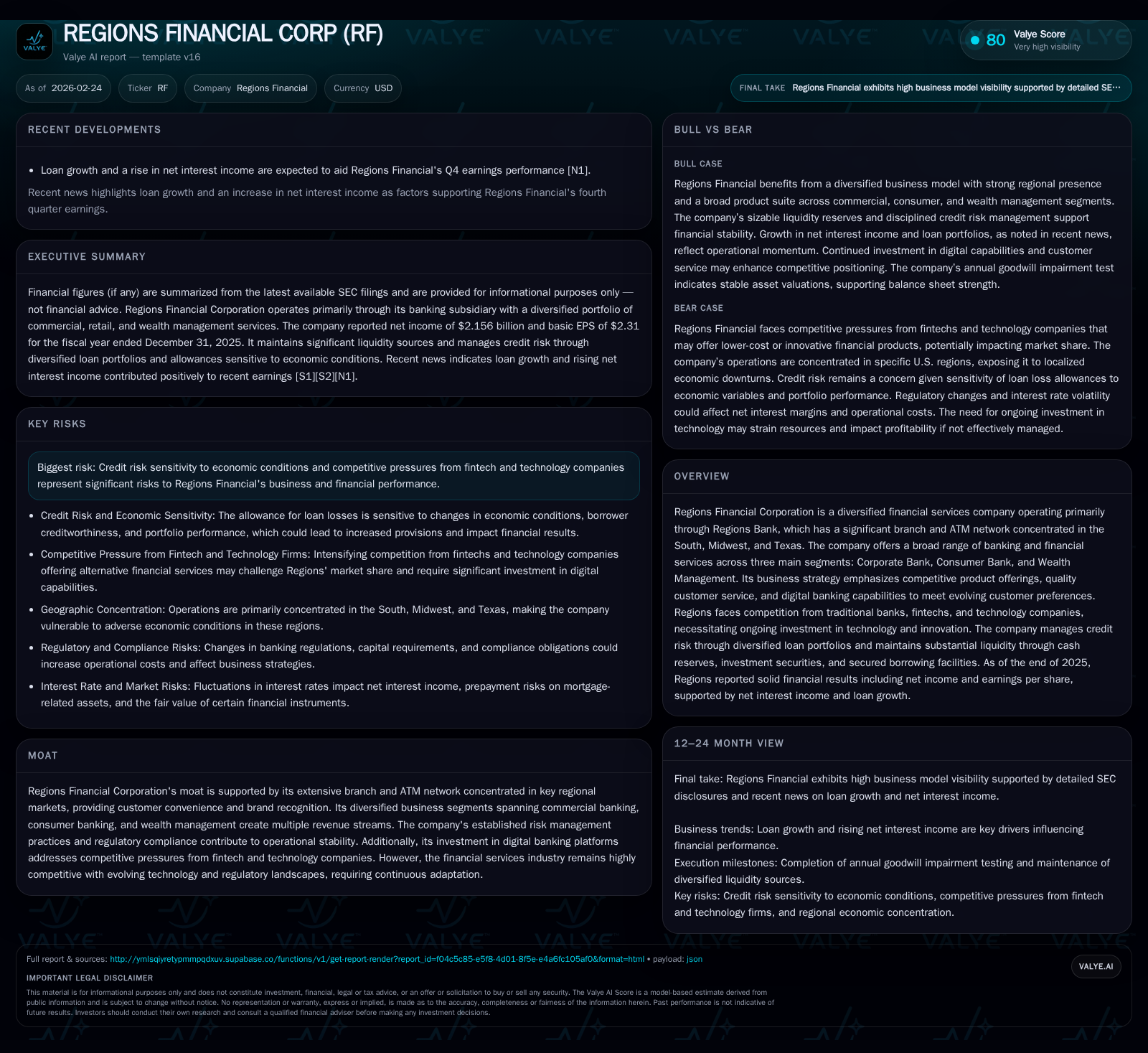
Regions Financial Corporation, a diversified U.S. regional bank focused primarily on the South, Midwest, and Texas, reported mixed earnings dynamics in 2025 characterized by a notable decline in operating income but an increase in net income. The company executed strategic runoff in leveraged lending, reducing commercial and industrial loans, yet simultaneously strengthened its capital base and maintained strong liquidity. Regions continues to face heightened regulatory scrutiny and competitive challenges from fintech entrants, investing in digital capabilities to retain customer engagement. Dividend and share repurchase activities highlight a disciplined capital allocation approach amid evolving credit risk and macroeconomic uncertainties.
Historical Performance Overview
Regions Financial Corporation operates primarily through Regions Bank with extensive branch coverage across the South, Midwest, and Texas. The company reports results across three segments: Corporate Bank, Consumer Bank, and Wealth Management.
The firm’s financial results for calendar years 2023–2025 reveal several dynamics. Operating income declined sharply from $212 million in FY2023 to just $53 million in FY2025 representing a -44.2% compound year-over-year drop [F1]. However, net income remained resilient, edging up from $2.07 billion in FY2023 to $2.16 billion in FY2025 (+13.9% YoY), indicating effective cost controls, tax optimization, or benefits from credit recovery [F1].
Operating cash flow also demonstrated improvement increasing by roughly 36.5% from FY2024 ($1.6 billion) to FY2025 ($2.18 billion) despite pressures on operating income [F1]. Regions grew its equity base from $17.4 billion at FY2023-end to $19 billion by end-2025 (a +9% increase), underscoring capital retention or accretion strategies [F1].
Meanwhile, dividends increased steadily each year reaching nearly $912 million paid out in FY2025 (15% growth over FY2024), while share repurchases accelerated dramatically more than tripling from $348 million to over $1.06 billion within the same period [F1]. This indicates a focus on returning capital efficiently to shareholders alongside balance sheet management.
Historical performance (annual)
| FY | Net ($bn) | CFO ($bn) | OpInc ($mm) | Net YoY |
|---|---|---|---|---|
| 2025 | 2.2 | 2.2 | 53 | +13.9% |
| 2024 | 1.9 | 1.6 | 95 | -8.7% |
| 2023 | 2.1 | 2.3 | 212 | -7.6% |
| 2022 | 2.2 | 3.1 |
Note: Omitted columns lack sufficient annual XBRL coverage in the provided tags (need ≥2 annual points): Rev, Capex, FCF. Source: SEC companyfacts cache [F1].
Capital returns and efficiency (annual)
| FY | Div ($mm) | Buybacks ($mm) | ROE% |
|---|---|---|---|
| 2025 | 912 | 1067 | 11.3 |
| 2024 | 890 | 348 | 10.6 |
| 2023 | 787 | 252 | 11.9 |
| 2022 | 663 | 230 | 14.1 |
Source: SEC companyfacts cache [F1].
Note: Operating expense breakdowns, revenue series, capex data not available.
Loan Portfolio Strategy and Credit Dynamics
A key driver of Regions’ recent performance is loan portfolio management amid a challenging economic backdrop.
The bank reduced commercial and industrial (C&I) loans by approximately $881 million during calendar year 2025 due to strategic runoff particularly targeting leveraged lending portfolios [S17]. This broad-based asset contraction aligns with risk pruning efforts amidst tightening underwriting standards and re-pricing strategies.
Owner-occupied commercial real estate loans remain prominent within the commercial portfolio with terms generally extending up to ten years backed by real estate collateral [S10][S17]. The company performs rigorous appraisal updates reflecting market volatility as part of ongoing credit monitoring.
Credit quality showed signs of improvement at quarter-end December 2025 with criticized loans falling by around $340 million compared to prior quarters; non-performing loans declined slightly as well [S21]. However, the allowance for credit losses modestly decreased to about 1.76% of total loans reflecting strengthened coverage alongside releases tied to portfolio resolutions [S22].
Risks remain elevated due to geographic concentration predominantly in economically sensitive regions —South, Midwest and Texas—and potential gas/commodity sector exposures [S1][S4]. Regulatory filings highlight ongoing vigilance regarding environmental liability when taking possession of real estate collateral.
Liquidity Position and Capital Structure
Regions maintains robust liquidity buffers essential for resilience under normal or stressful scenarios:
- Approximately $7.6 billion held as cash deposits at Federal Reserve institutions.
- Unencumbered investment securities exceeding $26 billion largely composed of liquid U.S Treasury securities and agency mortgage-backed securities enabling secured borrowing capacity [S12].
- Available borrowing facilities include over $11 billion from the Federal Home Loan Bank (FHLB) system plus ~$23 billion borrowing availability through Federal Reserve discount window mechanisms providing additional flexibility [S7][S12].
Borrowed funds usage shifted somewhat during the fiscal year: short-term borrowings increased modestly due to FHLB advances while total long-term debt obligations fell nearly $1.9 billion following note maturities [S14][S26]. Credit ratings remain stable or positive across agencies reflecting solid capitalization and deposit franchise strength [S14].
The Company adheres to a liquidity management framework encompassing ongoing stress testing, contingency funding plans, governance oversight by Board committees notably LROC (Liquidity Risk Oversight Committee), helping ensure compliance with internal risk appetite thresholds [S25].
Competitive Landscape & Digital Initiatives
Regions faces intensifying competition not only from traditional regional banks like Hancock Whitney (HWC) or U.S Bancorp but also from fintech disruptors driving innovation in payments, lending automation, and wealth management solutions [N1][N2][N3]. Strategic partnerships—as seen with GPN’s Worldpay expanding integration via Regions—signal efforts to bolster transaction banking capabilities supporting corporate clients [N4].
Investment in digital platforms aims at enhancing customer experience while improving operational efficiency amid evolving consumer preferences toward mobile and online banking channels [S1][N6][N8]. Nonetheless, such investments incur increased compliance costs especially around data privacy, cyber-security risks which could impact margins or accelerate capital deployment timelines [S15][S20][S24]. Industry participants must constantly anticipate technology shifts including emerging AI applications balancing innovation risks against operational benefits.
Capital Allocation & Returns
Despite operational headwinds reflected in diminishing operating income,[F1] Regions has upheld an active capital return policy evidenced by substantial dividend increases plus aggressive share buybacks notably more than tripling repurchases on a yearly basis reaching over $1 billion for FY2025 alone [F1][S2]. This suggests confidence by management in long-term value creation potential balanced against near-term earnings volatility.
Return on equity calculated roughly at 11.3% using full-year net income over end-year stockholders’ equity aligns reasonably with peer regional banks navigating constrained yield environments but supportive of shareholder returns [F1]. Cash flows from operations have also increased steadily reinforcing internal funding capacities.
Future buybacks may depend on regulatory approvals given constraints imposed post-financial crisis especially concerning regulatory capital ratios and overall bank safety metrics [S6][S9]. The company remains poised to opportunistically optimize its capital structure including retiring subordinated debt or issuing new notes as market conditions permit.
Regulatory & Legal Risks
Regions operates under significant regulatory oversight impacting business model flexibility:
- Strict compliance requirements span consumer protection laws (CRA), fair lending statutes alongside enhanced scrutiny around vendor management responsibilities elevating operating costs dramatically [S4][S9][S16][S19].
- Cybersecurity incidents pose reputational risks as well as regulatory penalties under evolving federal/state laws amplifying risk profiles given expanded data collection [S15][S20][S24].
- Litigation remains a possible source of contingent liabilities particularly related to intellectual property claims or compliance enforcement actions which can divert management attention or necessitate costly settlements [S8][S19][S23].
These factors caution against complacency as industry rules continue evolving rapidly around digital banking security standards.[N7]
Outlook Considerations & Monitoring Points (Analysis)
Explicit forward guidance was not detailed in recent SEC filings or news releases; thus investors should monitor:
- Loan portfolio trends especially commercial real estate exposure along with credit loss provisions for signs of stress reversals.
- Deposit growth/stability metrics amidst competitive pressure maintaining a diverse funding mix crucial for margin support.
- Impact trajectory of digital transformation investments on operating efficiency ratio improvements overtime.
- Capital adequacy ratios relative to evolving Basel III+/regulatory minimums determining future dividend/buyback leeway.
- Regulatory developments concerning consumer protections or cybersecurity legislation affecting compliance cost burdens.
- Market conditions influencing asset prepayment behavior relevant for mortgage servicing rights valuation exposed to fluctuating interest rates [S25].
In summary, Regions Financial is actively recalibrating its balance sheet amid shifting industry dynamics while maintaining a disciplined approach toward shareholder returns supported by sound liquidity reserves and capital adequacy metrics. The focus on digital innovation alongside measured credit risk mitigation will shape near-to-medium term financial outcomes within a complex regulatory terrain.
Disclaimer: This analysis is based solely on publicly available information as of February 24, 2026, including SEC filings and reputable news sources cited herein. It does not constitute investment advice or recommendations.
Disclaimer: This is research-only, informational analysis and not investment advice. It may include AI-generated interpretation and general industry context. Always verify important details using primary sources.

Comments