
Chefs' Warehouse Grows Specialty Food Reach with Strategic Expansion and Pricing Power
Extensive SKU range and geographic breadth underpin Chefs' Warehouse growth amid inflation and operational challenges.
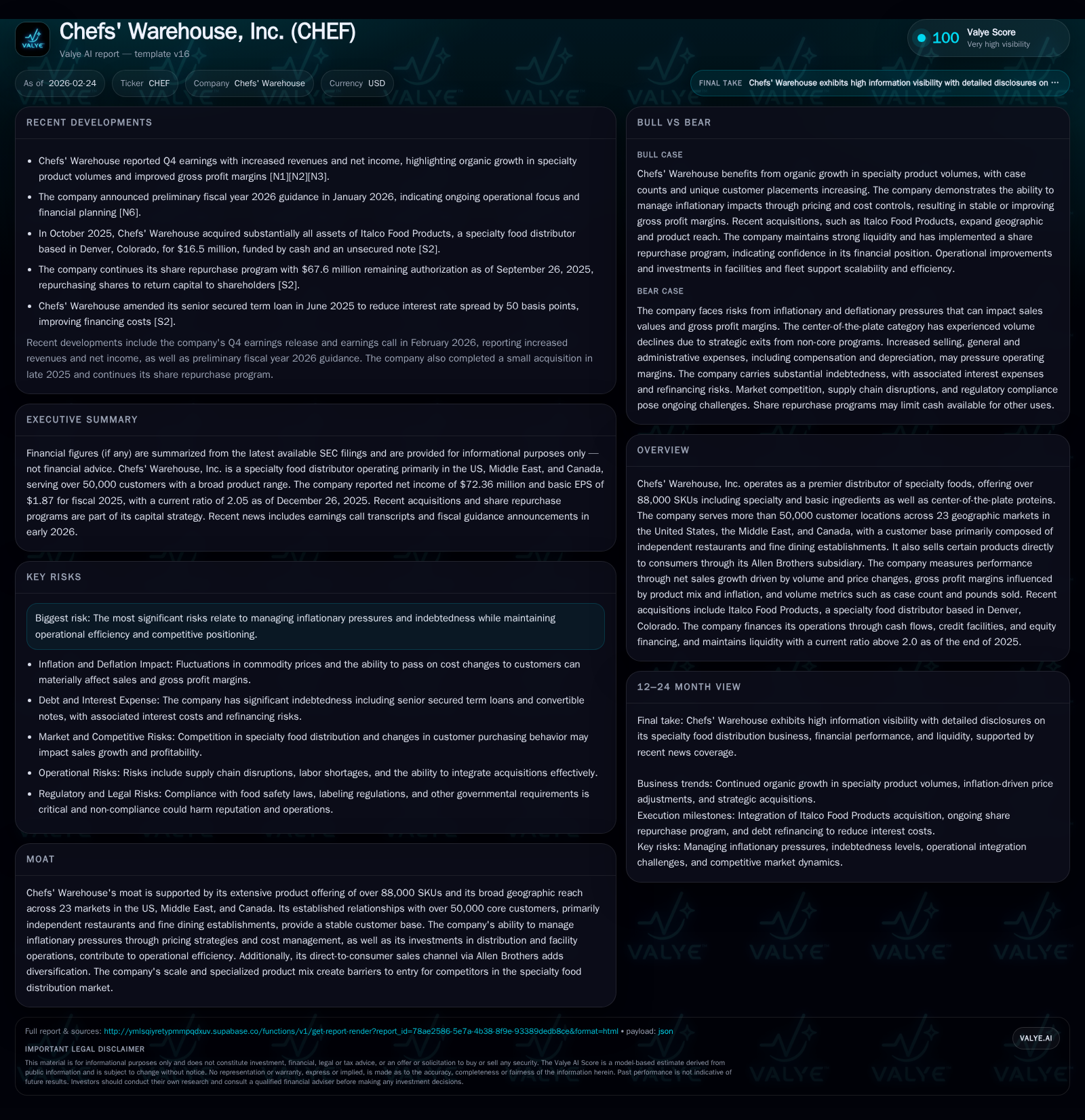
Chefs' Warehouse, Inc. maintains robust growth driven by its extensive specialty food portfolio and widespread market presence across the U.S., Middle East, and Canada. The company leverages strategic pricing methodologies that allow it to manage inflationary pressures effectively while expanding volume in key categories such as specialty products and center-of-the-plate proteins. Its recent acquisition strategy enhances product diversification, supporting continued revenue gains. Despite strong operating cash flow generation, the company balances capital expenditures and share repurchases against debt obligations amid a competitive specialty food distribution landscape.
From Specialty Food Provider to Multi-Market Distributor: Historical Revenue Growth Trends
Chefs' Warehouse has solidified its position as a premier specialty food distributor through steady top-line expansion backed by both organic growth and targeted acquisitions. Annual revenues climbed approximately 9.1% year-over-year to reach nearly $1.45 billion in fiscal 2025 [F1], led primarily by increased case counts within the specialty product category and strategic pricing adaptations that passed inflation costs onto customers effectively. Operating income grew more robustly at about 13.2%, reflecting scale benefits and carefully managed cost structures [F1]. Net income delivered an outsized improvement of roughly 30.4%, driven by operational leverage and favorable tax rate trends [F1].
This trajectory situates Chefs' Warehouse well within a competitive moat characterized by product breadth — over 88,000 SKUs — spanning specialty foods and center-of-the-plate proteins, alongside customer scale with more than 50,000 locations served primarily to independent restaurants and fine dining establishments across three continents [S9][S22].
Historical performance (annual)
| FY | Net ($mm) | CFO ($mm) | OpInc ($mm) | Capex ($mm) | Net YoY |
|---|---|---|---|---|---|
| 2025 | 72 | 129 | 145 | 41 | +30.4% |
| 2024 | 55 | 153 | 128 | 50 | +60.4% |
| 2023 | 35 | 62 | 101 | 57 | +24.6% |
| 2022 | 28 | 23 | 86 | 46 |
Note: Omitted columns lack sufficient annual XBRL coverage in the provided tags (need ≥2 annual points): Rev, Div. Source: SEC companyfacts cache [F1].
Capital returns and efficiency (annual)
| FY | Buybacks ($mm) | FCF ($mm) | ROE% |
|---|---|---|---|
| 2025 | 15 | 88 | 12.0 |
| 2024 | 17 | 104 | 10.3 |
| 2023 | 4 | 7.6 | |
| 2022 | -23 | 6.9 |
Source: SEC companyfacts cache [F1].
Note: Revenue figures for prior years excluded due to tag granularity.
Key Drivers Behind Margin Expansion and Volume Shifts
Gross profit margin improvements have been fueled by subtle yet impactful shifts in product mix coupled with a pricing framework responsive to commodity cost fluctuations. Chefs’ Warehouse employs a predominantly cost-plus pricing methodology wherein price adjustments generally occur at the point of order, enabling efficient inflation pass-through albeit with some timing lags causing transient margin variability [S6].
Volume growth was particularly strong in the specialty category where case count rose approximately over 4% organically during fiscal year periods, supported by enhanced item penetration into higher velocity segments like dairy products [N1][S16]. Conversely, pounds sold in center-of-the-plate proteins declined modestly due to management's decision to exit certain non-core commodity poultry programs—a move likely enhancing focus on higher-margin offerings but constraining absolute volume growth in this segment [N1][S16].
Additional unit economics indicators such as unique customer counts and placements per customer also trended positively within specialty categories, underscoring deeper market penetration beyond sheer volume increases [S11].
Inflation’s Role in Sales Dynamics and Pricing Strategy Execution
As with many distributors operating on thin margins susceptible to commodity price swings, managing inflation remains paramount for Chefs’ Warehouse. The company has successfully integrated inflationary cost increases into its pricing model primarily via immediate order-time price resets or through negotiated pass-throughs grounded in cost-plus contracts with customers [S6]. This approach mitigates gross margin erosion although it requires vigilant execution since lagged or incomplete pass-throughs can compress margins temporarily.
During fiscal year periods including most of calendar year 2025, estimated inflation averaged mid-single digits percentage-wise in the specialty category but exceeded double digits in certain center-of-the-plate protein lines before tactical exits from lower-margin commodities were executed [N1][S16]. This dynamic contributed positively to net sales values yet also placed pressure on margin consistency.
Geographic Footprint and Customer Base: Broadening Reach Across Culinary Hubs
Chefs’ Warehouse’s footprint spans an impressive array of culinary hotspots — totaling 23 markets domestically across the U.S., with strategic coverage extending into the Middle East and Canada [S9][S22]. This broad geographic exposure somewhat insulates the business from localized market disturbances or restaurant traffic variability tied to specific regions.
The customer base remains heavily concentrated in independent restaurants and fine dining establishments rather than large chain operators, allowing for differentiated demand patterns often linked to specialty foods preferences and premium ingredient adoption that drive higher average order sizes per case sold [S22][N3]. Furthermore, Allen Brothers subsidiary operations extend reach directly into consumer retail channels for select center-of-the-plate products, providing diversification outside traditional foodservice sectors.
Strategic Acquisitions Fueling Portfolio Diversification and Market Penetration
In October 2025, Chefs' Warehouse completed its acquisition of Italco Food Products based in Denver—an asset purchase incorporating inventory, receivables, goodwill, and intangibles valued at $16.5 million including cash consideration plus an unsecured note issuance of $11 million—representing a measured inorganic growth step aligned with expanding SKU depth regionally within specialty foods distribution [S10][N3].
While not material on consolidated financial statement scale-wise, this deal exemplifies the company's disciplined pursuit of bolt-on acquisitions targeting accretive expansion particularly in high-growth or higher velocity product categories bearing margin enhancement potential.
Capital Allocation: Share Repurchases, Capex Priorities, and Cash Flow Generation
Capital deployment reflects a judicious balance between internal reinvestment into infrastructure and returning value to shareholders via share repurchases. In fiscal year 2025, Chefs’ Warehouse generated operating cash flow of about $129 million despite a year-over-year decline of roughly 15.6%, largely attributable to working capital timing shifts including strategic inventory purchases ahead of expected demand spikes or cost increases [F1][S21].
Capital expenditures declined about 16.3% year-over-year to approximately $41 million as management sought enhanced operational efficiency through leaner facility capex spending without sacrificing network productivity gains garnered from prior investments [F1][S8][S23]. Alongside capex discipline, roughly $15 million was deployed toward share repurchases under an ongoing authorization program initiated late in calendar year 2023—signaling confidence in underlying business fundamentals while maintaining liquidity buffers amid economic uncertainty [S4][F1].
Liquidity Position and Debt Structure Amidst Growth Investments
Financial leverage optimization continues as credit facility amendments throughout calendar year 2025 secured reduced interest spreads on senior secured term loans (cutting rates by roughly half a percent), extended maturities out to mid-2030 for asset-based lending capacity ($300 million ceiling), and addressed incremental financing needs tied directly to acquisitions like Italco which was funded partly via unsecured notes totaling $11 million [S10][S28].
At fiscal year-end December 26, 2025, cash & equivalents stood near $121 million alongside a healthy current ratio exceeding two times—indicative of strong short-term liquidity adequacy given working capital neatly outpacing current liabilities by approximately double ($970 million versus $473 million) [F1]. Interest expense reductions exceeding single-digit millions relative to previous years further ease financing cost burdens while allowing flexible debt paydown initiatives as demonstrated by voluntary multi-million principal prepayments during reported quarters as conditions permit [F1][S17].
Outlook: Company Guidance and Critical Developments to Watch
Guidance issued early January for fiscal year 2026 suggests steady volume growth targets focusing on continued expansion within specialty product cases complemented by margin improvement efforts shaped around tightly executed pricing strategies amidst persistent inflation influences [N3][N1].
Key performance indicators warranting close attention include shifts in product mix weighted increasingly toward higher margin SKU penetration; timing effectiveness of inflation pass-throughs; integration milestones relating to recent acquisitions; expected recovery or stabilization of center-of-the-plate pounds sold post portfolio rationalization; as well as advances in operational efficiency via distribution network enhancements potentially reflected through relative changes in selling expense ratios.
While explicit forward-looking financial metrics remain sparse beyond preliminary commentary,[N3] analysts are advised to monitor quarterly volume metrics such as weekly unique customer counts/placements disclosed periodically since these are crucial barometers of organic growth health inherent within their distributed specialty foods market segment niche.
Disclaimer: This analysis is based exclusively on publicly available information from regulatory filings ([F1],[S#]) and recent news ([N#]) without any speculative assumptions or investment recommendations.
Disclaimer: This is research-only, informational analysis and not investment advice. It may include AI-generated interpretation and general industry context. Always verify important details using primary sources.

Comments