
Chevron Corp Strengthens Shareholder Returns Through Acquisition-Driven Growth
Chevron leverages the Hess acquisition and operational integration to fuel growth amid volatile commodity markets and disciplined capital deployment.
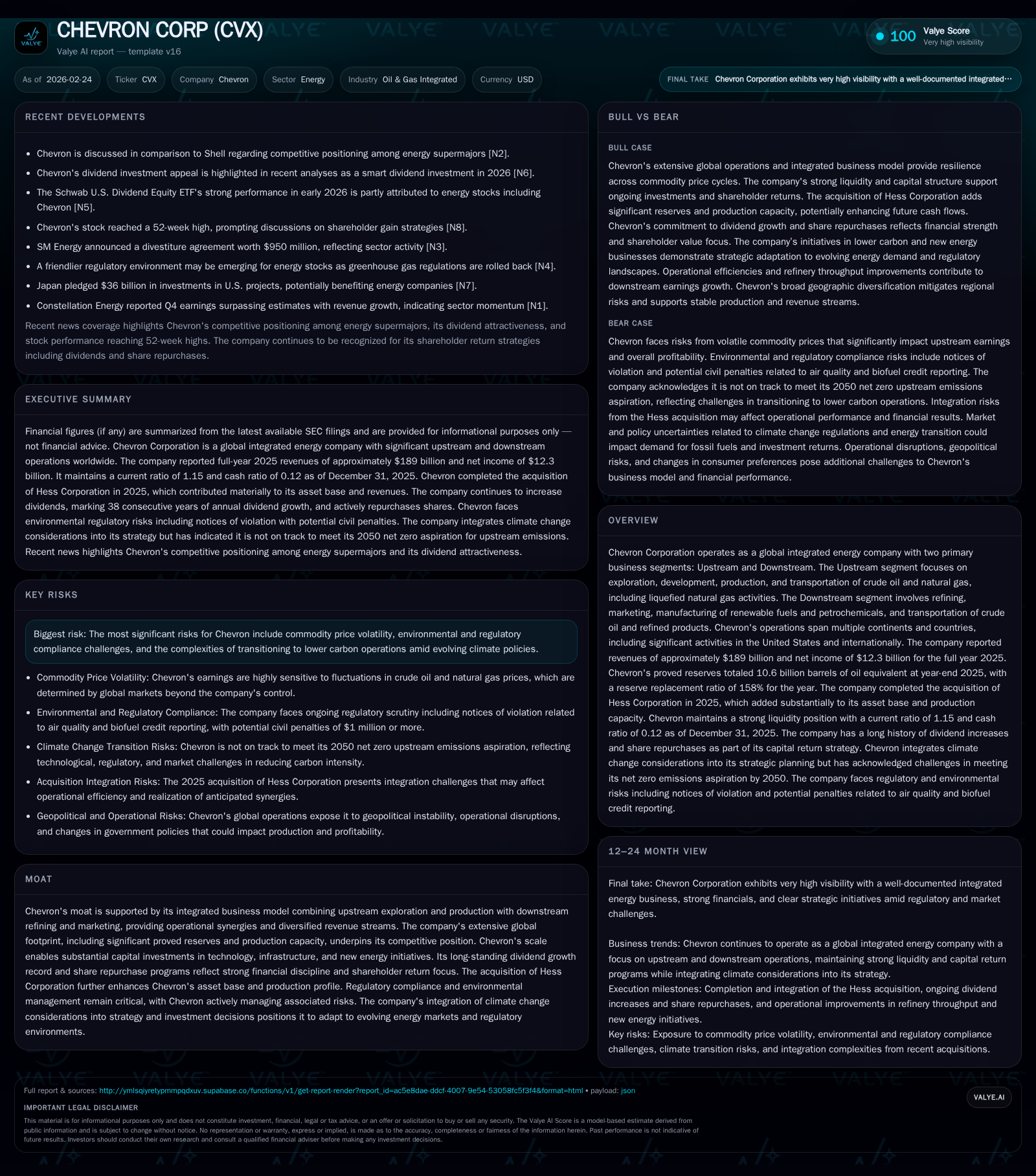
Chevron reported a revenue decline of 6.8% in 2025 to $189 billion, accompanied by a more than 30% drop in net income to $12.3 billion, yet demonstrated resilience with an 8% increase in operating cash flow. The strategic acquisition of Hess Corporation in mid-2025 is poised to enhance production scale and boost free cash flow prospects, though integration risks remain. Chevron’s upstream segment benefits from a strong reserve replacement ratio of 158%, supporting sustainable production, while downstream refining margins face pressure. Robust capital allocation prioritizes shareholder returns through dividend increases and $12 billion in share repurchases, balanced against sustained capex growth aimed at both asset expansion and energy transition initiatives. Environmental compliance challenges persist with multiple regulatory notices, underscoring ongoing risk management efforts.
Financial Trajectory: Revenue and Earnings Evolution in Context
Chevron's fiscal year 2025 exhibited a mixed financial performance against the backdrop of volatile energy markets. The company recorded revenues of approximately $189 billion, down from about $203 billion in 2024 — a decline of nearly 6.8% year-over-year [F1]. Net income experienced a sharper contraction, falling over 30% from $17.7 billion in 2024 to $12.3 billion in 2025 driven primarily by commodity price fluctuations, higher operating costs, and transitional expenses related to the Hess acquisition integration [F1][S1]. Despite margin pressures at the downstream level and elevated exploration activity costs upstream, Chevron’s operating cash flow increased nearly 8% to $33.9 billion, reflecting strong operational cash generation capabilities underpinned by resilient core assets [F1].
The company’s upstream segment sustainability is evidenced by its robust reserve replacement ratio of 158% for the year — well above the industry benchmark average — signaling effective reserve replenishment crucial for maintaining long-term production volumes [F1][S8]. Meanwhile, downstream operations faced margin headwinds due to global refining feedstock costs and regional demand-supply imbalances impacting throughput utilization rates [S6][S9]. These nuanced dynamics contributed to overall top-line contraction despite improved cash flow metrics.
Historical performance (annual)
| FY | Rev ($bn) | Net ($bn) | CFO ($bn) | Capex ($bn) | Rev YoY | Net YoY |
|---|---|---|---|---|---|---|
| 2025 | 189.0 | 12.3 | 33.9 | 17.3 | -6.8% | -30.4% |
| 2024 | 202.8 | 17.7 | 31.5 | 16.4 | +0.9% | -17.4% |
| 2023 | 200.9 | 21.4 | 35.6 | 15.8 | -18.4% | -39.7% |
| 2022 | 246.3 | 35.5 | 49.6 | 12.0 |
Note: Omitted columns lack sufficient annual XBRL coverage in the provided tags (need ≥2 annual points): OpInc, Div. Source: SEC companyfacts cache [F1].
Capital returns and efficiency (annual)
| FY | Buybacks ($bn) | FCF ($bn) | ROE% |
|---|---|---|---|
| 2025 | 12.1 | 16.6 | 6.6 |
| 2024 | 15.2 | 15.0 | 11.6 |
| 2023 | 14.9 | 19.8 | 13.3 |
| 2022 | 11.3 | 37.6 | 22.3 |
Source: SEC companyfacts cache [F1].
Note: Operating income not available for all periods; ROE calculated as net income/end-year equity.
Growth Inflection via Hess Acquisition: Integration Challenges and Synergies
In July 2025, Chevron consummated its acquisition of Hess Corporation, marking a pivotal enlargement of its upstream portfolio aiming to drive higher returns and better free cash flow growth over the medium term [S2][N2]. The deal boosts Chevron’s production capacity significantly by adding proved reserves and producing assets domestically and internationally.
Management highlighted expected run-rate cost synergies stemming from consolidation of overlapping operations, enhanced scale efficiencies, shared technology applications including improved seismic imaging for exploration efforts, and optimized supply chain logistics leading to reduced unit costs over time [S2]. These synergies underpin management's optimistic projection for five-year free cash flow expansion beyond historical patterns.
However, integration risks remain salient — ranging from potential culture clashes within newly combined workforce segments to unforeseen operational disruptions as workflows are merged across legacy systems [S2]. Early transition costs have already weighed on earnings through severance charges and restructuring expenses noted during Q4 earnings commentary [N4]. Careful monitoring will be critical as Chevron seeks to realize targeted benefits without distracting from core operational excellence.
Operational Footprint: Upstream and Downstream Segment Drivers
Chevron’s upstream offerings encompass exploration, development, and production activities across diverse geographies including the U.S., Africa, Asia Pacific, and Latin America regions with significant LNG operation involvement [S6][S8]. Of note is Chevron’s extensive equity stake in Tengizchevroil (TCO), which operates some of the largest onshore heavy oil fields employing advanced wellhead pressure management techniques enhancing hydrocarbon recovery efficiency [S16][S19]. Upstream capex was roughly $17.3 billion in 2025 reflecting investments to maintain production levels while bringing new discoveries online.
Downstream includes refining complex crude oil into high-value products like gasoline, diesel jet fuel as well as manufacturing petrochemicals, lubricants and renewable fuels incorporating biofuel credit generation programs compliant with evolving regulations [S6][S9]. Operational complexity such as managing low-NOx burners at thermal oxidizers used in sulfur recovery units typifies environmental compliance delicate balancing acts within refinery processes — disruptions here can materially impact margins due to regulatory penalties or lost production uptime [S10][S14].
The downstream segment also integrates transportation logistics including pipelines and marine vessels ensuring timely delivery that buffers inventory volatility effects on pricing spreads.
Profitability Metrics and Capital Efficiency Analysis
Chevron reported an approximate return on equity (ROE) near 6.6% for the latest fiscal period — subdued compared with prior years due largely to earnings contraction amid broader energy market cyclicality [F1]. Depreciation plus amortization expense remained elevated reflecting high capital intensity intrinsic to integrated oil & gas operations.
The company generated about $16.6 billion in free cash flow after deducting capex outlays approximating $17.3 billion — itself moderately increased by roughly +5.5% year-on-year as Chevron pursues targeted asset upgrades alongside selective greenfield projects responsive to market opportunities and energy transition imperatives [F1].
Margin pressures particularly challenge downstream profitability since crude feedstock comprises a dominant input cost susceptible to spikes driven by geopolitical events or supply chain constraints necessitating continuous efficiency improvements.
Capital Allocation Strategy: Dividends, Buybacks, and Investment Priorities
Chevron continues its long-standing shareholder return discipline as evidenced by increasing its dividend payout from $1.63 per share in late 2024 to $1.71 per share throughout all quarters of 2025—a pattern underscoring confidence in sustained cash generation capacity despite short-term headwinds [F1][N11][N12].
During calendar year 2025 alone, Chevron executed approximately $12 billion in common stock repurchases slightly reduced from prior years but aligned prudently with retaining liquidity amid acquisition-related financing needs [F1].
Simultaneously capital expenditures remain focused on growing upstream asset base—both organic developments within prolific plays enhanced by Hess integration—as well as selectively advancing lower carbon projects such as expanded biofuels manufacturing capabilities within downstream renewables businesses signaling strategic positioning towards longer-term energy transition pathways without compromising near-term profitability targets [N2][N12].
Regulatory and Environmental Risk Management Framework
Chevron faces numerous environmental compliance challenges with several Notices of Violation (NOVs) issued during recent years across key facilities including New Mexico air quality breaches (circa Oct '22–Sep '23), California refinery biofuel credit reporting infractions dating back to co-processing activities in calendar year '22, as well as equipment noncompliance tied specifically to low-NOx burners at Richmond refinery sulfur recovery units raising potential civil penalties exceeding one million dollars per infraction event—confirming ongoing vulnerability points within operational process controls requiring constant oversight [S1][S5][S10][S14].
Notably the Department of Justice has also engaged relating to alleged Clean Water Act violations at recently acquired Hess Gulf operations adding complexity amid integration phase [S11].
Chevron publicly commits resources towards emission control technologies including thermal oxidizers optimization while engaging regulators proactively aiming toward minimizing reputational risk alongside curtailing legal exposures arising from stringent environmental mandates becoming more prominent under shifting regulatory regimes nationally and internationally.
Market Outlook: Factors Shaping Chevron’s Future Performance
Looking ahead beyond current reporting periods analysis suggests Chevron’s trajectory will hinge heavily on sustaining commodity price levels conducive for profitable upstream development combined with successful realization of Hess merger synergies affecting volume growth and cost structure improvement metrics.[N2],[N6]
Regulatory environments continue evolving rapidly particularly with anticipated administration policy shifts influencing greenhouse gas emission rules—a scenario compelling Chevron’s adaptive energy transition strategy encompassing renewables investments balanced against core hydrocarbon resource monetization.[N9],[N6]
Key indicators warranting close observation include quarterly production volumes relative to target baselines post-acquisition integration milestones along with downstream refining margins sensitive not just to global crude pricing swings but also regional product inventory cycles affected by trade flows impacting forward pricing spreads.
Reserve replacement ratios above industry thresholds provide solid support evidencing resource base sustainability; however external geopolitical risks inherent in oil-producing regions require persistent monitoring given potential operational disruption implications.
This report synthesizes publicly available SEC filings including Chevron’s recent Form-10K/10Q disclosures ([S1]–[S29]), Nasdaq news updates ([N2], etc.), and XBRL-sourced financial data ([F1]) accurate as of February 24, 2026. It is intended for informational purposes only without providing any investment advice or recommendations.
Disclaimer: This is research-only, informational analysis and not investment advice. It may include AI-generated interpretation and general industry context. Always verify important details using primary sources.

Comments