
Globe Life Inc. Shows Resilient Profitability Through Focused Market Strategy
A disciplined underwriting approach, targeted multi-channel distribution, and prudent capital management drive Globe Life's steady growth in the underserved mid-market segment.
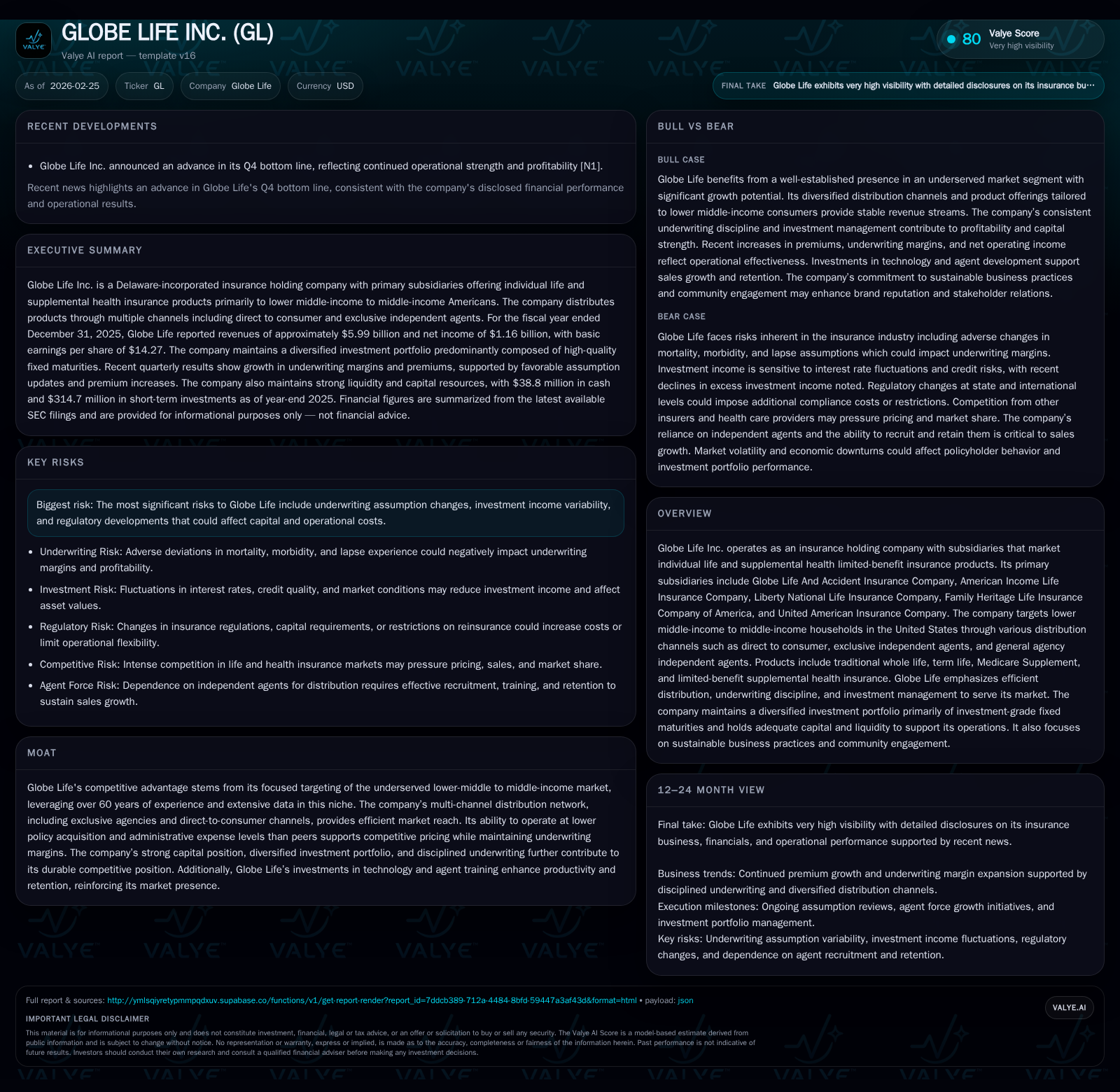
Globe Life Inc. has cultivated a durable competitive moat by focusing on lower-middle to middle-income households with tailored life and supplemental health insurance products. Its multi-channel distribution, including exclusive agents and direct-to-consumer platforms, ensures efficient market penetration and underwriting discipline sustains underwriting margins despite premium growth. The company demonstrated 3.7% revenue growth and an 8.4% net income increase in 2025 while maintaining strong returns on equity near 19.4%. Capital allocation remains balanced with consistent dividends and sizeable share repurchases funded by robust operating cash flows.
Foundations of Growth: Niche Market Focus and Distribution Strategy
Globe Life Inc.’s enduring competitive advantage lies in its concentrated focus on the traditionally underserved lower-middle to middle-income American households. For over six decades, it has built deep expertise serving this segment with essential life and supplemental health limited-benefit products that address financial security needs without complexity or excessive cost [S1][S2].
This population target offers significant growth potential due to historically low penetration rates relative to other insurance segments. Globe Life leverages multiple distribution channels tailored to reach these consumers effectively: direct-to-consumer efforts through mail and digital mediums, exclusive independent agents who are contractors selling solely for the company, and general agency independent agents [S1]. This diversified yet focused approach delivers policy acquisition at comparatively lower costs, preserving underwriting margins.
Exclusive agencies such as American Income Life constitute a vital pillar—boasting nearly 12,000 average producing agents across several countries with specialization in worksite and in-home sales [S1]. The Family Heritage and United American divisions complement with targeted supplemental health Medicare plans distributed primarily by independent agents.
Underwriting discipline remains rigorous throughout these channels. Management consistently emphasizes monitoring of policy acquisition costs alongside claims experience to maintain profitability despite premium increases. Key measures like underwriting margin (premiums minus policy obligations and acquisition expenses) spotlight this operational vigilance [S1][S2].
Financial Performance Recap: Revenue, Profitability, and Margins in 2025
Globe Life’s full-year 2025 revenue totaled approximately $6.0 billion representing a year-over-year increase of about 3.7% from $5.78 billion in 2024 [F1]. Operating income exhibited a pronounced improvement rising roughly 27.7% compared to the prior year’s level, underpinning the strength of underwriting margins combined with improved investment returns.
Net income for the year was about $1.16 billion, an increase of approximately 8.4% year-over-year from $1.07 billion [F1]. These results translate into a strong return on equity near 19.4%, reflecting efficient capital utilization against equity totaling nearly $6 billion [F1].
Notably, management’s non-GAAP net operating income metric backs out non-recurring items such as realized gains/losses ensuring closer alignment with operational profitability drivers including insurance underwriting margins plus excess investment income less operating expenses after tax [S1].
Agent productivity gains contributed with an average exclusive producing agent count rising about 3% year-over-year alongside total net sales increasing roughly 13%, illustrating effective scaling of distribution outcomes [S1].
Historical performance (annual)
| FY | Rev ($bn) | Net ($mm) | CFO ($mm) | OpInc ($mm) | Rev YoY | Net YoY |
|---|---|---|---|---|---|---|
| 2025 | 6.0 | 1161 | 1396 | +3.7% | +8.4% | |
| 2024 | 5.8 | 1071 | 1402 | +308.1% | +289.6% | |
| 2023 | 1.4 | 275 | 1482 | 1265 | -72.9% | -62.8% |
| 2022 | 5.2 | 740 | 1422 | 991 |
Source: SEC companyfacts cache [F1].
Capital returns and efficiency (annual)
| FY | Div ($mm) | Buybacks ($mm) | FCF ($mm) |
|---|---|---|---|
| 2025 | 86 | 881 | 1254 |
| 2024 | 85 | 1002 | 1331 |
| 2023 | 84 | 511 | 1433 |
| 2022 | 81 | 455 | 1394 |
Source: SEC companyfacts cache [F1].
Table: Historical Financial Overview Featuring Revenue, Net Income (YoY%), Operating Cash Flow (CFO), Capital Expenditures (Capex), Dividends (Div), Share Buybacks (Buybacks)
Drivers Behind Year-Over-Year Trends in Premiums and Underwriting Margins
Premium revenue growth reflects a bifurcated trend: life insurance premiums increased approximately three percent driven by steady policy additions within direct-to-consumer and exclusive agency channels; meanwhile supplemental health premiums rose more sharply by nine percent as Medicare Supplement offerings gained traction amidst demographic tailwinds [S1][S2].
This premium expansion coexists with disciplined expense control measures; policy acquisition costs remain tightly managed despite channel diversification owing to Globe Life’s data-backed actuarial assumptions honed over decades [S1]. The underwriting margin metric explicitly accounts for deductions including policy obligations plus commissions/expense line items associated with new business acquisition.
Moreover, incremental agent headcount growth—approximately three percent for exclusive producing agents during the year—supports revenue trends without proportional expense escalation, signaling distribution efficiency improvements [S1]. This balance enables maintenance or expansion of underwriting margins fundamental to sustained profitability.
Investment Segment’s Role and Excess Investment Income Dynamics
The investment segment serves as a critical earnings stabilizer through generation of excess investment income defined as net investment income less required interest on policy liabilities [S1][S2]. Within a rising interest rate environment during the period under review, Globe Life strategically extended duration in its fixed-income portfolio while increasing allocations to higher-yielding securities preserving attractive spreads above guaranteed contract rates.
Reportedly, excess investment income contributed materially to bottom-line advances complementing core underwriting results [S2]. This signifies astute asset-liability management practices ensuring liquidity adequacy alongside maximizing risk-adjusted yield.
Outlook: Growth Opportunities and Underwriting Challenges Ahead
Looking forward, Globe Life’s growth prospects hinge on expanding policy sales particularly within Supplemental Health lines where demographic trends prove favorable alongside evolving Medicare products [N1][S1][S26]. Additionally, retention efforts reinforced through proprietary agent training aim to sustain persistency ratios critical to renewal premia volume.
Nonetheless, challenges reside in calibrating underwriting assumptions amid dynamic mortality/morbidity landscapes potentially impacting reserve requirements or loss experience adjustments; operational cost inflation pressures also merit vigilance [N1][S26]. Monitoring regulatory developments affecting capital frameworks remain essential given interconnectedness with dividend capacity and business flexibility.
Risk Profile: Regulatory Landscape and Assumptions Sensitivity
Enterprise risk management frameworks emphasize governance structures overseeing cybersecurity risks at board level led by Audit Committee complemented by ERM Committee chaired by Chief Risk Officer—a layered oversight ensuring comprehensive threat assessments including incident response protocols are integrated company-wide [S1].
Further regulatory landscape considerations include solvency capital standards especially pertaining to Bermuda-based entities under BMA jurisdiction requiring maintenance of enhanced capital thresholds which Globe Life anticipates exceeding comfortably despite ongoing compliance rigor [S20]. Sensitivities related to changes in actuarial assumptions for mortality could materially influence future earnings volatility necessitating continuous risk calibration.
Capital Deployment: Share Repurchases, Dividends, and ROE Evaluation
Globe Life maintains an enduring share repurchase program active since the mid-1980s indicating consistent prioritization of shareholder return when excess capital is available post-dividend payouts [S11][F1]. In fiscal year 2025 alone, approximately $881 million was deployed towards share buybacks reflecting ongoing confidence in intrinsic valuation versus alternative capital uses.
Dividends paid remain stable around $86 million annually demonstrating commitment to steady income streams alongside accumulation of book value per share which rose an impressive nineteen percent in the latest twelve months evidencing retained earnings accumulation compounded by buyback-driven EPS accretion [F1][S20].
The reported return on equity approaches twenty percent underscoring efficacious use of shareholder funds fueled by robust net income generation aligned with conservative leverage profiles anchored primarily by long-term debt approximating $2.3 billion complemented by revolving credit liquidity reserves without draws on trust facility debt [F1][S14][S20].
Operational Excellence: Technology, Agent Network, and Underwriting Discipline
Investments in technology serve dual roles enhancing underwriting accuracy through sophisticated analytics platforms while facilitating agent productivity via streamlined CRM tools that improve client engagement workflows [S1][S2][F1].
Agent recruitment and retention efforts fortified through continuous education programs bolster channel exclusivity—a salient moat given specialized knowledge required for this niche market.
Underwriting cost discipline remains integral protecting margin sustainability especially when expanding volumes place upward pressure on expenses; Globe Life’s control over policy acquisition costs relative to peers evidences operational edge contributing directly to improved profit convertibility from gross premiums earned.
This analysis synthesizes publicly available financial disclosures and regulatory filings up to February 25, 2026; it does not constitute investment advice but aims to offer a comprehensive perspective on Globe Life Inc.'s strategic positioning within its targeted insurance market segment.
Disclaimer: This is research-only, informational analysis and not investment advice. It may include AI-generated interpretation and general industry context. Always verify important details using primary sources.

Comments