
Array Technologies Advances in Solar Tracking Through APA Integration and Operational Efficiency
Array Technologies leverages patented solar tracking innovations and the strategic APA acquisition to enhance its market position amid operational recovery.
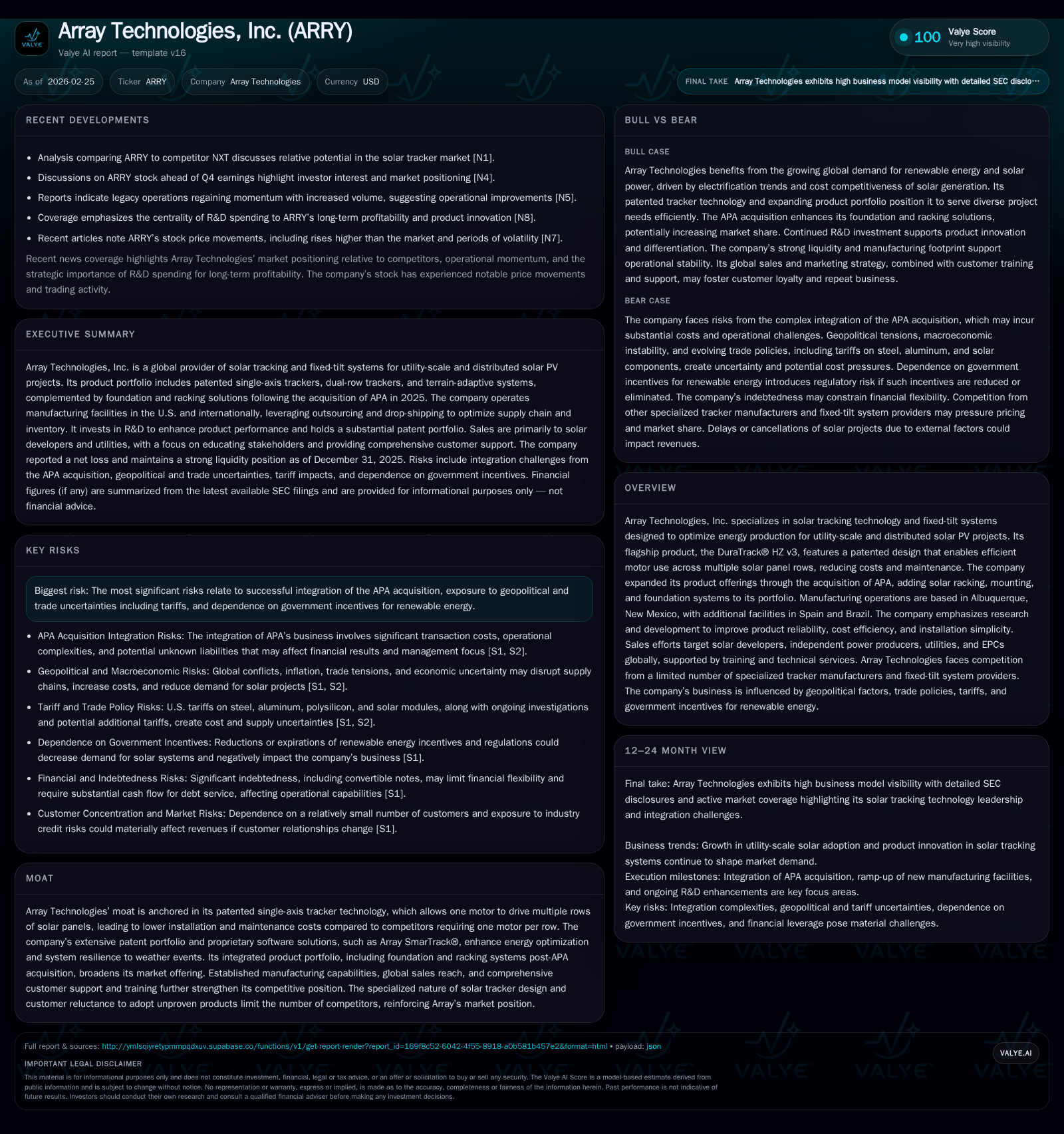
Array Technologies has experienced significant financial volatility between FY2022 and FY2025, notably recovering operating income by 87.2% from FY2024’s deep loss, reflecting ongoing integration costs and sector margin pressures. Its proprietary single-axis solar tracker technology—featuring a patented design that drives multiple rows with one motor—underpins cost efficiencies and competitive advantage, complemented by new product lines expanding application versatility. The APA acquisition broadens product offerings into racking and foundation systems but introduces integration complexity and short-term expenses. Future growth relies on expanding solar infrastructure demand, ongoing R&D investment, and mitigating geopolitical tariff risks. Despite near-term losses, positive free cash flow and disciplined capital allocation signal operational progress alongside legal and regulatory risks worth monitoring.
Historical Financial Overview: Navigating Volatility Amid Growth
Array Technologies’ financial results over the past four fiscal years reveal significant fluctuations driven by innovation cycles and acquisition activity. Operating income shifted from a loss of $18.1 million in FY2022 to a gain of $214.1 million in FY2023 before plunging to a $227.0 million loss in FY2024. The company partially reversed this trend in FY2025 with an operating loss of $29.0 million—an 87.2% improvement year-over-year—signaling progress though profitability remains challenged [F1].
Net income followed a similar pattern: modestly positive $4.4 million in FY2022, peaking at $137.2 million in FY2023, then declining sharply to a loss of $240.4 million in FY2024 before improving by 78.3% to a loss of $52.2 million in FY2025 [F1]. Operating cash flow remained strong despite profit volatility, registering $231.9 million in FY2023 before declining to $153.9 million in FY2024 and further to $101.8 million in FY2025—a nearly one-third decrease coinciding with capital expenditures rising over twofold from $7.3 million to $21.9 million between 2024 and 2025, likely reflecting increased investments tied to APA integration or product development scaling [F1].
Total equity turned negative by the end of FY2025 at approximately -$206.3 million compared with positive balances in prior years, indicative of balance sheet pressures related to restructuring or acquisition liabilities [F1]. These financial dynamics highlight the capital-intensive nature of Array’s operations amidst sector headwinds.
Historical performance (annual)
| FY | Net ($mm) | CFO ($mm) | OpInc ($mm) | Capex ($mm) | Net YoY |
|---|---|---|---|---|---|
| 2025 | -52 | 102 | -29 | 22 | +78.3% |
| 2024 | -240 | 154 | -227 | 7 | -275.2% |
| 2023 | 137 | 232 | 214 | 17 | +2996.6% |
| 2022 | 4 | 141 | -18 | 11 |
Source: SEC companyfacts cache [F1].
Capital returns and efficiency (annual)
| FY | FCF ($mm) | ROE% |
|---|---|---|
| 2025 | 80 | 25.3 |
| 2024 | 147 | 203.6 |
| 2023 | 215 | 52.9 |
| 2022 | 131 | 3.6 |
Source: SEC companyfacts cache [F1].
Note: All figures reflect full fiscal years ending December.
Proprietary Technology and Product Portfolio
Central to Array’s competitive edge is its patented single-axis DuraTrack® HZ v3 solar tracker technology where one motor drives multiple rows via articulated driveline joints—a design that reduces both installation complexity and maintenance costs relative to competitors who deploy one motor per row [S1]. This innovation supports lower Levelized Cost of Energy (LCOE), which is critical for customer adoption.
The company’s product suite also includes the dual-row STI tracker acquired through its earlier purchase of Soluciones Técnicas Integrales Norland (STI), optimized for irregular terrain with linked two-row movement enhancing site adaptability for fragmented plots [S1]. Additionally, the OmniTrack platform addresses uneven terrain challenges with significantly reduced grading requirements, enabling installations across diverse geographies.
Complementing hardware advances is Array SmarTrack® software featuring positioning algorithms that optimize energy production from bifacial panels by incorporating weather forecasts and site-specific adaptations while enhancing cybersecurity protections around control systems—a growing priority within critical infrastructure sectors [S9].
These combined innovations drive operational efficiencies with lower maintenance demands compared with competing designs, fostering customer loyalty and creating barriers for new entrants.
APA Acquisition: Strategic Expansion Amid Integration Complexity
On August 14, 2025, Array completed the acquisition of APA’s equity interests, extending its product portfolio beyond trackers into mounting, racking, and engineered foundation systems [S1][S2]. This horizontal expansion aims to provide comprehensive solar infrastructure solutions under one supplier umbrella for developers and EPCs.
However, integration introduces complexities including aligning IT systems, compliance programs across jurisdictions, supply chain consolidation, workforce realignment amidst cultural blending, all contributing to elevated near-term operating costs primarily related to transaction fees and employee retention measures designed to ensure stability during transition periods [S2].
Potential unknown liabilities or delays may increase costs beyond initial expectations, putting pressure on margins as synergy realization timelines could extend longer than anticipated per regulatory disclosures [S15][S20].
Strategically successful integration could yield scalable cost efficiencies via logistics streamlining and combined R&D efforts that accelerate innovation cycles—essential for defending market position against competitors with narrower offerings.
Growth Drivers and Market Outlook
Growth prospects hinge on expanding global solar deployments driven by decarbonization policies favoring photovoltaics with tracked systems offering higher capacity factors than fixed-tilt alternatives prevalent elsewhere [N2].
Backlog strength supported by utility-scale customers provides revenue visibility contingent on stable trade policies; however, ongoing tariff investigations affecting polysilicon cells indirectly impact downstream project economics utilizing Array’s trackers requiring close monitoring [S21][N8].
Government incentives remain critical; any subsidy reductions could dampen demand although continued R&D investments highlight commitment to reliability improvements sustaining customer trust vital for long sales cycles involving EPCs needing tailored solutions [N8][S9].
Capital Allocation and Profitability Metrics
Capital expenditures surged over twofold year-over-year reaching approximately $22 million in FY2025 as investments intensify around manufacturing capacity expansion and product development scaling linked partly to APA integration efforts [F1]. Despite net losses, free cash flow remains positive at about $79.8 million (operating cash flow minus capex), signaling disciplined liquidity management amidst restructuring outlays [F1].
The balance sheet shows negative equity at roughly -$206 million reflecting acquisition-related goodwill adjustments or accrued obligations compressing returns metrics; nevertheless approximate return on equity stands near mid-20%s based on reported net income relative to equity base though impacted by headline losses [F1].
The absence of dividends since FY2021 aligns with a reinvestment strategy typical among growth-oriented cleantech firms prioritizing capital deployment over shareholder payouts during transformational phases.
Risks: Litigation, Geopolitical Tensions & Regulatory Challenges
Key risks include ongoing appellate proceedings related to securities class actions stemming from IPO-period allegations dismissed at trial but currently unresolved on appeal creating uncertainty around contingent liabilities or reputational impacts [S4][S17].
Geopolitical risks center on U.S.-imposed tariffs on certain imported solar components which may delay project schedules indirectly affecting Array’s order pipelines despite not selling modules directly; these require vigilant monitoring given evolving trade policy reviews scheduled through mid-2026 [S21][S23].
Additionally, increasing privacy/data protection laws across U.S., EU and other jurisdictions impose compliance burdens while cybersecurity threats pose operational risks; breaches could disrupt business continuity or trigger regulatory penalties impacting financial results absent effective controls [S6][S10][S24].
Investor Considerations: Monitoring Ahead
Investors should track forthcoming quarterly earnings releases expected soon detailing Q4/FY25 performance clarifying post-APA synergy progress including margin trends alongside commentary on backlog conversion assumptions underpinning forward-looking revenue expectations given the absence of formal guidance disclosures thus far [N2][N3][S3].
Comparisons with peers such as Shoals Technologies’ recent earnings challenges provide valuable context on sector margin pressures while patent protections extending core U.S.-held technology until at least early next decade reinforce medium-term competitive moats deserving scrutiny especially amid industry patent litigations common among established tracker manufacturers [N1].
Policy developments regarding renewable energy incentives like Inflation Reduction Act amendments remain critical macro levers influencing demand elasticity necessitating active observation due to their potential material impact on ordering patterns and financial forecasting accuracy.
This analysis draws upon Array Technologies’ latest publicly filed Form 10-K dated February 25, 2026 ([S1]) supplemented by corroborative SEC filings ([S2]-[S29]) and recent market commentary ([N1]-[N14]). It offers an analytical perspective without investment recommendations.
Disclaimer: This is research-only, informational analysis and not investment advice. It may include AI-generated interpretation and general industry context. Always verify important details using primary sources.

Comments