
Cellectar Biosciences’ Clinical Progress and Capital Constraints Define 2025 Financial Outcomes
Clinical-stage development advances contrast with significant regulatory and funding hurdles shaping near-term outlook.
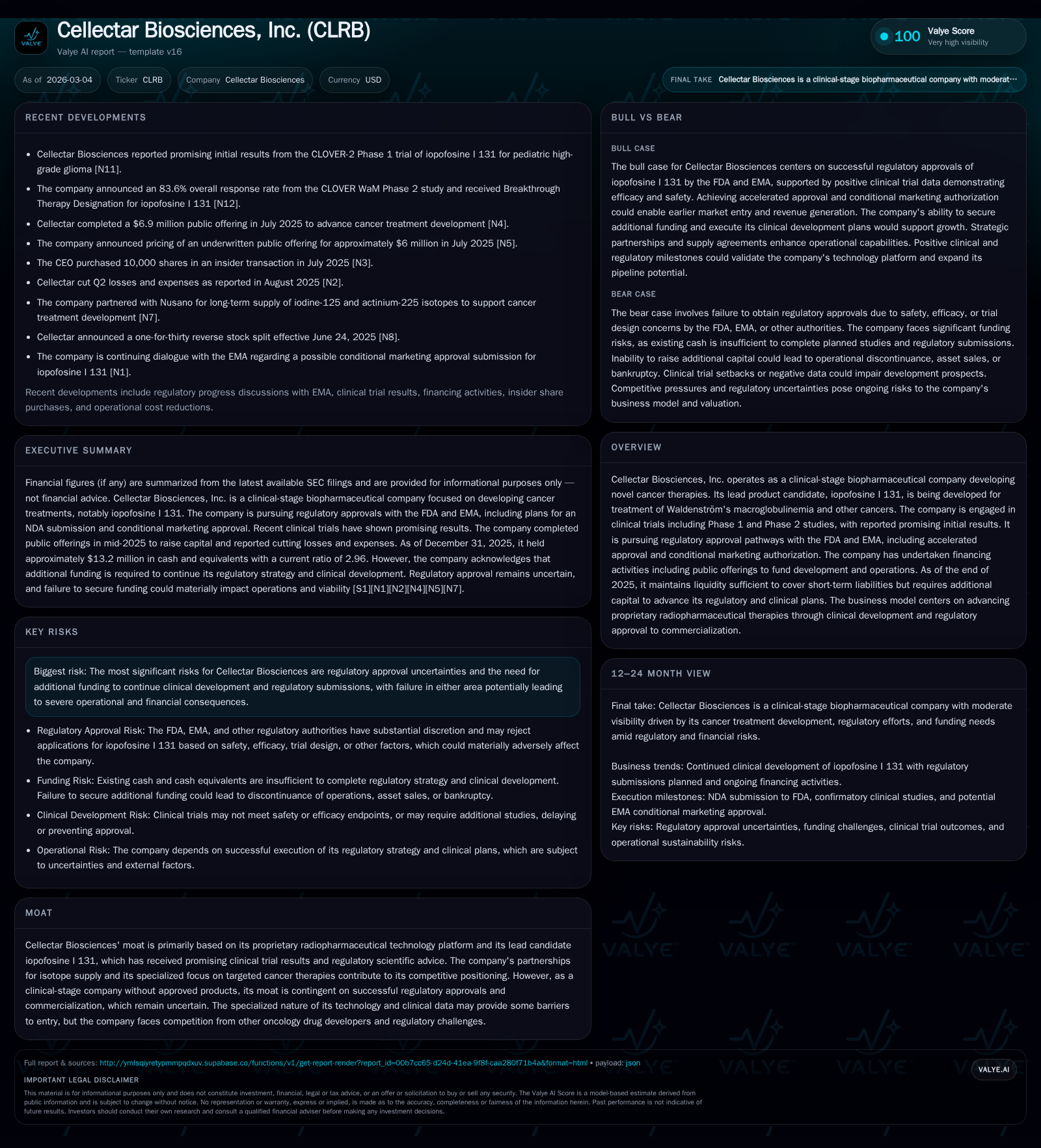
Cellectar Biosciences, Inc. advanced its lead radiopharmaceutical candidate, iopofosine I 131, through clinical development and regulatory engagement in 2025. While the EMA's Scientific Advice Working Party supported a conditional marketing authorization filing in Europe, approval uncertainties remain alongside FDA review challenges. The company reported reduced operating losses year-over-year but sustained negative cash flow and deeply negative returns on equity, reflecting ongoing investment in clinical programs. Cash and equivalents totaled approximately $13.2 million at year-end 2025, supplemented by a warrant exercise inducement raising about $5.8 million to extend operations into Q3 2026. Continued financing will be critical to support regulatory milestones and future confirmatory studies.
Company Overview and Business Model
Cellectar Biosciences, Inc. is a clinical-stage biopharmaceutical company developing radiopharmaceutical therapies targeting oncology indications. Its platform uses proprietary phospholipid drug conjugates designed to selectively deliver radioisotopes to cancer cells. The lead candidate, iopofosine I 131, is being developed primarily for Waldenström's macroglobulinemia (WM) patients who have received two prior lines of therapy including Bruton Tyrosine Kinase inhibitors (BTKi) [S6].
The company's regulatory strategy involves pursuing accelerated approval from the FDA alongside conditional marketing authorization (CMA) submissions in Europe based on scientific advice from the EMA’s Scientific Advice Working Party (SAWP), aiming to address an unmet medical need in this refractory patient population [S9][S21].
Historical Financial Performance
Recent annual financials reflect continued investment typical of a clinical-stage biotech with no product revenues. Key metrics from fiscal years 2022 through 2025 are summarized below:
Historical performance (annual)
| FY | Net ($mm) | CFO ($mm) | OpInc ($mm) | Capex ($) | Net YoY |
|---|---|---|---|---|---|
| 2025 | -22 | -23 | -23 | 5880 | +51.1% |
| 2024 | -45 | -48 | -52 | 104195 | -4.2% |
| 2023 | -43 | -32 | -39 | 864038 | -49.5% |
| 2022 | -29 | -25 | -29 | 225971 |
Source: SEC companyfacts cache [F1].
Capital returns and efficiency (annual)
| FY | FCF ($mm) | ROE% |
|---|---|---|
| 2025 | -23 | -255.2 |
| 2024 | -48 | -311.9 |
| 2023 | -33 | 282.1 |
| 2022 | -25 | -184.4 |
Source: SEC companyfacts cache [F1].
Operating losses halved from approximately $52 million in FY2024 to about $23 million in FY2025, indicating improved expense control or operational adjustments [F1]. Net losses similarly improved but remain substantial.
Operating cash outflows reduced by over half year-over-year (~51% improvement), though cash burn remains significant due to ongoing clinical development [F1]. Capital expenditures have become minimal relative to total spending, consistent with limited fixed-asset investments typical for companies at this stage [F1].
Equity fluctuated significantly with a negative position recorded at FY2023 before rebounding to positive territory by end-2025 around $8.5 million, reflecting capital raises including warrant exercises during late 2024 and throughout FY2025 [F1][S23].
Current assets exceeded current liabilities at year-end 2025 by nearly threefold, yielding a current ratio near 2.96 and suggesting reasonable short-term liquidity despite ongoing deficits [F1].
Growth Outlook and Regulatory Milestones
The primary growth catalyst is regulatory approval of iopofosine I 131 for WM patients refractory after two prior therapies including BTKi agents [S9][S21]. EMA SAWP's positive scientific advice supports filing for CMA in Europe, potentially enabling commercial availability as early as 2027 if approved [S21][S24].
Concurrent plans include submission of a New Drug Application (NDA) to the FDA under an accelerated pathway based on data from the CLOVER WaM Phase 2 trial [S9][S10]. However, significant uncertainties remain regarding FDA acceptance of trial design, safety and efficacy data sufficiency, and requirements for confirmatory studies.
Additionally, Cellectar is advancing CLR125 through early-phase dose-finding studies requiring further capital commitments [S11][S12]. These programs represent additional growth opportunities at earlier stages with inherent developmental risks.
Capital Allocation and Liquidity Considerations
Despite multiple financing efforts—including public offerings and warrant inducement transactions raising several million dollars—the company acknowledges its existing cash resources are insufficient to meet planned regulatory milestones without further funding [S7][S9][S18][S23]. Cash plus proceeds from warrant exercises are expected to sustain operations only into Q3 of calendar year 2026 [S20].
The inducement offering closed October 8, 2025 generated approximately $5.8 million gross proceeds through warrant exercises priced at $5.25 per share, illustrating reliance on dilutive equity instruments amid challenging market conditions for clinical-stage developers [S23][S18].
Failure to secure additional funding timely could jeopardize NDA/CMA filings or confirmatory study progression and may necessitate asset sales, operation scale-backs, or insolvency proceedings [S9][S12][S26].
Returns and Capital Allocation Policy
With no approved products or revenues yet, return metrics are deeply negative; approximate ROE for FY2025 is around -255%, reflecting net losses relative to modest equity—a profile typical of clinical-stage biotechs pre-commercialization [F1].
The company has not declared dividends nor conducted share repurchases; capital allocation focuses entirely on sustaining research and development activities required for clinical advancement [S14][S15][S25][F1]. Fixed asset investments remain minimal.
Industry Context Analysis
Waldenström’s macroglobulinemia post-BTKi failure represents a niche hematologic malignancy segment with substantial unmet need justifying expedited regulatory pathways.
Radiopharmaceutical development involves unique challenges including isotope supply logistics, stringent safety requirements due to radioactivity, and competition from emerging targeted therapies.
Regulators demand robust evidence balancing efficacy against long-term safety risks especially when approving novel modalities via accelerated pathways contingent on confirmatory data.
Successful commercialization thus depends on navigating initial approvals and demonstrating sustainable benefit amidst evolving standards of care.
What To Watch Next
Key upcoming developments include:
- Timing and acceptance of NDA submission by FDA;
- EMA CMA application decision following SAWP advice;
- Early CLR125 Phase 1b dose-finding study readouts requiring fresh capital;
- Additional financing rounds needed beyond Q3 2026 based on cash burn trends;
- Regulatory feedback potentially demanding expanded trials affecting timelines;
- Potential partnerships or licensing deals providing non-dilutive capital support.
Monitoring SEC filings and corporate announcements will be essential to gauge Cellectar's ability to convert pipeline assets into approved therapies amid sector challenges.
Disclaimer: This analysis is based solely on publicly available information as of March 4, 2026 ([F1],[S#]) without speculative assumptions beyond documented facts. It does not constitute investment advice.
Disclaimer: This is research-only, informational analysis and not investment advice. It may include AI-generated interpretation and general industry context. Always verify important details using primary sources.

Comments