
Bunker Hill Mining Advances Idaho Zinc-Lead-Silver Mine Restart with Strategic Alliances and Capital Restructuring
Bunker Hill Mining is progressing toward production at its polymetallic mine in Idaho, supported by key partnerships and a complex capital structure.
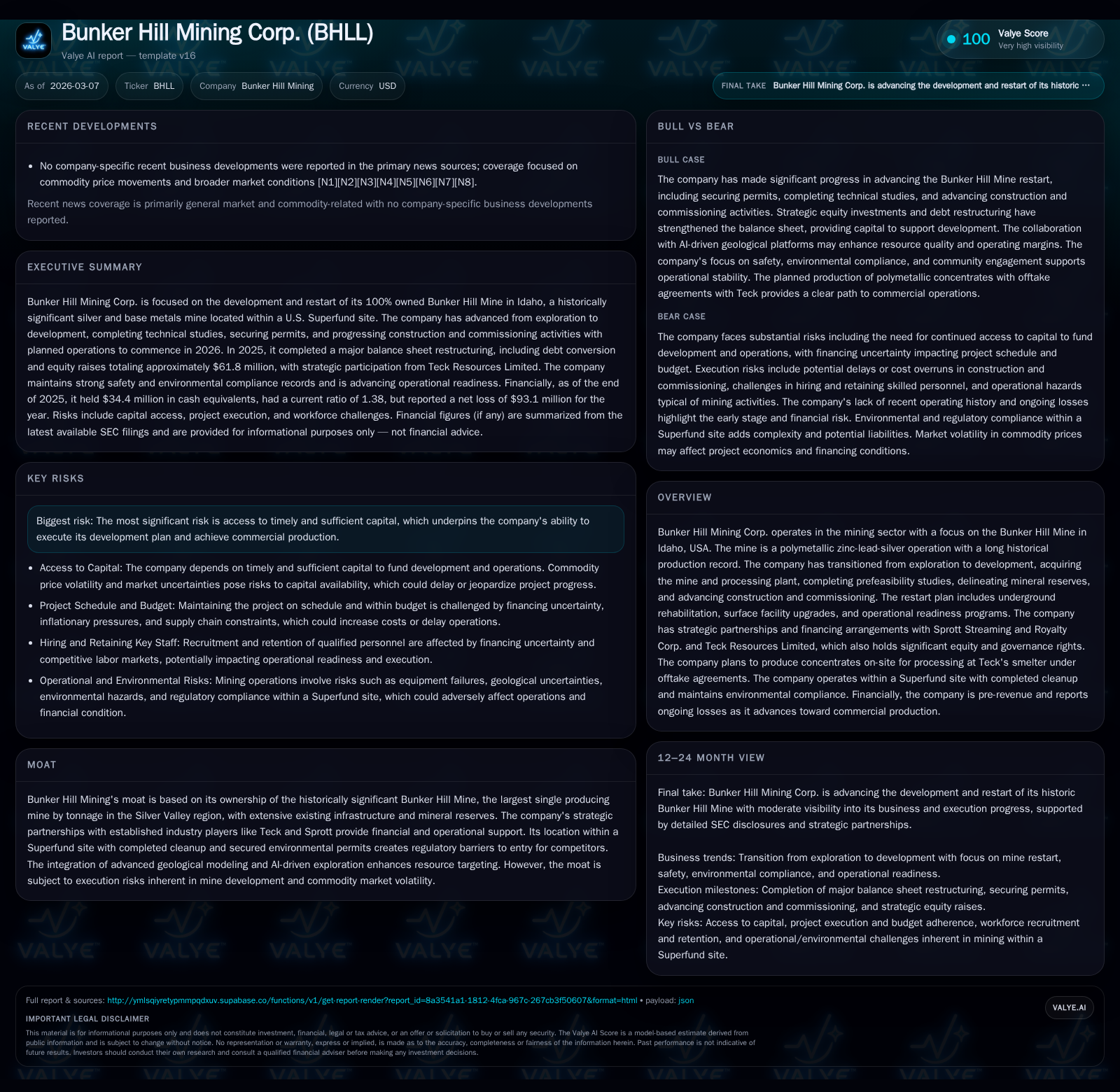
Bunker Hill Mining Corp. aims to restart the historic Bunker Hill Mine in Idaho with commercial operations targeted for the first half of 2026. The company restructured its balance sheet in 2025 through equity raises and debt conversions involving strategic partners including Sprott Streaming and Teck Resources. Despite no operating revenue and ongoing losses during development, the company has made significant progress rehabilitating underground workings, upgrading surface facilities, and initiating phased commissioning of its processing plant. The asset benefits from extensive legacy infrastructure within a completed Superfund cleanup site, regulatory permitting, and strategic financing agreements, though execution risk and capital access remain key challenges.
Company Overview and Historical Context
Bunker Hill Mining Corp., incorporated in Nevada since 2007 (formerly Lincoln Mining Corp.), operates the polymetallic Bunker Hill Mine located in Kellogg, Idaho. This historic mine produced over 165 million ounces of silver along with significant base metals from 1885 until closure in 1981. It lies within Operable Unit 2 of the Bunker Hill Superfund site where cleanup activities have been completed under EPA supervision [S1].
The asset's significance lies in its large tonnage production history and existing legacy infrastructure including underground workings, surface rights, processing plants, and comprehensive technical data critical for redevelopment.
Historical Performance
Since acquisition, Bunker Hill has advanced from exploration to active development targeting mine reopening. Key milestones include completing prefeasibility studies, delineating mineral reserves supporting restart plans, securing necessary permits, and maintaining strong safety performance marked by three consecutive years without lost time injuries (LTIs) as of 2025 [S1][S24].
Financially, the company remains pre-revenue with no commercial concentrate production yet. Operating losses reflect substantial investments:
Historical performance (annual)
| FY | Net ($mm) | CFO ($mm) | OpInc ($mm) | Net YoY |
|---|---|---|---|---|
| 2025 | -93 | -18 | -14 | -267.5% |
| 2024 | -25 | -10 | -16 | -88.7% |
| 2023 | -13 | -12 | -12 | -1594.8% |
| 2022 | 1 | -22 | -16 |
Source: SEC companyfacts cache [F1].
Capital returns and efficiency (annual)
| FY | ROE% |
|---|---|
| 2025 | 166.1 |
| 2024 | 48.6 |
| 2023 | 50.9 |
| 2022 | -3.4 |
Source: SEC companyfacts cache [F1].
Negative operating income highlights ongoing development expenditure prior to production ramp-up. The steep rise in net loss during FY2025 partly reflects non-cash charges including impairments and financing costs linked to restructuring efforts [F1].
Capital Structure and Financing
Capital management has been central to advancing the restart:
- In June 2025 the company restructured its balance sheet including converting certain debt into common stock issued to entities such as Sprott Streaming.
- The Metals Purchase Agreement with Sprott was replaced by senior secured Series 3 convertible debentures totaling $4 million plus additional life-of-mine gross revenue royalties on Bunker Hill claims [S4][S6].
- Teck Resources invested over $20 million through private placements becoming a related party with board representation and veto rights over additional financings or indebtedness; it also amended life-of-mine zinc and lead concentrate offtake agreements extending contract terms beyond initial five-year periods [S5][S9][S12][S24].
- A revolving standby prepayment credit facility provided by Teck bears interest initially at approximately 13.5%, available until mid-2028 or earlier upon achieving capacity or cash flow milestones [S9].
- Monetary Metals extended silver-backed loan financing via secured promissory notes bearing interest payable in cash or silver ounces along with capped warrant issuances [S14][S19].
These arrangements illustrate a complex mix of streaming/royalty modifications combined with convertible debt instruments designed to support liquidity while raising dilution considerations.
Operational Progress
By late 2025 and early 2026 preparatory work had advanced notably:
- Underground rehabilitation progressed significantly with connectivity between portals and mining areas established ensuring access to ore bodies planned for initial three years of operation. Ventilation upgrades and other ground support systems were substantially complete enhancing safety and operational readiness [S8][S24].
- Surface processing plant construction reached approximately 88% completion at year-end with phased commissioning initiated in January 2026; tailings filter press infrastructure was about halfway complete targeting readiness aligned with mine restart scheduled for H1 2026 [S8].
- Safety culture strengthened further sustaining zero LTIs over multiple years; environmental permitting maintained rigorously within the Superfund regulatory framework [S24].
- Equipment modernization included lease-to-own agreements for underground mining machinery crucial for efficient extraction given ore characteristics [S8].
Outlook & Risks
Growth Drivers:
- Mine restart delivering zinc-lead-silver concentrates under long-term offtake contracts primarily with Teck’s Trail smelter.
- Application of advanced geological modeling may identify higher-grade zones supporting extended mine life.
- Existing infrastructure provides scale efficiencies reducing capital intensity relative to greenfield developments.
- Potential resource base expansion through acquisitions such as December's Ranger Page property purchase adds high-grade silver-lead-zinc assets [N3][S20].
Key Risks:
- Access to sufficient capital remains critical; failure to secure timely funding could delay restart or constrain operations amid negative cash flows expected until stable production cash inflows begin [S1][S2].
- Inflationary pressures and supply chain disruptions may increase project costs affecting margins.
- Execution risk is elevated transitioning from construction phase towards steady mining operations amid stringent environmental regulations tied to the Superfund designation.
- Litigation risk persists notably from Crescent Mining alleging liability related to acid mine drainage remediation costs which could lead to financial or operational impacts pending resolution [S13].
- Maintaining regulatory compliance and community relations is essential given environmental sensitivities.
Financial Considerations & Capital Allocation
Operating cash flow remained negative at approximately $17.7 million in fiscal year 2025 due to ongoing investments focused on mine restart infrastructure. Net loss widened substantially driven by financing expenses and impairments associated with capital restructuring activities [F1]. Historical capex data is limited but reflects significant outlays consistent with development phase priorities.
No dividends or share repurchases have been declared as the company prioritizes growth capital preservation amid pre-production status [S10]. Return metrics such as ROE are currently affected by large net losses relative to negative equity values reflecting accumulated deficits. Future returns will depend on achieving sustained production coupled with favorable metal pricing dynamics.
Disclaimer: This analysis is based solely on publicly available information including recent SEC filings. Financial figures are cited only where reported officially. This summary does not constitute investment advice or recommendations.
Disclaimer: This is research-only, informational analysis and not investment advice. It may include AI-generated interpretation and general industry context. Always verify important details using primary sources.

Comments