
National Vision’s Return to Profit and Strategic Transformation
National Vision achieved a fiscal 2025 profitability turnaround driven by strategic modernization and omni-channel expansion amid a competitive U.S. optical market.
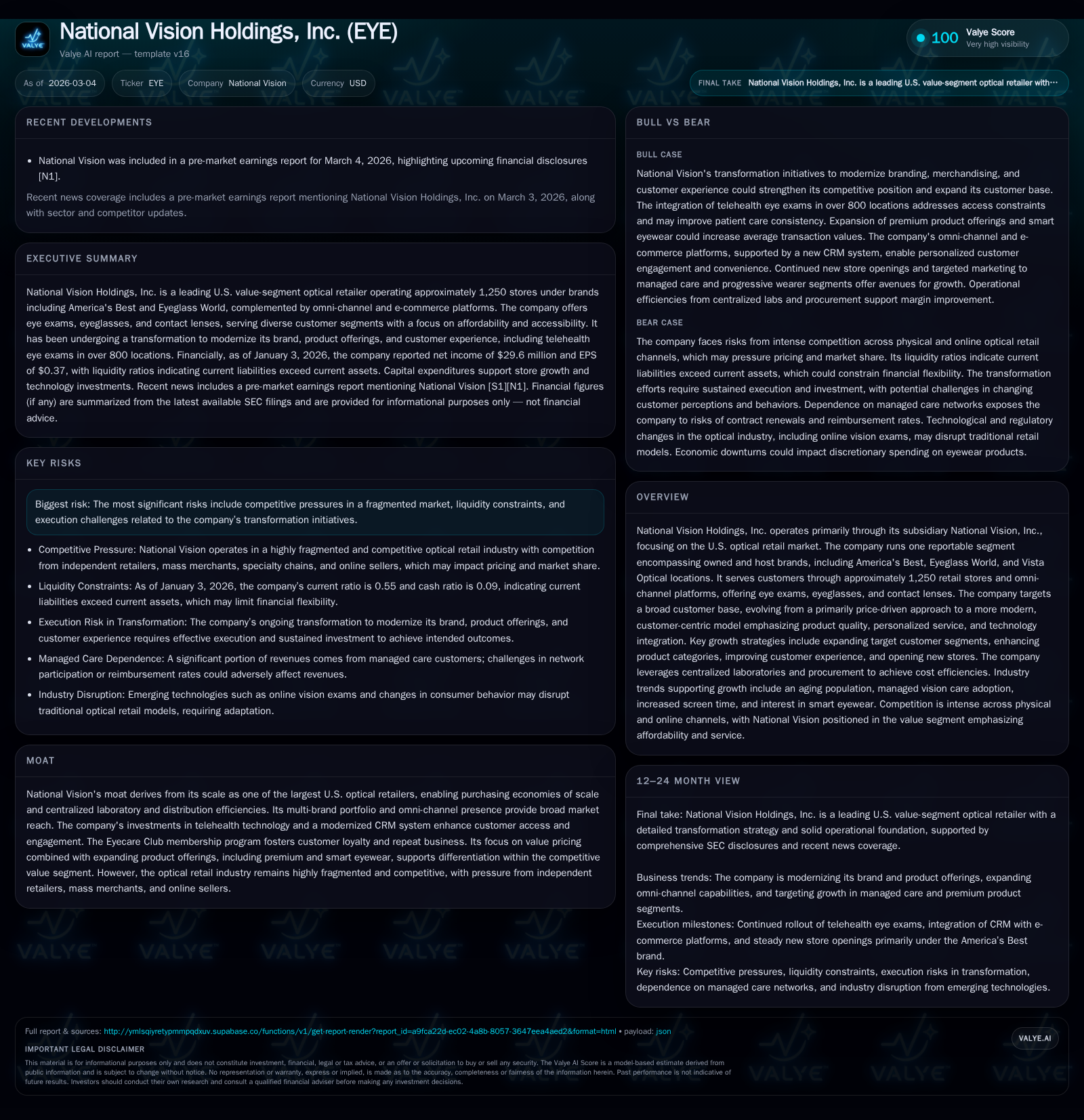
After consecutive years of operating losses in fiscal 2023 and 2024, National Vision regained profitability with an operating income of $58.8 million in fiscal 2025 supported by evolving beyond its traditional price-driven model toward enhanced customer experiences and technology integration. The company’s strategic transformation includes leveraging telehealth-enabled eye exams across over 800 stores, refreshing brand identities, expanding product categories with premium and smart eyewear, and accelerating omni-channel capabilities. Despite a fragile liquidity position marked by a 0.55 current ratio and competitive pressures in a fragmented industry, National Vision benefits from significant scale economies through centralized lab operations and exclusive supplier agreements extending through 2028. Capital allocation remains disciplined with declining capital expenditures and modest buybacks but no dividends since 2019. Monitoring progress on CRM integration, managed care penetration, and store growth will be crucial to sustaining momentum.
Historic Financial Performance and Key Value Drivers
National Vision’s fiscal track record over the past four years illustrates significant volatility centered on strategic shifts within a fragmented optical retail landscape. After reporting an operating income of $61.3 million in FY2022, the company experienced steep downturns with operating losses of $46.8 million in FY2023 and $25.6 million in FY2024 before swinging back to an operating profit of $58.8 million in FY2025 [F1]. This reversal underscores the effectiveness of transformation efforts initiated mid-cycle.
Revenue data is only explicitly disclosed for FY2025 at $321.8 million; while prior years are unavailable, management commentary suggests a relatively stable top line overshadowed by margin compression during the loss years due to discounting pressures and transitional costs inherent to business model evolution [F1][S1]. Operating cash flow has remained robust throughout this episode—growing from $119.2 million in FY2022 to $146.3 million in FY2025—indicating solid underlying cash-generating capability despite earnings volatility.
Capital expenditures have been on a declining trajectory—from $113.5 million in FY2022 down to $72.8 million in FY2025—reflecting lower new store investment alongside spend on modernizing existing assets [F1][S27]. The interplay between these factors facilitated free cash flow expansion totaling approximately $73.5 million last fiscal year.
Historical performance (annual)
| FY | Net ($mm) | CFO ($mm) | OpInc ($mm) | Capex ($mm) | Net YoY |
|---|---|---|---|---|---|
| 2025 | 30 | 146 | 59 | 73 | +203.5% |
| 2024 | -29 | 134 | -26 | 96 | +56.6% |
| 2023 | -66 | 173 | -47 | 115 | -256.5% |
| 2022 | 42 | 119 | 61 | 114 |
Source: SEC companyfacts cache [F1].
Capital returns and efficiency (annual)
| FY | Buybacks ($mm) | FCF ($mm) | ROE% |
|---|---|---|---|
| 2025 | 3 | 73 | 3.4 |
| 2024 | 3 | 38 | -3.5 |
| 2023 | 28 | 58 | -7.9 |
| 2022 | 84 | 6 | 4.7 |
Source: SEC companyfacts cache [F1].
Transformation Initiatives Reshaping Market Approach
Historically anchored around a price-driven value proposition targeting primarily lower-income consumers, National Vision undertook material initiatives starting in fiscal 2024 aimed at repositioning as a more consumer-centric operator focused on quality, experience, and technology integration [S1][N11]. These moves included:
- Entry into telehealth-enabled optical exams with installations completed in over 800 locations by January 2026 allowing remote optometrists to conduct exams via video conferencing — building consistency in patient care access while mitigating optometrist availability constraints [S12].
- Brand refreshes including new identities for National Vision and America’s Best alongside introduction of the America’s Best brand promise "Every Eye Deserves Better" capturing expanded demographic appeal beyond lowest cost alone [S21][N11].
- New merchandising strategies diversifying product assortment through additions at higher price points including premium frames (designer labels like Ray-Ban Meta smart glasses) and advanced lens technologies such as photochromic lenses, premium coatings, and advanced materials targeting underpenetrated categories relative to competitors [S16][S22].
- A revamped pricing architecture paired with investments in sales associate training shifting selling approaches toward consultative rather than transactional methods aiming at enhancing perceived value rather than competing purely on lowest prices [S13].
This comprehensive repositioning aligns strategically with secular growth drivers present within U.S optical retail: aging population increasing vision correction needs; rising managed vision care usage; growing digital eye strain among consumers; steady replacement cycles; plus an increasing focus on health & wellness trends favoring quality and innovation over commoditized offerings [S16][S23].
Channel Expansion and Omni-Channel Integration
Complementing its brick-and-mortar footprint of approximately 1,250 stores across four brands—America's Best Contacts & Eyeglasses, Eyeglass World, Vista Optical (host brand locations)—National Vision has progressively developed omni-channel capabilities embodying mobile-optimized store websites alongside DiscountContacts.com e-commerce platform [S4]. Omni-channel transactions including "buy-in-store and ship-to-home" services contributed roughly 7% of net revenue consistently across FY24-25.
Looking ahead into FY26, management plans highlight migration toward newly integrated e-commerce platforms fused with an upgraded Customer Relationship Management (CRM) system designed for dynamic customer journeys spanning digital channels and physical stores [S4][S13]. This leverages data-driven consumer insights for personalized engagement — crucial given the company's shift towards attracting higher-value segments such as progressive wearers and managed care customers.
The CRM upgrade also complements loyalty efforts including the America’s Best Eyecare Club membership program boasting approximately 1.3 million active members as of early 2026—a driver for repeat purchase behavior through bundled eye exams and eyewear discounts facilitating recurring revenue streams alongside strengthening lifetime customer value metrics [S7].
Market Position: Scale Economics in a Fragmented Industry
Operating within the highly fragmented U.S optical retail industry valued at approximately $69.5 billion (estimated for calendar year 2025 by The Vision Council), National Vision commands competitive differentiation predominantly through scale advantages uncommon among independent competitors or mass merchants [S4][S16].
Its moat rests chiefly on:
- Exclusive supply contracts notably with EssilorLuxottica granting sole rights to certain eyeglass lenses until May 2028 supporting procurement cost leverage.
- Centralized processing network comprising four state-of-the-art domestic optical laboratories equipped for high-volume low-cost lens customization enabling quick turnaround times typically within seven to ten days.
- A broad multi-brand portfolio catering across value segments including owned brands America’s Best and Eyeglass World complemented by host brand Vista Optical stores situated within Fred Meyer locations or military bases creating additional distribution channels [S5][S16].
While competition remains intense—spanning independent optical retailers that comprise nearly half the market plus online players exploiting relaxed contact lens sale regulation—the company leverages its national scale combined with quantified product innovation investments to carve defensible share particularly among managed care patients who delivered approximately 42% of revenues as of FY25 with aspirations to reach near half the revenue base given broader industry penetrance around 70% coverage levels [S6][S9].
Risks from Competitive Headwinds and Execution
Despite strategic strengths, National Vision operates amid pronounced risks:
- Market fragmentation fosters competition on price, convenience, service quality among independents, chains, mass retailers like warehouse clubs plus online disruptors presenting margin pressures.
- Liquidity concerns arise given a current ratio near just 0.55 reflecting limited short-term asset cushion against liabilities necessitating strict working capital management [F1][S10][S26].
- The complexity inherent within ongoing large-scale transformation poses execution risk including integration timelines for CRM systems alongside successful adoption of telehealth platform expansions.
- Cybersecurity threats constitute a material operational risk requiring constant vigilance; governance overseen by recently appointed CTO with extensive industry experience collaborating with VP IT Infrastructure emphasizing prevention monitoring detection remediation under Board audit committee supervision ensures structured mitigation protocols [S1].[...]
State regulatory shifts or contract renegotiations involving vision insurance networks could also impact managed care access dynamics presenting potential revenue volatility.
Capital Allocation Strategy and Returns Analysis
Capital deployment reveals measured discipline consistent with consolidation-phase priorities:
- Capital expenditures declined meaningfully from ~$95.5 million in FY24 to $72.8 million in FY25 correlated with fewer new store openings but offset partially by investments enhancing existing store exam capacity and technology infrastructure upgrades including doctor equipment enhancements [F1][S27].
- Share repurchases remained moderate at approximately $3.2 million during FY25 continuing low dividend payout policy since discontinuation post-FY2019 confirming management’s focus on operational reinvestment over shareholder yield distributions currently [F1][S15].[...]
- Operating cash flow increased moderately year-over-year improving free cash flow availability—to some extent fueling strategic investments without reliance on incremental debt—with net cash position holding steady at ~$38.7 million at FY25-end despite sizable current liabilities underscoring tight liquidity parameters [F1][S8]
- Equity base remained strong near $870 million supporting ROE around a modest ~3.4% indicative of early recovery phase balanced against capital intensity inherent to retail rollouts plus transformation expenses ongoing [F1].
This measured capital approach prioritizes sustainable growth capacity balancing new store rollout plans (~30–35 annually anticipated for FY26) coupled with execution investments underpinning long-term profitability targets.
What to Watch: Growth Milestones and Operational Metrics
Looking forward without explicit company guidance beyond qualitative disclosures signals several key focus areas warranting close observation:
- Effectiveness of CRM system rollout across e-commerce platforms expected during FY26 that will signal maturity level of seamless omni-channel consumer engagement potentially impacting retention rates.
- Further adoption rates for telehealth-enabled optical exams especially as coverage expands well past initial >800 store installations indicating scalability success resolving provider constraints while enhancing patient access.
- New store openings pace maintaining targeted range—circa mid-30s annually—primarily under America’s Best banner while positioning for accelerated expansion post-FY27 aiming near tripling annual openings—a critical volume inflection endpoint for network density economics.
- Progression towards achieving managed care penetration goals edging closer to approximately half total revenues serving as leading indicator reflecting stronger insurance payor relationships plus marketing effectiveness tailored toward benefits-maximizing consumers.
- Lens category mix enhancement reflecting increased sales contribution from premium coatings, photochromic options like Transitions lenses or smart eyewear models predicting improved average ticket size driving margin gains amidst competitive price pressures.
These operational vectors will collectively serve as bellwethers gauging whether strategic transformation translates into durable profitable market share gains within evolving U.S optical retail demographics.
This analysis is based upon information available as of March 4, 2026, primarily derived from National Vision Holdings' publicly filed documents along with select recent news releases which reflect management commentary but do not constitute explicit forecasts or investment recommendations.
Disclaimer: This is research-only, informational analysis and not investment advice. It may include AI-generated interpretation and general industry context. Always verify important details using primary sources.

Comments