
SunOpta Inc.’s Resurgence: Revenue Growth and Strategic Transition in 2025
SunOpta achieved a notable financial turnaround in 2025 while navigating tariff challenges and preparing for an impending acquisition.
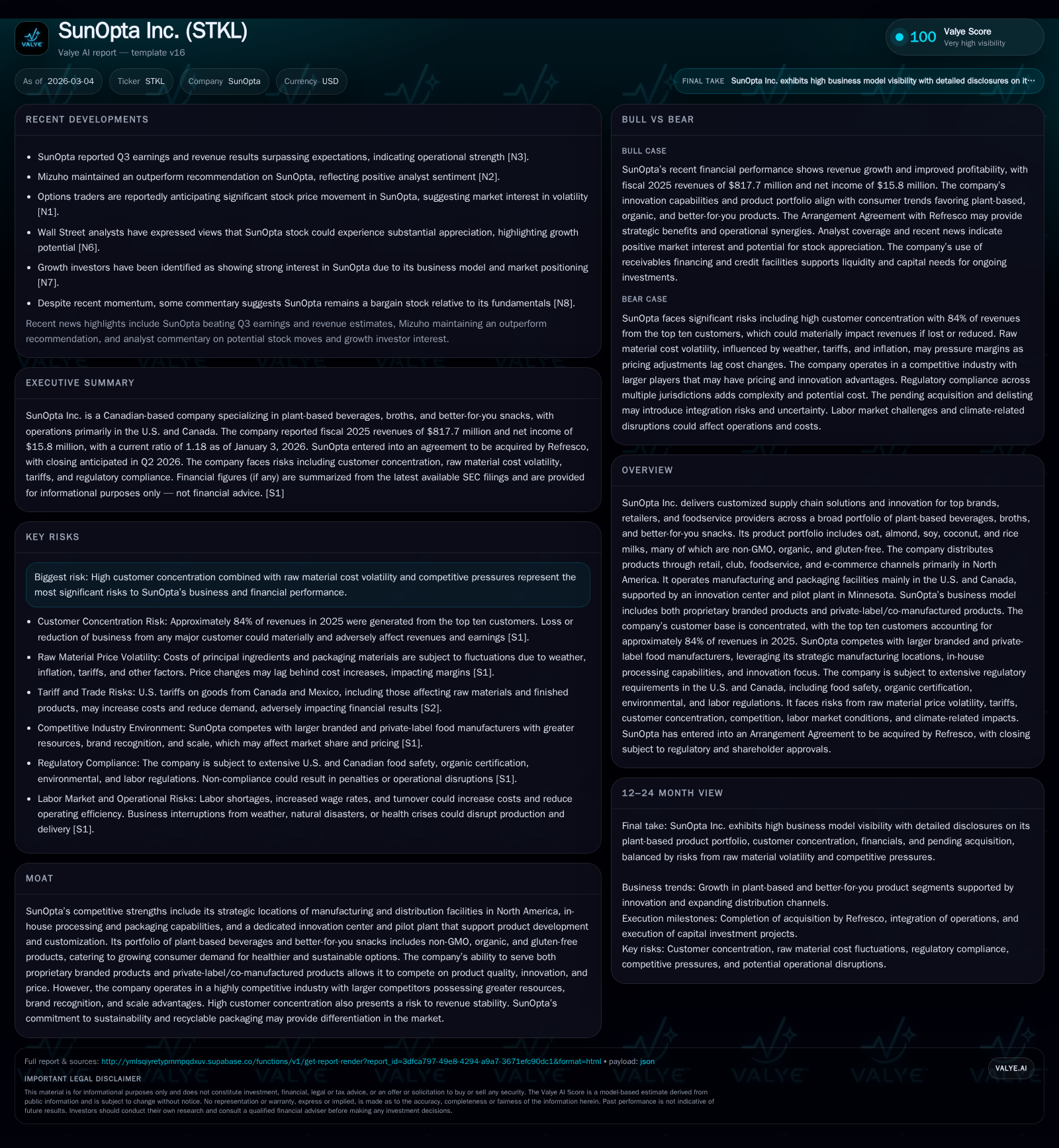
SunOpta Inc. reversed prior losses to post $818 million in revenue with double-digit growth and return to profitability in fiscal 2025, driven by its diversified plant-based beverage portfolio and efficient North American manufacturing footprint. The company’s results reflect solid margin improvement despite tariff-related cost pressures and significant customer concentration risks. SunOpta’s strategic transition includes an impending Refresco acquisition expected to close in mid-2026, which will transform its public status and capital outlook. Investors should monitor the completion process of this transaction alongside supply chain impacts from trade policy shifts.
Fiscal 2025 Financial Performance: Growth Metrics and Profitability Revival
SunOpta marked a decisive inflection point in fiscal 2025 with revenue reaching $817.7 million, up 13% year-over-year from $723.7 million in fiscal 2024 [F1], illustrating continued recovery momentum following sharp contractions in prior years. Operating income surged over 150%, climbing to approximately $39.7 million from $15.6 million the prior year [F1]. Net income swung from losses of $17.4 million in FY2024 to positive earnings of $15.8 million in FY2025—signaling effective cost containment alongside revenue expansion [F1]. These figures reflect a substantial operational rebound driven by top-line growth and margin improvement amid external pressures.
Strategic Drivers Behind Revenue Expansion and Margin Improvement
SunOpta leverages a diversified portfolio of plant-based beverages—including oat, almond, soy, coconut, and rice milks—that cater to growing consumer preferences for organic, non-GMO, and gluten-free alternatives [S1]. The company operates primarily through a North American manufacturing footprint utilizing advanced processing technology including Tetra Pak systems for extended shelf-life products [S19]. Proprietary branded products coexist alongside private-label co-manufacturing contracts enabling scale and customization [S1]. Its innovation center and pilot plant facilitate rapid product development tailored to customer needs, enhancing competitiveness against larger branded companies [S1]. Distribution channels span retail, club stores, foodservice, and e-commerce, contributing to revenue diversity.
Customer Concentration and Raw Material Costs: Emerging Risks
SunOpta's revenue is concentrated, with the top ten customers accounting for approximately 84% of sales in 2025 [S11][S19]. This concentration introduces exposure to volume fluctuations or contract renegotiations given many contracts are cancellable or subject to periodic bidding [S11]. Raw material inputs such as oats, almonds, soybeans, coconut, apples, and sugar face pricing volatility due to commodity market conditions influenced by weather, inflationary trends, tariffs, and logistics costs [S19][S24]. While the company employs annual supplier agreements and dynamic pricing where feasible, margin pressure remains a risk amid competitive constraints on pricing pass-through.
Tariffs Impact and Supply Chain Adjustments Amid Trade Uncertainty
The U.S. imposed escalating IEEPA tariffs during early 2025—ultimately reaching a 35% duty on Canadian imports not exempt under USMCA—which increased landed costs for SunOpta’s Canadian-sourced products [S1][S2]. Approximately 8% of total revenues stem from fruit snack products imported from Canada facing these tariff headwinds [S1]. The company responded with alternative sourcing strategies and negotiated pricing adjustments with customers to mitigate tariff impacts while leveraging its predominantly U.S.-based production infrastructure to reduce dependency on tariff-exposed imports [S1][S2]. This approach limited margin erosion but highlights geopolitical risks embedded in supply chains.
Pending Refresco Acquisition: Terms, Risks, and Market Implications
On February 6, 2026, SunOpta entered into an Arrangement Agreement with Refresco whereby Refresco will acquire all issued common shares at a cash price of $6.50 per share [S1][S3]. Closing is expected in Q2 calendar year 2026 upon receipt of court approvals—including from the Ontario Superior Court—and antitrust clearances along with shareholder approval [S1][S3][S17]. Post-closing SunOpta will become a wholly-owned subsidiary of Refresco with shares delisted from Nasdaq and TSX exchanges altering corporate governance and capital deployment flexibility. Risks include potential delays or failure to secure approvals or shareholder votes; dissenting shareholder actions; and integration challenges that could disrupt operations or affect value realization [S1][S7][S18].
Capital Allocation and Shareholder Returns Amid Transition
Operating cash flow remained steady at approximately $49.7 million in FY2025 despite working capital challenges related to lower utilization of receivables financing programs compared to prior years [F1][S4][S15]. Capital expenditures declined modestly by about 11% year-over-year to $28.4 million as management prioritized productivity projects over expansions while investing steadily in capacity projects at beverage (Texas) and fruit snack (Washington) facilities scheduled for lease-financed additions during 2026 [F1][S10]. Return on equity approximated 9.2%, reflecting normalized profitability against equity following restructuring losses [F1]. Dividends have been suspended since late-2019 consistent with conserving capital during turnaround phases; share repurchases were minimal ($1 million utilized against authorized $25 million program) ahead of acquisition execution [F1][S10]. Liquidity remains balanced between operational funding needs and preparing for integration.
Outlook and Key Milestones Ahead of Deal Closure
No explicit financial guidance beyond fiscal year-end reporting is provided [N/A][S1]; however, management identifies planned deal closure in Q2 calendar year 2026 as pivotal for near-term prospects. Key monitoring points include receipt of regulatory antitrust approvals, successful shareholder vote without material dissent, timely judicial orders validating the arrangement under Canadian law [S3], continued management of input cost volatility linked to commodities, and residual tariff uncertainties. Transitional risks include employee retention challenges or customer uncertainty impacting purchase volumes until ownership transfer completes [S18]. Investors should also track timing of capital deployment aligned with disclosed plans amid ongoing investment despite cost control focus.
SunOpta Key Financial Metrics (FY2022–FY2026)
Historical performance (annual)
| FY | Rev ($mm) | Net ($mm) | CFO ($mm) | OpInc ($mm) | Rev YoY | Net YoY |
|---|---|---|---|---|---|---|
| 2026 | 818 | 16 | 50 | 40 | ||
| 2024 | 724 | -17 | 50 | 16 | +298.5% | -48.2% |
| 2023 | 182 | -12 | 15 | 8 | -17.9% | -1213.3% |
| 2022 | 221 | 1 | 28 | 5 |
Source: SEC companyfacts cache [F1].
Capital returns and efficiency (annual)
| FY | FCF ($mm) | ROE% |
|---|---|---|
| 2026 | 21 | 9.2 |
| 2024 | 18 | -11.7 |
| 2023 | -31 | -7.3 |
| 2022 | -101 |
Source: SEC companyfacts cache [F1].
Note: Fiscal years correspond to periods ending near December each year except FY2025 ending January 3rd.
This analysis synthesizes publicly available filings through March 4th, 2026 without offering investment advice or predictions beyond reported facts regarding SunOpta Inc.'s performance and corporate developments.
Disclaimer: This is research-only, informational analysis and not investment advice. It may include AI-generated interpretation and general industry context. Always verify important details using primary sources.

Comments