
Greenwave Technology’s Financial Struggles Shadow Strategic Real Estate Expansion
Greenwave Technology has embarked on a $15 million real estate acquisition spree while grappling with severe liquidity shortfalls and mounting operating losses.
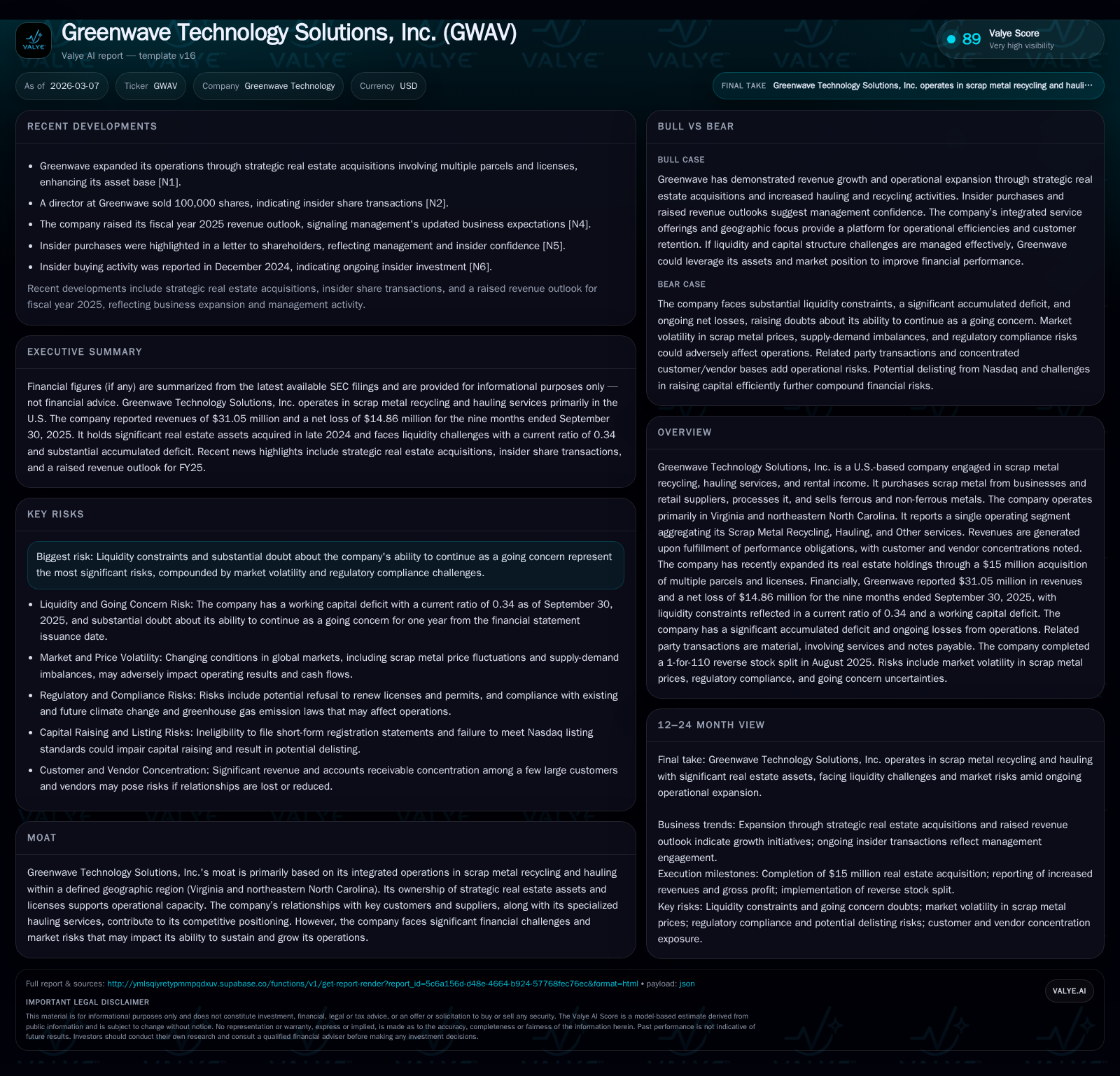
Greenwave Technology Solutions, Inc. has experienced a significant increase in revenue from nominal levels in 2020-21 to over $8 million in FY2021, with continued growth reflected in operations through 2025. However, these top-line gains have been consistently overshadowed by deepening operating losses and cash flow deficits, culminating in a current ratio of just 0.34 that highlights critical liquidity constraints. Despite these financial challenges, Greenwave expanded its real estate holdings through the acquisition of multiple parcels valued at $15 million, involving related-party transactions and secured notes payable. Customer and vendor concentration risks further exacerbate operational volatility amid commodity price fluctuations and regulatory compliance pressures. Capital allocation trends reveal declining capital expenditures coupled with persistent negative free cash flow and a deeply negative return on equity near -65%. The company's ability to balance growth ambitions with financial sustainability remains uncertain as it navigates complex market and regulatory challenges.
Historic Revenue Surge and Operating Loss Trends
Greenwave Technology Solutions has demonstrated a steep revenue incline over recent years. Starting from a negligible base in FY2020 ($6,964) and reporting revenues of approximately $8.1 million for FY2021 [F1], the company continued expanding operations through the first nine months of 2025 as noted in SEC filings [S2]. This growth contrasts sharply with deteriorating profits — operating income declined from -$2.93 million in FY2021 to approximately -$34.3 million for FY2024 (a worsening of about 75.6%) [F1]. Net losses followed a similar trajectory peaking near -$23.9 million for FY2024 despite increased scale.
Operating cash flows have remained negative across multiple years, with CFO declining sharply by over 840% from FY2023 to FY2024 to approximately -$17.3 million [F1], illustrating worsening cash burn despite expansion.
Historical performance (annual)
| FY | Net ($mm) | CFO ($mm) | OpInc ($mm) | Capex ($mm) | Net YoY |
|---|---|---|---|---|---|
| 2024 | -24 | -17 | -34 | +11.2% | |
| 2023 | -27 | -2 | -20 | 2 | +23.1% |
| 2022 | -35 | -3 | -11 | 6 | -2046.7% |
| 2021 | -2 | -2 | -3 | 0 |
Source: SEC companyfacts cache [F1].
Capital returns and efficiency (annual)
| FY | FCF ($mm) | ROE% |
|---|---|---|
| 2024 | -64.7 | |
| 2023 | -4 | 604.7 |
| 2022 | -9 | -228.5 |
| 2021 | -3 | 7.0 |
Source: SEC companyfacts cache [F1].
(*YoY calculations limited due to data availability) [F1]
Integrated Operations in Metal Recycling: Economic Characteristics
Greenwave operates three primary activities—Scrap Metal Recycling, Hauling Services and Other operations (mainly rental income)—aggregated into one reportable segment based on similar economic characteristics including production processes and customer profiles [S4][S5]. The Chief Operating Decision Maker (CODM), CEO Danny Meeks [S4], evaluates performance using revenues alongside gross profit margins and operating cash flows.
The company’s operations are geographically concentrated within the USA—specifically Virginia and northeastern North Carolina—with integrated logistics capabilities tying scrap procurement through hauling to processing facilities [S4][S5]. Accounts receivable represent amounts due from customers primarily on standard payment terms ranging from immediate to net-30 days without interest accruals [S17].
Real Estate Acquisitions: Strategic Expansion Amid Liquidity Pressure
In December 2024 Greenwave completed a significant real estate transaction acquiring seven parcels along with licenses at an aggregate price of $15 million payable partly through issuance of Series A-1 Preferred Stock plus a related-party promissory note totaling roughly $11.7 million bearing a 10% annual rate maturing within the next twelve months [N1][S19][S27].
This acquisition supports operational capacity expansion by controlling key logistics hubs or recycling yards; however it contrasts with working capital pressures—the current ratio stood at an alarming low of 0.34 as of September 30, 2025 (current assets roughly $7M vs liabilities exceeding $20M) highlighting strained liquidity conditions [F1][S12].
The related party nature of the transaction raises considerations regarding capital allocation priorities given limited free cash flow for debt servicing or reinvestment into core operations.
Liquidity Challenges and Capital Structure Dynamics
Cash totaled approximately $1.45 million at Q3’25 end down from nearly $2.58 million a year earlier; meanwhile current liabilities remained above $20 million leaving severe working capital deficits [$7M assets vs $20.7M liabilities] [F1][S14]. Operating activities consumed over $5.86 million in cash during the first nine months of fiscal ’25 alone representing ongoing cash burn distress [S26].
The indebtedness profile includes senior secured convertible notes originally issued at face values around $18 million but subject to conversion price adjustments reducing conversion prices from initial levels as high as $225/share down to about $7/share after warrant inducements affecting shareholder dilution risk [S6][S7][S25][S26]. Numerous amendments have pushed back amortization schedules while waivers have been sought amid covenant breaches underscoring financial strain [S6][S7]. Warrants exercisable at low exercise prices priced via Black-Scholes models using elevated volatilities exceeding 140% alongside risk-free rates near ~4-5% introduce further dilution potential.
Concentration Risks Amplify Market Vulnerability
Accounts receivable exhibit heightened concentration risk: six largest customers accounted for approximately 31.85%, 10.63%, and smaller fractions respectively of total receivables at September 30th Q3’25—far above historical norms where no single client exceeded double-digit shareings last year [S4][S19].
Revenue concentration mirrors this pattern—five customers combined contributed roughly half (~51%) of Q3’25 sales indicating potential volatility if client reductions occur abruptly [S4][S29]. On vendor side multiple suppliers individually represent upward of ~5-9% cost exposure intensifying supply chain vulnerability [S19]. This reliance increases susceptibility to shifting credit terms or payment delays impacting cash flow.
Regulatory and Commodity Price Risks Constrain Outlook
Company disclosures highlight material uncertainty stemming from possible license non-renewals restricting operations combined with stringent climate change regulations potentially increasing compliance costs [S2][S24]. Further market factors such as volatility in global scrap steel prices weigh heavily on margins and operational stability.
Capital Allocation Trends: Declining Investment Amid Negative Returns
Return on equity stands deeply negative around -65%, calculated using latest net income relative to shareholders' equity balances—highlighting destruction rather than creation of shareholder value amid ongoing losses [F1].
Capital expenditures contracted significantly from highs above $5.9 million in FY22 to just under $1.8 million in FY23 indicating attempts at conserving liquidity amid operational pressures though exact figures for FY24 are unavailable for comparison [F1]. Heavy negative free cash flow estimated near -$19 million further demonstrates persistent cash drain obstructing self-sustained growth reinvestments while forcing reliance on capital raises involving warrants and convertible debt issuances fraught with dilution risk [F1][S6][S7].
Disclaimer: This analysis relies exclusively on data available through company filings as of March 7th 2026 or cited news sources without extrapolation or forward-looking statements beyond documented disclosures.
Disclaimer: This is research-only, informational analysis and not investment advice. It may include AI-generated interpretation and general industry context. Always verify important details using primary sources.

Comments