
Nexxen International’s Revenue Plateau and Strategic AI Investments Shape 2025 Outcomes
Examining Nexxen's stable revenue in 2025 alongside margin pressures amid strategic AI platform enhancements within evolving digital ad markets.
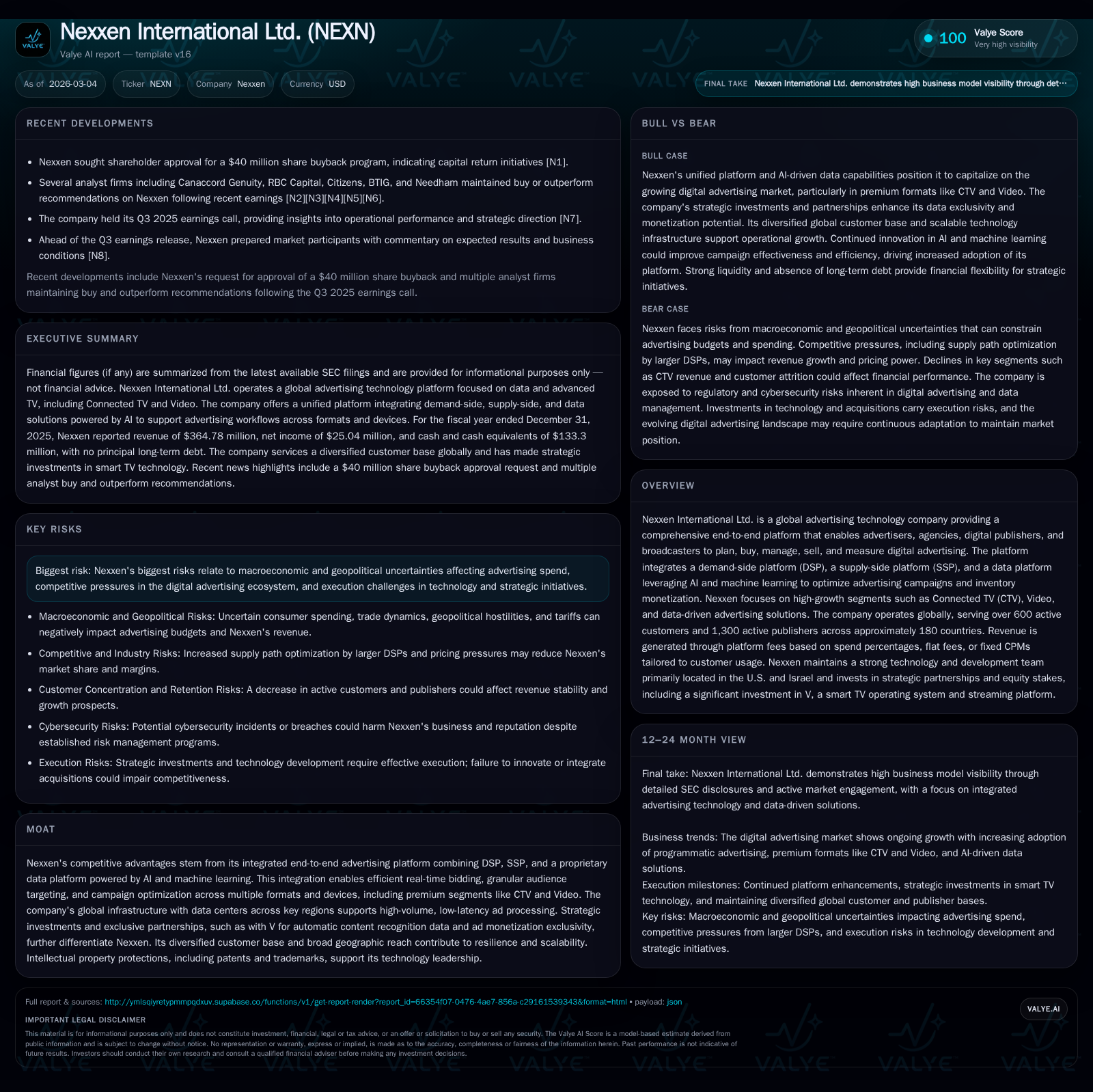
Nexxen International sustained near-flat revenue in 2025, reflecting a challenging advertising spend environment offset by gains in programmatic video and data-driven solutions. Profitability declined amid increased investments in AI-driven platform capabilities and growing costs associated with premium segments such as Connected TV. Despite margin compression, disciplined capital allocation and a strong cash position underpin Nexxen's capacity to invest in technology and sales expansion. Key risks include macroeconomic headwinds and competitive dynamics in the fragmented digital advertising ecosystem.
Evolution of Nexxen’s Business Model and Industry Position
Nexxen International Ltd. operates a comprehensive end-to-end advertising technology platform that integrates demand-side platform (DSP), supply-side platform (SSP), and a proprietary data platform leveraging artificial intelligence (AI) and machine learning. This unified system facilitates advertisers, agencies, digital publishers, and broadcasters in planning, buying, managing, selling, and measuring digital ad campaigns across multiple devices and formats.
The company has concentrated its efforts on high-growth verticals within the digital advertising landscape — notably Connected TV (CTV) and Video segments — areas where premium audience engagement commands higher CPMs (cost per mille). By combining large-scale data aggregation with algorithmic targeting precision and real-time bidding efficiencies, Nexxen creates a marketplace that optimizes audience segmentation and inventory monetization for both buyers and sellers.
Operating globally, Nexxen’s infrastructure supports localized data centers ensuring low-latency ad serving across roughly 180 countries. Their portfolio encompasses over 600 active advertiser customers and about 1,300 active publishers as of year-end 2025 [S1][S18], underscoring a diversified customer mix that spans brands seeking measurable ROI via programmatic advertising.
Strategic partnerships underpin Nexxen's moat; notably their exclusive agreements with V provide unique access to automatic content recognition (ACR) data pivotal for advanced CTV audience targeting – an increasingly critical advantage given the ongoing migration of linear TV budgets into programmatic digital channels [S14][S28].
Revenue Growth and Profitability Trends: Reviewing Historical Performance
Over the past four years, Nexxen's revenue trajectory has reflected incremental growth with volatility tied to broader macroeconomic factors impacting global ad spend.
Historical performance (annual)
| FY | Rev ($mm) | Net ($mm) | Rev YoY | Net YoY |
|---|---|---|---|---|
| 2025 | 365 | 25 | -0.2% | -29.3% |
| 2024 | 365 | 35 | +10.1% | +264.9% |
| 2023 | 332 | -21 | -1.0% | -194.5% |
| 2022 | 335 | 23 |
Source: SEC companyfacts cache [F1].
Capital returns and efficiency (annual)
| FY | ROE% |
|---|---|
| 2025 | 5.3 |
| 2024 | 6.7 |
| 2023 | -4.0 |
| 2022 | 4.1 |
Source: SEC companyfacts cache [F1].
Revenue plateaued at $364.8 million in FY2025 after a solid rebound from pandemic-impacted years, virtually flat compared to FY2024's $365.5 million [F1]. Meanwhile, net income contracted by nearly a third to $25 million despite stable top-line results owing primarily to rising operating expenses linked to R&D intensification and marketing spend increases.
The return on equity eased down to approximately 5.3% in FY2025 from an estimated peak of around 6.7% the previous year reflecting narrower net margins amid rising cost bases [F1]. These dynamics underscore challenges in translating incremental revenue into proportional bottom-line growth given competitive pricing pressure particularly within CTV inventory segments.
AI-Driven Platform Innovation Fueling Competitive Advantages
A core pillar of Nexxen’s strategy involves embedding enhanced AI/machine learning algorithms within its Data Platform component to elevate audience targeting granularity and campaign optimization efficacy.
By synthesizing massive real-time datasets spanning consumer behavior signals across devices—desktop video players through connected TVs streamed via smart TV OS platforms—the system dynamically adjusts bidding strategies on behalf of advertisers while concurrently boosting yield for publishers through efficient inventory monetization.
These technical strides enable superior programmatic performance fostering higher engagement metrics critical for maintaining premium CPMs despite an industry-wide trend toward supply path optimization (SPO), which compresses margins for open marketplace participants like Nexxen [S1][S7].
Notably, the platform's ability to seamlessly integrate DSP demand activation with SSP supply management underpinned by an AI-leveraged insights layer is targeted at consolidating spend among larger enterprise clients who increasingly prefer bundled multi-format media buys via self-service interfaces.
Current Market Dynamics Impacting Nexxen’s Growth Trajectory
Despite favorable secular trends—such as accelerating digitization of video advertising budgets estimated to grow at roughly a 10% CAGR globally—the macro backdrop sang cautionary notes for Nexxen during late CY2025.
Factors constraining performance included geopolitical tensions impacting trade relations causing spend dampening among certain key customers; intensified competition within the fragmented programmatic ecosystem as dominant DSPs push aggressive SPO initiatives reducing intermediary fee pools; absence of heightened political spending post-2024 U.S election cycle which normally supplements quarterly revenues; plus inflationary pressures influencing advertiser budget tightening especially across North American and European markets [S1][S17][S22].
Cybersecurity risks also warrant attention given increasing sophistication of fraud schemes threatening platform integrity—a risk governed closely at leadership level but persistent nonetheless.
Consequently, although overall industry momentum favors digital video growth—with live sports migration onto CTV environments amplifying premium inventory demand—the interplay of uneven advertiser spend patterns coupled with margin erosions due to intensified competition tempers near-term upside potential for Nexxen.
Financial Structure and Capital Allocation Priorities
Nexxen concludes FY2025 with robust liquidity: cash & equivalents of $133.3 million support operational flexibility while keeping net leverage comfortably below covenant thresholds per revolving credit facility arrangements capped at $50 million available until September 2027 [F1][S4]. As of year-end no borrowings were drawn against this line.
Capital expenditures rose sharply to $31.3 million fueled by hardware/software investments aimed at scaling underlying infrastructure capacity supporting anticipated volume ramp-ups related to platform usage growth [S5]. Concurrently, R&D expenses increased by over $8 million (+16%) totaling around $58 million reflecting heightened investment emphasis on AI-centric product innovation including their Discovery tool expansions as well as internal skills acquisition replacing previous external consultancy reliance [F1][S7].
On the other hand, share repurchases accounted for significant cash outflows ($101.7 million spent) as part of capital return policies complementing balanced dividend payments despite margin headwinds—a signal of confidence in maintaining shareholder value through disciplined financial stewardship even during uneven operating conditions [F1][S6].
Outlook: Key Milestones and Risks to Monitor
Looking forward, the digital advertising market is forecasted by third parties such as eMarketer to sustain roughly a double-digit annual growth rate through late decade; however tepid macroeconomic signals infuse uncertainty around execution timelines for client spend recovery post geopolitical shocks [S1].
Crucial milestones include accelerated adoption rates of Connected TV and video formats among current customer cohorts along with effective commercialization of newly developed AI functionalities expected to enhance client self-service autonomy leading to deeper integration within enterprise workflows.
Moreover, realization of full synergies from expanding partnership stakes—such as completing the planned additional investment tranche into V expected in 2026 which grants further exclusivity rights—remains a strategic factor impacting competitive differentiation in next-generation audience targeting technologies [S14][S28].
Emerging risks center on intensified supply path optimization actions by larger DSPs squeezing open marketplace economics; possible cybersecurity breach events; fluctuations in advertiser budgets tied to inflation-interest rate scenarios; along with execution risks implementing new tech frameworks under fast-evolving regulatory landscapes affecting data privacy compliance [S17][S22].
Historical Financial Performance Summary
| Metric | FY2022 | FY2023 | FY2024 | FY2025 |
|---|---|---|---|---|
| Revenue (USD) | $335.25M | $331.99M | $365.48M | $364.78M |
| Net Income (USD) | $22.74M | -$21.49M | $35.44M | $25.04M |
| Equity (USD) | $551.62M | $543.55M | $530.85M | $474.67M |
| ROE Approx (%) | 4.12 | Negative | 6.67 | 5.3 |
This analysis relies exclusively on publicly disclosed financial statements and regulatory filings up to March 4th, 2026 without speculation beyond documented facts or inferred estimates regarding future performance or stock valuations.
Disclaimer: This is research-only, informational analysis and not investment advice. It may include AI-generated interpretation and general industry context. Always verify important details using primary sources.

Comments