
Black Rock Coffee Bar’s Growth Ambitions Constrained by Profitability and Concentration Risks
BRCB’s drive-thru coffee bar expansion accelerates revenue but faces margin compression, geographic limits, and persistent losses.
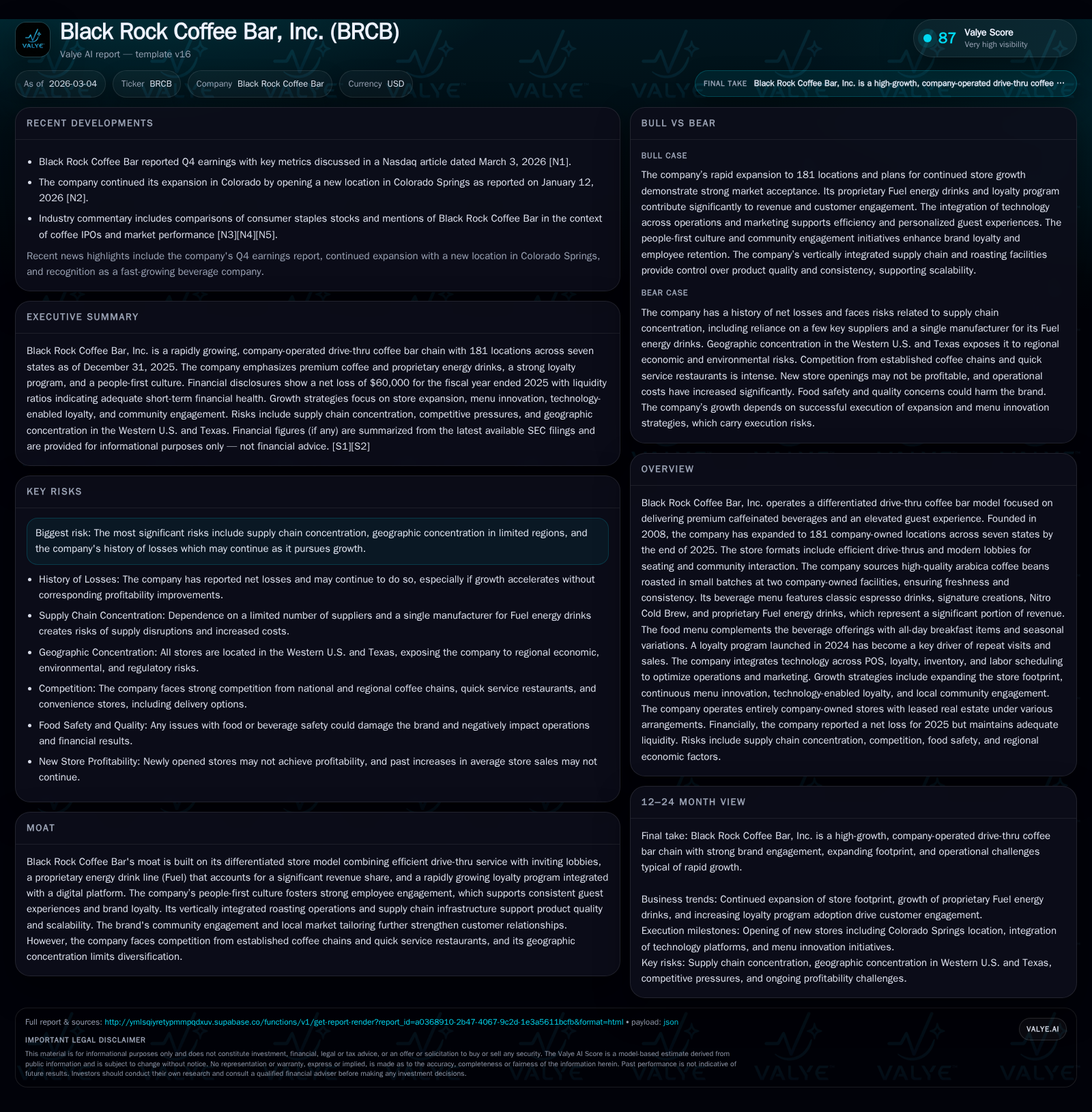
Founded in 2008, Black Rock Coffee Bar has rapidly expanded to 181 company-owned locations across seven states by end-2025, driving 24.5% revenue growth supported by a 10.1% same-store sales increase. Although store-level margins improved through operational efficiencies, overall operating income margins declined sharply amid increased expenses largely tied to growth investments and IPO-related costs. The company remains unprofitable with a net loss of $60,000 in 2025 and negative free cash flow due to high capital expenditures for new stores, especially drive-thru-enabled formats. Black Rock’s moat hinges on a distinctive store model blending efficient drive-thrus with modern lobbies plus proprietary energy drinks and a growing digital loyalty program; however, geographic concentration in limited U.S. regions and supply chain dependencies present notable risks. Liquidity is bolstered by an IPO and refinancing that reduced prior debt and created a $75 million credit facility, but restrictive covenants constrain financial flexibility. Future growth depends on continued unit expansion and maintaining guest engagement while managing inflationary pressures and operational scale challenges.
Company Overview and Historical Growth
Black Rock Coffee Bar, Inc., founded in 2008 in Beaverton, Oregon by Daniel Brand and Jeff Hernandez, has emerged as one of the fastest-growing beverage companies in the U.S., operating exclusively company-owned coffee outlets (no franchises) focused on a differentiated drive-thru plus lobby format. By December 31, 2025, the company expanded its footprint to 181 stores spanning seven states from the Pacific Northwest down to Texas ([S1]).
Initially built as exclusively drive-thru coffee bars, the brand evolved store design to include inviting "lobbies"—comfortable seating areas fostering community connections—found in roughly 73% of locations at year-end 2025 ([S1]). Their model blends fast service through efficient drive-thrus with an elevated retail experience inside.
Black Rock maintains vertical integration with two roasting facilities producing artisan small-batch roasted premium arabica coffee beans that are delivered fresh weekly to stores—consumed within approximately two weeks—to uphold flavor consistency and quality ([S1]). The product suite spans classic espresso drinks, signature concoctions like the indulgent Caramel Blondie latte variant, Nitro Cold Brew offerings geared towards consumers seeking refreshment without sugar overload, plus their proprietary Fuel energy drink line launched recently which contributes meaningfully to total revenue.
To cement recurring customer engagement alongside premium products and store design intimacy, Black Rock implemented a digital loyalty program in 2024 that quickly became instrumental for sales uplift through repeat visits ([S1]).
Financial Performance Summary (2019–2025)
Since inception as a private enterprise until public listing in mid-2025 via IPO priced at $20/share raising approximately $306 million net proceeds ([S1]), Black Rock invested aggressively in growth.
Revenue escalated significantly including scaled unit expansion:
Historical performance (annual)
| FY |
|---|
| 2025 |
Source: SEC companyfacts cache [F1].
*Complete historical data not disclosed; focus hereon is FY24-FY25 trends supported by the most recent disclosure ([F1], [S1]).
Revenue grew approximately +24.5% YoY in calendar year 2025 driven primarily by opening net +32 new units (~27% unit growth over prior year), complemented by robust same-store sales growth of +10.1%, supported by strong guest traffic and loyalty program impact ([S1]).
Store-Level Profit Margin—a non-GAAP metric reflecting unit-level profitability before corporate overhead—increased modestly to approximately 29.2% in FY25 from FY24’s ~27.9%, reflecting tighter operational cost control including labor efficiency gains despite inflationary pressures ([S1]).
However, operating income margin contracted substantially from about +3.7% in FY24 down to +0.4% for FY25 due largely to incremental expenses tied to accelerated store openings requiring upfront investments as well as one-time IPO-related charges totaling roughly $17 million spread mostly across FY25 ([S1]). Net income was effectively breakeven with a minor loss of $60k after these impacts ([F1]).
Cash flow from operations weakened considerably (~83.5% decline YoY) owing mainly to these expenses despite top-line momentum; compounded by heavy capital expenditures which rose ~54% YoY supporting larger stores with sophisticated drive-thru infrastructure enhancements accompanied by lobby seating build-outs ([S13], [F1]). Free cash flow is negative given capex outpaces operational cash inflows (CFO minus capex equals approximately -$32.7 million) ([F1]).
There were no dividends or share buybacks declared or executed during this period according to disclosures ([F1]).
Capital Structure & Liquidity Position
The September 15, 2025 IPO coincided with a pivotal refinancing step where Black Rock OpCo replaced its previous $117+ million term loans with new credit facilities totaling $75 million ($50M Term Loan + $25M Revolving Credit Facility) led by JPMorgan Chase Bank N.A., providing greater financial flexibility albeit with restrictive covenants aimed at conservative leverage management ([S4]–[S11]).
By end-2025, outstanding long-term debt was approximately $41 million net of repayments post-IPO including scheduled amortizations; weighted average interest rates hovered near mid-6% range presenting moderate interest expense obligations relative to scale ([S6], [F1]).
Liquidity was bolstered with year-end cash & equivalents reaching $28.4 million (~nearly triple previous year’s balance), supported by net proceeds from financing activities including the IPO; ongoing operating cash generation remains fragile but stable enough for near-term commitments ([F1], [S13]).
Notably, covenants restrict additional indebtedness beyond set leverage ratios capped at around ~4.75x net rent adjusted leverage ratio plus minimum fixed charge coverage ratios of ~1.2x; also limiting asset disposals without lender consent as well as dividend payments or stock repurchases restricting capital return flexibility for shareholders for now ([S6]–[S12]).
Moat & Differentiation Factors
Black Rock distinguishes itself within an intensely competitive coffee retail sector dominated by incumbents like Starbucks and regional chains through several pillars:
- Its hybrid drive-thru plus lobby model uniquely blends speed-driven convenience with community-focused hospitality creating multi-dimensional guest experiences.
- Proprietary beverage portfolio including the Fuel energy drink line contributes meaningful revenue diversification beyond standard coffee offerings.
- Vertical integration controlling roasting quality across two company-owned facilities guarantees freshness that supports consistent taste profiles.
- The digital loyalty platform swiftly scaled since its launch in early 2024 is gaining traction as an effective engagement tool driving frequency among core customers.
- Deep employee culture focus underpins exceptional barista guest connection enhancing service consistency across markets.
- Customizations tailored regionally along their footprint facilitate community resonance.
Nonetheless limitations persist:
- Geographic concentration limits exposure mainly to select Western U.S states and Texas constraining national scale benefits.
- Dependence on certain suppliers within their supply chain poses risks should disruptions or price spikes occur particularly around high-grade arabica beans or dairy alternatives.
- Labor market pressures impact wage costs; competition from quick-service restaurants offering caffeinated options adds pressure on margins.
Risks Highlighted In Regulatory Filings
The primary risks articulated include:
- Continued losses historically each year since inception ($7.2M loss in FY24 expanding to $16.5M loss primarily before IPO expenses), translating risk that profitable scaling is still forthcoming.
- Capital expenditure intensity rising due to larger formats featuring drive-thru lanes requiring higher upfront real estate outlays potentially compressing near-term returns.
- Food safety issues possibly damaging brand reputation given food contamination claims anywhere along production or distribution chain could adversely impact operations.
- Consumer shifts regarding caffeine perception or pricing sensitivity may influence demand unpredictably.
- Highly competitive landscape with increasing competition not only from coffee chains but emerging delivery options dilutes market share ability.
- Geographic concentration risk that economic downturns or regional disruptions could disproportionately affect results given lack of diversification ([S22]).
Forward-Looking Considerations: Growth Catalysts vs Constraints
Growth Catalysts:
- Continued aggressive new store rollout targeting >20% unit growth per annum leveraging operational model combining lobbies+efficient drive-thrus promoting higher average ticket sizes.
- Expansion of proprietary Fuel energy drink offerings including cross-channel marketing aligning with health-conscious consumers seeking functional beverages.
- Rolling out enhancements via the loyalty app can further boost frequency while providing personalized offers harnessing data analytics.
- Regional penetration within existing states with densification strategies augmenting same-store sales trajectory beyond current +10%
Constraints:
- Rising costs related to labor wage inflation plus commodity price volatility notably arabica coffee beans threaten margin preservation.
- Store-level profit gains may plateau if incremental efficiencies offset only partially against rising overheads associated with larger store formats.
- Restrictions imposed by debt covenant parameters curb ability for rapid leveraged expansion or shareholder returns like buybacks/dividends which may limit investor appeal transiently.
- Geographic concentration impedes benefiting from different market cycles or incremental scale economies nationally.
What To Watch Going Forward
Absent explicit published guidance post-filing ([N1], [S3]), critical milestones include:
- Quarterly updates on store count increments confirming sustained pace near mid-to-high double digit new openings yearly,
- Metrics around comparable sales trends maintaining >+10% growth amid macroeconomic fluctuations,
- Progressive improvement toward positive operating income margins at consolidated level beyond current sub-1% mark,
- Cash flow stabilization turning positive free cash flow driven by mature store economics,
- Development pipeline announcements targeting selective geographic expansion beyond current footprint;
- Updates on supply chain robustness or cost containment measures addressing inflationary environment;
- Progress on digital loyalty adoption metrics including active user counts and incremental spend per member;
- Potential strategic moves around international franchising or partnerships remain speculative but would be transformational changes if undertaken.
Conclusion: Balancing Rapid Scale With Profitability Challenges
Black Rock Coffee Bar stands out among rapidly expanding pure-play coffee retailers combining unique experiential formats aligned with evolving consumer preferences toward premium handcrafted caffeinated beverages enhanced digitally via loyalty programs. The firm demonstrated impressive top-line acceleration into late-stage private company transitioning public entity phase bolstered upon IPO financing structure refinements easing legacy debt burdens.
However considerable hurdles remain balancing profitability headwinds driven principally by rising corporate costs linked closely to aggressive capital investment-backed expansion designed for longer-term market leadership rather than immediate bottom-line returns evident given thin operating margins currently (<1%) post unprecedented growth phase coupled with negative free cash flow dynamics ([F1], [S1], [N1]).
Geographic concentration risk compounds uncertainty amidst larger sector competition dynamics requiring vigilant execution particularly around cost controls against commodity price swings plus workforce management complexity critical as retail hospitality segments face wage inflation/labor shortages consistently nationwide.
Investors tracking Black Rock’s evolution should watch key operational cadence signals paired alongside covenant compliance within leveraged capital structure framing how sustainably management can fuel further growth while steadily bending profitability curves upward amidst competitive intensity deeply embedded into specialty beverage retail markets today.
This report is prepared solely for informational purposes based on publicly available data as of early March 2026. It does not constitute investment advice.
Disclaimer: This is research-only, informational analysis and not investment advice. It may include AI-generated interpretation and general industry context. Always verify important details using primary sources.

Comments