
TScan Therapeutics’ Shift to Hematologic Malignancies Highlights Development and Capital Allocation Challenges
The company’s strategic pivot to focus clinical resources on its lead TCR-engineered therapy for blood cancers underscores operational and financial pressures amid early-stage biotech risks.
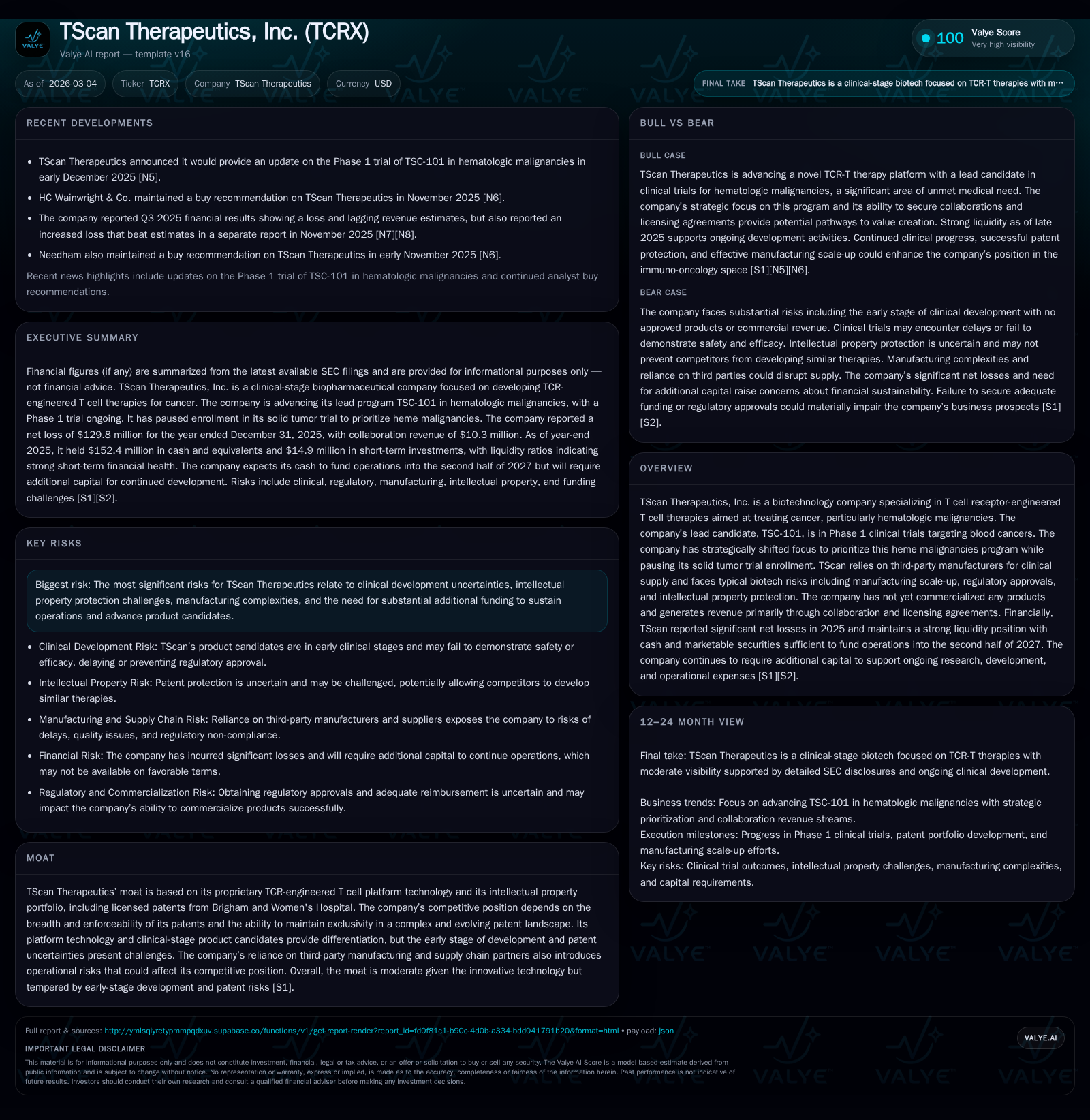
TScan Therapeutics has realigned its clinical development strategy by prioritizing its hematologic malignancies program, notably pausing enrollment for solid tumor trials. This shift reflects both regulatory alignment and a need to concentrate limited resources on the lead asset TSC-101. Financially, the company continues to operate at substantial losses, with net income declining further in 2025 alongside an expanding cash burn driven by growing R&D activities. Despite a robust liquidity position that supports operations into late 2027, TScan faces significant risks related to manufacturing, intellectual property, and funding that could influence its developmental trajectory and capital allocation decisions.
Historical Performance and Financial Overview
TScan Therapeutics, Inc. has experienced consistent operating losses as it advances its pipeline of T cell receptor (TCR)-engineered therapies targeting cancer indications. From fiscal year (FY) 2022 through FY2025, operating income has remained negative, with a notable increase in absolute loss magnitude year-over-year until flattening somewhat between FY2024 ($-134.8M) and FY2025 ($-135.8M), demonstrating intensifying research and development (R&D) investments paired with operational scaling [F1]. Net income trends exhibit a parallel pattern with a -1.8% decline in profitability over the same period.
Operating cash flows have deteriorated significantly, with CFO declining from -$66.5M in FY2022 to -$135.3M in FY2025, highlighting escalating cash consumption driven largely by clinical trial expenditures and preclinical pipeline expansion [F1]. Capital expenditures have grown moderately (+15.2% YoY), reflecting incremental investments likely directed toward manufacturing capabilities and enabling infrastructure for next-generation T cell engineering research [F1][S23][S25].
The company maintains a strong liquidity profile for its stage, holding $152.4 million in cash and equivalents at the close of 2025, which management expects will fund operations into the latter half of 2027 absent unforeseen developments [F1][S1][S18]. Current liabilities are modest relative to assets, yielding an exceptionally healthy current ratio exceeding 8x, indicating no short-term solvency concerns [F1].
Historical performance (annual)
| FY | Net ($mm) | CFO ($mm) | OpInc ($mm) | Capex ($mm) | Net YoY |
|---|---|---|---|---|---|
| 2025 | -130 | -135 | -136 | 4 | -1.8% |
| 2024 | -127 | -111 | -135 | 4 | -42.9% |
| 2023 | -89 | -61 | -93 | 3 | -34.7% |
| 2022 | -66 | -67 | -67 | 4 |
Source: SEC companyfacts cache [F1].
Capital returns and efficiency (annual)
| FY | FCF ($mm) | ROE% |
|---|---|---|
| 2025 | -140 | -105.4 |
| 2024 | -115 | -52.9 |
| 2023 | -65 | -59.1 |
| 2022 | -71 | -66.6 |
Source: SEC companyfacts cache [F1].
All figures in USD millions; data reflects annual totals per [F1]
Strategic Pivot: Prioritization of Hematologic Malignancies
In November 2025, shortly after aligning with the FDA on a registrational pathway for TSC-101—a lead candidate targeting blood cancers—TScan made a decisive shift to concentrate clinical development efforts exclusively on hematologic malignancies while pausing enrollment in its solid tumor Phase 1 trial [S2]. Concurrent with this pivot was a workforce reduction impacting roughly 30% of employees (approximately 66 roles), aimed at reallocating resources efficiently toward the prioritized program [S2][S24].
This strategic reallocation reflects typical biotech maneuvering where companies scale back less advanced or more resource-intensive indications to extend runway and optimize potential regulatory success around their most promising asset . Moreover, focusing on hematologic malignancies may leverage more straightforward manufacturing processes or clinical endpoints compared to solid tumors, which often face more complex tumor microenvironment challenges.
Preclinical investments continue selectively within solid tumors emphasizing in vivo engineering methods and autoimmunity target discovery, signaling sustained longer-term interest but with reduced near-term operational commitment [S2].
Industry Context: Challenges of TCR-Engineered Therapies
TCR-engineered therapies lie at the forefront of personalized immuno-oncology but face pronounced hurdles including manufacturing complexity for autologous cell products, stringent regulatory scrutiny given gene-engineering methodologies, and intense patent disputes across overlapping IP claims [S7][S21]. The competitive landscape includes established players wielding broader resources alongside emerging biotech innovators.
Operational dependencies on third-party contract manufacturers introduce supply chain risks frequently noted in early-stage CAR-T/TCR therapy developers — any disruptions can delay trials or escalate costs substantially [S1]. Additionally, reimbursement dynamics remain uncertain; payors demand robust pharmacoeconomic evidence before approving premium pricing for novel therapies which may affect commercialization potential later [S27][S17].
Intellectual Property Risks and Litigation Exposure
The company's moat centers on proprietary TCR platform technology supplemented by intellectual property licensed principally from Brigham & Women's Hospital [S1]. However, ongoing industry-wide patent litigation risks pose significant threats—disputes over inventorship rights, license validity challenges, and infringement claims could impose costly legal battles or impair exclusivity [S7][S15][S16][S19][S21].
Protection of trade secrets amidst employee transitions further complicates internal risk management [S7][S8]. Any unfavorable outcomes from such disputes might require royalty payments or forced redesigns that could materially impede product development timelines or raise R&D costs.
Funding History and Capital Allocation Priorities
TScan has pursued multiple equity raises including a March 2024 follow-on public offering netting $161.4 million as well as a December 2024 registered direct offering raising $30 million via Pre-Funded Warrants at $4 each [S1][S18], illustrating successful capital market access.
On the debt front, the company arranged term loans totaling up to $52.5 million from Silicon Valley Bank under conditions that restrict certain corporate actions—including limitations on additional indebtedness, asset sales, dividends, repurchases—to preserve lender security amidst continued negative earnings [S10][S11][S12]. The loan features interest-only periods contingent on milestone achievement before amortization commences.
Despite substantial losses leveraging cash reserves for ongoing R&D activities—with free cash flow approximated at negative $140 million in FY2025—ongoing capital discipline along with planned use of existing funds suggest management is pacing spend against near-term staging points [F1]. The absence of dividends or share repurchases aligns with typical early-stage biotech capital allocation focused squarely on product advancement rather than shareholder distributions.
Future Growth Catalysts and Risks To Monitor
Growth will hinge predominantly on progress milestones for TSC-101 clinical trials targeting hematologic malignancies—therapeutic safety signals, efficacy readouts sufficient for potential Biologics License Application filing pathways—and regulatory feedback positioning for registration-enabling studies [N3][N4][S2]. Success here would validate platform capabilities potentially unlocking value in partnership or licensing deals.
Meanwhile, uncertainties around continued funding availability loom large—even with mandated milestone achievements—given prolonged timelines inherent to oncology drug development coupled with potential market shifts affecting investor risk appetites [S12][S14]. Manufacturing scale-up complexities could also become rate-limiting factors affecting timelines.
Additional concerns relate to reimbursement environments where payors increasingly scrutinize price versus benefit metrics possibly requiring costly pharmacoeconomic substantiation before favorable coverage decisions materialize [S17], adding layers of commercialization risk beyond regulatory approval.
Conclusion
TScan Therapeutics remains an early-stage biotech innovator navigating typical sector headwinds: high cash burn underpinning R&D-intensive programs without near-term commercial revenues; dependency on external manufacturing partners; complex patent landscapes; and ongoing capital market reliance bolstered by equity raises and debt facilities constrained by protective covenants.
The recent strategic focus anchored around hematologic cancer TCR therapies represents a pragmatic consolidation likely aimed at optimizing resource deployment toward the most promising developmental candidate amid finite liquidity horizons extending into mid-2027 under current projections.
Investors should monitor trial progression milestones for TSC-101 closely alongside capital availability dynamics as key inflection points shaping TScan’s longer-term viability within an intensely competitive immuno-oncology landscape.
This analysis is based solely on publicly filed financial statements and regulatory documents as of March 4, 2026 (including periodic reports Form 10-K/10-Q/8-K), supplemented by relevant industry context; it does not constitute investment advice.
Disclaimer: This is research-only, informational analysis and not investment advice. It may include AI-generated interpretation and general industry context. Always verify important details using primary sources.

Comments